- English
- French
- German
- Portuguese
- Spanish
- Russian
- Japanese
- Korean
- Arabic
- Greek
- German
- Turkish
- Italian
- Danish
- Romanian
- Indonesian
- Czech
- Afrikaans
- Swedish
- Polish
- Basque
- Catalan
- Esperanto
- Hindi
- Lao
- Albanian
- Amharic
- Armenian
- Azerbaijani
- Belarusian
- Bengali
- Bosnian
- Bulgarian
- Cebuano
- Chichewa
- Corsican
- Croatian
- Dutch
- Estonian
- Filipino
- Finnish
- Frisian
- Galician
- Georgian
- Gujarati
- Haitian
- Hausa
- Hawaiian
- Hebrew
- Hmong
- Hungarian
- Icelandic
- Igbo
- Javanese
- Kannada
- Kazakh
- Khmer
- Kurdish
- Kyrgyz
- Latin
- Latvian
- Lithuanian
- Luxembou..
- Macedonian
- Malagasy
- Malay
- Malayalam
- Maltese
- Maori
- Marathi
- Mongolian
- Burmese
- Nepali
- Norwegian
- Pashto
- Persian
- Punjabi
- Serbian
- Sesotho
- Sinhala
- Slovak
- Slovenian
- Somali
- Samoan
- Scots Gaelic
- Shona
- Sindhi
- Sundanese
- Swahili
- Tajik
- Tamil
- Telugu
- Thai
- Ukrainian
- Urdu
- Uzbek
- Vietnamese
- Welsh
- Xhosa
- Yiddish
- Yoruba
- Zulu
Why Choose UTI320E Handheld Infrared Thermal Imager for Inspections?
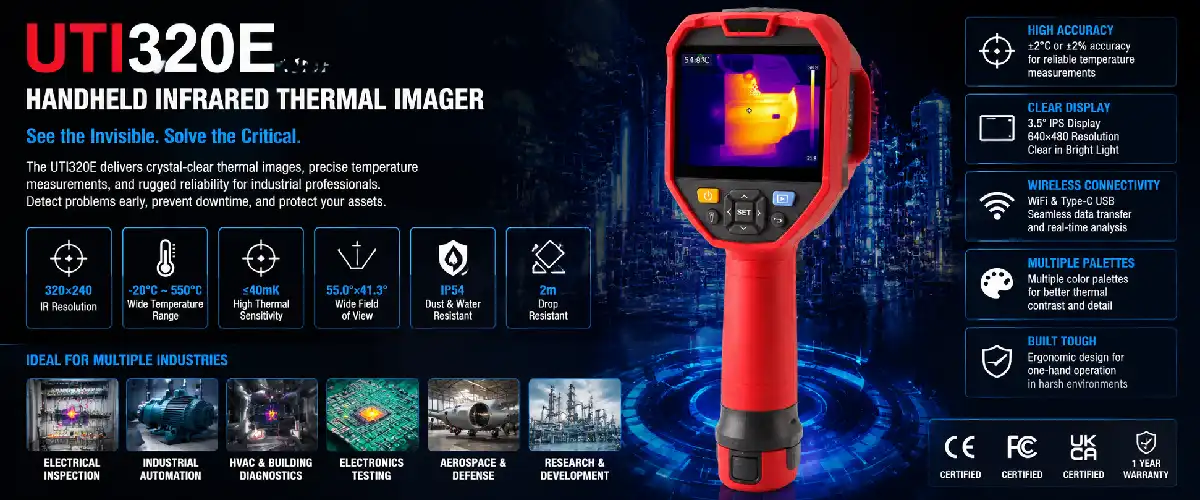
The UTI320E Handheld Infrared Thermal Imager is a must-have troubleshooting tool for industrial workers when they need to check things with accuracy, dependability, and speed. This high-tech thermal camera combines 320x240 high-resolution infrared detection with very accurate measurements across a temperature range of -20°C to 550°C. This lets engineers find thermal problems that can't be seen with normal inspection methods. This device is made for tough jobs in areas like aerospace, industrial automation, electronics testing, and research and development. It solves important problems like finding equipment that is overheating, figuring out where energy is being lost, and planning preventative maintenance with amazing accuracy and operational flexibility.
Introduction to UTI320E Handheld Infrared Thermal Imager
Tools that can keep their accuracy under pressure are needed for industrial checks. The UTI320E is a big step forward in portable thermal imaging technology. It was made for workers who can't afford mistakes in diagnosis or equipment failure.
Addressing Critical Inspection Challenges
Temperature changes often warn of coming machine failures before they become catastrophic. This thermal camera uses an uncooled vanadium oxide infrared sensor that clearly records thermal patterns. This lets test and measurement engineers find hot spots, cold zones, and temperature differences that could mean problems. The 55.0°H×41.3°V field of view of the device makes sure that single-pass checks cover everything. This cuts down on survey time while improving diagnostic accuracy.
Standout Features for Industrial Applications
This thermal imaging option stands out because it combines professional-grade features with sturdiness that is ready for the field. The 640x480 resolution on the 3.5-inch IPS display makes it easy to see even in bright outdoor conditions. The IP54 grade for security and 2-meter drop resistance make sure that the device can keep working in tough industrial settings. The procurement managers like this mix because it gets rid of the usual trade-off between high-tech features and tough build.
Solving Real-World Inspection Constraints
A lot of inspection situations involve gear that can't be reached, live electrical systems, or places where touch measurement could be dangerous. The UTI320E gets around these problems with infrared temperature monitoring that doesn't require touch. This lets R&D managers and system engineers do full diagnostics without stopping production. This feature is very useful in defense and military uses where the integrity of the parts cannot be compromised during tests.
Core Technologies and Specifications Behind UTI320E's Performance
To make technical choices about purchases, you need to know the engineering principles that affect how accurate measurements are and how well they work.
Infrared Detection Technology Explained
A 320x240-pixel vanadium oxide microbolometer grid that is not cooled is used in the UTI320E Handheld Infrared Thermal Imager device. This infrared sensor technology picks up electromagnetic waves with a wavelength range of 8 to 14 μm. It then turns thermal energy into electrical data that makes pictures of how the temperature is distributed. The thermal sensitivity requirement of less than 40mK at 25°C outdoor temperature means that the system can tell the difference between temperatures as little as 0.04 degrees Celsius. This means that it can find small changes in temperature that show early signs of equipment breakdown.
Measurement Accuracy and Temperature Range
Accuracy of measurements has a direct effect on the trust in diagnostics. In a temperature range from -20°C to 550°C, the UTI320E keeps its readings accurate to within ±2°C or ±2%, whichever is greater, at 25°C. This design meets strict testing requirements in semiconductor research and electronics manufacturing, where accurate thermal profiling affects the quality of the output and the best way to make the process work. The emissivity range can be changed from 0.01 to 1.00, which works with a wide range of material surfaces, from smooth metals to painted enclosures. This means that accurate temperature readings are possible no matter what the target is made of.
Operational Efficiency and Connectivity
Today's inspection processes need data to be integrated without any problems. With WiFi wireless communication and Type-C USB connection, this thermal imaging device lets you instantly send images to computers or mobile devices for group analysis. Test engineers who are inspecting things in the field can send temperature data to technical teams that are far away so that they can be consulted in real time. This speeds up the decision-making process. The fact that both PC software and mobile apps can be used makes analysis flexible in a range of operational settings, from labs to industry repair sites.
Reliability Standards and Certifications
Compliance paperwork is important for buying workers who run operations in more than one country. The device has been approved by CE, FCC, and UKCA, which means it meets safety and electromagnetic compatibility standards in all major countries. The one-year warranty from the maker shows that they stand behind the quality of their products, and the operating temperature range of 0°C to 50°C makes sure that it will work in the wide range of climates found in industrial buildings around the world.
Comparing UTI320E with Other Thermal Imagers in the B2B Market
When choosing strategic equipment, it's important to compare it objectively to well-known options and to the best equipment on the market.
Feature Set Evaluation Against Industry Standards
Compared to thermal image products from FLIR or Seek Thermal, the UTI320E has the same infrared clarity and more connectivity options at a lower price. Technical leaders looking at measurement capabilities will notice that the 320x240 detector resolution is the same as mid-range professional tools that usually cost a lot more. The four image output modes—thermal-only, visible light, fusion, and picture-in-picture—make this diagnostic tool more flexible than basic thermal cameras.
Cost-Performance Analysis for B2B Procurement
The total cost of ownership goes beyond the price of the original buy. The PC analysis software and mobile app that come with the device get rid of the need for ongoing membership fees that come with some competing platforms. This lowers the long-term costs of running the business. System integrators who need standard setups across multiple sites or custom branding for end-client deployments can get more value from approved distributors like MXTD, who offer bulk buy options and OEM customization services.
Handheld Versus Fixed Thermal Imaging Systems
The best tool designs are based on the needs of the application. UTI320E Handheld Infrared Thermal Imager handheld thermal imagers are very portable and flexible, so techs can quickly check out many places without having to set up new equipment. The 2x and 4x digital zoom features of this device increase the effective scanning range. This partly makes up for the fixed lens setup while keeping the portability benefits. Fixed thermal monitoring systems, on the other hand, are better for situations where continuous temperature tracking is needed, but they are much more expensive to set up and cover less space per unit.
Smartphone Thermal Attachments: Professional Viability Assessment
Smartphones with built-in thermal monitors have become more popular as cheaper options. But compared to professional-grade tools, these add-ons usually have much lower resolution (often 80x60 pixels), smaller temperature ranges, and less accurate measurements. The UTI320E's dedicated 320x240 infrared detector has more than 16 times the thermal pixel density of most smartphone attachments. This means it can find defects more accurately, which is very important for industrial diagnostics where missing problems can have big financial and safety effects.
Practical Applications and Advantages of UTI320E for Professional Inspections
Validation of real-world success comes from a variety of operational applications in different industries.
Electrical System Diagnostics and Safety
One of the most important uses for thermal images is solving electrical problems. This thermal camera lets you look at live distribution panels, motor control centers, and power transmission parts without touching them, so you don't have to worry about being exposed to arc flashes. The visual and LED high-temperature warning function lets workers know right away if connections are too hot, circuits are overloaded, or parts are failing, before they damage equipment or stop production.
Maintenance teams at factories say that thermal scanning of electrical infrastructure finds loose connections with high resistance heating, wire overloading patterns, and failed contactors with thermal signatures that are different from how they normally work. These early signs let fixes be planned for planned downtime instead of having to be done quickly when something goes wrong.
HVAC and Building Envelope Evaluation
For energy efficiency tests and comfort improvement, accurate thermal measurement is needed. The accurate temperature readings on the device help HVAC workers figure out how well heating systems, refrigerators, and air distribution systems are working. The fusion display mode makes it easier to see insulation gaps, thermal bridges, and moisture entry areas that hurt energy performance. It does this by superimposing thermal patterns on top of visible light pictures.
Mechanical Equipment Condition Monitoring
Trending study of equipment thermal signatures is needed for predictive maintenance systems to work. This thermal imaging tool is used by test and measurement engineers who are watching over spinning machinery to set standard temperature distributions for bearings, couplings, and drive components when the machine is running normally. Periodic re-inspection shows changes in temperature that could mean that the grease is breaking down, the bearings are misaligned, or the wear is getting worse. This lets you plan condition-based maintenance that extends the life of parts and stops catastrophic failures.
The device has many measurement tools, such as point, line, circle, and rectangular area temperature analysis, which make it easy to do full thermal surveys that find the highest, lowest, and average temps across specific equipment zones. This critical skill helps make maintenance decisions based on data, which is in line with reliability-centered maintenance methods.
ROI Through Downtime Prevention
Investing in inspection tools can only be financially justified if it has measurable practical benefits. When OEM makers use thermal inspection as part of their quality assurance procedures, they find assembly flaws and strange parts earlier, which lowers the number of failures that happen in the field. System integrators who do pre-commissioning temperature studies find problems with the installation before handing over the system. This cuts down on warranty claims and unhappy customers. These results mean real cost savings that are much higher than the cost of buying the tools and usually pay for themselves within the first year of use.
Procuring UTI320E: Trusted Suppliers, Purchase Options, and After-Sales Support
To buy equipment successfully for the UTI320E Handheld Infrared Thermal Imager, you need to pay attention to where to get it, how to pay for it, and the framework for help after the purchase.
Authorized Distribution and Sourcing Reliability
Buying a product through official means is necessary to make sure it is real and that the guarantee still applies. MXTD, Xi'an Mingxi Taida Information Technology Co., Ltd., is a well-known company that sells industrial test and measurement tools. They have direct relationships with manufacturers so they can guarantee that the goods they sell are real and come with full warranties. They have worked in the PXIe systems, integrated testing solutions, and precision instruments industries for 12 years, so they know what R&D centers and system integration firms need technically and how hard it is to get it.
Pricing Structure and Volume Purchase Programs
The UTI320E's standard price represents its professional-level features while still being competitive with other thermal image tools in the same class. Volume purchasing programs offer savings that go up as the number of units ordered goes up. This makes fleet standardization a good idea for businesses that run more than one facility or have field service teams. System developers can use proven thermal imaging technology and make their solutions stand out by using OEM personalization services like private labeling, parameter pre-configuration, and custom packing.
Technical Support and Training Materials
How well equipment works depends a lot on how skilled the person using it is. MXTD offers full technical support, including quick responses to customer questions (usually within an hour during business hours), remote video help for practical questions, and software changes that make sure the company stays compatible with new analysis platforms. Technical tools that are available in both English and Chinese make communication easier. This is especially helpful for multinational companies that have to coordinate purchasing and technical specs across many places.
Warranty Terms and Service Commitments
The maker offers a normal one-year warranty that covers problems with the materials or the work. For mission-critical uses where equipment downtime has big practical effects, extended service agreements and faster replacement plans can be set up. The flexible design of the device and the availability of service documents make it possible for organizations with established calibration and repair facilities to do their own maintenance. However, for complicated problems that need specialized diagnostic tools, factory service is still available.
Logistics and Delivery Considerations
Specialized handling is needed to move precise instruments. MXTD uses packing methods that are resistant to wetness, shock, and static electricity that can be used for both ground and air freight. These methods protect sensitive infrared detector elements and optical components while they are being shipped. International shipping makes it easier to buy things all over the world, and it helps with paperwork and following the rules for customs clearance. This is especially important for defense and aerospace companies that have to get import approval.
Conclusion
The UTI320E has professional thermal imaging features that meet the most important inspection needs in research, aircraft, industrial automation, and electronics testing. With a 320x240 infrared resolution, a wide temperature measurement range, a sturdy build, and built-in connectivity, it gives technical directors and procurement managers a reliable diagnostic tool that improves operational safety, supports predictive maintenance strategies, and gives a clear return on investment. When measuring accuracy, operational durability, and total ownership value are more important than premium brand positioning alone, this thermal camera is a great option for businesses that want to improve their inspection capabilities without spending a lot of money.
FAQ
1. How does the UTI320E thermal imager find out what the temperature is without touching it?
Infrared thermal imaging works by picking up electromagnetic energy that everything above absolute zero temperature naturally gives off. The device's vanadium oxide sensor array takes in infrared energy in the 8-14μm wavelength range and turns it into electrical signals. These signals are then processed by algorithms that show on the screen as temperature values and visual thermal patterns.
2. What battery life can inspection teams expect during field operations?
How long it works relies on how it's used, such as the brightness settings, how often the WiFi is turned on, and the surroundings. For most field inspections, a single charge lasts for several hours of constant use. Type-C fast charging makes it easy to switch between inspection tasks quickly.
3. Can the device be adjusted at the spot, or does it need to be serviced at the factory?
The thermal imager has emissivity settings that can be changed so that people in the field can get the most accurate measurements for a variety of target materials. Organizational quality system rules say that formal calibration checks should be done against traceable temperature references. Calibration services are offered in the plant for users who need certified measurement traceability.
Partner with MXTD for Your Thermal Imaging Inspection Needs
At MXTD, we know that buying tools is only one part of putting together a good inspection program for the UTI320E Handheld Infrared Thermal Imager. Our technical team has been helping research institutions, aircraft, industrial automation, and electronics testing with high-reliability measurement tools for more than 12 years. Whether you need standard thermal imaging tools or special diagnostic systems that are connected to a larger testing network, we answer technical questions within an hour and provide solutions that are priced competitively based on the best performance in the industry. In addition to delivering the product, we also offer full after-sales support, online technical assistance, and software updates to make sure that your investment stays at its best throughout its working lifecycle.
Please email our team at manager03@mxtdinfo.com to talk about your unique thermal inspection needs and find out how the UTI320E thermal imager can help you with your diagnostics. As a provider of the UTI320E Handheld Infrared Thermal Imager with a lot of experience, we can offer you cheap bulk prices, OEM customization options, and technical advice services that are tailored to your needs.
References
1. International Electrotechnical Commission. "Thermal Imaging Systems: Performance Requirements and Testing Methods for Industrial Applications." IEC Technical Report 62446-3, 2021.
2. American Society for Nondestructive Testing. "Infrared and Thermal Testing Handbook, Volume 3: Applications in Predictive Maintenance and Condition Monitoring." ASNT Publications, 2020.
3. National Institute of Standards and Technology. "Calibration Standards for Infrared Thermography in Industrial Temperature Measurement." NIST Special Publication 1210, 2019.
4. Institute of Electrical and Electronics Engineers. "Guidelines for Thermographic Inspection of Electrical Systems and Rotating Equipment." IEEE Standard 1415-2018, revised 2022.
5. Building Performance Institute. "Thermal Imaging Applications in Building Diagnostics: Standards for Energy Auditing and Moisture Detection." BPI Technical Standards TS-500, 2021.
6. Society of Automotive Engineers International. "Thermal Imaging Procedures for Aerospace Component Testing and Failure Analysis." SAE Aerospace Information Report AIR6850, 2020.
Our customers’ satisfaction speaks for our quality — contact us to experience the same reliable service.