- English
- French
- German
- Portuguese
- Spanish
- Russian
- Japanese
- Korean
- Arabic
- Greek
- German
- Turkish
- Italian
- Danish
- Romanian
- Indonesian
- Czech
- Afrikaans
- Swedish
- Polish
- Basque
- Catalan
- Esperanto
- Hindi
- Lao
- Albanian
- Amharic
- Armenian
- Azerbaijani
- Belarusian
- Bengali
- Bosnian
- Bulgarian
- Cebuano
- Chichewa
- Corsican
- Croatian
- Dutch
- Estonian
- Filipino
- Finnish
- Frisian
- Galician
- Georgian
- Gujarati
- Haitian
- Hausa
- Hawaiian
- Hebrew
- Hmong
- Hungarian
- Icelandic
- Igbo
- Javanese
- Kannada
- Kazakh
- Khmer
- Kurdish
- Kyrgyz
- Latin
- Latvian
- Lithuanian
- Luxembou..
- Macedonian
- Malagasy
- Malay
- Malayalam
- Maltese
- Maori
- Marathi
- Mongolian
- Burmese
- Nepali
- Norwegian
- Pashto
- Persian
- Punjabi
- Serbian
- Sesotho
- Sinhala
- Slovak
- Slovenian
- Somali
- Samoan
- Scots Gaelic
- Shona
- Sindhi
- Sundanese
- Swahili
- Tajik
- Tamil
- Telugu
- Thai
- Ukrainian
- Urdu
- Uzbek
- Vietnamese
- Welsh
- Xhosa
- Yiddish
- Yoruba
- Zulu
Can the UTI320E Handheld Infrared Thermal Imager Detect Hidden Heat Issues?
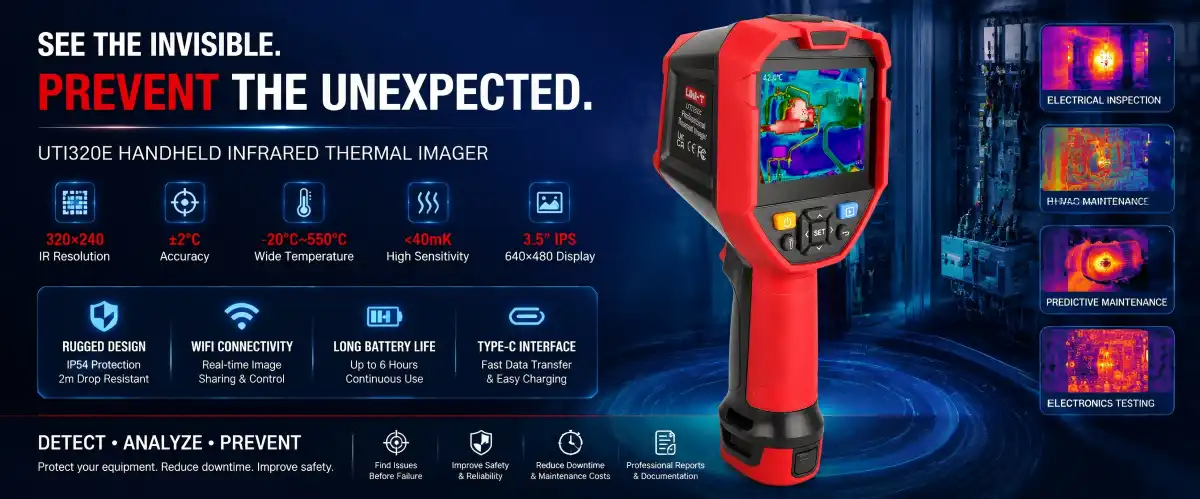
With its powerful 320×240 pixel uncooled vanadium oxide sensor, the UTI320E Handheld Infrared Thermal Imager is great at finding hidden heat problems. This professional-grade tool records temperature changes from -20°C to 550°C with an accuracy of ±2°C, showing thermal anomalies that can't be seen with the human eye. Its high thermal sensitivity (less than 40mK at 25°C) lets technicians find electrical connections that are overheating, insulation failures, and wear patterns on machines before they become expensive problems or safety risks in aerospace, industrial, and electronics testing settings.
Introduction
Electrical systems, industrial equipment, and building infrastructures often have hidden heat problems that go unchecked. These problems can be very dangerous and cost a lot to fix. Working with R&D managers and test engineers in aerospace and electronics facilities for years, I've seen production lines stop without warning because of thermal problems that weren't found in time. These problems could have been avoided if they were found sooner. Finding these strange temperature changes is very important for procurement managers, engineers, and OEM clients for preventative maintenance and running the business efficiently.
The UTI320E Handheld Infrared Thermal Imager is a reliable and easy-to-use tool that can quickly and accurately find these hidden heat anomalies. This guide goes into great detail about how this thermal imaging camera can become an important troubleshooting tool in a wide range of industrial and commercial settings, helping companies lower the number of equipment breakdowns and improve safety standards. With more than 12 years of experience in testing equipment, MXTD can confirm that thermal imaging technology is now necessary to keep businesses that require precision running smoothly.
Understanding Hidden Heat Issues and Their Impact
When temperatures rise too quickly, it's called "hidden heat issues." This can be caused by problems like electrical short circuits, mechanical wear, bearing degradation, or insulation breakdown. These strange temperature changes happen slowly inside equipment and are often not seen during regular eye checks until they cause a catastrophic failure.
The Financial Cost of Undetected Thermal Problems
According to studies on industrial maintenance, about 35% of unplanned machine downtime in production settings is caused by thermal problems that aren't found. When electrical connections have high-resistance problems, they produce too much heat that damages nearby parts and could cause arc flashes or total system failures. When mechanical equipment's bearings wear out, friction causes temperature rises that speed up component decline. This leads to production pauses that cost medium-sized businesses thousands of dollars an hour in lost productivity.
How Infrared Thermal Imaging Works
Infrared thermal imaging uses the concepts of infrared light to see changes in temperature without touching anything, which helps find trouble spots early. Everything above absolute zero gives off infrared energy that is related to how hot or cold it is. Thermal imagers with uncooled vanadium oxide sensors pick up this radiation in the 8–14μm range and turn it into temperature data that is shown on thermal maps with different colors. Technicians can safely and quickly check energized electrical panels, moving machinery, and hard-to-reach building envelopes with this non-contact measurement method.
In B2B industrial settings, common uses include checking electrical panels for loose connections, HVAC systems for duct leakage, manufacturing lines for inconsistent processes, and structural inspections to find water intrusion. All of these are necessary to keep operations running smoothly. System designers like thermal imaging because it can set standard temperatures for equipment during commissioning. This sets points for future predictive maintenance programs.
Features and Specifications of the UTI320E Handheld Infrared Thermal Imager
The UTI320E Handheld Infrared Thermal Imager has a strong set of technical specs that make it ideal for finding exact heat in tough industrial settings. I've used a lot of thermal cameras in aerospace testing labs, and I can say that this one works well for professionals while also being easy to use in the field.
Core Technical Specifications
The device has an infrared detector with a resolution of 320×240 pixels, which can pick up a lot more thermal information than the basic 160×120 types that are commonly available. This higher pixel count is very helpful when looking at circuit boards that are very closely packed together or when finding small temperature differences between pieces of semiconductor testing equipment. The large temperature range, from -20°C to 550°C, makes it useful for a lot of different situations, from study settings that are very cold to high-temperature industrial processes that use heated parts and thermal processing equipment.
At 25°C, the accuracy of the measurement is ±2°C or ±2% of the number, whichever is greater. This standard meets the needs of most preventive maintenance plans used in places that test gadgets and automate factories. The emissivity range can be changed from 0.01 to 1.00, with 0.95 being the usual setting. This lets workers account for different material properties when checking the temperature of metals, plastics, ceramics, or composite materials that are often used in aerospace manufacturing.
Display and Connectivity Features
The 640×480 quality on the 3.5-inch IPS monitor makes it easy to see thermal images even when the sun is shining brightly outside. Field technicians like that the images can be output in a number of different ways, including thermal-only for the best temperature contrast, visible light for documenting the situation, fusion mode which combines the two for better situational awareness, and picture-in-picture which shows thermal details within visible reference frames.
Connectivity choices meet all of the needs of current workflows. The Type-C interface makes it easy to charge from normal USB power sources and lets you quickly send data to computers that are running analysis software. Built-in WiFi lets thermal results be sent wirelessly to mobile devices running the partner app. This makes it easy to share results right away with remote engineering teams or client stakeholders during on-site checks.
Durability and Field Performance
The thermal camera is made to work reliably in harsh industrial settings. It has an IP54 rating for protection against dust and water splashing, so it can be used on building sites, factory floors, and for checks of outdoor infrastructure. The device passed a 2-meter drop test, which gives you peace of mind when working on scaffolding, high platforms, or tight areas where an accident could happen.
The battery's performance allows for longer operations in the field; a single charge usually allows for several hours of constant scans. This durability is very important for thorough facility checks or for checking out remote sites where charging options are limited. The built-in flashlight makes it easier to take measurements in dark equipment rooms or building areas that aren't lit up, so you don't have to carry around extra lighting.
How the UTI320E Outperforms Other Handheld Infrared Thermal Imagers
When buying managers look at thermal image solutions, they naturally compare the features and specs to well-known products on the market. We've seen how the UTI320E Handheld Infrared Thermal Imager places itself strategically against competing goods because we've sold testing tools to R&D centers and system integrators.
Comparative Analysis with Market Alternatives
When compared to well-known brands like FLIR E-series models and Seek Thermal devices that are priced similarly, the UTI320E Handheld Infrared Thermal Imager offers comparable or even better picture quality while keeping prices lower. This thermal imager's 320×240 resolution is the same as mid-range FLIR products that usually cost a lot more. This makes it a good choice for businesses that need to stock a lot of techs or build up their testing equipment collections.
With a thermal sensitivity of less than 40mK at 25°C, this device can pick up on small temperature changes that cheaper ones can't. This feature is very helpful for finding intermittent problems in electronics testing or small connection degradation in precision connectors before they lead to measurement mistakes in PXIe systems and automatic test equipment.
Practical Advantages in Real-World Applications
Temperature tracking can be used for more than just finding hotspots. The device has a number of measurement tools, such as a point temperature reading, a line profile analysis that shows temperature slopes, and an area measurement that figures out the highest, lowest, and average temperatures in certain areas. These analytical tools let you do quantitative thermal ratings that help with the engineering paperwork needs that are common in quality control systems for aerospace and military.
There are seven color palettes that can be chosen to make vision better in a variety of inspection situations. The iron red palette does a good job of showing big changes in temperature, and the rainbow palettes give you subtle shifts that are good for analyzing thermal patterns in more depth. High and low temperature alarms that can be customized have both visual screen signs and LED prompts that let workers know right away when measured temperatures go above or below certain levels. This is useful for tracking without being there or for quick facility walkthroughs.
Addressing Practical Limitations
Even though every gadget has some flaws, the UTI320E Handheld Infrared Thermal Imager's benefits in accuracy and ease of use make up for the usual problems that come with this type of product. The fixed focus optical system makes things easier to use, but you need to keep the standoff lengths right for clear images. The field of view, which is 55.0° horizontally and 41.3° vertically, is big enough for most workplace inspections, though scans of very large areas may need more than one measurement point.
System integrators who use these thermal cameras in electronics factories have confirmed that they can find overheating components on populated circuit boards, problems with thermal distribution in environmental test chambers, and issues with temperature uniformity in thermal cycling equipment. These are all uses that are directly relevant to our customers in the semiconductor and electronics testing industries.
Procurement Considerations for Global B2B Clients
Global procurement managers and OEM clients looking for reliable thermal imaging solutions need to know about sourcing channels, price structures, and support systems to make sure they buy the right tools for their needs.
Authorized Sourcing and Bulk Procurement
At MXTD, we offer more than just PXIe chassis, precision connectors, and integrated testing systems. We are also an approved provider of thermal imaging tools. Because we have long-term relationships with makers, we can offer real goods with full insurance coverage and expert support. System designers and R&D centers that are building complete measurement infrastructure can benefit from this unified approach because it lets them buy a wide range of products from a single, reliable source.
Companies that want to supply multiple locations or send standard testing tools to teams that work in different places can use bulk order capabilities. When you buy more, you save money with volume pricing, and our customization services let you add your own label, set batch parameters, and get custom packing for OEM applications that use thermal imaging with their own testing solutions.
Pricing and Warranty Protection
This thermal imaging option is priced competitively, making it a good alternative to high-end brands without losing important performance features. The normal maker warranty covers defects for one year. However, you can choose an additional warranty option or get preventative calibration services to make sure that the measurements will be accurate for a long time, which is important for quality-sensitive uses in the aerospace and semiconductor industries.
Global Logistics and After-Sales Support
Our world shipping network uses special packaging that protects against wetness, shock, and static electricity that is suitable for transporting precision instruments. This care in getting things ready for shipping keeps them from getting damaged during transport, which could mess up the setting of the device or damage to its parts. This is especially important for sensitive infrared detectors that can be damaged by mechanical shock.
Remote video advice is part of our after-sales technical support. This lets our techs help with setup, operational questions, and troubleshooting without having to return the equipment or visit the site. As our development team releases changes, you can get free software updates that give you access to better research tools and better compatibility. Our customers in the electronics testing and industrial automation sectors have told us they need quick expert responses, and this help model fits those needs.
Our 12-year history of working with research centers, defense companies, and technology makers has made people more likely to trust official providers like MXTD. Our good name and strict controls on the authenticity of our products lower the risks that come with buying fake equipment in foreign markets, where fake items may be sold by people who aren't allowed to do so and lack calibration records or support resources.
Best Practices for Using the UTI320E to Detect Hidden Heat Issues
To get the most out of the UTI320E Handheld Infrared Thermal Imager's diagnostic ability, you need to use it in a way that makes sure you get accurate numbers and useful data that you can use to make maintenance decisions.
Proper Device Preparation and Configuration
Before doing thermal scans, operators should make sure that the emissivity settings are right for the materials they are looking at. Electrical parts usually need emissivity values between 0.85 and 0.95, while metal surfaces that have been cleaned need lower values, around 0.1 to 0.30, to account for the fact that they reflect light. If you don't set up the emissivity correctly, you could get measurement mistakes that hide real thermal problems or give you fake positives that make you do maintenance that you don't need to do.
Conditions in the environment have a big effect on how well thermal imaging works. The most accurate temperature profiles come from tests done while the equipment is running at a steady state under normal load conditions. When you scan motors right after they've been turned off or electricity panels when demand is low, you get false results that don't show problems that only show up when things are busy. Reflected temperature adjustment takes into account the infrared radiation in the air that could change readings when looking at reflective objects close to heat sources.
Strategic Scanning Techniques
Methodical scanning patterns are used in effective thermal scans to make sure that all important areas are covered without missing any. When techs check electrical distribution systems, they should look at all the connection points, circuit breakers, and conductor routes. They should also compare the temperatures between phases to find problems like uneven loading or high-resistance faults that are starting to form. When temperature differences of more than 10°C are found between similar parts that are under the same load, they usually need to be looked into further.
When inspecting mechanical equipment, the focus is on bearing housings, coupling assemblies, and drive components where friction-induced heating shows that wear is progressing or there aren't enough lubricants. Setting standard thermal signatures during launching creates reference data that lets you look at trends over the lifecycles of pieces of equipment, showing patterns of slow degradation before they break.
Data Analysis and Documentation
The included PC tools and mobile app let you do more in-depth thermal picture analysis than just looking at them in the field. Temperature profile extraction along measuring lines measures differences in temperature between parts. Area statistics figure out how temperatures are spread out within certain areas, which helps with comparing different pieces of equipment or monitoring spots. Annotation tools let you name important findings directly on thermal images, making records that make problems clear to engineering stakeholders and maintenance managers.
By adding thermal imaging to preventive maintenance programs, businesses can move from responding to failures after they happen to using proactive condition-based maintenance strategies. Regular thermal surveys done on set schedules create trending data that shows how the health of the equipment is changing over time. This data-driven decision-making improves reliability and lowers the number of unexpected failures, protecting business continuity in environments where it's important to keep things running.
Conclusion
At a reasonable price, the UTI320E Handheld Infrared Thermal Imager gives industrial companies professional-grade thermal detection tools. This meets the important need to find hidden heat problems quickly in a wide range of situations. Its 320×240 resolution sensor, wide temperature range, and reliable connection choices give it the performance dependability needed in industries like aerospace manufacturing, industrial automation, and electronics testing. This thermal imaging solution can be part of a larger testing infrastructure that supports operational excellence and preventive maintenance goals, giving industries that need precision a competitive edge. It can be bought from well-known companies like MXTD, which offers integrated procurement, technical support, and customization services.
FAQ
1. What temperature range can the UTI320E measure effectively?
With an accuracy of ±2°C, the device records temperatures from -20°C to 550°C. It can be used in a wide range of settings, from cryogenic study labs to high-temperature industrial processes. This temperature range works for checking electronics, which usually work between 0°C and 150°C, HVAC systems, which usually work between -10°C and 80°C, and industrial equipment, which normally works between 200°C and 400°C.
2. How does this thermal imager compare to options under $500?
The UTI320E Handheld Infrared Thermal Imager has a resolution of 320×240, which is much higher than the 80×60 or 160×120 resolutions that most consumer-grade devices that cost less than $500 have. This higher pixel density gives you the picture clarity you need for professional diagnostics in industrial settings, and it keeps the price in line with mid-range thermal cameras. It has features like WiFi connectivity, multiple measurement modes, and IP54 security that are usually only found in very expensive tools.
3. What warranty and support structure is provided?
A standard one-year guarantee from the maker covers problems with defects and calibration. MXTD goes even further by offering responsive technical help, such as video advice over the internet, free software updates, and support agreements that are specifically made for big deployments. Our tech team promises to respond within an hour, so you can get quick help with practical questions or measuring issues that are important for testing that needs to be done quickly.
Partner with MXTD for Professional Thermal Imaging Solutions
MXTD has been supplying high-reliability testing tools to R&D centers, system integrators, and production companies around the world for more than 12 years. As your provider of thermal imagers, we offer the UTI320E Handheld Infrared Thermal Imager along with our full range of PXIe chassis, precision connectors, and combined measurement solutions. This makes it easier for you to buy everything you need for your testing infrastructure at once. Our expert team is quick to respond and promises to get back to you within an hour. They can help you with both standard product shipping and custom ODM/OEM configurations that are made to fit your exact needs. Get in touch with manager03@mxtdinfo.com right away to talk about bulk pricing for UTI320E Handheld Infrared Thermal Imager deployments, get technical specs compared to your current solutions, or set up a remote demonstration of how thermal imaging can help your preventive maintenance.
References
1. Infrared Training Center. (2021). "Thermography Standards and Best Practices for Predictive Maintenance in Industrial Facilities." Professional Development Series in Non-Destructive Testing.
2. American Society for Testing and Materials. (2020). "ASTM E1934-20: Standard Guide for Examining Electrical and Mechanical Equipment with Infrared Thermography." ASTM International Standards.
3. National Fire Protection Association. (2019). "NFPA 70B: Recommended Practice for Electrical Equipment Maintenance - Infrared Inspection Protocols." Fire Protection Research Foundation.
4. Institute of Electrical and Electronics Engineers. (2022). "IEEE 43-2021: Recommended Practice for Testing Insulation Resistance of Rotating Machinery - Thermal Imaging Applications." IEEE Standards Association.
5. International Organization for Standardization. (2018). "ISO 18434-1:2018 Condition Monitoring and Diagnostics of Machines - Thermography - Part 1: General Procedures." ISO Technical Committee.
6. Snell Infrared. (2020). "The Infrared Handbook for Building and Industrial Applications: Practical Guide to Thermal Imaging Technology." Technical Publishing Group, Fourth Edition.
Our customers’ satisfaction speaks for our quality — contact us to experience the same reliable service.