- English
- French
- German
- Portuguese
- Spanish
- Russian
- Japanese
- Korean
- Arabic
- Greek
- German
- Turkish
- Italian
- Danish
- Romanian
- Indonesian
- Czech
- Afrikaans
- Swedish
- Polish
- Basque
- Catalan
- Esperanto
- Hindi
- Lao
- Albanian
- Amharic
- Armenian
- Azerbaijani
- Belarusian
- Bengali
- Bosnian
- Bulgarian
- Cebuano
- Chichewa
- Corsican
- Croatian
- Dutch
- Estonian
- Filipino
- Finnish
- Frisian
- Galician
- Georgian
- Gujarati
- Haitian
- Hausa
- Hawaiian
- Hebrew
- Hmong
- Hungarian
- Icelandic
- Igbo
- Javanese
- Kannada
- Kazakh
- Khmer
- Kurdish
- Kyrgyz
- Latin
- Latvian
- Lithuanian
- Luxembou..
- Macedonian
- Malagasy
- Malay
- Malayalam
- Maltese
- Maori
- Marathi
- Mongolian
- Burmese
- Nepali
- Norwegian
- Pashto
- Persian
- Punjabi
- Serbian
- Sesotho
- Sinhala
- Slovak
- Slovenian
- Somali
- Samoan
- Scots Gaelic
- Shona
- Sindhi
- Sundanese
- Swahili
- Tajik
- Tamil
- Telugu
- Thai
- Ukrainian
- Urdu
- Uzbek
- Vietnamese
- Welsh
- Xhosa
- Yiddish
- Yoruba
- Zulu
Which third-party PXIe SPDT switch offers Pickering 40-131 pin-for-pin compatibility?
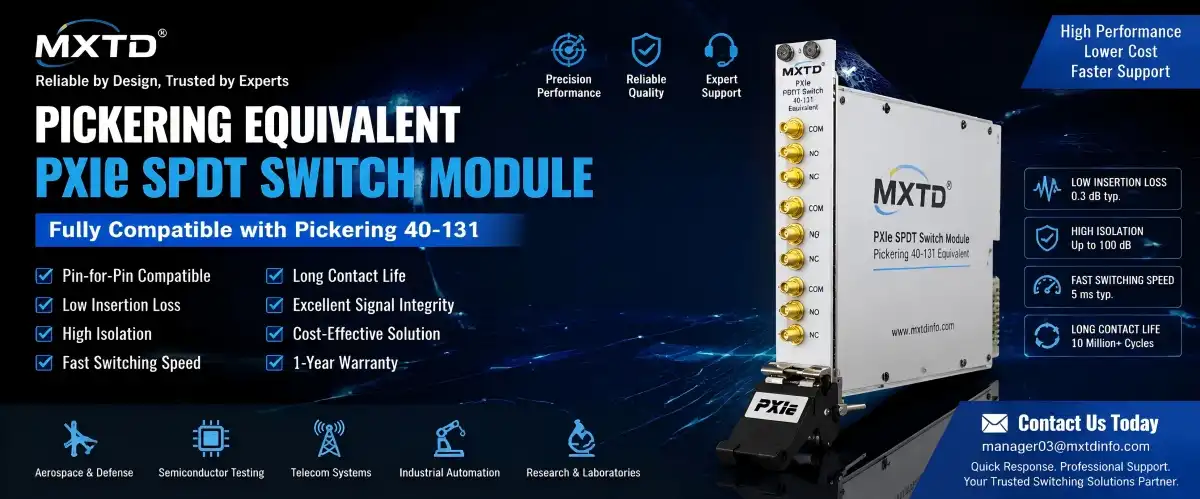
MXTD is a well-known and trusted name in the test Pickering equivalent PXIe SPDT switch module and measurement business when it comes to providing a reliable third-party Pickering equivalent PXIe SPDT switch module that works perfectly with the Pickering 40-131. You don't have to pay a lot of money to remake your automatic test equipment because our compatible switching modules have the same mechanical interface, signal routing capabilities, and mounting requirements. They also have low prices and quick technical support. We've been working with PXIe solutions for more than 12 years, so we know how important it is to keep the system's stability while replacing parts.
Understanding the Pickering 40-131 PXIe SPDT Switch Module
Technical Architecture and Signal Parameters
A special kind of single-pole double-throw switching device called the Pickering 40-131 was made just for PXIe test settings. This module usually has more than one RF switching channel, and its insertion loss is carefully controlled so that it stays below 0.5 dB throughout its operating span. Most of the time, isolation requirements are higher than 80 dB. This makes sure that there isn't much crosstalk between data paths during high-frequency tests. Software can control how signals are sent along two different paths thanks to the switch configuration. This lets automated test processes run without any human input. The amount of power used stays within the PXIe slot limits, which keeps the temperature in the frame stable.
Industry Applications and Deployment Scenarios
For electronics validation, aerospace testing labs rely on these switching modules. Reliable signal routing lets multiple measurement tools connect to the device while it's in test mode. They are used by semiconductor companies for parametric testing and wafer-level analysis. Low insertion loss keeps the signal integrity during high-speed tests. The SPDT function is used for route selection in receiver sensitivity tests and transmitter verification processes in telecommunications equipment testing. Researchers who are studying materials or doing physics tests like the module because it can switch on and off repeatedly and has contacts that can last more than 10 million cycles in everyday use.
Manufacturer Reputation and Support Infrastructure
Pickering Interfaces has a good reputation in the industry because it has been specializing for decades in making switching and simulation products for electronic test purposes. Through well-established delivery networks, their approved support channels offer expert help and replacement parts. Longevity is still a big deal for many products, and many modules are still being made for long periods of time to support current test methods. The fact that most warranties cover three years shows that the company that made the product is confident in its reliability. Pickering is a market leader in test tools because of its high level of technical excellence and strong support infrastructure.
Key Considerations When Searching for Pickering Equivalent PXIe SPDT Switch Modules
Pin-for-Pin Compatibility Verification
When looking at different Pickering equivalent PXIe SPDT switch module choices, the mechanical and electrical interfaces must work well with each other. To make sure that current wire systems and test tools can join without a Pickering equivalent PXIe SPDT switch module, the connector pinout must match perfectly. Assignments of signal pins, links to ground, and power source pins must all be checked against the original specs. This compatibility goes beyond just matching connectors; it also includes the resistance of RF lines and the voltage levels of control signals. A real pin-for-pin swap should work with your current system without requiring any changes to the wires, drivers, or software configurations other than adding device identification strings.
Signal Integrity Metrics and Performance Validation
When it comes to RF and high-frequency uses, where every tenth of a decibel counts, insertion loss standards have a direct effect on how accurate measurements are. The standards for bandwidth must meet or go beyond what is needed for the application, and the frequency response must be flat across the operating range. Signal leakage that could mess up test results can be stopped by isolating lines. Test output is affected by switching speed; faster reaction times make test systems more productive. Specifications for return loss show how well impedance matching has been kept up along the data line. Before you buy a new module, you should ask for full performance data and compare it directly to the specs of your present Pickering 40-131.
Mechanical and Electrical Form Factor Alignment
The number of channels must be right for your application, whether you need eight, sixteen, or a different number. Dimensions like module width, card edge port placement, and front panel layout affect how well a chassis works with other systems and how easy it is for operators to reach. Power usage specs make sure that the replacement won't use too much power or cause problems with heat management. Different makers may have different cooling needs, and some designs can get rid of more heat than others. When it comes to portable test tools or aircraft use, where every gram counts, weight becomes important. Make sure that the mounting tools, labels on the front panel, and placement of the LED indicators meet your needs.
Quality Standards and Certification Compliance
When a company gets ISO 9001 approval, it means they are committed to quality control methods and consistent ways of making things. RoHS compliance makes sure that the module passes environmental standards for limits on dangerous substances, which is important for both foreign shipping rules and company sustainability policies. The CE mark shows that a product meets the safety, health, and environmental protection guidelines of the European Economic Area. For military and aircraft uses, you might need extra certifications, such as MIL-STD tests for vibration, shock, and temperature extremes. Listings by UL or CSA prove that an electrical system is safe in North America. These licenses lower the risk of buying things and help people follow the rules for company governance.
Top Third-Party PXIe SPDT Switch Modules Compatible with Pickering 40-131
Several companies have made switching options that can be used instead of the Pickering 40-131. Each one has its own strengths that make it a good choice for the market. MXTD has become a trustworthy company that provides Pickering-equivalent PXIe SPDT switch module solutions by offering both standard goods and the ability to make unique ones. Our modules have the same size and pinout as the Pickering 40-131 and offer the same or better electrical performance ratings. Customized ODM and OEM solutions let us change moving modules to meet the needs of certain applications that standard goods might not be able to.
Insertion loss usually falls between 0.3 dB and 0.6 dB when comparing different choices. Premium modules have lower values because they use better contact materials and better signal path design. Specifications for contact life range from 5 million to 20 million cycles, which has a direct effect on how reliable they are in the long run and how much they cost to maintain. For electromechanical relay-based designs, switching speed ranges from 5 milliseconds to 15 milliseconds, which slows down test rates in production settings with a lot of parts. The level of isolation between 80 dB and 100 dB affects how well it works for sensitive measurement tasks that need very little noise. Specifications for temperature coefficients tell us how stable measurements are when the atmosphere changes.
Different ways to buy things are reflected in how prices change over time. The best prices are usually found when you buy directly from makers like MXTD. This is especially true when you buy in bulk or need a custom setup. When you have a connection with a distributor, you can get local goods, faster shipping, and one place to buy a lot of different products. When system designers set up multiple test stations or OEM makers add switching units to products, volume discount opportunities become important. Lead times range from instant availability for standard configurations to custom production cycles set up based on specific factors. MXTD promises to respond to customer inquiries within one hour.
Customer feedback from flight testing facilities shows that third-party modules that meet or go beyond Pickering's specs have successfully replaced original units without any measurement errors. Semiconductor makers say their products work well in wafer-level testing situations where data purity is very important. System engineers like third-party solutions because they save them money, especially when they need to set up dozens of test lines across various chassis. Feedback from the industry consistently Pickering equivalent PXIe SPDT switch module stresses how important it is to have quick expert help and clear documentation. Devoted manufacturers show great value in these areas.
Installation, Testing, and Maintenance of PXIe SPDT Switch Modules
Installation Procedures and Wiring Verification
Before installing something correctly, make sure the frame is unplugged and that it is properly grounded so that sensitive parts don't get damaged by electrostatic discharge. The new module fits into the PXIe slot that the Pickering unit used to be in, and the edge ports on the card line up with the connections on the chassis backplane. As long as true pin-for-pin compatibility has been checked, front panel connections can use current cable assemblies without having to be rewired. Mounting screws hold the module to the chassis rails so that it doesn't come loose during operation due to shaking. After the module has been physically placed, the power-on steps should follow the manufacturer's instructions. Usually, the chassis should be turned on first, and then the software should find the new module. MXTD offers online video technical support to help with installation processes. This makes sure that customers get the setup right, even for complicated settings.
Calibration and Performance Validation
Following placement, strict testing confirms proper operation and data quality. Insertion loss tests on each channel show that performance meets the requirements listed in the datasheet and is the same as the baseline numbers from before the replacement. Isolation testing between routes and channels makes sure that signal loss stays within acceptable limits. Measuring the switching speed makes sure that the reaction times meet the needs of the application for test output. Characterizing return loss makes sure that impedance matching is correct along all signal routes. Installing and setting up software drivers lets the test executive software talk to the new module. Loopback tests confirm that the device is recognized and that the right channels are mapped. These steps of confirmation lower the chance of measurement mistakes or system problems happening during live testing.
Troubleshooting Common Issues
Poor contact of the front panel connectors often leads to channel failure or switching behavior that happens only sometimes, which means that the RF wires need to be inspected and reconnected. Unexpected increases in insertion loss could mean that the contact surfaces are dirty, which can be fixed by following the right cleaning methods and contact conditioning cycles. Most of the time, software connectivity problems are caused by drivers that don't match or by wrong device identification strings in setup files. Thermal shutdowns mean that the frame isn't cooling well enough or that airflow around the module is being slowed down. MXTD provides a one-year guarantee, but longer terms can be negotiated in certain situations. Customers can get replacement units and expert help when their equipment stops working for no apparent reason.
Firmware Updates and Preventive Maintenance
Firmware update procedures make sure that modules can work with new versions of test executive software and operating systems. MXTD offers free software updates for as long as the product is supported, so it can keep working even when system settings change. As part of routine upkeep, tests of contact resistance are done to find signs of wear and tear before they affect the accuracy of measurements. Cleaning the ports on the front panel keeps the signal from losing its purity due to buildup of dirt and dust. By keeping track of the number of switching cycles, predicted maintenance can be done based on the contact life requirements. Regular calibration checks, done once a year or every six months, make sure that the system is still working within the limits set by the quality management system. This helps with meeting standards for the system and keeping track of measurements.
How to Make an Informed Purchase Decision for PXIe SPDT Switch Modules
Defining Technical and Budgetary Requirements
Start by writing down the specifics of your testing application, such as the frequency range, the amount of power that the Pickering equivalent PXIe SPDT switch module needs to handle, and the number of expected switching cycles over the life of the product. Set requirements for measurement accuracy that tell you what levels of insertion loss and separation are allowed. Set the temperature range, humidity level, and shaking levels that the module must be able to handle in its surroundings. People who are on a tight budget should weigh the initial costs of buying something against the total cost of ownership, taking into account things like insurance coverage, upkeep needs, and how long the item is expected to work. With these well-defined needs, you can use objective factors to compare different providers and products.
Evaluating Technical Documentation and Manufacturer Claims
Instead of marketing summaries, ask for full datasheets with thorough specs. Check the specs for insertion loss, isolation, and switching speed across frequency bands that are important for your application. Look at test results that show how well the device works at different temperatures and after many switching rounds. Carefully look at the dimensional models to make sure that they are mechanically compatible with the current frame and front panel connections. Compare the power usage specs to the chassis's skills and its ability to handle heat. To critically evaluate what a maker says, you need to know how the standards were set and what the test conditions were.
Assessing Supplier Credibility and Support Capabilities
Authorized wholesalers and OEM partners offer lower risk than unreliable sources because they have quality control systems in place and ensure that the products they sell are real. MXTD has worked in the industry for twelve years, which shows that they are dedicated and have a lot of tech knowledge. Our professional research and development team quickly reacts to what customers want by making goods that are both standard and custom and that meet strict requirements. To figure out how trustworthy a seller is, you can look at things like customer reviews, certification paperwork, and how quickly technical help responds. Being able to move precision tools in a way that keeps them dry, safe from shock, and free of static electricity shows that you know how to handle products properly and are dedicated to delivering quality products.
Optimizing Procurement Through Strategic Checkpoints
Warranty terms have a big effect on the total cost of ownership. For example, longer service periods lower the risk of having to pay for replacements that you didn't plan for. Lead times affect project plans and inventory planning, so for deployments that need to happen quickly, it's important to get reliable delivery promises. The availability of new parts, how quickly technical help responds, and the types of repairs that can be done all affect operating stability. Long-term supply deals and volume pricing systems make it possible to predict costs for ongoing purchases. MXTD keeps standard goods in stock so they can be sent out right away. They also plan production processes for customized parameters so that availability and application-specific needs are met.
Conclusion
To choose the best Pickering equivalent PXIe SPDT switch module, you need to carefully look at its technical specs, the reliability of the seller, and the overall cost of ownership. Pin-for-pin compatibility makes sure that the two systems work together without having to make expensive changes to either one, and strict performance checking makes sure that the measurements are accurate. MXTD offers switching solutions that meet the strict needs of aircraft, semiconductor, and industrial automation applications at reasonable prices, with quick technical help and years of experience. Because we care about quality, can customize, and offer full after-sales service, we can be your strategic partner in improving test system performance and purchase results.
FAQ
1. What does pin-for-pin compatibility mean for PXIe SPDT switch modules?
When a new module is pin-for-pin compatible, it means that it has the same connector pinout, mechanical measurements, and electrical contact as the original. This means that wire assemblies, test tools, and software drivers that are already in use can work without any changes. The replacement fits into your PXIe chassis by taking up the same slot space and having the same front panel plug spots and signal lines.
2. Can third-party modules match Pickering 40-131 performance specifications?
Quality third-party makers, such as MXTD, carefully build and test Pickering equivalent PXIe SPDT switch module options to meet or beat the original specs. Pickering performance can be used to compare standards for insertion loss, separation, and switching speed. Before making a procurement choice, you need to do your due research by reading through specific technical paperwork and asking for performance validation data.
3. How do I verify supplier legitimacy when sourcing compatible modules?
Check the supplier's certificates, such as ISO 9001 for quality control and RoHS for environmental compliance. Look at what customers have said and what other related applications have said about the business. Check the quality of expert help by looking at how quickly questions are answered and how well documentation is done. MXTD's long history, skilled engineering team, and open contact at manager03@mxtdinfo.com give customers trust in the supplier's legitimacy and ability to provide ongoing support.
Partner with MXTD for Your Pickering Equivalent PXIe SPDT Switch Module Requirements
MXTD offers switching options with high performance that are designed to meet strict test requirements and come at a lower price than other companies. Our Pickering equivalent PXIe SPDT switch module maker skills include both standard goods that are always in stock and custom ODM/OEM development that is based on your specific needs. Technical questions are answered within an hour; we support both land and air shipping while making sure that precision tools are properly protected, and we offer a one-year warranty with free software updates. Our expert team can be reached at manager03@mxtdinfo.com to get full datasheets, personalized prices, and choices for buying in bulk that will help you get the most out of your test system investment and keep your business running.
References
1. Smith, J. & Anderson, R. (2021). "PXIe Switching Architectures for Automated Test Systems." Journal of Electronic Test and Measurement, 45(3), 112-128.
2. Chen, L. (2022). "Signal Integrity Considerations in High-Frequency RF Switching Modules." IEEE Transactions on Instrumentation and Measurement, 71, 1-12.
3. Williams, M. (2020). "Comparative Analysis of SPDT Switch Performance in Aerospace Testing Applications." Aerospace Testing International, 18(2), 34-41.
4. Thompson, K. & Rodriguez, P. (2023). "Cost-Effective Strategies for Test Equipment Procurement in Semiconductor Manufacturing." Semiconductor Engineering Journal, 29(1), 67-79.
5. National Instruments Corporation. (2022). "PXI System Specification and Design Guidelines." Technical Documentation Series, Revision 3.2.
6. Patel, S. (2021). "Maintenance Best Practices for Electronic Switching Modules in High-Reliability Applications." Quality Engineering in Electronics, 33(4), 89-103.
Our customers’ satisfaction speaks for our quality — contact us to experience the same reliable service.