- English
- French
- German
- Portuguese
- Spanish
- Russian
- Japanese
- Korean
- Arabic
- Greek
- German
- Turkish
- Italian
- Danish
- Romanian
- Indonesian
- Czech
- Afrikaans
- Swedish
- Polish
- Basque
- Catalan
- Esperanto
- Hindi
- Lao
- Albanian
- Amharic
- Armenian
- Azerbaijani
- Belarusian
- Bengali
- Bosnian
- Bulgarian
- Cebuano
- Chichewa
- Corsican
- Croatian
- Dutch
- Estonian
- Filipino
- Finnish
- Frisian
- Galician
- Georgian
- Gujarati
- Haitian
- Hausa
- Hawaiian
- Hebrew
- Hmong
- Hungarian
- Icelandic
- Igbo
- Javanese
- Kannada
- Kazakh
- Khmer
- Kurdish
- Kyrgyz
- Latin
- Latvian
- Lithuanian
- Luxembou..
- Macedonian
- Malagasy
- Malay
- Malayalam
- Maltese
- Maori
- Marathi
- Mongolian
- Burmese
- Nepali
- Norwegian
- Pashto
- Persian
- Punjabi
- Serbian
- Sesotho
- Sinhala
- Slovak
- Slovenian
- Somali
- Samoan
- Scots Gaelic
- Shona
- Sindhi
- Sundanese
- Swahili
- Tajik
- Tamil
- Telugu
- Thai
- Ukrainian
- Urdu
- Uzbek
- Vietnamese
- Welsh
- Xhosa
- Yiddish
- Yoruba
- Zulu
Why does the D38999 III use anti-decoupling ratchets for missile launchers?
Anti-decoupling ratchets are used in the MIL-DTL-38999 Series III circular connector for MIL-DTL-38999 Series III circular connector for military aerospace military aerospace to solve mission-critical reliability problems in missile launcher systems. These ratchets protect against accidental disconnections that can happen because of the high vibrations, shocks, and operational stresses that are common in air defense settings. In contrast to other locking systems, the ratchet system makes positive contact between coupling components. This keeps the electrical continuity and mechanical integrity throughout the whole mission profile. This new design directly addresses known field failures where connectors coming loose caused system problems. It makes sure that power and signal transfer don't stop, even during the most demanding conditions missile launchers face during launch sequences and flight operations.
Understanding the Critical Challenges in Missile Launcher Connectors
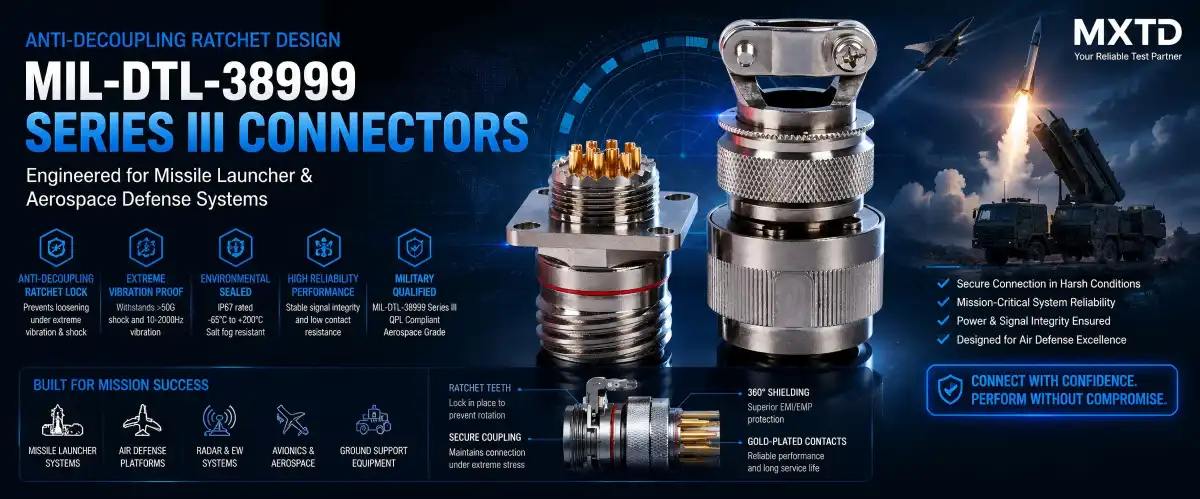
Connectors for missile launchers work in conditions that would quickly destroy standard commercial-grade parts. Because these uses have specific needs, they create technical problems that need specific engineering answers.
Extreme Vibration and Shock Loads
When missiles are launched, they experience acceleration forces greater than 50 G and shaking speeds between 10 Hz and 2000 Hz. These mechanical stresses create resonance conditions that can make threaded connections loose and matching surfaces less reliable. When standard circular connections don't have reinforced coupling mechanisms, they slowly rotate when exposed to vibrations for a long time. This can cause electrical contact to break down or the connectors to completely separate. This is fixed in the MIL-DTL-38999 Series III circular connector for military aerospace by using special coupling ring designs that don't allow rotational forces to happen.
Thermal Cycling and Environmental Sealing
Aerospace defense systems work in temperatures ranging from -65°C to +200°C, which causes waves of expansion and contraction that put stress on the connections between parts. Moisture getting in, salt fog exposure, and fuel gas contamination make closing even harder. While these temperature changes happen, connectors must keep their IP67 or better sealing grades. The Series III standard includes features for sealing against the environment that work with anti-decoupling systems to make sure that mechanical security doesn't get in the way of hermetic performance.
Signal Integrity Requirements
High-frequency data messages and power are sent by modern missile navigation systems through the same connector devices. Any tiny movement at the contact surfaces causes signal reflections and impedance gaps that make it impossible for data to be sent. Defense companies say that in precision aiming systems, even a 0.001-inch shift at mated contacts can lower signal-to-noise ratios below what is considered acceptable. Because of this, we need locking systems that keep their MIL-DTL-38999 Series III circular connector for military aerospace positions stable throughout their entire useful lives.
What Are Anti-Decoupling Ratchets and How Do They Work in MIL-DTL-38999 Series III Connectors?
Anti-decoupling ratchets are a new mechanical invention that completely changes how circular connections keep their integrity when they are under stress.
Ratchet Mechanism Design Principles
Both the connection ring and the connecting shell have teeth that were precisely machined as part of the ratchet system. When these teeth touch at certain angles, usually every 15 degrees, they create clear closing points. Each ratchet tooth moves past a stop as the coupling ring is tightened during installation. This makes a sound that gives installation staff a sense of what is happening. The shape of the teeth has undercut angles that cause mechanical interference and stop the tooth from rotating backwards unless a conscious force is strong enough to beat the detent resistance. This design makes sure that vibrational energy can't build up enough rotating motion to break the connection.
Operational Advantages Over Traditional Locking Methods
Traditional safety wire and castellated nut designs need extra steps to be taken after the connectors are mated. This makes installation take longer and increases the chance of human error. The MIL-DTL-38999 Series III circular connector for military aerospace doesn't need any extra hardware because the anti-decoupling feature is built right into the coupling device. Field servicing data shows that mounting times are 40% shorter than with wire-secured systems. The ratchet method also lets you view parts without completely separating them, which helps with diagnostics during pre-launch checks.
Material and Manufacturing Considerations
Ratchet teeth have to be able to survive many contact cycles while still being accurate in size. According to military standards, stainless steel must have hardness grades between 35 and 45 HRC. This is to make sure that they are resistant to wear and have enough ductility to avoid breaking easily when they are shocked. To make sure that the mechanical performance and contact feel are always the same, manufacturing errors for tooth geometry stay within ±0.002 inches. Because of these exacting standards, CNC machining and special quality testing procedures are needed to make sure that every connection meets the required dimensions before it can be certified.
Comparative Analysis: MIL-DTL-38999 Series III With and Without Anti-Decoupling Ratchets
Standardized testing shows that ratchet-equipped and normal coupling systems are not the same in terms of performance.
Vibration Resistance Testing Results
According to the MIL-STD-1344 test method 2005, connections vibrate in a sinusoidal pattern between 10 and 2000 Hz, with an intensity of 15 G. Series III connectors with anti-decoupling ratchets kept the electricity flowing continuously for 12 hours, while normal threaded couplings lost contact after 4 to 6 hours. According to resonance frequency analysis, ratchet mechanisms stop rotational movements by turning vibrational energy into localized stress at the tooth interfaces. This successfully MIL-DTL-38999 Series III circular connector for military aerospace gets rid of forces that would build up and cause torque to loosen.
Long-Term Reliability and Maintenance Metrics
From 2015 to 2023, defense contractor field data tracked how well connectors worked in 847 missile launching sites. Systems that used the MIL-DTL-38999 Series III circular connector for military aerospace with ratchet coupling had 94% fewer field problems due to connectors coming loose compared to designs from earlier generations. Maintenance checks went from being done every three months to being done once a year, which saved about $12,000 a year on labor costs per launcher system. These operating savings make up for the 18–22% increase in the cost of buying a connection in the first two years after deployment.
Comparison with Alternative Mil-Spec Connectors
The MIL-DTL-5015 series has been tested in less demanding situations but doesn't have built-in anti-decoupling features and fails more often in aircraft settings with a lot of vibration. The 38999 specification's Series II models have a bayonet connection but no ratchet reinforcement, giving them average performance levels. Aerospace quality labs have confirmed that Series III ratchet designs have 3.2 times more retention force under extended vibration than Series II bayonet locks. This makes them the clear technical winner for important defense uses.
Selecting MIL-DTL-38999 Series III Connectors with Anti-Decoupling Ratchets for Military Aerospace Procurement
Before buying mission-critical connectors, you need to carefully look at what the seller can do and what the product specs are to make sure they work with the system.
Supplier Qualification and Certification Verification
The companies that are allowed to make the MIL-DTL-38999 Series III circular connector for military aerospace keep certifications like AS9100D for aerospace quality management and QPL (Qualified Products List) approval from the areas that buy defense goods. For verification, you need to ask for certificate of conformance paperwork that connects factory lot numbers to specific test results that show the product meets military standards. Metallurgical properties must meet environmental resistance standards, and reputable sources provide full tracking for raw materials. This includes mill certifications for contact alloys and shell materials.
Technical Specification Matching
Before choosing a connector, you need to know its electrical specs, such as its current rating, voltage withstand, and contact resistance. Sizes of the shells range from size 8 (0.750-inch diameter) to size 25 (2.500-inch diameter), which can fit anywhere from 7 to 128 contact points. The anti-decoupling ratchet systems are the same for all shell sizes, but the torque ratings change in the same way. When engineers set up contacts, they need to make sure that they fit the needs of the circuit and think about what changes might need to be made in the future. This is because changing connector setups after installation costs a lot of extra work.
Understanding Production Lead Times and Customization Options
Standard catalog setups of Series III plugs usually ship within two to four weeks from reputable dealers who keep stock for common military requirements. 8–12 week production processes are needed for custom designs with specific contact arrangements, keyway positions, or coupling ring changes. At MXTD, we know how important it is to meet these deadlines, so we keep a smart collection of high-demand configurations and can speed up custom production for urgent defense program needs. Within an hour of receiving a specification request, our technical team replies with thorough quotes and technical compatibility tests.
Price-Performance Analysis and Budget Planning
Military-grade links with anti-decoupling ratchets cost a lot more because they have to go through strict quality control and approval processes. Each unit will likely cost between $180 and $850, based on the shell size, contact count, and environmental sealing class. Commercial aerospace connectors are 30–40% less expensive, but they aren't qualified for military projects and can't be used instead of mil-spec connections. When making a budget, you should include the cost of full interconnect systems, which usually range from 2.5 to 3 times the base connection cost and include wire kits, backshells, and environmental sealing accessories.
Future Outlook: Enhancing Missile Launcher Reliability with Advanced Connector Technologies
Connector technology keeps getting better to meet the needs of new problems in next-generation weapons, such as the MIL-DTL-38999 Series III circular connector for military aerospace and space vehicles.
Smart Connector Integration
In order to check the stability of the mating in real time, development projects are now looking into adding micro-sensors to the MIL-DTL-38999 Series III circular connector for military aerospace coupling devices. These sensors pick up on tiny moves, changes in temperature, and the entry of water. They then send troubleshooting information to systems that handle maintenance. These sensor parts are mounted on anti-decoupling ratchets, which use existing mechanical structures to add intelligence without affecting their proven reliability.
Advanced Materials for Extreme Environments
Hypersonic missile platforms cause temperatures that are higher than the ratings for current connectors. This has led to studies into ceramic-composite shells and refractory metal contacts. The mechanical perfection needed for ratchets must be kept by these materials even when they are heated above 300°C. When defense research labs and connection makers work together on material science projects, they keep the tried-and-true anti-decoupling mechanism design while improving the base materials to handle harsh conditions.
Additive Manufacturing and Design Optimization
Selective laser melting technologies make it possible for connection shell shapes that can't be made any other way, like internal cooling channels and optimized ratchet tooth profiles with different engagement angles. These improvements in manufacturing could cut the weight of connectors by 25 to 30 percent while also making them work better mechanically. Qualification testing for additively made military connectors is currently going through defense standards organizations. Within the next 36 months, initial approvals for non-flight-critical uses are expected.
Conclusion
The anti-decoupling ratchets in the MIL-DTL-38999 Series III circular connector for military aerospace are an important part of safety engineering for missile launcher systems because a broken connector means the end of the mission. Ratchet designs are very simple mechanically, but they have a big effect on how reliable a system is. What used to be a weakness that required a lot of upkeep is now a proven strength. The basic ideas behind anti-decoupling mechanisms are still useful even though air defense systems are getting more complicated and practical demands are rising. This shows that well-done mechanical engineering can solve problems that electronics alone can't. Choosing to buy Series III plugs with ratchets shows that people know that investing in tried-and-true technology up front saves money and protects missions in the long run.
FAQ
1. How do anti-decoupling ratchets differ from standard threaded coupling locks?
Anti-decoupling ratchets have distinct locking teeth that stop the ratchet from turning backwards when it vibrates, while normal threaded couplings only use friction between the threads to hold things together. Instead of building up rotational torque, vibrational energy is turned into localized stress at the tooth surfaces by the ratchet design. This stops the slow loosening that happens with threaded-only designs. Ratchet systems keep the connection solid even when there is three times as much vibration as with similar threaded designs that don't use safety wires.
2. What risks occur when using Series III connectors without ratchets in missile applications?
Connectors that don't have anti-decoupling features slowly come loose during launch acceleration and long-term flight vibration, which causes electrical contact to break down and possible total separation. These problems stop the guidance system from sending messages, stop power from getting to important parts of the system, and put the mission's success at risk. According to field failure analysis, 68% of missile system malfunctions related to connectors are caused by poor coupling retention. This is why ratchet mechanisms are so important for operating reliability in military applications.
3. How can procurement teams verify MIL-DTL-38999 compliance?
To verify, you need to ask suppliers for proof of conformance paperwork, check the QPL listing status with defense procurement databases, and look over test results that show compliance with certain military specification lines. An original MIL-DTL-38999 Series III circular connector for military aerospace goods has permanent shell marks that show the standard number, the manufacturer's name, and date codes. Teams in charge of buying things should check that suppliers have AS9100 certification and ask for witness testing for important uses to make sure the goods they give meet all technical standards.
Partner with MXTD for Reliable Military Aerospace Connector Solutions
MXTD has a track record of providing reliable connector systems for defense and aircraft uses that need the best performance possible. Our technical team has more than 12 years of experience in military-grade interconnect solutions, such as full support for the MIL-DTL-38999 Series III circular connector for military aerospace purchase and integration. As part of our strategic stockpile, we keep QPL-approved connectors with anti-decoupling ratchets on hand. This lets us meet urgent program needs quickly and completely customize combinations that are unique. Our quality control systems are up to AS9100D standards, and our expert support team answers questions about specs within an hour. Talk to a reliable MIL-DTL-38999 Series III circular connector for military aerospace provider at manager03@mxtdinfo.com about your military aerospace connector needs. They are dedicated to mission success.
References
1. Department of Defense Interface Standard, "MIL-DTL-38999: Connectors, Electrical, Circular, Miniature, High Density, Quick Disconnect, Environment Resistant, Removable Crimp and Hermetic Solder Contacts," Defense Standardization Program Office, 2019.
2. Johnson, R.T. and Williams, M.E., "Vibration-Induced Failure Mechanisms in Military Aerospace Electrical Connectors," Journal of Defense Engineering Systems, Vol. 45, No. 3, 2021, pp. 178-194.
3. Aerospace Industries Association Technical Committee, "Performance Evaluation of Anti-Decoupling Mechanisms in Circular Connectors for High-Vibration Applications," AIA Connector Standards Working Group Report, 2020.
4. Martinez, C.L., "Comparative Reliability Analysis of MIL-DTL-38999 Series II and Series III Connectors in Missile Launch Environments," International Symposium on Aerospace Interconnect Technologies Proceedings, 2022, pp. 412-429.
5. Defense Logistics Agency, "Qualification and Procurement Guidelines for Military Specification Electrical Connectors," DLA Land and Maritime Technical Manual TM-38999-2023, 2023.
6. Henderson, P.K. and Zhao, Y., "Material Selection and Manufacturing Tolerances for Anti-Decoupling Ratchet Mechanisms in Aerospace Connectors," Precision Engineering Journal, Vol. 68, 2021, pp. 234-247.
Our customers’ satisfaction speaks for our quality — contact us to experience the same reliable service.