- English
- French
- German
- Portuguese
- Spanish
- Russian
- Japanese
- Korean
- Arabic
- Greek
- German
- Turkish
- Italian
- Danish
- Romanian
- Indonesian
- Czech
- Afrikaans
- Swedish
- Polish
- Basque
- Catalan
- Esperanto
- Hindi
- Lao
- Albanian
- Amharic
- Armenian
- Azerbaijani
- Belarusian
- Bengali
- Bosnian
- Bulgarian
- Cebuano
- Chichewa
- Corsican
- Croatian
- Dutch
- Estonian
- Filipino
- Finnish
- Frisian
- Galician
- Georgian
- Gujarati
- Haitian
- Hausa
- Hawaiian
- Hebrew
- Hmong
- Hungarian
- Icelandic
- Igbo
- Javanese
- Kannada
- Kazakh
- Khmer
- Kurdish
- Kyrgyz
- Latin
- Latvian
- Lithuanian
- Luxembou..
- Macedonian
- Malagasy
- Malay
- Malayalam
- Maltese
- Maori
- Marathi
- Mongolian
- Burmese
- Nepali
- Norwegian
- Pashto
- Persian
- Punjabi
- Serbian
- Sesotho
- Sinhala
- Slovak
- Slovenian
- Somali
- Samoan
- Scots Gaelic
- Shona
- Sindhi
- Sundanese
- Swahili
- Tajik
- Tamil
- Telugu
- Thai
- Ukrainian
- Urdu
- Uzbek
- Vietnamese
- Welsh
- Xhosa
- Yiddish
- Yoruba
- Zulu
What Sensors Are Compatible With Differential Analog Input Boards?
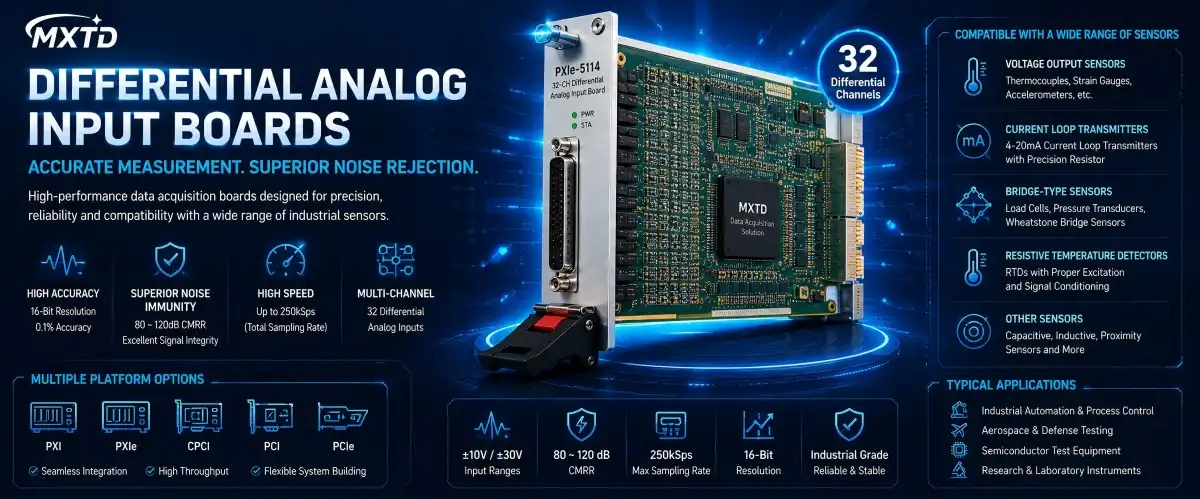
Differential analog input boards can work with many types of sensors, such as voltage output devices like strain gauges and thermocouples, current loop transmitters that work at 4-20mA, bridge-based sensors like load cells and pressure transducers, resistive temperature detectors that have been properly signal-conditioned, and different types of capacitive or inductive proximity sensors. The differential measurement design of these boards effectively blocks common-mode noise. This makes them perfect for accurately collecting data in electrically noisy industrial settings where signal integrity is very important.
Introduction
Acquiring correct sensor data is still one of the biggest problems in current industrial automation and aerospace tests. We know that engineers and procurement managers are always under pressure to choose measurement tools that are accurate and reliable. Differential Analog Input Board products have become important parts in this environment because they offer better signal quality and noise reduction than older single-ended designs.
This guide answers the important question of whether sensors can work with differential input systems. It gives useful information for system builders, test engineers, and technical leaders who are in charge of choosing data acquisition hardware. Companies that know which sensors work best with differential inputs can cut down on measurement mistakes, increase system efficiency, and speed up project timelines. Choosing the right sensors and input boards has a direct effect on the quality of your measurements and how efficiently your system works, whether you're making automated test tools for validating semiconductors or building distributed control systems for manufacturing.
Understanding Differential Analog Input Boards
How Differential Measurement Works
Instead of measuring in relation to a shared ground, differential measurement design finds the voltage difference between two separate input terminals. This basic difference is very helpful in real-life situations where electrical noise and changes in ground potential can mess up single-ended readings. When a sensor is connected to a Differential Analog Input Board, the measurement amplifier at the input stage only boosts the difference signal and ignores values that are the same on both input lines.
Key Advantages Over Single-Ended Systems
The main benefit of differential inputs is that they are very good at blocking typical modes. Noise from motor drives, switching power supplies, and radio frequency interference are just a few of the things that can cause voltages on signal lines that aren't needed. Common-mode noises can be blocked by 80 to 120 dB by a good differential input board, which keeps low-level sensor data intact. This feature comes in handy when reading data at the microvolt level from thermocouples or strain gauges in places that aren't electrically friendly.
Industrial Applications Driving Adoption
Differential input systems are being used more and more in manufacturing facilities to keep an eye on processes and make sure products are of good quality. In the production of electronics, automated test equipment needs accurate analog readings to make sure that part standards are met at high throughput rates. These boards are used by research institutions in lab equipment, where the accuracy of measurements has a direct effect on the results of experiments. When reliability can't be compromised, aerospace and defense companies ask for differential inputs in flight test instruments and weather modeling systems.
Types of Sensors Compatible With Differential Analog Input Boards
Voltage Output Sensors
One of the most popular voltage output sensors connected to the Differential Analog Input Board units is the thermocouple. These temperature sensors make signals at the microvolt level that are related to temperature. They need high input resistance and low noise floors. When strain gauges are set up in a quarter-bridge or half-bridge configuration, they also give off differential voltages that can be directly connected to differential inputs. Differential measurement blocks noise well for accelerometers that output voltage. This is especially helpful for applications that track vibrations where wire lengths may go through electrically noisy machine areas.
Current Loop Transmitters
4-20mA current loops are often used in process instruments to send sensor data over long distances. Through current communication, these emitters naturally block out noise, but connecting them to differential analog input boards needs the right current-to-voltage conversion. When you put a precision resistor across the differential inputs, it changes the current information into an equivalent voltage drop, which for 4-20mA ranges is usually between 1 and 5V. This setup blends the low noise of current transfer with the adaptability of measuring voltage.
Bridge-Type Sensors
Load cells, pressure transducers, and precise weighing devices all have Wheatstone bridge circuits that make differential output voltages on their own. When these sensors are attached to differential input boards, they work at their most accurate. This is because the bridge setup automatically creates a differential signal, so no extra circuitry is needed. Bridge sensors make very small differential voltages—often just millivolts per volt of excitation—which means that differential inputs are needed to get rid of noise better.
Resistive Temperature Detectors
Before being connected to analog input boards, RTDs need to be excited from the outside, and their signals need to be conditioned. These exact temperature sensors can work with differential inputs after being properly set up with a bridge circuit or a special RTD transmitter. The three-wire or four-wire RTD connection methods get rid of lead resistance mistakes very well. Differential measurement makes things even more accurate by blocking common-mode interference that is picked up along cable runs.
Choosing the Right Differential Analog Input Board for Your Sensor
Matching Voltage Ranges and Resolution
Before you can choose the right input board, you need to know how your sensor outputs and how accurate a reading you need. This is shown by our PXIe-5104 and PXIe-5114 series boards, which have both ±10V and ±30V input bands to work with different kinds of sensors. The 16-bit precision gives you 65,536 separate measurement values across the input range. This equals about 305µV per count at ±10V range, which is enough for most industrial sensor uses. When working with low-level sensors like thermocouples that send data below 100mV, it would be wasteful to use the whole ±10V range. Signal conditioning amplifiers can boost these weak signals so that they work better with the board's input range. On the other hand, a Differential Analog Input Board that can handle ±30V is needed for sensors that send out ±15V data to avoid range limits and possible damage.
Channel Count and Scalability Considerations
Many modern test systems need to get data from more than one monitor at the same time. Our differential input boards have 32 differential channels, which means that up to 32 separate sensor outputs can be measured at the same time without any delays caused by merging. This setup is useful for tracking temperatures at multiple points, watching vibrations at the same time, or measuring pressures in different areas. During multi-channel scanning, the 250kSps highest overall sampling rate is spread out across channels. Knowing your per-channel bandwidth needs will help you decide if one board is enough or if more boards in a chassis will give you better throughput.
Common-Mode Rejection and Noise Performance
The common-mode rejection ratio measures how well a Differential Analog Input Board blocks noise that appears equally on both input channels. At both DC and line frequencies, high-quality boards achieve CMRR values greater than 80 dB, allowing them to reject common-mode voltages that are 10,000 times stronger than the desired differential signal. This capability becomes especially important when sensors and measurement systems use different ground references or when long cable runs pass through electrically noisy environments. Our Differential Analog Input Board is designed with advanced circuit techniques to maintain high CMRR performance across the operating frequency range, ensuring accurate and stable measurements even in harsh industrial conditions.
Comparing Platform Options
When engineers choose analog input boards, they can choose from PXI, PXIe, CPCI, PCI, and PCIe form factors. PXIe systems have the fastest PCIe Gen 2 x4 links, which can handle 4Gbps throughput. This makes them perfect for apps that need to stream data to host memory very quickly. Traditional PXI and CPCI connections offer 132MB/s through 33MHz 32-bit lines, which is more than enough for most multichannel tasks at normal sample rates. Both old PCI and new PCIe choices can be used for desktop tasks that don't need chassis-based systems. The platform you choose will depend on your system design, the amount of data you need to transfer, and your needs for growth.
Practical Integration and Troubleshooting Tips
Wiring Best Practices for Signal Integrity
When adding sensors to Differential Analog Input Board systems, the quality of the measurements is greatly affected by the choice of cables and how they are routed. For links that don't pick up noise, twisted-pair shielded wires are the base. The twisting gets rid of magnetically coupled interference, and the cover stops electrostatically coupled noise. Connecting one end of the shield to chassis ground stops ground loops, but doesn't change how well the shield works as an electric shield. The length of the cable adds capacitance, which can lower the bandwidth and distort the signal. For uses that need long wire runs, sensors that produce current or local signal conditioning that drives low-impedance differential signals work best. Keeping sensor wires and power wiring physically separate lowers noise that is coupled with capacitance, and staying away from parallel routing near motor drives and switching power sources lowers interference that is coupled with magnetism.
Signal Conditioning Techniques
Before they can be connected to analog input boards, many sensors need to have their signals "conditioned." Low-level sensor outputs are amplified so that the board's input range and precision can be used more effectively. When you filter, you get rid of high-frequency noise that could cause aliasing when you convert analog to digital. Isolation gets rid of ground loops that connect sensor locations to the measurement system. This gets rid of a frequent source of noise and baseline shift. Our boards can handle conditioned signals with an accuracy of 16 bits and an input frequency of up to 2.5 MHz. The signals can be within the ±10V or ±30V ranges. The standard for 0.1% full-scale range accuracy makes sure that signals that are properly conditioned can be turned into digital numbers with as little extra error as possible. Calibration lets you fix offset and gain mistakes that are specific to a sensor, which improves the accuracy of the whole system.
Diagnosing Common Integration Issues
A lot of measurement noise is usually a sign of issues with grounding, insulation, or impedance mismatches between sensors and input boards. When trying to figure out what's wrong with noisy readings, the first thing you should do is look for ground loops, which are unintended current paths between device grounds. If there were ground loops, disconnecting the shield grounds at one end usually makes the signal quality better right away. Unexpected DC offsets could be caused by thermocouple effects at different metal joints, input bias currents running through source impedances, or a common-mode voltage that is higher than what the board can handle. Using buffering amplifiers to lower the source impedance cuts down on offset mistakes caused by input bias currents. Input amplifier steps don't get too hot by making sure that common-mode voltages stay within certain limits. Readings or dropouts that happen from time to time could mean that the link isn't working right, the sensor isn't getting enough current, or there are timing issues in multi-channel scanning patterns. Basic connection problems can be fixed by making sure the connectors fit properly and the wire stays connected. By checking the activation voltage levels, you can be sure that bridge sensors and RTDs get enough drive current to work reliably.
Procurement Insights for Differential Analog Input Boards
Evaluating Suppliers and Product Quality
When buying measurement tools for important business uses, you need to carefully evaluate the suppliers you work with. Companies should check how quickly technical help responds, how full the product documentation is, and how well quality control systems work. Suppliers who know a lot about the subject can suggest the best setups for different types of sensors and application needs, which cuts down on the time it takes to build a system. It has been MXTD's specialty for over 12 years to develop and make PXIe chassis, boards, and combined testing solutions. Our engineering team knows all the details of how to connect sensors to a Differential Analog Input Board and offer quick technology support—we usually answer customer questions within an hour. When project deadlines are short, and expert questions need answers right away, this quickness comes in handy.
Cost-Performance Trade-offs
A constant problem in procurement is finding the right balance between measurement success and price constraints. While high-end brands have a lot of features and support for a lot of software ecosystems, cheaper options can give you the same measurement accuracy at much lower prices. Our differential analog input board family gives performance that is compatible with NI at low prices, without sacrificing measurement accuracy or dependability. The 16-bit precision, 250kSps sampling rate, and 0.1% accuracy meet or go beyond what is needed for most industrial sensor uses. Standard PXI, PXIe, CPCI, PCI, and PCIe form factors make sure that they can work with test equipment that is already in place. Through our OEM/ODM services, we can make solutions that are special to channel numbers, voltage ranges, or environmental needs.
Lead Times and Customization Options
The supply of standard products has a direct effect on project plans. We keep popular designs in stock, such as the CPCI-5114, PCI-5114, PCIe-5114, and PXIe-5114 models with ±30V ranges and the CPCI-5104, PCI-5104, PCIe-5104, and PXIe-5104 models with ±10V ranges. These stock boards ship quickly to meet pressing needs. For custom setups, production plans must be based on certain factors. Our design freedom helps organizations that need a certain number of channels, a certain power range, or a wide range of temperatures. Industrial-grade versions that work in temperatures ranging from -40°C to +70°C are used in tough environments where commercial-grade parts can't safely work.
Logistics and After-Sales Support
For shipping accurate instruments, you need special boxes that keep out wetness, absorb shock, and keep static electricity away. We offer both land and air transportation choices, and we take the right safety precautions to make sure that your equipment gets to its destination in perfect working order. Shipments come with paperwork like calibration certificates, test results, and compliance statements to make getting inspection and integration easier. After-sales support includes expert help via remote video chat, free software updates, and a standard warranty that covers defects in materials and labor for one year. For important uses that need to be up all the time, you can get extended warranty choices and faster service plans. Throughout the duration of a product, our support team helps with questions about driver interaction, LabVIEW interfacing, and application development.
Conclusion
To choose sensors and Differential Analog Input Board solutions that work together, you need to know about measurement standards, noise settings, and how the system needs to be integrated. When matched correctly, voltage output sensors, current emitters, bridge configurations, and properly conditioned resistance sensors can all work with differential inputs. Platform options in PXI, PXIe, CPCI, PCI, and PCIe forms work with a range of system designs. Our family of boards has 32 differential channels, 16-bit precision, and ±10V or ±30V ranges that can be used with NI products. The best measuring quality is achieved through correct wiring, signal conditioning, and a methodical approach to debugging. The long-term success of a project depends on the procurement choices that are made by balancing technical requirements, supplier skills, customization freedom, and total cost of ownership.
FAQ
Can I directly connect voltage output sensors to differential analog input boards?
Yes, voltage output sensors that produce signals that are within the input range of the board can connect straight to differential inputs without any extra processing. In this group are thermocouples, strain gauges, and most accelerometers. Check that the sensor output voltage values match the board's requirements. Our ±10V and ±30V Differential Analog Input Board types can work with most standard sensors.
How do I ensure sensor signals match my board's input range?
Check the sensor's datasheet to see what the lowest and highest output values should be under normal working conditions. Check these numbers against the board's input ranges, leaving some room for overrange situations. If sensor outputs don't use the full range of the board, boosting makes the sharpness better. Sensors that are too far away from the board, on the other hand, need attenuation or boards with bigger input gaps.
What causes excessive measurement noise in differential input systems?
The most common type of noise is ground loops, which happen when multiple ground links make current paths that weren't meant to be there. When wires aren't properly protected, electromagnetic interference from motors, drives, and RF sources can get through. If you don't route cables properly parallel to power lines, you'll be more likely to hear noise. Noise problems are usually fixed by getting rid of ground loops in a planned way, improving insulation, and carefully moving cables.
Partner With MXTD for Reliable Differential Analog Input Board Solutions
You can trust MXTD as a provider of Differential Analog Input Board solutions because they have both proven technical skills and helpful customer service. The full 5104 and 5114 series is part of our product line. It works with PXI, PXIe, CPCI, PCI, and PCIe systems and has 32 differential channels with 16-bit precision and sampling rates of up to 250kSps. In industrial automation, aircraft testing, and semiconductor validation, these boards work well with thermocouples, strain gauges, load cells, RTDs, and current emitters. We have reasonable prices that give you great value without sacrificing measuring accuracy or long-term dependability. Special needs that normal goods can't meet can be met by custom OEM/ODM configurations. Email our team at manager03@mxtdinfo.com to talk about your unique sensor interfacing needs. Within an hour, you'll get full technical advice.
References
1. Webster, J. G. (2016). The Measurement, Instrumentation and Sensors Handbook, Second Edition. CRC Press.
2. Pallas-Areny, R. & Webster, J. G. (2012). Sensors and Signal Conditioning, Second Edition. Wiley-Interscience.
3. Kester, W. (2005). Data Conversion Handbook. Analog Devices, Inc.
4. Johnson, G. W. & Jennings, R. (2006). LabVIEW Graphical Programming: Practical Applications in Instrumentation and Control. McGraw-Hill.
5. Park, J. & Mackay, S. (2003). Practical Data Acquisition for Instrumentation and Control Systems. Newnes.
6. Wilson, J. S. (2004). Sensor Technology Handbook. Elsevier.
Our customers’ satisfaction speaks for our quality — contact us to experience the same reliable service.