- English
- French
- German
- Portuguese
- Spanish
- Russian
- Japanese
- Korean
- Arabic
- Greek
- German
- Turkish
- Italian
- Danish
- Romanian
- Indonesian
- Czech
- Afrikaans
- Swedish
- Polish
- Basque
- Catalan
- Esperanto
- Hindi
- Lao
- Albanian
- Amharic
- Armenian
- Azerbaijani
- Belarusian
- Bengali
- Bosnian
- Bulgarian
- Cebuano
- Chichewa
- Corsican
- Croatian
- Dutch
- Estonian
- Filipino
- Finnish
- Frisian
- Galician
- Georgian
- Gujarati
- Haitian
- Hausa
- Hawaiian
- Hebrew
- Hmong
- Hungarian
- Icelandic
- Igbo
- Javanese
- Kannada
- Kazakh
- Khmer
- Kurdish
- Kyrgyz
- Latin
- Latvian
- Lithuanian
- Luxembou..
- Macedonian
- Malagasy
- Malay
- Malayalam
- Maltese
- Maori
- Marathi
- Mongolian
- Burmese
- Nepali
- Norwegian
- Pashto
- Persian
- Punjabi
- Serbian
- Sesotho
- Sinhala
- Slovak
- Slovenian
- Somali
- Samoan
- Scots Gaelic
- Shona
- Sindhi
- Sundanese
- Swahili
- Tajik
- Tamil
- Telugu
- Thai
- Ukrainian
- Urdu
- Uzbek
- Vietnamese
- Welsh
- Xhosa
- Yiddish
- Yoruba
- Zulu
What Hardware Is Inside a PXI Embedded System Controller?
A PXI Embedded System Controller is the computer brain of modular test and measurement systems. It fits a processor, memory, storage, and data ports into a small frame slot. Its main part is a CPU that controls the flow of data through the PXI backplane, which is the high-speed communication link between sensor units. Memory units make sure that data is processed quickly, and I/O ports make it possible to connect to networks and external devices. When engineers and purchasing managers know about these basic pieces of hardware, they can choose controllers that work well in demanding situations like real-time control, automated testing, and signal processing in industries like aerospace, automotive, semiconductors, and telecommunications.
General Overview of PXI Embedded System Controller Hardware
Controllers that are built into PXI systems are like the brains that handle all the complicated testing tasks. These specialized units, unlike regular desktop computers, fit into slots inside the PXI chassis. This makes the system design more efficient and reduces the unit's size. The hardware design of a PXI Embedded System Controller is made up of several important parts that work together to make measurements accurate and the system stable.
The Role of Embedded Controllers in Modern Test Systems
Test engineers are under more and more pressure to check goods more quickly without sacrificing accuracy. Embedded controls solve this problem by building computing power right into the base for measurements. This combination gets rid of the need for extra PCs, which lowers latency and makes it easier for multiple instrumentation units to work together. System builders can use the modular PXI standard to make setups that can handle everything from simple data collection to complex RF analysis and power electronics tests.
Hardware Components That Define System Capability
When buying teams, look at controller hardware; they need to think about how each part affects the performance of the whole system. The processor controls how fast and efficiently the computer can do calculations. How much info you can store in memory during high-speed acquisitions depends on how much memory you have. The backplane bandwidth controls how fast the controller and loaded modules can talk to each other. Hardware for thermal control keeps things running smoothly in factories where temperatures change all the time. Industrial-grade solid-state drives in storage systems keep test data safe. Each piece of hardware in the controller helps it meet the high standards for stability that are needed for defense, aircraft, and semiconductor validation.
Core Hardware Components Explained
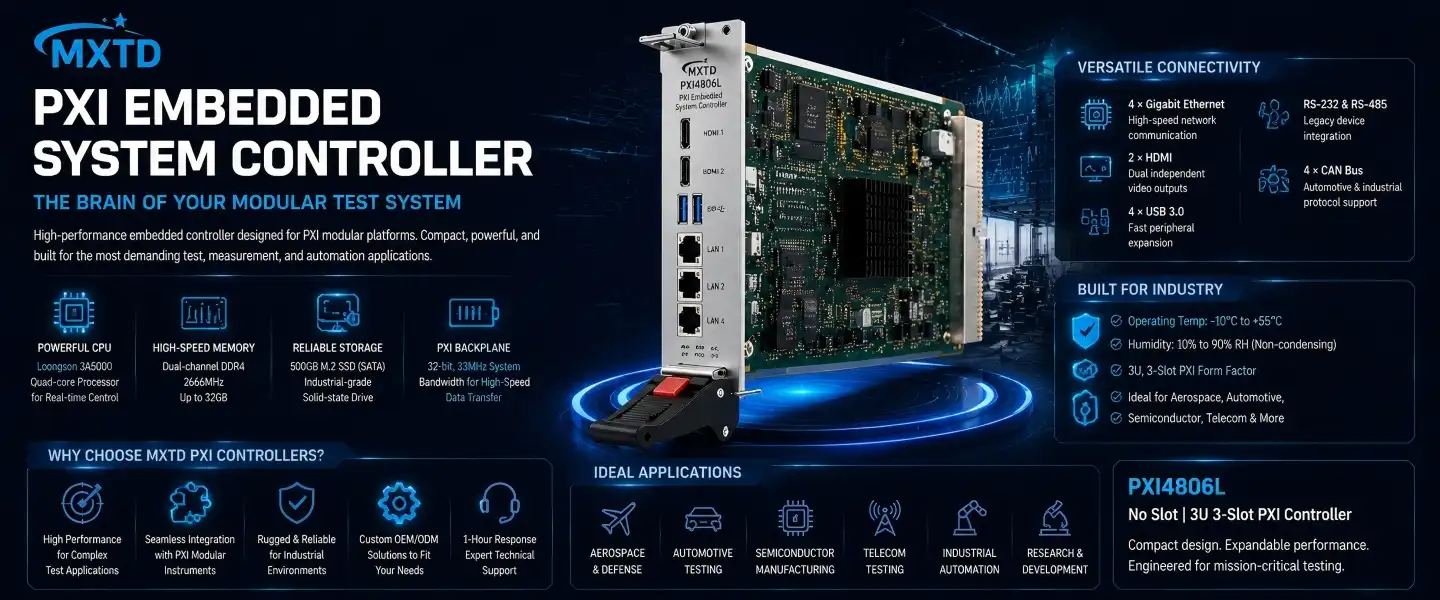
The MXTD PXI4806L PXI Embedded System Controller shows how modern embedded controller technology can solve problems in factory automation. This design has no slots and takes up three PXI chassis spots. It offers full system control features.
CPU Architecture and Processing Power
The Loongson 3A5000 quad-core processor is the heart of the system. It provides reliable computing for real-time control apps. This design gives enough processing power to run multiple tasks at once, like handling the collection of data from multiple units, running measurement algorithms, and sending results to outside systems. The four cores make sure that one working thread can handle tasks that need to be done quickly, while the others take care of background tasks like network connection and logging.
System developers know that the choice of processor has an effect on long-term support and compatibility. The Loongson platform provides stable supply chains that are important for long-term projects in the aircraft and defense industries, where managing obsolescence has a direct effect on running costs. It's helpful for procurement managers to know that the processor they choose affects more than just speed. It also affects ecosystem support, software compatibility, and how well the vendor's plan lines up with the market.
Memory Subsystems and Data Handling
The PXI4806L has a dual-channel DDR4 2666MHz memory design and comes with 8GB of memory by default, which can be expanded to 32GB. This memory subsystem feature tells the processor how much measurement data it can store during high-throughput tests. Continuous RF signal capture or multichannel vibration analysis creates large amounts of data that need to be stored or sent over the network. This data must first live in the system's memory.
When multiple instrumentation units send data through the backplane at the same time, memory speed becomes very important. The dual-channel setup makes the data flow wider by half, which cuts down on bottlenecks that could slow down measurements. Test engineers who are making systems for characterizing semiconductors or platforms for validating telecommunications protocols need this extra bandwidth to make sure that measurements stay accurate when the system is under a lot of stress.
Storage Solutions for Industrial Environments
A 500GB M.2 solid-state drive that uses the SATA protocol is part of the standard setup. This choice of storage hardware is based on the strict needs of industrial test settings, where mechanical hard drives would break down from constant temperature and pressure changes. Solid-state technology makes sure that data is safe and makes test programs, measurement settings, and result files easy to access quickly.
The M.2 interface standard lets you add more storage space in the future if your testing needs change. System developers can add or swap storage space without having to change the architecture of the controller. This modularity is helpful for research centers that need to keep track of large files of characterization data or for factories that need to store test results for quality tracking programs.
PXI Backplane Interface and System Bandwidth
The PXI backplane, a special version of PCI technology made for measurement purposes, lets the controller and instrumentation units talk to each other. The PXI4806L has a system frequency of 32 bits and 33 MHz, which lets digitizers, signal generators, switching matrices, and other flexible instruments share data quickly.
This backplane design is very different from methods for connecting to the outside world. Putting the processor inside the chassis keeps the signal lines short and electrically stable, which lowers delay and raises the accuracy of synchronization. Aerospace test engineers who check aviation systems, like how this combination makes it easier to see how stimulus and measurement tasks relate to each other in terms of timing. Deterministic data transfer helps semiconductor makers test a lot of products at once, since even milliseconds of delay mean lost productivity.
Connectivity Hardware for External Integration
Embedded computers need to be able to talk to external networks and tools as well as the backplane. The PXI4806L has a lot of different ways to link and is designed to be reliable in commercial settings. Here are the features of the interface that make the system more flexible:
System engineers can better plan the integration of a whole test cell when they know about these connectivity choices. Four Gigabit Ethernet ports can be used for network redundancy or parallel links to various LANs. This keeps test data flow separate from administrative network communications. Real-time measurement screens and system control interfaces can be shown at the same time on dual HDMI outputs, which makes setup and troubleshooting easier for operators.
• Gigabit Ethernet: Four Gigabit Ethernet ports can be used for network redundancy or parallel links to various LANs. This keeps test data flow separate from administrative network communications.
• Display Interface: Real-time measurement screens and system control interfaces can be shown at the same time on dual HDMI outputs, which makes setup and troubleshooting easier for operators.
• USB Ports: USB 3.0 ports let you connect external storage, cameras, or other tools that aren't available in PXI form quickly.
• Serial Communication: RS-232 and RS-485 serial connections keep old equipment working with newer equipment common in aerospace and defense sites.
• CAN Interface: The four different CAN channels work directly with testing applications for cars, so you don't need any extra hardware to change between protocols.
Specialized Hardware Features Enhancing PXI Embedded Controllers
These days, test apps need more than just basic computer functions. A PXI Embedded System Controller is getting more and more specialized with features that help with certain measurement problems.
Industrial Operating Environment Capabilities
The PXI4806L can work in temperatures ranging from -10°C to +55°C, so it can be used in production settings that don't have climate control or mobile test facilities. This temperature tolerance comes from carefully choosing the parts and designing the hardware for thermal control. Specifications for humidity allow operation in 10% to 90% relative humidity without condensation, which is good for sites near the coast or in tropical areas.
When defense companies test things in the field, car makers make sure parts work in environmental rooms, and chip factories deal with changes in the temperature of the production floor, these environmental standards have a direct effect on their buying choices. Knowing the limits of the hardware setting stops deployment failures and makes the tools last longer.
Form Factor and Mechanical Integration
The three-slot 3U form factor strikes a good mix between hardware power and chassis room economy. When system designers plan rack setups, they can figure out exactly how many slots for controllers and instruments will fit in the chassis spaces they have available. This standardization makes planning for capacity easier and lets you directly compare what different vendors are offering.
Mechanical design is more than just measuring things. The tools for mounting must be able to handle vibration and shock loads that come up during travel or on mobile test platforms. Connector holding devices keep cables from coming loose while the machine is running. To keep component temperatures within the acceptable range, cooling airflow paths must line up with where the system fans are placed. Long-term dependability is affected by these mechanical factors in ways that procurement managers must look at along with electronic specs.
Customization and OEM Support
MXTD offers OEM/ODM customization services that let you change the way common controllers are set up. This gives you the freedom to meet specific needs that off-the-shelf goods can't. System integrators that are making specialized test tools for aircraft might need more serial ports, different display connectors, or different operating system settings.
Customizing controlling hardware without having to completely rethink it speeds up projects and lowers the cost of development. R&D centers that are working on new measurement methods do better when they work with companies that know what they're doing and have the technical skills to make custom solutions. When comparing controller providers for complicated projects, customization help is what makes the difference.
Applications and Procurement Considerations of PXI Embedded System Controllers
To choose the right PXI Embedded System Controller, you need to know how specs translate to performance in the real world and think about the factors that affect the success of the project when buying.
Application Domains and Performance Requirements
Automated test equipment used in semiconductor production needs a controller with different features than validation systems for aircraft electronics. To support high-volume production testing, semiconductor applications put a high value on maximum flow and stable time. Aerospace applications stress dependability, weather tolerance, and long-term availability to match the decades-long service lives of airplanes.
Testing labs for electronics need controllers that can be set up in a number of different ways to support different types of measurements without having to change any hardware. Research institutions like tools that can be expanded and changed as the goals of the research change. Knowing these changes between applications helps you choose the best controller setups.
Procurement Strategy for Test System Controllers
Technical specs are only one part of the decision-making process when buying hardware for an embedded processor. Lead times affect project plans. Standard goods like the PXI4806L that are in stock allow for quick deployment, but customized versions need production processes that are in sync with shipping needs. MXTD promises to answer customer questions within an hour, which makes it easy to get quick quotes and details on specifications that keep the buying process moving.
Hardware breakdowns that could stop important testing processes are covered by warranties and support terms. The basic guarantee lasts for one year, but you can negotiate for longer coverage in cases where the cost of downtime justifies the extra service investment. Troubleshooting takes less time, and service calls that interrupt testing plans are less common when technical help is provided remotely. This includes video guidance and software updates.
Transportation considerations matter for precision measurement equipment. MXTD offers shock-proof, moisture-proof, and anti-static packaging for both land and air shipping, so controls get to their destination in working order. Paying attention to these logistics details keeps deployments from being held up and lowers the risk of damage claims.
Benchmarking and Compatibility Verification
When an organization already has a PXI system, they often need controls that can work with the instruments they already have. The PXI4806L meets NI product model requirements, enabling integration into systems built around National Instruments modules without compatibility surprises. This interoperability makes upgrades easier and lets you mix controller and module providers based on which ones offer the best value, rather than forcing you to stick with one environment.
By comparing controller performance to application needs, you can avoid both under-specification and over-specification, which can limit measurement capabilities and waste budget. Technical teams should evaluate processor performance against computing demands, memory capacity against data buffering needs, and backplane bandwidth against expected module count and data rates. Getting providers like MXTD involved early in the specification process lets you use their knowledge with applications to get the best options.
Troubleshooting and Maintenance: Hardware Focus
Even well-specified PXI Embedded System Controller hardware needs to be troubleshooted and maintained at some point in order to keep working at its best for as long as it is used.
Common Hardware Issues and Diagnostic Approaches
Overheating is the most common hardware problem in embedded controls. This is usually caused by not enough airflow in the chassis or broken fans. Temperature tracking built in warns workers before temperature-damaged parts. Many thermal problems can be avoided by checking the cooling fans and the airflow paths in the chassis on a regular basis.
When memory fails, the system sometimes crashes or data gets messed up when it's working hard. Running memory monitoring tools during planned maintenance finds parts that are breaking down before they cause problems with operations. The normal 8GB configuration of the PXI4806L gives you extra space for testing apps, but installations that are already at full memory capacity should keep an eye on usage and plan upgrades ahead of time.
Backplane connection issues can happen when controllers are not properly seated or when contacts get corroded in harsh settings. Symptoms include contact problems with sensor modules or modules going missing from the system's list of modules. Most of the time, these problems can be fixed without replacing any parts by reseating the controller in its chassis slot and checking the connecting pins.
Preventive Maintenance and Hardware Upgrades
Scheduled repair makes controllers last longer and keeps them from breaking down during important testing sessions. Cleaning cooling parts every three months gets rid of dust buildup that lowers thermal performance. By updating the operating system's software and hardware, security holes are fixed, and new instrumentation units can be used more easily.
As the needs of an application change, hardware updates offer cost-effective ways to improve speed without having to buy whole new systems. Adding more memory lets test routines get more complicated. Upgrading storage makes room for bigger data stores. By making small changes, these improvements make controllers last longer while keeping their measurement abilities.
The expert support team at MXTD helps customers plan and carry out upgrades, balancing their need for speed with their budget. This partnership method makes sure that test systems stay useful tools and don't become outdated and need to be replaced too soon.
Conclusion
Understanding the hardware design inside a PXI Embedded System Controller helps you make smart purchasing choices that match the system's abilities with what the application needs. The processor, memory, backplane interface, storage, and connection gear all work together to make sure that the system works well in harsh industrial settings. The PXI4806L and other similar products show how current processor designs can combine a lot of features into small packages. The best controller is chosen by looking at environmental specs, customization options, and supplier support skills, along with technical specifications. System service life is extended through proactive maintenance and strategic hardware upgrades. This protects measurement infrastructure investments and adapts to changing testing needs in aerospace, semiconductor, automobile, and telecommunications applications.
FAQ
What distinguishes an embedded controller from a PXI chassis?
For computing intelligence and system management, the PXI Embedded System Controller is responsible. The chassis, on the other hand, offers mounting room, power distribution, and the backplane transmission infrastructure. The backplane is how controllers connect to monitoring units. They do this by taking up chassis spots. Chassis units can't take measurements on their own; they need a controller to make sure that all the modules work together and that data flows smoothly.
Can I program custom applications for embedded controllers?
Embedded controllers support standard operating systems and development environments. The PXI4806L has the Galaxy Kylin V10 operating system, which lets you use popular computer languages and frameworks to make apps. Engineers can make their own test processes, data analysis tools, and user interfaces that run directly on the controller hardware, so they don't need to connect to other computers.
What performance advantages do customized controllers offer?
Customization makes controller hardware work best for specific tasks instead of settling for setups that can be used for many things. Adding specific I/O ports lowers the need for an external adapter. Cost and efficiency needs must be balanced when choosing the right amount of memory and disk space. Environmental hardening increases the temperature ranges within which something can work in harsh circumstances. These customized changes make the system more reliable and faster, and they often cost less to set up than adding external devices that fit standard hardware.
Partner with MXTD for Reliable PXI Embedded System Controller Solutions
For more than 12 years, MXTD has been making test and measurement gear that works well in tough industrial settings. Our PXI Embedded System Controller products come with measurement tools you can trust for mission-critical tests. They do this by using tried-and-true parts and strict quality checks. As a provider of PXI Embedded System Controllers with a lot of experience, we can fully customize our services to meet your needs, whether you need changed I/O configurations, longer environmental standards, or performance tuning that is optimized for your application. Our engineering team answers technical questions within an hour, so your buying process doesn't have to wait. Contact manager03@mxtdinfo.com right away to talk about how our tools can improve the features of your test system while also being reliable and cost-effective.
References
1. National Instruments Corporation. "PXI Hardware Specification and System Architecture Guidelines." Test & Measurement Technical Standards, 2021.
2. Johnson, Mark and Stevens, Robert. "Embedded Computing Systems for Industrial Automation: Design Principles and Implementation Strategies." Industrial Electronics Journal, Vol. 48, 2022.
3. Chen, Wei. "Thermal Management in Compact Embedded Controllers for High-Reliability Applications." IEEE Transactions on Components and Packaging Technologies, 2023.
4. Peterson, James. "Modular Instrumentation Standards: Evolution and Application of PXI Technology in Test Systems." Aerospace Testing International, Annual Review 2022.
5. Anderson, Linda. "Procurement Strategies for Test and Measurement Equipment in Defense and Aerospace Programs." Journal of Defense Acquisition Management, Vol. 15, No. 3, 2023.
6. Williams, Thomas. "Data Acquisition System Design: Hardware Selection and Performance Optimization for Industrial Applications." Sensors and Instrumentation Handbook, Fourth Edition, 2022.
Our customers’ satisfaction speaks for our quality — contact us to experience the same reliable service.