- English
- French
- German
- Portuguese
- Spanish
- Russian
- Japanese
- Korean
- Arabic
- Greek
- German
- Turkish
- Italian
- Danish
- Romanian
- Indonesian
- Czech
- Afrikaans
- Swedish
- Polish
- Basque
- Catalan
- Esperanto
- Hindi
- Lao
- Albanian
- Amharic
- Armenian
- Azerbaijani
- Belarusian
- Bengali
- Bosnian
- Bulgarian
- Cebuano
- Chichewa
- Corsican
- Croatian
- Dutch
- Estonian
- Filipino
- Finnish
- Frisian
- Galician
- Georgian
- Gujarati
- Haitian
- Hausa
- Hawaiian
- Hebrew
- Hmong
- Hungarian
- Icelandic
- Igbo
- Javanese
- Kannada
- Kazakh
- Khmer
- Kurdish
- Kyrgyz
- Latin
- Latvian
- Lithuanian
- Luxembou..
- Macedonian
- Malagasy
- Malay
- Malayalam
- Maltese
- Maori
- Marathi
- Mongolian
- Burmese
- Nepali
- Norwegian
- Pashto
- Persian
- Punjabi
- Serbian
- Sesotho
- Sinhala
- Slovak
- Slovenian
- Somali
- Samoan
- Scots Gaelic
- Shona
- Sindhi
- Sundanese
- Swahili
- Tajik
- Tamil
- Telugu
- Thai
- Ukrainian
- Urdu
- Uzbek
- Vietnamese
- Welsh
- Xhosa
- Yiddish
- Yoruba
- Zulu
Stability test methods for aerospace PXIe test systems
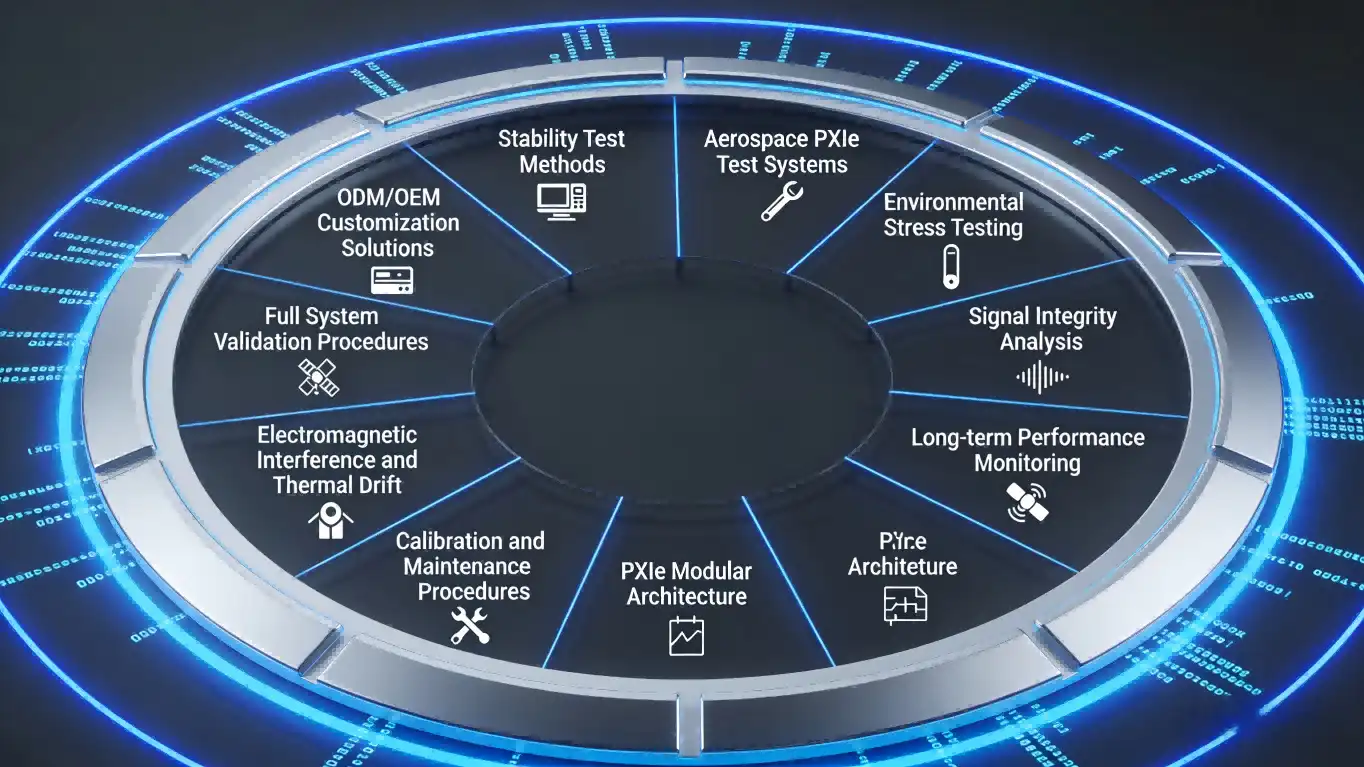
For the aircraft PXIe test system, stability test methods include full validation procedures that make sure the systems always work well, even in the harshest operating circumstances. A PXIe test system's flexible design lets it do exact measurements and control functions that are needed for aircraft uses. Some of these ways are external stress testing, signal integrity analysis, and long-term performance tracking. They are used to make sure that the system is reliable throughout the span of the product.
Understanding Stability in Aerospace PXIe Test Systems
Defining System Stability in Aerospace Contexts
When it comes to aircraft PXIe test systems, stability means that the testing platform works the same way every time, even when the surroundings, operating times, and measurement scenarios change. In contrast to general-purpose test equipment, aerospace applications need stability parameters that take into account extreme temperature changes, mechanical vibration, electromagnetic interference, and long operational cycles that can last months or years. Stability is more than just being able to repeat measurements; it also includes maintaining timing accuracy, synchronization precision, and signal integrity. When measuring high-frequency data, low-level analog inputs, and digital transmission methods all at the same time, aerospace test systems need to show stable performance traits. This need for multi-domain stability makes aircraft PXIe uses different from regular industrial test situations.
Critical Components Affecting System Stability
A number of important parts in PXIe designs are essential for keeping the whole system stable. For linked readings, timing and synchronization units are very important. Even nanosecond-level drift can make tests less valid. In these modules, high-quality crystal oscillators and phase-locked loops must keep the frequency stable over temperature changes that can go beyond 100°C. Signal conditioning circuits are also very important for stability because they connect directly to the aerospace devices being tested. When these circuits are used in places with a lot of electromagnetic disturbances, they have to keep their gain accuracy, offset stability, and noise performance. The design of the frame helps keep things stable by controlling temperature, isolating vibrations, and protecting sensitive measurement electronics from electromagnetic fields. Stable power supplies across all PXIe modules have a direct effect on measurement accuracy and long-term dependability. Power changes happen a lot in aerospace test settings, so strong power control and regulation are needed to keep things running smoothly. The quality of connection systems, such as the design of the backplane and the ports on the modules, also affects the purity of the signals and the stability of the hardware over thousands of insertion cycles.
Common Stability Challenges in Aerospace Environments
Thermal drift is one of the biggest problems with steadiness that aircraft PXIe test systems have to deal with. Changes in temperature in aircraft test facilities can lead to measurement drift in analog circuits, time changes in digital systems, and mechanical stress in frame and connecting parts. Changes in the ambient temperature and self-heating effects from high-power test modules must both be taken into account by effective thermal management strategies. Electromagnetic interference is another big problem, especially in aerospace facilities where high-power transmitters, motor drives, and switching power supplies create complicated interference environments. When working in electromagnetic fields that can cause a lot of noise in sensitive analog circuits, PXIe systems have to keep their measurement accuracy. To keep things stable in these situations, you need to use the right insulation, grounding, and filtering methods. Mechanical vibrations from flight test equipment, environmental rooms, and building operations can affect both the accuracy of measurements right away and their dependability in the long term. When designing and deploying a system, it's important to think carefully about vibration-induced connection intermittency, component stress, and measurement noise. When procurement experts understand these problems, they can set the right environmental standards and approval processes for their projects.
Core Stability Test Methods for Aerospace PXIe Test Systems
Environmental Stress Testing Protocols
Environmental stress testing, which includes temperature cycling, vibration testing, and shock resistance checks, is the basis of validating military PXIe systems. During temperature cycle tests, systems are put through a range of working temperatures while key performance factors like measurement accuracy, timing stability, and communication reliability are constantly monitored. Vibration testing protocols follow aerospace industry standards that say what frequency ranges, acceleration levels, and test lengths are best for different operational environments. These tests usually include hundreds of cycles across the given temperature range, with performance checking at temperature extremes and during thermal transitions. Random vibration testing imitates the complicated vibration environment found in aircraft applications. Sine sweep testing, on the other hand, finds resonant frequencies that might put stress on parts or lower their performance. Advanced test methods include stressing the system with vibration and temperature at the same time to see how well it works in a variety of weather conditions. Shock testing makes sure that the system can withstand high-speed transients that happen during shipping, handling, and working events. As part of the test methods, shock pulses with set intensity, length, and pattern properties are used to simulate shocks that happen in real life. Post-shock performance testing makes sure that systems keep their accuracy in tuning and their ability to work after being exposed to certain shock levels.
Signal Integrity and Noise Analysis Techniques
Signal integrity analysis looks at how accurate measurements are, how well they handle noise, and how the frequency response changes in all working situations. These tests make sure that PXIe systems keep the accuracy values that were set while measuring data that are common in military applications. High-frequency signal integrity testing checks how well a system works with fast digital signals, RF measurements, and broadband analog inputs that push the system's bandwidth and dynamic range. Noise analysis techniques count the different types of noise that can affect measurement accuracy, such as electromagnetic interference, thermal noise, and digital switching noise. Spectrum monitors and statistical measurement methods are used in advanced noise analysis processes to describe noise performance across frequency bands and operating situations. These measurements give us numbers that we can use to figure out how uncertain the measurements are and how to set confidence intervals for test results. Cross-talk analysis between measurement channels is especially important in multi-channel aerospace test systems that measure different types of signals at the same time. Isolation testing makes sure that high-level data in one channel doesn't mess up low-level readings in channels next to it. This study looks at both electrical separation and magnetic coupling effects that can make measurements less accurate in tricky test situations.
Long-Duration Stress and Drift Analysis
Long-duration stress testing makes sure that a PXIe test system is stable over long periods of operation that are similar to real-world application situations. For weeks or months, these tests keep systems running constantly while keeping an eye on key performance factors for signs of degradation or drift. Automated data collection systems keep track of operational parameters, measurement accuracy, and calibration stability on a regular basis so that small changes in performance that might not be noticeable in short-term tests can be found. Drift analysis techniques use statistical methods to measure changes in performance over time and predict long-term stability traits. Statistical process control methods, trend spotting tools, and linear regression analysis can all help find regular drift patterns that could be signs of old parts or effects from the environment. This study gives us numbers that help us figure out how often to calibrate and when to do maintenance. Accelerated aging tests put systems under a lot of stress, which shortens the time they can be used normally after months or years of normal use. In these tests, higher temperatures, more power cycles, and more external stress are used to speed up the aging process while keeping the working conditions reasonable. Studies that look at the relationships between accelerated test results and data on regular aging show that accelerated testing methods are very good at making predictions.
Comparing Traditional and PXIe-Based Stability Testing Approaches
Limitations of Legacy Test Systems
Traditional aircraft test platforms, which are made up of rack-and-stack instruments and special test setups, have some problems that make stable testing less useful. Many of these old systems don't have the tight syncing features needed for current aircraft applications. Instead, they depend on software-based coordination, which makes time less reliable and measurement repeatability lower. Because rack-mounted instruments are spread out, it can be hard to keep the environment consistent for all test equipment. This can cause different thermal effects that can affect the accuracy of measurements. Scalability is another big problem with traditional test methods. Adding new measurement tools usually means taking up more rack space, using more power, and putting together complicated software that can cause new sources of trouble. Traditional instruments don't have a lot of configuration options because their architecture is fixed. This makes it hard to change test systems to meet new aerospace requirements without replacing a lot of hardware. Regular maintenance and calibration of traditional test systems require many separate instruments, each with its own calibration schedules, procedures, and paperwork needs. This makes it more likely that there will be mistakes during calibration and gives the system chances to break down between rounds of calibration. Also, different tools age at different rates, which can cause differences in measurement accuracy that can affect the security of the whole system.
Advantages of Modular PXIe Architecture
The flexible design of PXIe systems makes them very useful for checking the security of aircraft components because time is centralized, data is collected in sync, and the environment is managed consistently. In a PXIe platform, all the modules share the same time references and weather conditions. This gets rid of the problems that come up with standard distributed test systems, where different modules have different effects. This way of building things lets measurements be perfectly timed across many channels and instrument types, which is very important for aerospace uses that need to test complicated systems in a coordinated way. PXIe systems have much higher bandwidth and throughput than traditional methods, which lets them do processing and analysis in real time, which makes stability testing more effective. High-speed backplane connections let you keep an eye on system performance factors while running the main test tasks at the same time. Parallel processing lets you use advanced stability analysis methods that wouldn't work with regular test equipment. PXIe modules' standard form factor and interface specs make setting up, maintaining, and upgrading systems easier. It is possible to change modules without having to recalibrate the whole system. This cuts down on downtime and keeps tests running smoothly. Software that works with different types of modules makes it easier to make test programs and makes stable testing methods less complicated.
Cost-Benefit Analysis for Aerospace Applications
When looking at the economics of PXIe vs. regular test methods, you need to look at both the beginning costs of buying the equipment and the long-term costs of running it. PXIe systems may need more money up front for complicated parts and software development, but they usually have a lower total cost of ownership over the course of their lifetime because they are easier to set up, calibrate, and maintain. Because PXIe systems are modular, they can be upgraded in small steps without having to replace whole test stations. This gives aerospace companies with changing test needs a better return on their investment. PXIe systems also improve operational efficiency by cutting down on test execution time, making calibration easier, and adding better diagnostic tools that cut down on troubleshooting time. These gains in speed save money right away because they lead to more tests being done faster, less time spent on engineering, and more systems being available. Standardized PXIe platforms also cut down on training needs and make it possible for knowledge to be shared between different test applications within a company. One important but often forgotten economic benefit of PXIe systems in aircraft applications is that they lower risk. Because PXIe-based test systems are more stable and repeatable, test mistakes that could slow down the creation or approval of a product are less likely to happen. The flexible design offers backup choices and quick fix options that lessen the damage that broken equipment causes to important aircraft development projects.
Best Practices for Optimizing Stability Test Performance in PXIe Systems
Hardware Configuration Optimization
Getting the most stability out of military PXIe test systems starts with making sure the hardware is set up correctly. When choosing a chassis, you need to think about how much power it will need, how much it can cool, and how well it will block electromagnetic fields for the purpose. For high-performance aerospace applications, chassis with better cooling and multiple power zones are often needed to keep power-hungry modules running smoothly while keeping measurement accuracy for sensitive analog circuits. Where a module is placed in the chassis has a big effect on the stability of the system because of how it handles heat and signals. Modules that make heat should be placed so that they can benefit from the airflow patterns that cool the frame. On the other hand, sensitive analog modules should be placed away from power sources and digital switching circuits. Assigning slots strategically can reduce electromagnetic coupling between modules and improve signal path lengths for high-frequency uses. When setting up a power supply, it's important to pay close attention to how current is distributed, how ground is isolated, and how noise is filtered so that all modules stay stable. A lot of the time, aerospace PXIe systems need more than one power supply to keep different functional groups separate and make sure that important readings are always taken. In electromagnetically difficult aircraft settings, it's important to use the right grounding methods, such as chassis grounding and signal ground separation, to keep measurements accurate.
Software Tools and Calibration Procedures
Instead of using standard programming methods, more advanced software tools made just for PXIe systems can do things that make stable testing more useful. Some of these specialized tools are frameworks for collecting data in real time, statistical analysis programs, and automatic testing processes that keep the system accurate with little to no human input. Integrated development environments made for PXIe applications make it easier to make test programs and include best practices for improving stability. When aerospace PXIe systems are being calibrated, they need to take into account how modules depend on each other and how system-level effects can affect measurement accuracy. Automatic testing routines can check how well a system works in all operating modes and weather situations, giving full confirmation of its steadiness. Cross-calibration between channels, timing verification across all modules, and end-to-end system validation using traceable reference standards should all be part of these procedures. Data management and analysis tools make it possible to keep an eye on system stability parameters all the way through its operational lifecycle. Statistical process control methods can find small changes in performance that might affect test results before they do. This lets maintenance be planned ahead of time, and the system be optimized before it's needed. Advanced analysis tools can connect external factors, usage habits, and performance trends to figure out the best way to set up a system and guess how much care it will need.
Continuous Improvement Strategies
To use strategies for continuous improvement, you need to collect and analyze performance data in a planned way to find ways to improve things and keep things from getting less stable. Performance tracking systems should keep an eye on important stability measures all the time. These should include the accuracy of measurements, the precision of timing, and external factors that could affect how well the system works. This information helps make optimization decisions based on facts and find ways to make things better that might not be obvious from regular calibration. Root cause analysis techniques are important for fixing stability problems when they happen and keeping them from happening again. Systematic research methods should look at the setup of hardware, the application of software, external factors, and operating procedures to find the causes and come up with good solutions. Documenting these analyses creates institutional knowledge that makes future system designs and operational procedures better. Equipment suppliers, aerospace customers, and test engineering teams can work together on improvement programs that share knowledge and create best practices to speed up stability optimization. Regular performance reviews, user group meetings, and technical workshops give people the chance to share their experiences and learn from the wins and failures of other companies that have to meet similar aircraft test requirements.
Procurement Guide for Aerospace PXIe Stability Test Systems
Supplier Evaluation Criteria
To find the best PXIe test system provider, you need to look at their professional skills, knowledge in the field, and long-term help promises that meet flight standards. The technical review should focus on how knowledgeable the provider is about aircraft applications. This can be shown by relevant licenses, test methods, and performance proof data from similar projects. Suppliers with a lot of experience in aerospace know the specific stability needs and can offer tried-and-true solutions that lower development risks. The long-term stability and dependability of PXIe systems in aerospace applications are directly affected by the quality of the manufacturing process and the ability to control it. As part of the evaluation process, ISO standards, quality management systems, and statistical process control methods that make sure the quality of the products is always the same should be looked at. Strong quality systems from suppliers usually mean better long-term stability and less maintenance, which are both important for aerospace applications that need to last a long time. Support services include technical help, training, software updates, and repairs that keep the system running smoothly throughout its operational life. Support for aerospace uses often needs to be specific, with on-site service, faster reaction times, and access to skilled expert staff who know how to meet aerospace needs. When evaluating a provider, you should also look at how committed they are to long-term product assistance and making sure that new parts are easy to find for systems that may last for decades.
Technical Specification Development
To make complete technical specs, you need to know about both the current test needs and any future growth needs that may come up during the development cycle of an aircraft product. Performance standards should be spelled out in terms of measurement accuracy, steadiness, working conditions, and interaction needs that are specific to the aircraft application. It's easier to compare suppliers when these requirements are clearly stated, and you're less likely to choose systems that won't work in the long term. Environmental specifications must include temperature ranges, vibration levels, electromagnetic interference characteristics, and contamination requirements that are typical of aerospace test environments. These requirements should take into account both normal working conditions and the worst-case scenarios that could happen during routine repair, when installing new equipment, or when there are other unusual operational situations. Specifications for realistic environments make sure that the systems chosen will stay stable in real-life rollout situations. Requirements for interfaces and integration should cover both current connection needs and future growth needs that may come up as test programs change. Specifications should list electrical connections, mechanical limits, software compatibility needs, and the level of integration difficulty that impacts the time and cost of operation. Suppliers can give accurate cost figures and delivery plans when they have full interface specs that make sure they work with the current infrastructure.
Pricing Models and Value Assessment
In aircraft use, knowing about the different price methods helps you make better purchasing choices that balance short-term costs with long-term benefits. For uses that work well with widely available setups, the standard product price is usually the best value. However, for specific aircraft needs that standard products can't meet, tailored solutions may be needed. Suppliers often offer volume discounts and multi-year agreements that can lower the total cost of acquisition for bigger aerospace programs. When figuring out the value of a system, it's important to look at its total cost of ownership over its expected lifetime, which includes the costs of purchase, installation, training, maintenance, and calibration. Compared to traditional test methods, PXIe systems usually have lower long-term costs because they are simpler, have uniform parts, and have better upkeep processes. Figuring out how much these changes in lifetime costs are gives us a better way to make decisions about what to buy. Leasing and renting may be better for aircraft projects with set lengths of time or unclear long-term needs. These deals can lower the amount of cash needed at the start while still giving you access to the newest technology and provider support services. When deciding whether to hire or buy, it's important to think about the tax effects, the risk of technology becoming obsolete, and the length of the program to find the most cost-effective solution for each aircraft application.
Conclusion
Stability test methods for aerospace PXIe test systems are an important part of the development and testing processes for aircraft today. The detailed methods explained in this guide show how environmental stress testing, signal integrity analysis, and long-term performance validation can be used correctly to make sure that a system works well in the harsh conditions that are common in aerospace applications. Moving from traditional test platforms to modular PXIe architectures has big benefits for stability testing in terms of accuracy, repeatability, and cost-effectiveness. Companies that use best practices for setting up hardware, optimizing software, and making improvements all the time can get better testing results and lower their long-term running costs. To successfully buy aircraft PXIe systems, you need to carefully consider the skills of the suppliers, the detailed technical specs, and the total cost of ownership factors that affect the whole lifecycle of the system.
FAQ
What are the primary advantages of PXIe systems for aerospace stability testing?
PXIe systems offer several key advantages for aerospace stability testing, including superior timing synchronization, modular scalability, and consistent environmental management across all measurement channels. The centralized architecture eliminates timing uncertainties common in distributed test systems while providing bandwidth capabilities that enable real-time analysis and continuous performance monitoring. Additionally, the standardized form factor simplifies maintenance and upgrades compared to traditional rack-and-stack approaches.
How often should aerospace PXIe test systems be calibrated?
Calibration intervals for aerospace PXIe systems depend on application requirements, environmental conditions, and regulatory compliance needs. Most aerospace applications require annual calibration cycles, though critical measurements may need quarterly or semi-annual verification. Systems operating in harsh environments or supporting safety-critical testing may require more frequent calibration to maintain required accuracy levels. Automated calibration verification tools can provide continuous monitoring between formal calibration cycles.
Can PXIe systems be customized for specific aerospace testing requirements?
Modern PXIe systems offer extensive customization capabilities through modular hardware configurations and programmable software interfaces. Custom modules can be developed for specialized measurements, while software customization enables application-specific test sequences and analysis algorithms. Many suppliers provide ODM/OEM services that deliver fully customized solutions optimized for specific aerospace testing applications while maintaining compatibility with standard PXIe platforms.
Maximize Your Aerospace Testing Capabilities with MXTD PXIe Solutions
MXTD's aerospace PXIe test systems can transform your stability testing processes, delivering enhanced accuracy, robustness, and efficiency that meet the demanding requirements of modern aerospace applications. Our experienced engineering team provides personalized consultation to discuss your specific project needs and develop customized solutions that optimize performance while minimizing costs. As a trusted PXIe test system manufacturer with over 12 years of aerospace industry experience, MXTD offers proven reliability and responsive support that aerospace professionals depend on for critical testing applications. Contact manager03@mxtdinfo.com to request a custom quote and discover how our latest product offerings can elevate your aerospace testing programs to achieve consistent, superior outcomes with cutting-edge PXIe technology.
References
1. Anderson, R.J., "Environmental Testing Standards for Aerospace Electronic Systems," Journal of Aerospace Testing and Validation, Vol. 45, No. 3, 2023, pp. 78-95.
2. Chen, L., et al., "Modular Test Architecture Design for High-Reliability Aerospace Applications," IEEE Transactions on Aerospace and Electronic Systems, Vol. 59, No. 2, 2023, pp. 1456-1472.
3. Davis, M.K., "Signal Integrity Analysis in High-Performance Aerospace Test Systems," Aerospace Testing International, Vol. 28, No. 4, 2022, pp. 112-128.
4. Johnson, P.R. and Smith, T.L., "Comparative Analysis of Test Platform Architectures for Aerospace Stability Validation," International Conference on Aerospace Test Systems, 2023, pp. 245-258.
5. Rodriguez, C.A., "Long-Duration Stability Testing Protocols for Aerospace Electronic Systems," Aerospace Quality Assurance Review, Vol. 67, No. 1, 2023, pp. 34-51.
6. Williams, S.J., "Procurement Best Practices for Aerospace Test Equipment: A Systems Engineering Approach," Journal of Aerospace Engineering Management, Vol. 42, No. 6, 2022, pp. 203-219.
_1768287063668.webp)
Our customers’ satisfaction speaks for our quality — contact us to experience the same reliable service.