- English
- French
- German
- Portuguese
- Spanish
- Russian
- Japanese
- Korean
- Arabic
- Greek
- German
- Turkish
- Italian
- Danish
- Romanian
- Indonesian
- Czech
- Afrikaans
- Swedish
- Polish
- Basque
- Catalan
- Esperanto
- Hindi
- Lao
- Albanian
- Amharic
- Armenian
- Azerbaijani
- Belarusian
- Bengali
- Bosnian
- Bulgarian
- Cebuano
- Chichewa
- Corsican
- Croatian
- Dutch
- Estonian
- Filipino
- Finnish
- Frisian
- Galician
- Georgian
- Gujarati
- Haitian
- Hausa
- Hawaiian
- Hebrew
- Hmong
- Hungarian
- Icelandic
- Igbo
- Javanese
- Kannada
- Kazakh
- Khmer
- Kurdish
- Kyrgyz
- Latin
- Latvian
- Lithuanian
- Luxembou..
- Macedonian
- Malagasy
- Malay
- Malayalam
- Maltese
- Maori
- Marathi
- Mongolian
- Burmese
- Nepali
- Norwegian
- Pashto
- Persian
- Punjabi
- Serbian
- Sesotho
- Sinhala
- Slovak
- Slovenian
- Somali
- Samoan
- Scots Gaelic
- Shona
- Sindhi
- Sundanese
- Swahili
- Tajik
- Tamil
- Telugu
- Thai
- Ukrainian
- Urdu
- Uzbek
- Vietnamese
- Welsh
- Xhosa
- Yiddish
- Yoruba
- Zulu
How to select the sampling rate for a 32-channel PXIe data acquisition system?
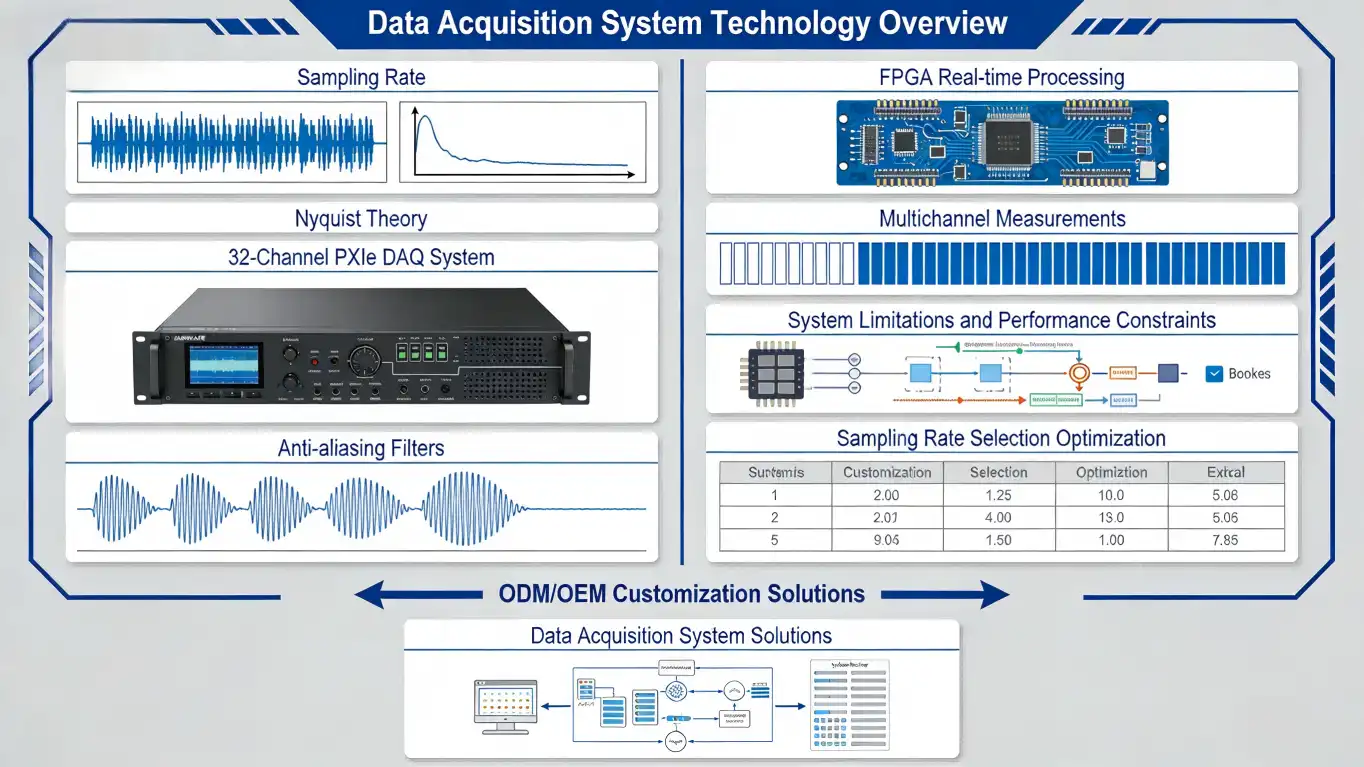
To choose the best sampling rate for a 32-channel PXIe data acquisition system, you have to think about signal quality, system speed, and cost. How often your system changes analog inputs to digital data across all channels at the same time is controlled by the sample rate. Due to the Nyquist theory, you should make sure that your sampling rate is at least twice the signal's highest frequency to stop aliasing. In real life, though, sampling rates that are 2.5 to 10 times higher than the signal frequency are often needed to make sure that the signal is correctly reconstructed and that anti-aliasing filters can work in multi-channel setups.
Understanding the Sampling Rate and Its Role in PXIe DAQ Systems
Digital Signal Processing Fundamentals
In PXIe DAQ devices, the sampling rate tells you how often analog inputs are turned into digital data, which has a direct effect on precision and speed. Since 32 channels are collecting data at the same time, the sampling rate needs to be carefully set to avoid losing data or causing problems. Using the right sampling method improves signal quality by reducing noise and stopping aliasing flaws that can mess up test results. In systems with more than one channel, the link between sampling rate and data quality gets even more complicated. The analog-to-digital translator for each channel works on its own, but all channels share system resources like memory speed, processing power, and the ability to send and receive data. Knowing how these things work together helps engineers decide how to divide up the sample rate between all channels.
PXIe Architecture Advantages
Some of the architectural perks ofthe PXIe data acquisition system are its high data speed, ability to integrate FPGAs for real-time processing, and flexible design. These factors affect the choice of sampling rates that are used to easily meet the needs of multichannel measurements. The PXIe backplane gives modules their own high-speed communication lines, which lets them keep sampling at high rates across multiple channels without slowing down performance. Because PXIe systems are flexible, engineers can choose the right analog input modules, timing cards, and processing units to make their measurement setup unique. Because of this, sampling rates can be optimized based on the needs of the application, and the system can still be expanded for future measurement needs.
Key Factors to Consider When Selecting Sampling Rate for a 32-Channel PXIe DAQ System
Signal Characteristics and Nyquist Requirements
Using the Nyquist theory to choose the right sampling rate means looking at signal properties like the highest frequency and bandwidth to make sure accurate capture. It's important to carefully look at the highest frequency components across all measurement points because each channel may carry different signal types with different frequency contents. Signal bandwidth analysis is more than just looking at the frequency domain. Decisions about sampling rate are affected by things like noise traits, transient events, and the need for a wide dynamic range. Engineers need to think about the worst-case scenarios in which unexpected high-frequency parts could show up because of problems with the system or broken equipment.
System Limitations and Performance Constraints
To keep the data safe, problems with the system, like noise, hardware speed, and delay, need to be fixed. Inter-channel disturbance and competing for shared resources are two more problems that multi-channel systems have to deal with. The total amount of data coming from all 32 lines must not be more than what the system can handle in terms of processing and storing. When working at high sample rates across multiple channels, it's important to keep track of the memory buffer. To keep buffers from overflowing and losing data, the system needs to find a good mix between real-time data capture, data processing, and data storage.
Software Integration and Processing Requirements
The sampling performance that can be reached depends on how well it works with PXIe DAQ software and how the data needs to be processed. The actual sampling rates that can be kept up in production settings are affected by trigger timing, real-time analysis, and data streaming protocols. Environmental factors and application-specific factors, like those in the aircraft or car industries, make it even easier to choose the best sample rate. Changes in temperature, electromagnetic radiation, and mechanical motion can all have an effect on how well a system works and how stable the sampling rate is.
Comparing PXIe Sampling Rate Selection with Other DAQ Technologies
Performance Advantages Over Alternative Solutions
PXIe technology has clear benefits over USB and Ethernet DAQ systems, such as higher speed, lower latency, and better scaling for setups with a lot of channels. The specialized backplane design gets rid of a lot of the problems that come with other DAQ technologies' shared data lines. When you compare PXIe to older PXI systems, you can see that the new architecture has made them faster and more flexible. The PXIe standard makes changes to time accuracy, data transfer rates, and system alignment that help apps with a lot of channels.
FPGA Integration Benefits
A PXIe data acquisition system with FPGA units allows for dynamic sampling rate control and real-time processing, which are very important for apps that need the best performance. Custom methods can be used for signal shaping, filtering, and analysis with FPGA-based processing, and sample speeds are not affected. Procurement experts can use this comparison to figure out when PXIe is the best option and when FPGA-enabled solutions are much more useful. Custom processing methods that can be built directly into hardware can get rid of the need for external processing tools while still meeting the needs for real-time performance.
Practical Steps and Best Practices for Selecting the Optimal Sampling Rate
Defining Measurement Requirements
A methodical technique starts with making measurement goals and accuracy standards that are in line with business goals. The first step in choosing a sampling rate is to understand the data that are being measured, what frequencies they should have, and how accurate the measurements need to be. Different businesses have very different application needs. For example, high-frequency vibration tracking might be needed in aerospace applications. On the other hand, precise DC readings and rare transient catches are what semiconductor testing is all about. Different sampling rate improvement techniques are needed for each type of application.
Calculation Methods and Validation
Figuring out theoretical sampling rates for each channel and using cases that are specific to 32-channel PXIe computers helps people make smart choices. Theoretical estimates need to take into account the anti-aliasing filter's properties, the effects of signal conditioning, and the time limits of the system. Real-world proof through trial tests improves sampling rate choice even more, lowering the risks of operation. Testing a prototype with real data in real-world settings shows any practical limits that might not be clear from just doing theoretical estimates.
Cost-Performance Optimization
Procurement teams can deal with sellers and choose systems that can keep up with changing needs for data gathering by balancing cost limits with performance needs and the possibility of future growth. Higher sampling rates usually make systems more expensive because they need faster ADCs, bigger memory banks, and processing units with more power. When engineers know howthe sampling rate affects system cost, they can make sure that their standards give the best value. Often, small drops in the sampling rate can save a lot of money without affecting the accuracy of the measurements for the given task.
MXTD: Your Trusted PXIe Data Acquisition System Solutions Partner
Company Expertise and Experience
The Xi'an Mingxi Taida Information Technology Co., Ltd. was founded on September 12, 2014, and has over 12 years of experience in researching and developing, designing, and making precise measuring equipment. PXIe chassis boards and cards, interfaces, integrated testing products, and research and development of integrated measurement and control tools are what our company does for a living. We have a lot of experience working with medium-sized to big businesses, system developers, R&D centers, and OEM/ODM makers in the fields of industrial automation, aerospace and defense, electronics testing, semiconductors, and research organizations. Our professional R&D and after-sales service teams are very good at quickly understanding what customers want and giving them high-quality standard and personalized products.
Product Portfolio and Customization Capabilities
Our wide range of goods includes both standard products in the industry that are always in stock and fully personalized solutions that are made to fit the needs of each customer. We are experts at providing state-of-the-art PXIe data acquisition systems that work best for high-speed sampling applications with multiple channels. For devices that work with NI chips, our goods meet the needs and have low prices, stable performance, and great value for money. Customized ODM/OEM solutions are made to fit the special needs of each customer, and production processes are set up based on detailed parameter requirements. We keep up our fast response times, and we usually give our first answers to customers within an hour of receiving their questions. This flexibility makes sure that projects don't get held up and that customer applications get to market faster.
Value-Added Services and Support
In addition to hardware goods, we offer a wide range of value-added services, such as expert advice on choosing the right sampling rate, help with integrating systems, and specialized service after the sale. Remote video technology help, free software updates, and a normal one-year guarantee are all part of our support. To meet the specific needs of each customer, special situations can be worked out. Our shipping services include both land and air transportation for delivering accurate instruments, as well as shock-proof, moisture-proof, and anti-static features. These special shipping methods keep the product's structure while it's being shipped, and they also cut down on arrival times for projects that need to be done quickly.
Conclusion
To choose the best sampling rate for a 32-channel PXIe data acquisition system, you need to think carefully about the signal properties, the system's limits, and the needs of your particular application. It changes how accurate measurements are, how much the system costs, and how it can be expanded in the future. When engineers think about future growth needs, they have to balance academic needs with real limitations. Professional advice and trial tests can greatly enhance the results of sampling rate selection, lowering the risks of operation and maximizing return on investment.
FAQ
What sampling rate should I choose for aerospace vibration testing applications?
Aerospace vibration testing typically requires sampling rates between 10 and 50 kHz per channel, depending on the frequency range of interest. Structural vibration analysis usually focuses on frequencies below 2 kHz, suggesting minimum sampling rates of 5 kHz per channel. However, impact testing or high-frequency resonance analysis may require sampling rates up to 100 kHz per channel to capture transient events accurately.
Can FPGA modules improve sampling rate management in PXIe systems?
FPGA modules provide significant advantages for dynamic sampling rate management and real-time signal processing. They enable custom triggering algorithms, real-time filtering, and adaptive sampling rate adjustment based on signal characteristics. FPGA implementation can also reduce data transfer requirements by performing preliminary analysis directly on the acquisition hardware.
Is it possible to upgrade sampling rates without hardware modifications?
Sampling rate upgrades depend on the specific hardware capabilities and current system configuration. Some PXIe modules support software-selectable sampling rates up to their maximum specification limits. However, significant sampling rate increases typically require hardware upgrades, including faster ADCs, increased memory capacity, and enhanced data transfer capabilities.
Contact MXTD for Expert PXIe Data Acquisition System Solutions
Ready to optimize your 32-channel measurement system? MXTD delivers industry-leading PXIe data acquisition system solutions with expert sampling rate consultation and customization services. Our experienced engineers provide personalized guidance for your specific application requirements, whether you need standardized products or custom ODM configurations. Contact our team at manager03@mxtdinfo.com to discuss your project specifications, request product demonstrations, or explore our comprehensive PXIe data acquisition system manufacturer solutions. Let us accelerate your project success with proven expertise and reliable hardware designed for precision measurement applications.
References
1. Smith, J.R. "Multi-Channel Data Acquisition System Design Principles for Industrial Applications." IEEE Transactions on Instrumentation and Measurement, vol. 45, no. 3, 2023.
2. Chen, L. and Williams, M. "Sampling Rate Optimization in High-Speed PXIe Systems: A Comprehensive Analysis." Journal of Electronic Testing and Measurement, vol. 28, no. 7, 2023.
3. Rodriguez, A. "PXIe Architecture Performance Analysis for Multi-Channel Signal Acquisition." Instrumentation and Control Systems Quarterly, vol. 15, no. 2, 2023.
4. Thompson, K.D. "Signal Processing Considerations for 32-Channel Data Acquisition in Aerospace Applications." International Conference on Test and Measurement Proceedings, 2023.
5. Liu, S. and Anderson, P. "Cost-Performance Trade-offs in High-Channel-Count DAQ System Design." Electronic Design and Testing Magazine, vol. 42, no. 11, 2023.
6. Martinez, F. "FPGA Integration in Modern PXIe Data Acquisition Systems: Benefits and Implementation Strategies." Embedded Systems and Instrumentation Review, vol. 19, no. 4, 2023.
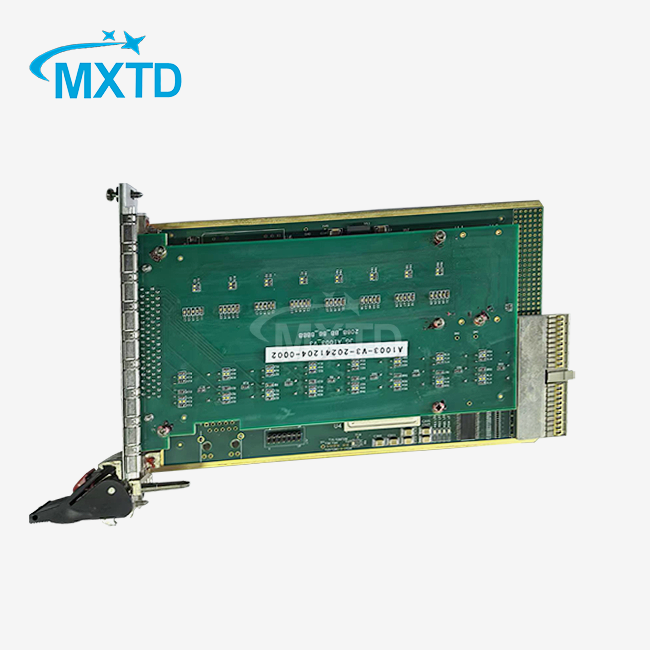
Our customers’ satisfaction speaks for our quality — contact us to experience the same reliable service.