- English
- French
- German
- Portuguese
- Spanish
- Russian
- Japanese
- Korean
- Arabic
- Greek
- German
- Turkish
- Italian
- Danish
- Romanian
- Indonesian
- Czech
- Afrikaans
- Swedish
- Polish
- Basque
- Catalan
- Esperanto
- Hindi
- Lao
- Albanian
- Amharic
- Armenian
- Azerbaijani
- Belarusian
- Bengali
- Bosnian
- Bulgarian
- Cebuano
- Chichewa
- Corsican
- Croatian
- Dutch
- Estonian
- Filipino
- Finnish
- Frisian
- Galician
- Georgian
- Gujarati
- Haitian
- Hausa
- Hawaiian
- Hebrew
- Hmong
- Hungarian
- Icelandic
- Igbo
- Javanese
- Kannada
- Kazakh
- Khmer
- Kurdish
- Kyrgyz
- Latin
- Latvian
- Lithuanian
- Luxembou..
- Macedonian
- Malagasy
- Malay
- Malayalam
- Maltese
- Maori
- Marathi
- Mongolian
- Burmese
- Nepali
- Norwegian
- Pashto
- Persian
- Punjabi
- Serbian
- Sesotho
- Sinhala
- Slovak
- Slovenian
- Somali
- Samoan
- Scots Gaelic
- Shona
- Sindhi
- Sundanese
- Swahili
- Tajik
- Tamil
- Telugu
- Thai
- Ukrainian
- Urdu
- Uzbek
- Vietnamese
- Welsh
- Xhosa
- Yiddish
- Yoruba
- Zulu
NI PXIe-4309 High Dynamic Configuration Analysis from 18-bit to 28-bit
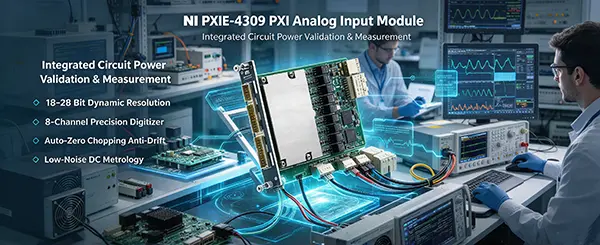
In metrology-grade voltage calibration, high-energy physics particle diagnostics, and microscopic electrochemical analysis, an expansive dynamic range coupled with an ultra-low noise floor defines the baseline of measurement validity. The NI PXIe-4309 18-28 Bit PXI Analog Input Module is an 8-channel, high-precision digitizer featuring fully autonomous analog front-ends per channel. The paramount technical highlight of this module lies in its innovative flexible analog-to-digital conversion (ADC) architecture, empowering engineers to programmatically adjust the digitization quantization resolution across a broad envelope—spanning from 18-bit (high-rate dynamic capture) to 28-bit (extreme-precision static DC metrology) via the software layer (NI-DAQmx). Delivers an in-depth technical decryption of the underlying hardware mechanics enabling the NI PXIe-4309's 28-bit extreme resolution, its auto-zero capacitive chopping anti-drift schema, and the performance trade-offs across separate bit configurations, serving as an authoritative deployment reference for constructing nanovolt-level low-noise instrumentation platforms.
Mastering High-Fidelity Signal Synthesis & Hardened Telemetry Infrastructure: The MXTD Engineering Paradigm
De-risk your mission-critical system initialization timelines by engaging our international technical applications desk at manager03@mxtdinfo.com / manager02@mxtdinfo.com for validated architectural schematics, bespoke OEM co-development framework proposals, or complete physical-layer data-compliance audits.
Strategic Mandate & Core Technology Competencies
In boundary-pushing aerospace analytics, continuous destructive fatigue testing, and ultra-stabilized sub-kelvin quantum mechanics setups, unverified data feeds present severe operational liabilities. For more than 12 years, Xi'an Mingxi Taida Information Technology Co., Ltd. (MXTD) has functioned as an elite integration ally, provisioning ultra-low-noise data acquisition (DAQ) architectures and hardened edge-computing topologies. Operating as a comprehensive technology ecosystem, we excel at isolating, capturing, and processing highly transient, multi-domain physical phenomena—ranging from hyper-g kinetic mechanical shocks to sub-microstrain crystalline deflections—and translating them into uncompromised, real-time digital intelligence.
Constructed on the unyielding principles of absolute galvanic channel isolation and advanced thermodynamic mechanics, MXTD has migrated from an exclusive sensor development laboratory into a premier international authority for complex industrial measurement. Our unified corporate framework coordinates proprietary micro-circuitry R&D, certified high-yield electronic fabrication plants, and a friction-free international distribution network. Across more than a decade of continuous product iteration, our cross-functional engineering teams have systematically overcome legacy barriers in multi-channel bandwidth constraints, environmental noise infiltration, and baseline thermal drift—seamlessly linking harsh physical dynamics with high-level analytical software.
The Noise Rejection Barriers Facing Nanovolt-Level Measurement
When environmental measurement waveforms compress into microvolt (μV) or nanovolt (nV) domains, active signals become fully submerged beneath thermodynamic thermal noise, the inherent 1/f flicker noise of semiconductor junctions, and spatial power-line electromagnetic interference. Legacy 16-bit or 18-bit data acquisition modules possess a Least Significant Bit (LSB) voltage resolution too coarse to isolate such minute physical potential shifts from background fuzz.
To demolish these mechanical and electrical noise boundaries, National Instruments (NI) developed the NI PXIe-4309 18-28 Bit PXI Analog Input Module, engineered explicitly for extreme precision instrumentation. It acts not merely as a high-gain amplifier but reconfigures Delta-Sigma modulators and digital decimation filters at the hardware layer to grant the network a "digital microscope" capability, shifting seamlessly from 18-bit dynamics up to an extreme 28-bit resolution where the resolvable voltage step hits nanovolt thresholds.
Underlying Hardware Mechanics of NI PXIe-4309 High-Dynamic Resolution
[ Analog Input ] ───> [ Auto-Zero Chopping Front-End ] │ ▼ [ 28-Bit Decimation Filter ] <─── [ High-speed low-order Delta-Sigma modulator ] (Based on the DAQmx sampling rate setting, bit depth is obtained by software oversampling and superposition.)
Hardware-Level Oversampling and Digital Decimation Noise Reduction
The internal architecture of the NI PXIe-4309 embeds a high-speed Delta-Sigma modulator matrix. In 18-bit mode, the module streams dynamic raw waveforms at its peak capacity of 2 MS/s/ch. However, when systems engineers programmatically lower the sampling rate configuration (e.g., down to 2 S/s), the local onboard FPGA fabric initializes extreme hardware-level oversampling and digital decimation filtering. It mathematically aggregates hundreds of thousands of high-frequency raw points through optimized digital low-pass networks. Governed by the statistical laws of white noise, every 4x reduction in sample throughput steps up the Signal-to-Noise Ratio (SNR) by 6 dB, increasing the effective quantization resolution by 1 bit. Via this extreme hardware-level time-averaging data fusion, a pristine, ultra-precise 28-bit static DC dataset is extracted at lower tracking sample rates.
Auto-Zero Capacitive Chopping Anti-Drift Scheme
At a 28-bit extreme voltage resolution ceiling, minor semiconductor thermal variances and parasitic thermoelectric potentials introduce severe zero-point baseline wandering. To anchor the absolute zero reference, the NI PXIe-4309 incorporates advanced Auto-Zero capacitive chopping technology. Internal high-frequency solid-state gates alternately toggle the input amplifier grids between the authentic field transducer and an internal referenced ground plane. Within microsecond-scale chopping cycles, the hardware automatically samples the native offset errors of the internal loop, subtracting them directly at the analog front-end. This completely eradicates \(1/f\) flicker noise and long-term thermal drift, ensuring an unyielding nanovolt baseline over extended test metrics.
Configuration Resolution and Performance Trade-Off Matrix From 18-Bit to 28-Bit
During the system instrumentation profiling phase, systems engineers must rigidly balance the sampling rate against the target quantization bit depth based on the characteristics of the DUT (static precision metrology vs. high-frequency dynamic capturing):
|
Quantization Resolution |
Max Stable Sample Rate |
RMS Noise @ ±10V Range |
Target Engineering Scenario |
|
18-Bit High-speed High Dynamic Range Capture |
2 MS/s/ch |
\(\approx 250\,\mu\text{V}_{\text{rms}}\) |
Radar transient pulse, detonation waveform, and dynamic high-speed pressure shock capture |
|
Balanced Medium Speed Monitoring |
100 kS/s/ch |
\(\approx 45\,\mu\text{V}_{\text{rms}}\) |
Multi-axis mechanical structure fatigue load testing and high-sensitivity dynamic structure transient monitoring |
|
Laboratory-level Precision Measurement and Control |
10 S/s/ch |
\(\approx 1.2\,\mu\text{V}_{\text{rms}}\) |
Precision battery charge-discharge cycle testing, semiconductor device temperature leakage current characterization |
|
28-Bit Extreme Metrology-grade DC Precision Measurement |
2 S/s/ch |
\(\approx 0.08\,\mu\text{V}_{\text{rms}}\) (80 nV) |
Nanovolt-level calibration, national standard voltage source calibration, superconducting cryogenic phase transition monitoring |
Software Configuration and Data-Link Streaming Regimes
To successfully unlock the 28-bit resolution of the PXIe-4309 while eliminating software-layer data bit truncation, the following low-level engineering protocols must be implemented within the NI-DAQmx API configuration:
Enforcing Data Type Promotion to Double-Precision (DBL): Legacy 16-bit DAQ routines regularly map array arrays to single-precision float structures. For 28-bit telemetry, however, the effective quantization bit depth tracks dangerously close to the single-precision physical bit-width barrier. When invoking the DAQmx Read sub-routine, the developer must explicitly promote the output matrix syntax to a 64-bit Double-Precision Floating-Point (DBL) configuration, or capture raw binary streams inside signed 64-bit integer (I64) buffers, preventing software-layer numeric rounding from degrading signal fidelity.
Programmatic Invocation of the Auto-Zero Variable: Inside the virtual channel attribute node, explicitly toggle the AI.AutoZeroMode property to Every Sample, compelling the low-level hardware silicon to drive the capacitive balance auto-nulling loops during runtime polling.
By smashing the physical limitations of traditional fixed-resolution architectures, the NI PXIe-4309 18-28 Bit PXI Analog Input Module secures its position as the industry benchmark for ultra-high-precision instrumentation via a dual-paradigm framework balancing 18-bit rapid digitization and 28-bit extreme oversampled decimation filtering. Synthesized within the high-determinism PXIe-1088 chassis matrix, this framework not only systematically neutralizes zero-point baseline wandering anomalies triggered by thermal gradients at the physical source but establishes an absolute fidelity, high-confidence enterprise-grade data nucleus at the nanovolt-level measurement frontier.
References
National Instruments. (2025). NI PXIe-4309 High-Resolution Analog Input Module Specifications Manual. Austin, TX: National Instruments.
National Instruments. (2026). Oversampling and Noise-Floor Optimization Methodologies in Delta-Sigma Data Acquisition Architectures. White Paper ID: DAQ-4309-88.
FAQs:
Q1: When configuring the PXIe-4309 to 28-bit (or very low sampling rate) for high-precision DC measurements in the software, why am I still able to measure periodic microvolt-level glitches?
A1: This measurement noise typically stems from an entry-level integration error known as secondary environmental noise injection driven by unshielded cable wiring layouts, parasitic power-line inductive coupling, or un-isolated Seebeck thermoelectric potentials. While the 28-bit digital decimation filter inside the PXIe-4309 excels at removing high-frequency Gaussian white noise, if your external connection trace omits high-density braided copper Shielded Twisted Pairs (STP), or routes too close to AC utility conductors (e.g., 220V runs), large 50Hz/60Hz electromagnetic coupling leaks directly into the input. Furthermore, at nanovolt thresholds, even the minimal Seebeck Effect thermoelectric potentials generated by mating two dissimilar metals across screw terminals injects multiple microvolts of static DC offset drift under minor thermal gradients. Mitigating this layout pain point requires:
- Shorten cable runs and separate them from active radiation sources;
- Utilize low-thermoelectric-potential pure copper gold-plated lugs, encapsulating the breakout strip inside a sealed thermal insulation shroud to block localized air convection.
Q2: Does this module support simultaneous configuration of 8 channels for 28-bit independent acquisition? Will sharing the same ADC between channels cause sampling throughput delay?
A2: Yes, it supports full, autonomous 28-bit parallel acquisition across all 8 channels simultaneously, utilizing an independent ADC-per-channel architecture with zero switching latency. Budget-grade multiplexed multi-channel cards share a singular ADC engine via a switching matrix, commanding tracking delay gaps to settle inter-channel cross-talk. Conversely, the NI PXIe-4309 implements an advanced ADC-per-channel architecture. Each of its 8 inputs houses an entirely independent conditioning, chopping, and converting hardware engine. Consequently, all 8 channels compute 28-bit quantization metrics strictly in parallel under deterministic synchronization, maintaining absolute electrical isolation margins completely immune to channel switching crosstalk or inter-modulation decay.
Q3: Why does the system report a packet loss error and display a "bus overflow overload" message after a few minutes when my program runs at the highest speed of 2 MS/s (18-bit mode)?
A3: This performance breakdown maps back to a standard data link layer software polling velocity mismatch anomaly. When all 8 channels run full-capacity execution schedules at their maximum 2 MS/s frequency, because each data frame encapsulates channel metadata, the aggregated telemetry tsunami exceeds 32 megabytes per second. If your primary LabVIEW executable synchronizes time-heavy hard-drive disk writing operations (such as saving straight to a TDMS track) or computes complex non-linear floating-point array matrices within that exact same high-priority polling loop, the host CPU processing margins saturate instantly, driving the memory buffer cache into rapid overflow saturation. The mandatory correction workflow requires deploying an asynchronous Producer-Consumer architecture at the software abstraction layer. Isolate the DAQmx Read task into a dedicated top-priority single loop tasked exclusively with extracting metrics via DMA and pushing them into a lock-free real-time circular FIFO queue (the Producer); offload the time-heavy file logging and mathematical analysis loops to parallel independent CPU cores running at a lower priority (the Consumer), utilizing extensive physical RAM depth to smooth out physical disk write latencies.
Our customers’ satisfaction speaks for our quality — contact us to experience the same reliable service.