- English
- French
- German
- Portuguese
- Spanish
- Russian
- Japanese
- Korean
- Arabic
- Greek
- German
- Turkish
- Italian
- Danish
- Romanian
- Indonesian
- Czech
- Afrikaans
- Swedish
- Polish
- Basque
- Catalan
- Esperanto
- Hindi
- Lao
- Albanian
- Amharic
- Armenian
- Azerbaijani
- Belarusian
- Bengali
- Bosnian
- Bulgarian
- Cebuano
- Chichewa
- Corsican
- Croatian
- Dutch
- Estonian
- Filipino
- Finnish
- Frisian
- Galician
- Georgian
- Gujarati
- Haitian
- Hausa
- Hawaiian
- Hebrew
- Hmong
- Hungarian
- Icelandic
- Igbo
- Javanese
- Kannada
- Kazakh
- Khmer
- Kurdish
- Kyrgyz
- Latin
- Latvian
- Lithuanian
- Luxembou..
- Macedonian
- Malagasy
- Malay
- Malayalam
- Maltese
- Maori
- Marathi
- Mongolian
- Burmese
- Nepali
- Norwegian
- Pashto
- Persian
- Punjabi
- Serbian
- Sesotho
- Sinhala
- Slovak
- Slovenian
- Somali
- Samoan
- Scots Gaelic
- Shona
- Sindhi
- Sundanese
- Swahili
- Tajik
- Tamil
- Telugu
- Thai
- Ukrainian
- Urdu
- Uzbek
- Vietnamese
- Welsh
- Xhosa
- Yiddish
- Yoruba
- Zulu
NI PXIe-4309 18-28 Bit PXI Analog Input Module
2. 32 differential analog input channels
3. Maximum sampling rate of 2 MS/s/ch
4. 18-bit ADC native resolution, 28-bit equivalent measurement resolution
5. 4-range programmable measurement
The NI PXIe-4309 is the highest-end high-precision PXI analog input module in the NI SC Express series, it achieves nanovolt-level low-level precision measurement capabilities.
The NI PXIe-4309 18-28 Bit PXI Analog Input Module's differentiating advantage lies in its flexible resolution architecture—through onboard signal averaging technology, the module dynamically balances sampling rate and effective resolution: high-speed mode (2 MS/s/ch) provides 18-bit resolution for dynamic signal capture, while low-speed mode (2 S/s/ch) achieves 28-bit equivalent resolution for precise DC measurements. Combined with chopper mode, its absolute accuracy within a ±0.1V range reaches sub-μV levels, comparable to a 7.5-digit digital multimeter, while maintaining the modularity and multi-channel expansion advantages of the PXI platform.
The NI PXIe-4309 18-28 Bit PXI Analog Input Module product number is currently 784471-01, with a delivery cycle of approximately 8-9 weeks. The module is fully driven by NI-DAQmx (supported since version 17.1), compatible with mainstream development environments such as LabVIEW, Python, C/C++, and C#/.NET, and can run on Windows and Linux operating systems.
The NI PXIe-4309 is a flexible resolution PXI Express analog input module, belonging to the NI SC Express (Signal Conditioning Express) product line. As one of the flagship models in NI's high-precision DAQ portfolio, it combines high channel density, high sampling rate, and nanovolt-level measurement accuracy, designed specifically for applications requiring simultaneous capture of dynamic signals and accurate measurement of low-level DC signals.
This module employs an architecture with eight synchronously sampling 18-bit SAR ADCs. Each ADC can scan up to four independent input channels via a multiplexer, supporting a total of 32 differential analog input channels. This architecture allows the module to achieve high-speed synchronous sampling of 2 MS/s/ch (8 channels simultaneously) in single-channel mode, and to provide high-density measurement capabilities of up to 32 channels in multi-channel mode (4 channels per ADC, aggregated at 400 kS/s).
MXTD Supplier / Wholesaler
Global Expertise in High-End Technology Solutions
Xi'an Mingxi Taida Information Technology Co., Ltd ( MXTD). brings over 12 years of proven industry excellence as a premier, full-service technology corporation. We seamlessly integrate cutting-edge R&D, advanced manufacturing, global sales, and dedicated technical support to empower clients worldwide. Today, our footprint spans major markets across North America, South America, Europe, and Africa. In addition to our proprietary innovations, we offer authorized distribution services for world-leading international brands to satisfy your diverse operational needs. Through rigorous, multi-tiered quality control protocols, we ensure that every system we deliver operates with absolute reliability, giving our global partners the confidence to excel.
Description
The NI PXIe-4309 18-28 Bit PXI Analog Input Module belongs to the NI SC Express series of PXI analog input modules. The SC Express series is NI's PXI module product line designed for highly integrated signal conditioning and data acquisition applications, covering a variety of models from isolated voltage measurement and low-level signal conditioning to high-precision power measurement. This series of products are all driven by the NI-DAQmx driver, sharing the PXI backplane clock and trigger signals, and supporting multi-device synchronous tasks.
Within NI's overall PXI analog input module portfolio, the PXIe-4309 is positioned in the niche market of high precision, medium-to-high speed, and high channel density. It complements the PXIe-4300/4310 series, which focuses on high-voltage isolation; the PXIe-4302/4303/4304/4305 series, which focuses on medium-speed 24-bit bridging/voltage measurement; and the PXIe-4481 (DSA) module, which focuses on high-speed dynamic signals, together forming NI's complete PXI analog input product matrix.
The core value of the NI PXIe-4309 18-28 Bit PXI Analog Input Module lies in its ability to achieve both precision multimeter and high-speed DAQ functionality in a single module. Traditional low-power verification solutions typically require both a high-precision digital multimeter (DMM) and a high-speed data acquisition card. The former is used to accurately measure minute currents in low-power modes, while the latter captures dynamic power consumption changes. The PXIe-4309, through its flexible resolution architecture and onboard signal processing, simultaneously meets both requirements within a single PXI slot, significantly simplifying the system architecture and reducing costs.
Key Features of The NI PXIe-4309 18-28 Bit PXI Analog Input Module
| Item | Features | Illustrate |
| Channel architecture | 8 synchronous sampling ADCs, | Each ADC has an independent signal conditioning path, enabling truly synchronous sampling |
| 32 differential analog input channels | Each ADC can have up to 4 channels, expanded through multiplexing | |
| Sampling performance | Maximum sampling rate of 2 MS/s/ch | Single-channel per ADC mode, 8 channels simultaneously |
| Variable sampling rate configuration | Supports 18-bit to 28-bit equivalent resolution | |
| Measurement accuracy | 18-bit ADC native resolution | SAR-type ADC, no code loss |
| 28-bit equivalent measurement resolution | Achieve low speed through onboard averaging technology | |
| Auto Zero | Eliminates offset error and supports single-shot/per-sample mode | |
| Chopping | 16 pairs of channels enable nanovolt-level measurements | |
| Input range | 4-range programmable measurement | ±0.1 V, ±1 V, ±10 V, ±15 V |
| DC coupling | Supports DC voltage measurement | |
| ±30 V overvoltage protection | Channel protection to prevent damage from incorrect connection | |
| Signal processing | Onboard signal averaging and filtering | Hardware implementation, does not consume CPU resources |
| Programmable low-pass filter | Anti-aliasing and noise suppression | |
| Timed trigger | 2-channel PFI digital trigger | Supports start/reference/pause triggering |
| PXI backplane trigger bus | PXITrig<0..7>、PXISTAR | |
| PXIe_DSTAR High-Speed Trigger | Point-to-point high-speed differential triggering | |
| Reference clock synchronization | Onboard clock/PXIe_CLK100 | |
| Interfaces and Software | x1 PXI Express Bus | Specification version 1.0, DMA transfer |
| NI-DAQmx Driver | Supported from version 17.1 onwards | |
| Multilingual programming | LabVIEW、Python、C/C++、C#、.NET | |
| System Integration | Automatic Parts Detection | Automatically identify compatible junction boxes |
| Multi-device synchronization | Synchronization with other SC Express/X series modules | |
| Measurement Category CAT I | Suitable for low voltage signal measurement |
Several key differentiating features of PXIe-4309:
-
Highest effective resolution: The PXIe-4309 is the only module in the entire 4300 series to offer 28-bit equivalent resolution, far exceeding the 24-bit PXIe-4302/4303/4304/4305 and the 16-bit PXIe-4300/4310. This makes it capable of handling the most precise low-level measurement needs, making it the ideal choice for nanovolt signal measurement.
-
The highest sampling rate/resolution product: The PXIe-4309's 2 MS/s sampling rate is also outstanding among high-precision modules. While the PXIe-4303 is a 24-bit, 32-channel module, its sampling rate is only 51.2 kS/s/ch; the PXIe-4481, although boasting a high sampling rate of 20 MS/s, has only 6 channels and is a DSA (sound vibration) type product. The PXIe-4309 maintains high channel density while providing sufficient bandwidth to capture transient signals and dynamic power consumption changes.
-
Unique chopping and automatic zeroing technologies: These high-precision features are fully equipped only on the PXIe-4309, giving it a significant advantage over its peers in DC accuracy and offset stability. In chopping mode, the module can eliminate low-frequency error sources such as 1/f noise and thermoelectric potential, achieving long-term stable nanovolt-level measurements.
-
Isolation comparison with PXIe-4300/4310: PXIe-4300 and PXIe-4310 feature channel-to-channel isolation (300 V CAT II) and are suitable for high-voltage or multi-grounding system measurements; while PXIe-4309 does not offer channel isolation but has advantages in accuracy and channel density. The two are designed for different applications.
The PXIe-4309 was developed as part of the evolution of NI's SC Express (Signal Conditioning Express) product line. The SC Express series is an integrated signal conditioning and data acquisition solution launched by NI on the PXI platform. It aims to integrate the functions that traditionally required separate signal conditioning and DAQ modules into a single PXI module, thereby reducing system size, lowering costs, and improving reliability.
The earliest model in this series included the PXIe-4300 (8-channel, 16-bit, 250 kS/s, 300V isolated), primarily targeting industrial high-voltage measurement applications. NI subsequently expanded the series, introducing models for different applications:
- PXIe-4302/4303/4304/4305 Series: 24-bit resolution, 32-channel bridging/voltage input modules for sensor signal conditioning and medium-speed precision measurements.
- PXIe-4309: Flagship high-precision module, 28-bit variable resolution, 32 channels, 2 MS/s, for low-level precision measurements.
- PXIe-4310: 16-bit, 8-channel, 400 kS/s inter-channel isolation module, supplementing the high-voltage isolation product line.
- PXIe-4330/4331/4339/4340 Series: Dedicated modules for bridge sensors/strain gauges.
- PXIe-4353/4357 Series: Temperature measurement modules.
The PXIe-4309 holds a pivotal position in NI's high-precision DAQ product line. It inherits NI's technological expertise in high-resolution DMMs (Digital Multimeters), presenting nanovolt-level measurement capabilities in a modular PXI form while retaining the multi-channel and high-speed advantages of DAQ products.
Regarding multi-device task compatibility, the PXIe-4309 can be used with PXIe-4300, PXIe-4310, and PXIe X-series (63xx) modules to form multi-device synchronous tasks, sharing clock and trigger signals to build hybrid measurement systems. However, it does not support direct multi-device task synchronization with the 4302/4303/4304/4305 series.
Efficacy of the NI PXIe-4309 18-28 Bit PXI Analog Input Module
- Variable resolution acquisition is the core technical feature of the PXIe-4309. The module is equipped with eight 18-bit 2 MS/s SAR ADCs, but through onboard digital signal averaging, it can achieve higher effective resolution at lower sampling rates. The principle is to average the same signal after multiple high-speed samplings to suppress random noise and increase the effective number of bits in the measurement. The lower the sampling rate, the more times the averaging is performed, and the higher the effective resolution—gradually increasing from 18 bits at 2 MS/s to an equivalent resolution of 28 bits at 2 MS/s.

The advantage of this architecture lies in its flexibility, allowing users to configure it flexibly according to their specific application needs: a high sampling rate mode can be used when capturing rapidly changing dynamic signals, while a low sampling rate mode can be used to achieve higher accuracy when performing precise DC measurements. This versatility makes the PXIe-4309 adaptable to a wide range of applications, from high-speed transient capture to nanovolt-level steady-state measurements.
-
Auto Zero is another important accuracy enhancement feature of the PXIe-4309. This function eliminates the effects of amplifier offset errors and temperature drift by periodically shorting the input to the internal reference ground, measuring the offset voltage at this point, and subtracting it from the actual reading. The module supports three Auto Zero modes: None (not used), Once (executed once at the start of acquisition), and Every Sample (executed on every sample). Enabling Every Sample mode provides the best offset stability, but the sampling rate will be reduced to a maximum of 10 kS/s.
-
Chopping is the most advanced error cancellation technology in the PXIe-4309. It eliminates 1/f noise, thermoelectric potential, and other low-frequency drift errors in the digital domain by alternating the positive and negative polarities of the signal through pairing two channels (16 pairs in total). In chopping mode, the module achieves nanovolt-level measurement accuracy, which is the core reason why the PXIe-4309 is called a "nanovoltmeter." It's important to note that chopping mode halves the effective number of channels (from 32 channels to 16 differential pairs), and the sampling rate is also limited to less than 10 kS/s.
The PXIe-4309 signal path can be divided into the following key components:
- Input Protection and Multiplexing: The input signal of each channel first passes through an overvoltage protection circuit (±30 V withstand), and then a multiplexer selects the channel to be sampled. Eight independent signal conditioning groups (each corresponding to one ADC) each support four input channels, for a total of 32 channels.
- Programmable Gain Amplifier (PGIA): The signal passes through a programmable gain amplifier, which amplifies or attenuates the signal according to the selected range (±0.1V/±1V/±10V/±15V) to ensure the signal matches the optimal input range of the ADC.
- Low-Pass Filtering: The amplified signal passes through a programmable low-pass filter to remove high-frequency noise and aliasing components.
- SAR ADC Sampling: The output of each signal conditioning path is connected to an 18-bit 2 MS/s SAR ADC for analog-to-digital conversion. The eight ADCs operate synchronously to ensure phase matching between channels.
- Onboard Digital Processing: The ADC output data is processed on the FPGA, including signal averaging, decimation filtering, automatic zeroing, and chopping operations, achieving variable resolution and error elimination.
- PXIe Bus Interface: Processed data is transferred to the host memory via the PXI Express bus using DMA, for the host computer software to read and analyze.
Application:
-
Semiconductor and integrated circuit power consumption verification is the primary application area for the PXIe-4309. In modern chip design, accurate measurement of power consumption in different operating modes is crucial—ranging from nA-level sleep current to mA-level operating current, with a dynamic range spanning several orders of magnitude. The PXIe-4309's multi-range and high-precision characteristics enable it to cover such a wide current measurement range (via a series sense resistor), and its multi-channel capability allows for simultaneous monitoring of power consumption across multiple power rails.
-
Power characterization of consumer electronics is another important application area. The battery life of smartphones, wearable devices, and IoT devices directly depends on their power management level. The nanovolt-level measurement accuracy of the PXIe-4309 allows for precise capture of power consumption changes at the microwatt level, helping engineers optimize the energy efficiency of their products.
-
In addition, PXIe-4309 is widely used in fields requiring high sensitivity and high channel density, such as laboratory precision measurement, sensor signal conditioning, material property testing, and biomedical signal acquisition.
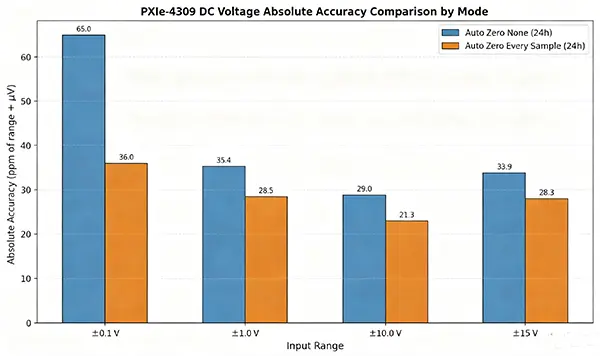
As shown in the table above, enabling the Auto Zero Every Sample mode significantly reduces the offset error term. Taking the ±0.1V range as an example, the offset term decreases from 3.2 μV to 0.3 μV, which is particularly crucial for improving the accuracy of measuring low-level signals at the 10 μV level—the total error decreases from approximately 33 ppm + 3.2 μV to 33 ppm + 0.3 μV, representing a reduction of approximately 90% in offset error.
Supported programming languages and development environments
| Development Environment / ADE | Windows Support | Linux Support |
| NI LabVIEW | ✅ | ✅ |
| LabWindows/CVI | ✅ | ❌ |
| ANSI C / C++ | ✅ | ✅ |
| C# / .NET | ✅ | ❌ |
| Visual Basic .NET | ✅ | ❌ |
| Python | ✅ | limited |
| MATLAB® ( by Data Acquisition Toolbox ) | ✅ | / |
Software User Manual
NI offers a variety of software options for the PXIe-4309 to suit different application needs and programming capabilities:
FlexLogger: A no-programming data acquisition and logging software that provides an intuitive graphical interface and supports sensor configuration, data logging, real-time monitoring, and computing channels. A free Lite version and a professional version are available, suitable for quickly building data logging systems.
LabVIEW: A graphical programming environment that provides complete hardware control, data analysis, and user interface development capabilities. Suitable for test and measurement applications requiring customized development.
LabVIEW+ Suite: A complete toolset for test engineers, including:
- NI LabVIEW (graphical programming)
- NI TestStand (test sequence management)
- NI DIAdem (data visualization and analysis automation)
- NI FlexLogger™ (data acquisition software)
- NI InstrumentStudio™ (interactive PXI measurement)
Programming Interface and Configuration
All functions of the PXIe-4309 can be programmed and configured via the NI-DAQmx API, including:
- Channel configuration (range, termination configuration, auto-zero mode, chopper enable)
- Timing settings (sampling rate, sampling mode, sampling clock source)
- Trigger configuration (trigger source, trigger polarity, debouncing filter)
- Synchronization configuration (reference clock source, multi-device task)
- Self-calibration (software-triggered gain/offset/linearity correction) In the Windows environment, users can also configure the device, operate the test panel, and create simulation devices through Measurement & Automation Explorer (MAX), verifying module functionality without writing code.
Custom Design
We get it that standard arrangements do not continuously meet one of a kind prerequisites. Our experienced building group gives comprehensive OEM/ODM customization administrations. Whether you require adjusted recurrence ranges, specialized activating alternatives, or custom frame components, we work closely with you to create the idealize arrangement. Our adaptable plan approach guarantees your particular application needs are completely tended to whereas keeping up our quality standards.

Why Choose MXTD?
Proven Experience
With over 12 years in the industry, we understand your challenges and deliver solutions that work.
Quality Assurance
Strict quality control processes ensure every board meets our high standards for reliability and performance.
Comprehensive Support
Our technical team provides ongoing assistance from initial consultation through long-term maintenance.
Fast Response
We respond quickly to your needs, whether for standard products or custom solutions.
Reliable Delivery
Partnering with trusted logistics providers ensures your orders arrive safely and on time.


FAQs:
Q: Can all 32 channels achieve a sampling rate of 2 MS/s?
A:
No. The PXIe-4309 has 8 built-in synchronous sampling SAR ADCs.
When only one channel of each ADC is enabled (8 channels in total), the maximum sampling rate per channel is 2 MS/s.
When multiplexing enables all 32 differential channels (4 channels per ADC), the maximum sampling rate per channel drops to 10 kS/s.
Q: How can I troubleshoot an abnormal residual DC offset of 5-8 µV observed during measurement?
A:
First, confirm that the signal ground reference point is correctly connected. Although the differential channels of the PXIe-4309 support extremely high noise suppression, allowing the common-mode voltage source to float completely during wiring can easily introduce power frequency interference and environmental stray errors. It is recommended to connect the system reference ground to PFI_GND on the terminal block (such as TB-4309).
Q: What are the differences between the TB-4309 (ST) and TB-4309 (MT) terminal blocks?
A:
The TB-4309 (ST) is a standard screw terminal type, facilitating flexible manual wiring in the field; the TB-4309 (MT) is a high-density, high-capacity mass termination type, typically used with quick-connect plugs for automated test fixtures or large-scale test hosts. This terminal block features automatic identification; the board can detect its model number in real time after insertion.
Q: How to perform accuracy calibration on PXIe-4309?
A:
NI has designed a dedicated automated calibration accessory, the CAL-4309, for this module. It can automatically check and correct the module's DC offset accuracy. When performing external calibration, it is typically used in conjunction with a high-precision Fluke 5700A standard source and a PXIe-4081 multimeter.

Contact Us
Ready to integrate reliable PXI Module control into your system? Our team is here to help you select the right configuration and provide ongoing support.
Contact our technical specialists at manager03@mxtdinfo.com / manager02@mxtdinfo.com for detailed specifications, pricing information, or to discuss your custom requirements. We're committed to delivering the perfect NI PXIe-4309 18-28 Bit PXI Analog Input Module solution for your application needs.
Our customers’ satisfaction speaks for our quality — contact us to experience the same reliable service.
Our customers’ satisfaction speaks for our quality — contact us to experience the same reliable service.