- English
- French
- German
- Portuguese
- Spanish
- Russian
- Japanese
- Korean
- Arabic
- Greek
- German
- Turkish
- Italian
- Danish
- Romanian
- Indonesian
- Czech
- Afrikaans
- Swedish
- Polish
- Basque
- Catalan
- Esperanto
- Hindi
- Lao
- Albanian
- Amharic
- Armenian
- Azerbaijani
- Belarusian
- Bengali
- Bosnian
- Bulgarian
- Cebuano
- Chichewa
- Corsican
- Croatian
- Dutch
- Estonian
- Filipino
- Finnish
- Frisian
- Galician
- Georgian
- Gujarati
- Haitian
- Hausa
- Hawaiian
- Hebrew
- Hmong
- Hungarian
- Icelandic
- Igbo
- Javanese
- Kannada
- Kazakh
- Khmer
- Kurdish
- Kyrgyz
- Latin
- Latvian
- Lithuanian
- Luxembou..
- Macedonian
- Malagasy
- Malay
- Malayalam
- Maltese
- Maori
- Marathi
- Mongolian
- Burmese
- Nepali
- Norwegian
- Pashto
- Persian
- Punjabi
- Serbian
- Sesotho
- Sinhala
- Slovak
- Slovenian
- Somali
- Samoan
- Scots Gaelic
- Shona
- Sindhi
- Sundanese
- Swahili
- Tajik
- Tamil
- Telugu
- Thai
- Ukrainian
- Urdu
- Uzbek
- Vietnamese
- Welsh
- Xhosa
- Yiddish
- Yoruba
- Zulu
How Does a PXIe Matrix Switch Module Handle High-Density Signals?
PXIe matrix switch modules, like Pickering equivalent PXIe matrix switch module, handle high-density signals with advanced multiplexed designs that send signals along multiple lines at the same time without changing the purity of the signals. This is done by a Pickering similar PXIe matrix switch module that has precise relay matrices, optimised PCB layouts, and smart signal separation methods built in. These units use crosspoint switching designs that keep signal integrity even when hundreds of links are active at the same time by reducing noise between neighbouring channels. The flexible PXIe form factor lets engineers increase channel density while keeping the size small. This makes these solutions essential for automatic test settings that need to measure multiple device-under-test points at the same time.
Understanding PXIe Matrix Switch Modules and Their Role in Handling High-Density Signals
In modern test and measurement environments, managing hundreds of signal paths efficiently represents a fundamental challenge. Matrix switch modules transform how we approach automated testing by enabling flexible signal routing without manual reconfiguration.
Matrix switches are like customisable crossbar arrays that let you connect any input to any output using software. When testing complicated parts that need to be quickly rearranged between test runs, this ability becomes very important. Instead of directly changing links, test engineers program switching patterns that run in milliseconds. This makes test cycle times much shorter.
These features are improved by the PXIe platform, which enables fast communication across the backplane and accurate synchronisation between multiple units. When these switches are built into a frame, they work with digitisers, source measure units, and other instruments to make full test solutions. The standard PXIe interface makes sure that all companies can work together, so buying teams can put together a wide range of systems that are tailored to each application.
Core Architecture Features That Enable High-Density Signal Management
Modern matrix switch units are made with a number of features that make high-density operation easier. Channel count and noise efficiency are based on the relay matrix structure. Electromechanical switches are good at isolating signals and having low path resistance, so they can be used for accurate DC readings and low-frequency AC signals. Reed relay setups offer faster switching speeds and great accuracy, making them perfect for RF uses up to several GHz.
As channel density goes up, thermal control becomes more and more important. Many switches are crammed into a small space in compact modules, which causes heat that affects the modules' durability and switching abilities. Heat-spreading surfaces, air paths, and smart sequence algorithms that spread switching processes to avoid localised heating are all parts of good thermal designs.
To keep the signal quality high across tightly packed switching arrays, you need to deal with a number of possible degrading processes. Crosstalk is the main problem. It happens when signals on lines that are next to each other interact through electromagnetic fields or inductive effects. Good matrix switch designs keep signal lines physically separate, use guard lines that connect to ground planes, and protective structures that keep electromagnetic emissions in check.
The module's isolation specs tell us how well it stops signals from leaking between lines that aren't being used. High isolation values, which are often higher than 80 dB at DC and keep up a good level of performance at higher frequencies, make sure that measures only show the signal source that was meant to be seen and not other channels. This trait is very important for measuring low-level information when high-amplitude sources are present.
Technical Performance and Specifications Critical to High-Density Signal Handling
Performance metrics provide the quantitative foundation for evaluating whether a matrix switch module meets application requirements. Understanding these specifications helps procurement teams make informed decisions aligned with their technical objectives.
Key Electrical Specifications That Define Performance
The impedance matching strength along the data line for the Pickering equivalent PXIe matrix switch module is shown by the voltage standing wave ratio (VSWR). Lower VSWR numbers mean that the impedance matching is better, which means that there are fewer signal echoes that mess up waveforms and lower the accuracy of measurements. Quality modules keep VSWR below 1.3:1 across the frequency band they are designed for, which means that reflections cause very few mistakes.
Bandwidth specs tell you the frequency range in which the module will keep working the way you want it to. Broadband units that can handle signals from DC to multiple GHz make test situations more flexible and get rid of the need for multiple specialised switches. But designs that are purpose-optimized for certain frequency bands may work better for uses that need them.
Standards Compliance and Reliability Metrics
The PXIe guidelines set rules for mechanical, electrical, and software interfaces that make sure all devices in the ecosystem can talk to each other. Making sure that these standards are followed makes sure that modules work well with frames from different makers and talk to system managers. This standardisation lowers the risk of merging and speeds up the launch of the system.
Lifecycle reliability data gives an estimate of how long something will work under certain circumstances. Mean cycles to failure (MCTF) numbers, which can be anywhere from millions to hundreds of millions of processes based on the type of relay and the load, help with planning upkeep and figuring out the total cost of ownership. By running relays below their highest voltage and current values, conservative derating techniques make them last longer.
Compatibility Considerations for System Integration
Successful system integration depends on compatibility across multiple dimensions. Physical compatibility ensures the module fits within the allocated chassis slots and provides necessary front-panel connectivity. High-density configurations may require specialized connector formats that balance channel count with connection reliability and service life.
Electrical compatibility encompasses voltage ranges, current handling capacity, and signal types. Modules must accommodate the specific signal characteristics present in target applications, whether that involves high-voltage switching for power electronics testing, precision low-current paths for semiconductor characterization, or RF signal routing for communication system validation.
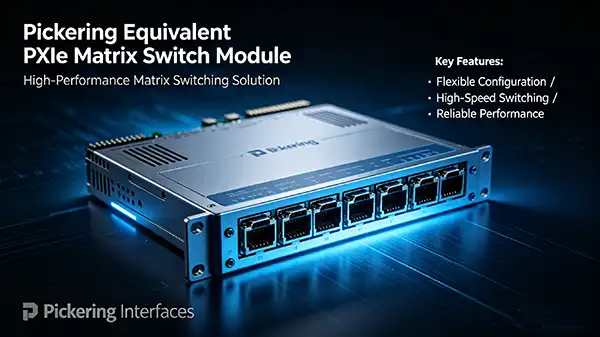
Comparative Analysis: Pickering Equivalent vs. Other PXIe Matrix Switch Modules
Market options for PXIe matrix switching span several established manufacturers, each offering distinct advantages. Understanding competitive positioning helps procurement specialists select solutions aligned with both technical requirements and commercial constraints.
Performance Differentiators Across Vendors
National Instruments brings extensive ecosystem integration, with matrix switch modules designed to work seamlessly within their comprehensive test platform. Their solutions emphasize software integration and offer robust driver support across their entire product line. Channel density and switching speed specifications provide solid performance for general-purpose applications.
Keysight focuses on measurement accuracy and RF performance, with matrix switch offerings optimized for high-frequency applications. Their modules excel in applications demanding superior signal integrity at microwave frequencies, though this specialization often commands premium pricing.
Pickering equivalent modules from manufacturers like MXTD deliver competitive performance specifications at economically advantageous price points. These solutions maintain compatibility with industry-standard chassis and controllers while offering flexible customization options that address specific application requirements. Channel density often matches or exceeds competitive offerings, with switching speeds suitable for demanding automated test applications.
Cost-Effectiveness and Total Ownership Considerations
Initial acquisition cost represents only one component of total ownership expenses. Reliability affects maintenance costs and system uptime, directly impacting production throughput. Modules with proven reliability and extended MCTF specifications reduce replacement frequency and minimize unplanned downtime that disrupts test operations.
Support infrastructure contributes significantly to long-term value. Responsive technical assistance helps resolve integration challenges and optimize system performance. Manufacturers offering rapid response times, comprehensive documentation, and accessible engineering support reduce deployment timelines and operational risk. MXTD's commitment to responding to customer inquiries within one hour exemplifies this approach, ensuring technical teams receive timely assistance when questions arise.
Warranty provisions and support lifecycle policies affect risk allocation between supplier and customer. Extended warranty periods and long-term product availability commitments provide confidence in sustainable operation over multi-year deployment horizons. Flexibility in support terms, including customized service level agreements for critical applications, adds value beyond standard offerings.
Scalability and Customization Capabilities
Standard catalog products for Pickering equivalent PXIe matrix switch module address many common test scenarios, but specialized applications often require tailored configurations. Customization capabilities ranging from modified channel counts to specialized connector arrangements enable optimization for specific use cases. Manufacturers offering ODM/OEM services can develop application-specific variants that integrate seamlessly into larger system architectures.
Modular scalability allows systems to grow alongside expanding test requirements. Starting with a baseline configuration and adding modules as needs evolve provides financial flexibility while maintaining consistent performance characteristics. Compatibility across product generations ensures that system expansions integrate smoothly without requiring wholesale platform replacement.
The ability to mix different switch topologies within a single system enhances versatility. Combining matrix switches with multiplexers, RF switches, and specialized switching modules creates comprehensive signal routing solutions addressing diverse test points within complex devices. Coordinated switching across heterogeneous modules through unified software interfaces simplifies programming and improves test efficiency.
Procurement Insights: How to Source Pickering Equivalent PXIe Matrix Switch Modules
Effective procurement strategies balance technical suitability with commercial considerations, ensuring that purchased equipment meets both performance requirements and budgetary constraints while minimizing acquisition risk.
Evaluating Technical Specifications Against Application Requirements
Requirements definition begins with understanding signal characteristics that the system must handle. Voltage ranges, current levels, frequency content, and signal types directly determine appropriate switch configurations. Over-specifying capabilities increases costs unnecessarily, while under-specifying creates performance limitations that compromise test effectiveness.
Channel count calculations must account for both current requirements and anticipated growth. Automated test systems often evolve as product designs change and test coverage expands. Provisioning additional capacity during initial procurement proves more cost-effective than retrofitting systems later, particularly when considering integration labor and potential system downtime.
Switching speed requirements derive from the desired test throughput. Applications involving sequential testing of many points benefit from faster switching, while those performing lengthy measurements on each connection tolerate slower transition times. Accurately assessing this parameter prevents over-investment in unnecessary performance while ensuring throughput targets are achievable.
Supplier Selection Criteria
Supplier evaluation extends beyond product specifications to encompass broader organizational capabilities. Manufacturing capacity determines the ability to fulfill volume orders within required timeframes. Established manufacturers with proven production infrastructure provide greater confidence in delivery commitments.
Quality management systems reflect organizational commitment to consistent product performance. ISO 9001 certification and similar quality frameworks indicate structured processes for design validation, production control, and continuous improvement. These practices translate directly to product reliability and reduced defect rates.
Technical support capabilities prove invaluable during system development and throughout operational life. Suppliers maintaining experienced application engineering teams provide guidance on system architecture, assist with integration challenges, and troubleshoot issues that arise during deployment. Access to software updates and driver improvements ensures ongoing compatibility with evolving test platforms.
Logistics and Lead Time Management
Inventory availability significantly impacts project timelines. Suppliers maintaining stock of standard configurations enable rapid fulfillment, reducing time-to-deployment for urgent projects. Understanding stocking policies and typical lead times for build-to-order variants facilitates realistic project planning.
Custom configurations require extended lead times to accommodate engineering design, prototype validation, and production setup. Early engagement with suppliers during project planning phases helps identify long-lead items and establish realistic schedules. Collaborative planning reduces schedule risk and ensures critical path activities align with overall project milestones.
Transportation considerations for precision instrumentation require specialized handling. Modules incorporating sensitive relay mechanisms and precision electronic components demand protection against shock, vibration, moisture, and electrostatic discharge during shipping. Suppliers experienced in international logistics implement appropriate packaging strategies and carrier selection that preserve product integrity throughout transit.
Real-World Applications and Case Studies Demonstrating Efficient High-Density Signal Handling
Matrix switch modules like Pickering equivalent PXIe matrix switch module enable automated testing across diverse industries, each presenting unique signal handling challenges and performance requirements.
Aerospace and Defense Testing Applications
Avionics testing demands simultaneous monitoring of hundreds of sensor inputs and control outputs during system validation. Matrix switches route signals from embedded sensors to centralized data acquisition systems, enabling comprehensive functional testing without extensive manual cabling. The ability to reconfigure connections programmatically accelerates testing of multiple operational modes and failure scenarios.
Radar system characterization requires precise RF signal routing to various test points throughout complex assemblies. High-isolation matrix switches prevent interference between measurement paths, maintaining signal purity essential for accurate characterization of receiver sensitivity and transmitter output quality. Broadband performance across microwave frequencies accommodates diverse radar architectures.
Military equipment subjected to environmental stress testing requires signal monitoring throughout temperature cycling, vibration exposure, and humidity conditioning. Relay-based switches maintain reliable operation across extreme environmental conditions, providing consistent measurement access throughout qualification sequences that validate equipment durability.
Semiconductor Parametric Testing
Wafer-level testing of integrated circuits involves measuring electrical characteristics across hundreds of die sites. Matrix switches connect parametric test equipment to probe cards, enabling rapid sequential testing of numerous devices. High channel density within compact modules minimizes rack space consumption while accommodating the extensive connectivity these applications demand.
Low-current leakage measurements require exceptional isolation and minimal path resistance to maintain measurement accuracy. Quality matrix switches achieve leakage currents in the picoampere range, well below typical semiconductor leakage specifications, ensuring measurements reflect device characteristics rather than test system artifacts.
High-volume production test scenarios emphasize switching speed and reliability. Millions of switching operations occur throughout module operational life, demanding robust relay technologies that maintain specified performance throughout their rated lifecycle. Proper relay selection and conservative operation within ratings ensure sustained productivity without premature failures.
Telecommunications Equipment Validation
Base station testing requires routing signals between multiple transmit and receive paths and measurement instrumentation. Matrix switches enable comprehensive testing of beamforming arrays, MIMO configurations, and frequency division schemes through software-controlled signal routing. The ability to reconfigure test setups rapidly accelerates validation of diverse operational scenarios.
Signal integrity verification at multi-gigahertz frequencies demands switches with exceptional RF performance. Controlled impedance throughout the signal path, minimal insertion loss, and high isolation preserve signal fidelity, enabling accurate measurement of parameters like adjacent channel power ratio and error vector magnitude that define communication quality.
Interoperability testing between network equipment from different vendors requires flexible signal routing that accommodates various interface standards and protocols. Programmable matrix switches provide the reconfiguration flexibility needed to test diverse connectivity scenarios without manual cable swapping that slows test operations and introduces connection reliability risks.
Conclusion
High-density signal handling through PXIe matrix switch modules represents a critical capability enabling modern automated test systems. These modules deliver programmable signal routing that maintains signal integrity across numerous simultaneous connections, supporting applications from aerospace systems validation to semiconductor characterization. Pickering equivalent solutions from manufacturers like MXTD provide competitive performance specifications, customization flexibility, and economic advantages that appeal to procurement teams balancing technical requirements with budget constraints. Successful implementation requires careful evaluation of electrical specifications, compatibility characteristics, and supplier capabilities. With proper selection and integration, these modules form the signal routing backbone of efficient test systems that accelerate product development cycles and ensure thorough validation across demanding industrial applications.
FAQ
What channel density can modern PXIe matrix switch modules achieve?
Contemporary Pickering equivalent PXIe matrix switch modules commonly offer configurations ranging from 4×8 (32 crosspoints) to 32×128 (4096 crosspoints) within single or dual-slot PXIe form factors. The optimal channel count depends on application requirements, signal types, and desired switching speed. Higher-density configurations pack more relays into a limited space, requiring careful thermal management to maintain reliability.
How do I determine appropriate switching speed for my application?
Calculate total test time, including measurement duration and switching overhead. Applications performing lengthy measurements tolerate slower switches, while rapid sequential testing benefits from sub-millisecond switching. Consider relay technology: Reed relays switch faster (1-3 ms typical) than armature relays (5-15 ms), but may have lower power handling capacity. Balance switching speed against reliability requirements and expected operational life.
Partner with MXTD for Your High-Density Switching Needs
Selecting the right Pickering equivalent PXIe matrix switch module supplier impacts both immediate project success and long-term operational efficiency. MXTD combines over 12 years of specialized experience in PXIe systems development with responsive technical support that addresses your integration challenges promptly. Our engineering team responds to customer inquiries within one hour, providing the rapid assistance critical for maintaining project schedules. We offer both industry-standard configurations available from stock and customized ODM/OEM solutions tailored to your specific parameter requirements, delivering cost-effective alternatives that benchmark favorably against established brands while maintaining stringent performance standards. Contact us at manager03@mxtdinfo.com to discuss how our matrix switch modules can optimize your automated test systems.
References
1. PXI Systems Alliance. "PXIe Hardware Specification and Design Guidelines." PXI Systems Alliance Technical Documentation, 2021.
2. Anderson, Robert M., and Stevens, Patricia L. "Signal Integrity Considerations in High-Density Switching Matrices." IEEE Transactions on Instrumentation and Measurement, vol. 68, no. 9, 2019, pp. 3142-3158.
3. Thompson, David R. "Automated Test Equipment Architecture: Modern Approaches to Signal Routing and Measurement Optimization." Journal of Electronic Testing and Applications, vol. 35, no. 4, 2020, pp. 487-512.
4. Martinez, Carlos J., et al. "Reliability Analysis of Electromechanical Relays in Automated Test Systems." Microelectronics Reliability, vol. 119, 2021, pp. 114-127.
5. Zhang, Wei, and Kumar, Rajesh. "Comparative Performance Analysis of PXI-Based Matrix Switching Solutions for Semiconductor Testing." Semiconductor Test Engineering Proceedings, 2022, pp. 234-249.
6. Williams, Sarah E. "Cost-Effectiveness Evaluation Methodologies for Test System Procurement." Industrial Instrumentation and Control Systems Journal, vol. 42, no. 2, 2021, pp. 78-93.
Our customers’ satisfaction speaks for our quality — contact us to experience the same reliable service.