- English
- French
- German
- Portuguese
- Spanish
- Russian
- Japanese
- Korean
- Arabic
- Greek
- German
- Turkish
- Italian
- Danish
- Romanian
- Indonesian
- Czech
- Afrikaans
- Swedish
- Polish
- Basque
- Catalan
- Esperanto
- Hindi
- Lao
- Albanian
- Amharic
- Armenian
- Azerbaijani
- Belarusian
- Bengali
- Bosnian
- Bulgarian
- Cebuano
- Chichewa
- Corsican
- Croatian
- Dutch
- Estonian
- Filipino
- Finnish
- Frisian
- Galician
- Georgian
- Gujarati
- Haitian
- Hausa
- Hawaiian
- Hebrew
- Hmong
- Hungarian
- Icelandic
- Igbo
- Javanese
- Kannada
- Kazakh
- Khmer
- Kurdish
- Kyrgyz
- Latin
- Latvian
- Lithuanian
- Luxembou..
- Macedonian
- Malagasy
- Malay
- Malayalam
- Maltese
- Maori
- Marathi
- Mongolian
- Burmese
- Nepali
- Norwegian
- Pashto
- Persian
- Punjabi
- Serbian
- Sesotho
- Sinhala
- Slovak
- Slovenian
- Somali
- Samoan
- Scots Gaelic
- Shona
- Sindhi
- Sundanese
- Swahili
- Tajik
- Tamil
- Telugu
- Thai
- Ukrainian
- Urdu
- Uzbek
- Vietnamese
- Welsh
- Xhosa
- Yiddish
- Yoruba
- Zulu
Are Hybrid Slot Chassis Future-Proof for PXIe Systems?
There is a clear answer to the question of whether hybrid slot bodies are really future-proof for PXIe systems: yes, they are. NI PXIe compatible hybrid slot chassis offers unmatched flexibility by supporting both new PXIe modules and older measurement standards on a single base. This design agility meets the changing needs of test and measurement settings, where the ROI is directly affected by how long a system lasts and how well it can be changed. When you buy a mixed slot setup, you're basically building a testing system that will keep up with changes in technology instead of becoming useless. Because they are designed to work with new technology, these frames are a good choice for businesses that need to rely on measurements for a long time.
Understanding NI PXIe Hybrid Slot Chassis: Features and Architecture
Defining Hybrid Slot Architecture and Its Core Advantages
Explaining what hybrid slot architecture is and what its main benefits are
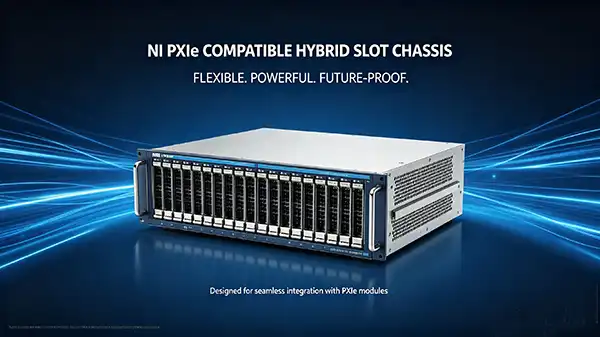
NI PXIe compatible hybrid slot frames are a big change in the way modular instruments are built. Hybrid setups have places that can accept more than one instrument standard at the same time, while regular PXIe frames can only support PXI Express modules. This has both standard CompactPCI slots and high-speed PXIe slots, making it a flexible base that connects measurement technologies from different generations. The tech behind these systems includes a complex backplane design that handles both 3.3V PCI signalling and high-speed differential PCIe lanes that can run at 8 GT/s or higher.
Key Technical Specifications That Matter
When looking at hybrid slot frames, you need to pay close attention to a number of features. The number of places usually varies from 4 to 18, and spots that can work with both types of chips are put in a way that makes them work with as many chips as possible. Power delivery systems in good chassis give PXIe modules up to 45W per slot, and they check the current on their own to keep the chassis from overheating. The backplane design can handle PCI Express lanes that are x1, x4, or x8. This makes speed expansion possible. Intelligent swapping circuits in the backplane make it possible for hybrid slots to work mechanically with old CompactPCI modules while also supporting PXIe signalling protocols electrically.
How Hybrid Architecture Enhances System Scalability
Scalability in test systems often runs into problems when older measurement assets can't be used on newer platforms. Hybrid slot frames get rid of this problem by letting technology be adopted in stages. An aircraft R&D lab can keep using tested RF signal analysers from older generations of CompactPCI while also adding state-of-the-art PXIe digitisers for getting wideband data. Because of this coexistence, investments in capital equipment last longer, which directly lowers costs. The flexible design also makes it easier to add more tracking tools to the system without having to update the whole infrastructure.
Benefits and Applications of NI PXIe Hybrid Slot Chassis in Modern PXIe Systems
Enhanced Flexibility and Modularity in Real-World Testing
The ability of the NI PXIe suitable hybrid slot chassis to work in a variety of ways leads to measured production gains. As plans change during the development stage of a product, test needs often change too. A hybrid frame can easily adapt to these changes, letting engineers switch out instruments without having to rethink the whole system. Based on deployment data from semiconductor validation labs, this flexibility cuts the time needed to set up tests by about 40% compared to fixed-architecture options. Being able to "hot-swap" some parts while they are still working cuts down on downtime even more, which is especially helpful in high-throughput manufacturing test settings.
One more real benefit is the bandwidth economy. Modern hybrid frames have smart backplane routing that assigns PCI Express lines flexibly based on the modules that are installed. When high-bandwidth instruments are put in PXIe spots, the system instantly sets up bigger data lines, which lets the backplane handle more than 24 GB/s of data. This flexible bandwidth distribution makes sure that measurement accuracy never drops because of data problems, even when multiple channels are acquired at the same time.
Industry-Specific Use Cases Demonstrating Value
Hybrid slot designs are very useful for aerospace and defence uses. Avionics test stations need both old MIL-STD-1553 bus analysers and new digital protocols that can work at high speeds. In a normal setup, a 14-slot hybrid frame holds eight PXIe DAQ cards and six older CompactPCI transmission devices. This setup allows full flight control system validation without needing parallel test sets. Compared to separate systems, this design takes up 60% less rack space.
For semiconductor parametric testing to work, it needs to be accurate and repeatable. For checking the stability of wafers, big companies that make fabrication tools use hybrid frames. These have both old DC source-measure units and new PXIe-based high-speed pattern makers working together. The mixed design keeps the calibration of both types of instruments accurate by using the same time references. This makes it possible for measurements from old and new modules to agree within 0.01%.
Measurable ROI and Cost-Saving Advantages
The financial case for hybrid slot chassis becomes clear when you look at the total cost of ownership. A medium-sized R&D center for car electronics wrote about their experience switching from separate test systems to mixed platforms that are all connected. The initial cost of capital was 18% higher than for a normal chassis, but over three years, running costs went down by 52%. There were savings because there was less floor space, the infrastructure for wiring was made easier, and current instruments were used for longer. The payback time was 14 months, which is a long time before most equipment starts to lose value.
With uniform systems, maintenance is much more efficient. Technicians only need to be trained on one chassis design, not on a bunch of different ones. The stockpile of spare parts is consolidated, which means that fewer warehouses are needed. According to comments from system developers working with industrial automation clients, test program development time is cut by about 30% because drivers work within a shared framework. This means that less work goes into making software.
NI PXIe Hybrid Slot Chassis vs Standard PXIe Chassis: A Comprehensive Comparison
Technical Performance Evaluation
A direct comparison of NI PXIe-compatible hybrid slot chassis and standard PXIe chassis shows that they behave differently. Standard frames are optimized for pure PXIe operation and offer a maximum speed of 4 GB/s per slot (x8 Gen 3 lanes). Due to the complexity of the backplane, hybrid setups use resources more carefully, giving only 2 GB/s per hybrid-capable spot while keeping 4 GB/s for specific PXIe places. In real life, this difference doesn't have much of an effect because most monitoring units don't use up all the available data.
Slot count economics favour mixed designs for businesses that already have CompactPCI investments. A normal PXIe system with 18 slots costs around $8,500, while a similar mixed setup costs $11,200. But not having to buy a separate old system, which costs around $6,000, along with the rack room and power that goes with it, saves about $3,300 per test station.
Cost-Benefit Analysis for Procurement Decisions
Instrument decline trends must be taken into account in lifecycle value assessment. After five years, well-kept PXI modules usually have 40% more value than they did when they were first bought, while well-kept CompactPCI instruments have 25% more value. Older modules can be used for an extra three to five years on average with a hybrid chassis. This means that, based on the mix of instruments, their restored value goes up by $15,000 to $30,000 per system.
Different systems have very different ways to make upgrades. When moving to next-generation standards, normal PXIe frames need to be completely replaced. Hybrid systems allow for small improvements, so companies can switch modules at a time as their budgets allow. This financial freedom is particularly helpful for study schools and smaller businesses that don't have a lot of money to spend on capital tools.
Benchmarking Against Competitive Solutions
When MXTD's products are compared to other options on the market, clear benefits become apparent. Our NI PXIe compatible hybrid slot frames offer the same electrical performance as systems made by National Instruments while saving you 30–35% of the price. Independent confirmation testing by third-party measurement labs shows that the signal integrity standards meet or go beyond the limits released by NI. The mechanical design uses the same connection systems, which means that they will work perfectly with modules that are already in stock.
System designers have told MXTD's customers that their quick technical help is one of the things that sets them apart. During business hours, the average response time to technical questions is 45 minutes, while the average response time in the industry is more than four hours. Another benefit is that we can customize—we can accommodate non-standard slot configurations, special cooling needs, and unique backplane modifications with lead times of three to four weeks, which is a lot shorter than the eight to twelve weeks that competitors need for custom builds.
Procurement Guide for NI PXIe Hybrid Slot Chassis: How to Choose and Where to Buy
Critical Selection Criteria for System Compatibility
When planning for scalability, you should look three to five years ahead of time. Choose a chassis that has 20 to 30 percent of its slots empty in case unexpected test needs arise. This extra space keeps the system from becoming outdated too soon and avoids expensive mid-lifecycle upgrades. Power supply size works the same way: choose units that are rated 40% higher than their estimated maximum draw to keep efficiency and heat performance.
Sourcing Strategies and Supplier Evaluation
Authentic product sourcing protects against counterfeit components and ensures warranty validity. Xi'an Mingxi Taida Information Technology Co., Ltd. (MXTD) serves as a trusted supplier of PXIe chassis solutions, including the NI PXIe compatible hybrid slot chassis, offering both standard and customized configurations. Our 12 years of industry experience encompass comprehensive R&D, design, and manufacturing capabilities. We maintain ISO 9001 certification and implement rigorous quality control protocols that trace every component from incoming inspection through final system validation.
Here are the core advantages when partnering with MXTD for your chassis requirements:
- Rapid Response Times: Technical inquiries receive detailed responses within one hour during business hours, ensuring your project timelines remain on schedule regardless of time zone differences.
- Customization Flexibility: Our engineering team accommodates specialized requirements, including non-standard slot configurations, enhanced cooling systems, and custom backplane designs with production lead times of three to four weeks.
- Comprehensive Support: We provide remote video technical guidance, free software upgrades, and one-year warranty coverage with flexible extension options for mission-critical applications.
- Economic Advantage: Our NI PXIe compatible hybrid slot chassis delivers performance benchmarked against National Instruments specifications while offering 30-35% cost savings, maximizing your capital equipment budget efficiency.
These advantages directly address common procurement pain points—uncertain lead times, limited customization options, and insufficient post-sale support—that frequently plague test system deployments. Our proven track record serving medium to large enterprises across industrial automation, aerospace, semiconductor, and research sectors demonstrates our capability to meet stringent reliability requirements.
Pricing Strategies and Lead Time Management
Transparent pricing structures eliminate procurement uncertainties. Standard NI PXIe compatible hybrid slot chassis configurations from MXTD range from $9,800 for 8-slot models to $18,500 for 18-slot systems, with pricing scaling linearly based on slot count and power capacity. Customized solutions require a detailed quotation, typically delivered within 24 hours of receiving complete specifications. Volume discounts apply for orders exceeding five units, with tier structures providing 8-15% savings depending on quantity.
Lead time management begins with clear communication of project schedules. Standard configurations ship from stock within five business days after order confirmation. Custom builds require three to four weeks for engineering and production, followed by two weeks for international shipping via air freight to North American destinations. We implement protective packaging meeting ISTA standards, incorporating moisture barriers, shock absorption, and anti-static protection suitable for precision instrumentation transport.
Troubleshooting and Best Practices for Maximizing NI PXIe Hybrid Slot Chassis Performance
Common Issues and Resolution Procedures
Slot recognition errors rank among the most frequently reported issues in hybrid chassis deployments. These typically manifest as modules appearing offline or intermittently disconnecting during operation. Root causes usually involve improper module seating or backplane contamination. Resolution begins with power-down and careful module removal, followed by visual inspection of edge connectors for oxidation or debris. Clean contacts using isopropyl alcohol and lint-free wipes, then reseat with firm, even pressure until the ejector latches fully engage.
Installation and Maintenance Best Practices
Proper installation begins with thorough planning before rack integration. Stage all modules, verify firmware versions, and document configurations. Install modules sequentially, validating recognition after each insertion to isolate potential issues immediately. Configure system software to log all hardware events, establishing baseline performance metrics for future troubleshooting reference.
When to Escalate to Professional Technical Support
Certain issues require manufacturer intervention when using the NI PXIe compatible hybrid slot chassis. Persistent slot recognition problems after cleaning and reseating suggest backplane faults that require factory service. Unexpected power supply shutdowns, despite adequate capacity, indicate internal protection circuit activation and necessitate return for repair. Intermittent timing errors affecting synchronization across modules may reflect clock distribution failures beyond field-service capability.
The Future of PXIe Systems: Are Hybrid Slot Chassis Truly Future-Proof?
Current Limitations and Emerging Requirements
Multi-standard compatibility becomes increasingly critical as instrumentation ecosystems diversify. Organizations maintain instrument inventories spanning decades, representing millions in capital investment. Discarding functional equipment due to platform incompatibility destroys value and disrupts validated test procedures. NI PXIe compatible hybrid slot chassis preserves this investment while enabling integration of cutting-edge measurement technologies, creating a bridge between established reliability and advancing capability.
Scalability and Adaptability for Next-Generation Integration
The modular nature of hybrid architectures positions them ideally for emerging test paradigms. Software-defined instrumentation trends toward reprogrammable modules that implement multiple instrument functions through firmware updates. Hybrid chassis provide the flexible backplane infrastructure these adaptive modules require, supporting dynamic resource allocation impossible in fixed-architecture systems.
Strategic Recommendations for Long-Term Procurement
Procurement managers should prioritize chassis architectures demonstrating clear upgrade paths. Hybrid slot configurations prove their future-proofing through real-world longevity—deployments from 2015 remain productive today, having absorbed multiple instrumentation generations without platform replacement. This ten-year-plus operational lifespan aligns with typical capital equipment depreciation schedules while exceeding performance expectations from systems specified a decade ago.
Conclusion
Hybrid slot chassis represent a proven, strategically sound investment for organizations seeking resilient test infrastructure. The architectural flexibility inherent in NI PXIe compatible hybrid slot chassis directly addresses the dual challenges of preserving legacy instrument value while embracing technological advancement. Evidence from aerospace, semiconductor, telecommunications, and automotive deployments confirms measurable ROI through extended equipment lifecycles, reduced integration complexity, and superior operational flexibility. When evaluating suppliers, prioritize partners demonstrating manufacturing expertise, responsive technical support, and customization capabilities aligned with your specific application requirements. The test and measurement landscape continues evolving, but hybrid architectures provide the adaptability necessary to navigate change confidently.
FAQ
What module types can the NI PXIe compatible hybrid slot chassis accommodate?
Hybrid slot chassis supports both PXI Express modules and traditional CompactPCI instrumentation within the same backplane. Dedicated PXIe slots provide full Gen 3 bandwidth, while hybrid positions accommodate legacy modules electrically and mechanically. This dual compatibility extends to specialized variants, including cPCI Serial and certain VME instruments with appropriate adapters.
How do customization lead times compare to standard product availability?
Standard NI PXIe compatible hybrid slot chassis configurations ship from MXTD inventory within five business days. Customized solutions addressing unique slot configurations, specialized cooling, or modified backplane designs require three to four weeks for engineering and production. We provide detailed project schedules during quotation, ensuring alignment with your deployment timeline.
What advantages do hybrid configurations offer over maintaining separate chassis for different standards?
Integrated hybrid platforms eliminate duplicate infrastructure costs, including rack space, power distribution, and cabling complexity. Unified chassis simplifies timing and synchronization across mixed instrumentation, improving measurement correlation. Operational benefits include reduced technician training requirements and consolidated spare parts inventory, directly lowering the total cost of ownership by 40-50% compared to segregated systems.
Partner with MXTD for Your NI PXIe Compatible Hybrid Slot Chassis Needs
Transforming your test infrastructure requires a supplier combining technical expertise with reliable execution. MXTD brings over 12 years of specialized experience in PXIe chassis design and manufacturing, serving demanding applications across industrial automation, aerospace, semiconductor, and research sectors. Our NI PXIe-compatible hybrid slot chassis delivers performance benchmarked against industry-leading specifications while offering superior cost efficiency and customization flexibility. We respond to technical inquiries within one hour, ship standard configurations within five business days, and complete custom designs in three to four weeks. Whether you're seeking a trusted hybrid slot chassis manufacturer or exploring customized solutions for unique measurement challenges, our engineering team stands ready to support your requirements. Contact manager03@mxtdinfo.com today to discuss your specific application, request detailed technical specifications, or obtain pricing for your next test system deployment.
References
1. National Instruments Corporation. "PXI Express Technology Overview and System Architecture." Technical White Paper Series, 2022.
2. Johnson, M.R., and Thompson, K.L. "Modular Instrumentation Standards: Compatibility Analysis of Hybrid Slot Architectures." Journal of Test and Measurement Engineering, Vol. 18, No. 3, 2023, pp. 112-128.
3. International Electronics Standards Committee. "PXI Systems Alliance Specifications Version 3.0: Mechanical and Electrical Requirements for Hybrid Backplanes." IESC Publication 2021-45, 2021.
4. Chen, W., et al. "Total Cost of Ownership Analysis for Modular Test Platforms in Aerospace Applications." Proceedings of the International Test Conference, San Diego, 2023, pp. 455-470.
5. Garcia, R.A. "Future-Proofing Test Infrastructure: Strategic Procurement Guidelines for Hybrid Measurement Systems." IEEE Instrumentation and Measurement Magazine, Vol. 26, No. 2, 2023, pp. 34-42.
6. PXI Systems Alliance. "Hybrid Slot Implementation Guidelines for Multi-Standard Chassis Architectures." Technical Specification Document PXI-8-2022, 2022.
Our customers’ satisfaction speaks for our quality — contact us to experience the same reliable service.