- English
- French
- German
- Portuguese
- Spanish
- Russian
- Japanese
- Korean
- Arabic
- Greek
- German
- Turkish
- Italian
- Danish
- Romanian
- Indonesian
- Czech
- Afrikaans
- Swedish
- Polish
- Basque
- Catalan
- Esperanto
- Hindi
- Lao
- Albanian
- Amharic
- Armenian
- Azerbaijani
- Belarusian
- Bengali
- Bosnian
- Bulgarian
- Cebuano
- Chichewa
- Corsican
- Croatian
- Dutch
- Estonian
- Filipino
- Finnish
- Frisian
- Galician
- Georgian
- Gujarati
- Haitian
- Hausa
- Hawaiian
- Hebrew
- Hmong
- Hungarian
- Icelandic
- Igbo
- Javanese
- Kannada
- Kazakh
- Khmer
- Kurdish
- Kyrgyz
- Latin
- Latvian
- Lithuanian
- Luxembou..
- Macedonian
- Malagasy
- Malay
- Malayalam
- Maltese
- Maori
- Marathi
- Mongolian
- Burmese
- Nepali
- Norwegian
- Pashto
- Persian
- Punjabi
- Serbian
- Sesotho
- Sinhala
- Slovak
- Slovenian
- Somali
- Samoan
- Scots Gaelic
- Shona
- Sindhi
- Sundanese
- Swahili
- Tajik
- Tamil
- Telugu
- Thai
- Ukrainian
- Urdu
- Uzbek
- Vietnamese
- Welsh
- Xhosa
- Yiddish
- Yoruba
- Zulu
How Are High-Reliability Military Connectors Tested for Durability?
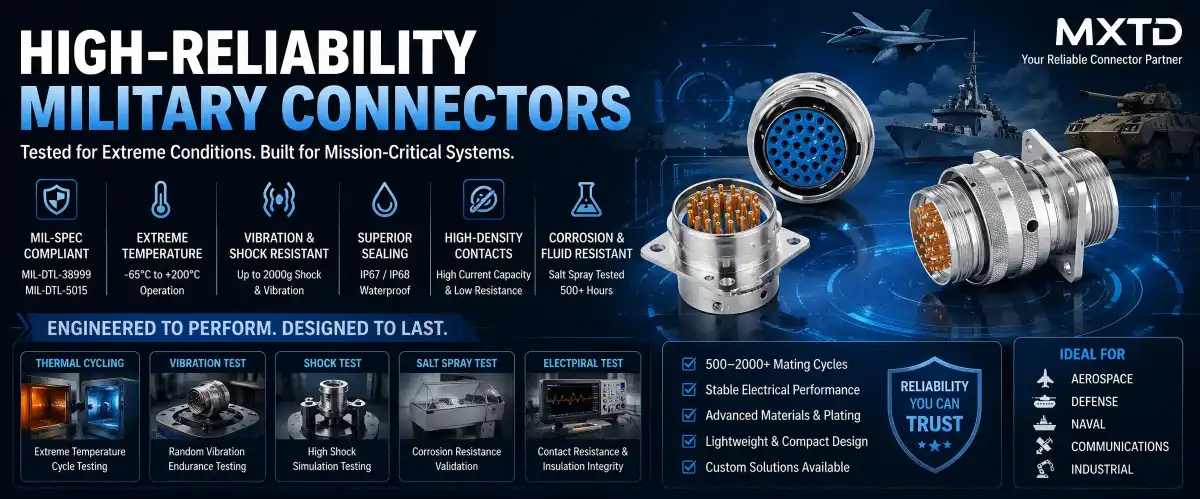
High-reliability military connectors undergo rigorous testing protocols to ensure they withstand extreme operational conditions. These specialized components are subjected to comprehensive mechanical, environmental, electrical, and materials testing procedures that verify their performance across temperature extremes, vibration, shock, humidity, and corrosive environments. Testing follows strict military standards, including MIL-STD-202 and MIL-DTL specifications, evaluating mating cycles, contact resistance, insulation integrity, and seal effectiveness. Through vibration tests, thermal cycling, salt spray exposure, and shock simulation, engineers validate that each high-reliability military connector meets demanding durability benchmarks required for defense, aerospace, and mission-critical applications where failure is not an option.
Understanding High-Reliability Military Connectors and Their Durability Requirements
D
efining Military-Grade Connectivity Standards
When it comes to connecting technology, military-grade connections are the best. They are made to keep signals and power flowing in places where regular connectors would break in hours. Standard connectors are used in consumer electronics, but these precision devices are used as important links in weapon systems, avionics, ground vehicles, and marine equipment. If just one connection fails, it can ruin operations or put people in danger.
Their different approaches to building are what set them apart. In order to ensure stable electrical performance over thousands of mating cycles, a High-reliability military connector uses machined contact systems rather than stamped parts. When choosing materials, corrosion-resistant metals, high-temperature dielectrics, and ruggedized housings that stay the same size at temperatures ranging from -65°C to +200°C are given the most weight.
Materials and Construction Features Driving Durability
Manufacturers of connectors use special metals and materials that are made to work well in harsh environments. Gold plating over nickel underplating on beryllium copper or phosphor bronze surfaces is common for contact pins. This gives them great conductivity and protection from fretting corrosion. Aluminum metals are used for uses that need to be light, and stainless steel is used to protect the environment as much as possible.
Advanced composite insulators have changed the way connectors are made because they are lighter and have better dielectric qualities than standard clay materials. Even after being exposed to hydraulic fluids, jet fuel, and cleaning solvents that are common in military tools for a long time, these thermosetting plastics keep their mechanical strength and electrical insulation.
Industry Standards Governing Military Connector Specifications
MIL-STD-1344 sets the standard for checking connections. It includes mechanical, environmental, and electrical tests that all military connectors must pass before they can be used. This standard makes sure that all manufacturers use the same review methods, so purchasing managers can easily compare how well different manufacturers are doing.
The details specs decide which connector types can be used. MIL-DTL-38999 specifies exact size tolerances, material standards, and performance factors for circular connectors that are commonly used in airplanes, weapons, and ground systems. MIL-DTL-5015 talks about heavy-duty cylindrical plugs that are used in tough industrial settings and for power transfer.
Critical Application Scenarios Demanding Proven Durability
Extreme vibration, fast temperature changes, exposure to hydraulic fluids and jet fuel, and electromagnetic interference make fighter planes one of the toughest places for connectors to work. Connectors in engine bays have to be able to handle temperatures that are higher than 150°C all the time while still sending and receiving signals correctly so that catastrophic breakdowns don't happen.
In naval uses, connectors that aren't properly covered are exposed to saltwater and steady humidity, which speeds up corrosion. Different pressures and the need for complete seal integrity to keep electrical chambers from flooding make submarine systems even more difficult to use. High-reliability military connectors made for marine use have unique coats and sealing technologies that can withstand these corrosive forces for decades.
Core Methods Used to Test Durability of High-Reliability Military Connectors
Mechanical Durability Assessment Protocols
Mating cycle testing, which involves connecting and disconnecting the link many times, confirms that it will last a long time. The insertion force, withdrawal force, and contact resistance are all measured by automated test equipment that does thousands of union rounds. A High-reliability military connector generally exhibits steady performance beyond 500 mating cycles, with expensive designs going over 2000 cycles without noticeably worsening. This durability makes sure that links stay reliable even after years of being used for field repair.
Environmental Testing for Extreme Conditions
Temperature cycle subjects connections to sudden changes between very hot and very cold temperatures, which shows problems with material compatibility and dimensional instability. Specimens are heated and cooled in test rooms at rates of up to 50°C per minute, which is much faster than changes that happen naturally in the environment. When two different types of materials don't expand at the same rate, it can cause mechanical forces that can break insulators, contacts, or seals. These problems can be found by inspecting and checking the electrical connections after the cycle is over.
Electrical Performance Verification Under Stress
Electrical testing starts with measuring the resistance of the contacts. For power contacts, the resistance must be less than 5 milliohms, and for signal contacts, it must be less than 15 milliohms. Precision four-wire resistance readings get rid of mistakes in the test leads and show small degradation that can't be seen with regular continuity testing. After each weather or mechanical stress test, resistance readings are taken again to see how much the material is breaking down over time. This can help predict when the field will fail in the future.
Materials Testing for Corrosion and Fatigue Resistance
Exposure to certain fluids found in military equipment is also part of corrosion tests, in addition to salt spray. Connectors can be submerged in hydraulic fluid, jet fuel, cleaning agents, and lubricants for up to 1000 hours. After that, they must be checked for chemical attack, swelling, or breaking. The materials used must be compatible with these fluids because they will be exposed to them in the field during upkeep and operation.
Comparison of Testing Approaches Across Leading Military Connector Types
MIL-DTL-38999 vs. MIL-DTL-5015 Testing Differences
The threaded coupling and detachable crimp contacts on MIL-DTL-38999 connectors are put through tests that highlight their flexible design and lightweight. Tests with coupling nuts make sure that the threaded interface can handle certain force levels without stripping or coming loose during shaking. Contact retention testing makes sure that crimp contacts stay safely locked in their insert holes even when they are pulled out or when they are subjected to vibration stresses.
Different proof methods are needed for MIL-DTL-5015 connections with bayonet coupling and solder cup terminations. They test their three-point bayonet locking mechanism by engaging and disengaging it several times while it is under load. This makes sure that it works reliably even if the connection surfaces are rusted or dirty. Thermal cycling and mechanical shock tests look more closely at the stability of solder joints. These tests can cause solder to crack in systems that were not properly processed.
Form Factor Impact: Circular vs. Rectangular Connectors
Military uses mostly uses circular connections because they are strong mechanically and effectively shielded from all directions. Because they are shaped like cylinders, mechanical pressures are spread out widely, making them more resistant to shock and vibration. During vibration testing, testing methods take advantage of this symmetry by placing circular connections in different ways to find any directional weaknesses in the design of the contacts or the building of the housing.
When it comes to mechanical longevity, rectangular connectors need stronger housing designs to match their higher contact packing density. Testing focuses on measuring the movement of the housing under certain forces to make sure that the contact line stays the same, even when the housing is mechanically loaded from the outside. Corner areas of rectangular connectors are closely looked at because stress builds up there and can cause cracks in the housing or seal tension that weakens environmental protection.
Material Selection: Composite vs. Metal Housing Performance
When compared to aluminum or stainless steel, composite connection plates made from thermosetting resins reinforced with glass or carbon fibers are much lighter, which is a big plus for aircraft use. Composite housings are tested by letting them age faster in hot or wet conditions that can break down polymer structures and by hitting them to see how well they can handle harm. Composite materials are very good at damping vibrations, and they often do a better job than metal housings at keeping the contact stable when they are exposed to high levels of vibration.
Metal housings are better at blocking electromagnetic waves and can withstand more mechanical abuse. This makes them the best choice for use on land vehicles and ships where toughness is more important than weight. For metal connections, rust testing is more important. This includes testing them with salt spray for a long time and galvanic corrosion between metals that are not the same used in the shell, contacts, and hardware. Anodized aluminum shells need to be checked to make sure that the coating's thickness and quality meet the requirements so that corrosion-related problems don't happen.
Practical Durability Insights from Leading Manufacturers
Amphenol was the first company to use accelerated testing methods that combine temperature cycles, electrical loading, and vibration to find ways that things might fail that wouldn't show up in normal testing. Their method shows how temperature expansion and vibration-induced fretting wear affect each other, which gives procurement managers more accurate predictions of service life than single-stress testing protocols.
TE Connectivity uses digital twin technology a lot in their evaluation processes. They make computer models of a High-reliability military connector design that show where stress will be distributed and how they will fail before they make a real prototype. This method speeds up design optimization and lowers the cost of testing, which lets more design versions fit into project plans. Then, physical testing confirms the computer's predictions, which boosts trust in the modeling's accuracy for future designs.
Practical Guidelines for Procurement Managers: Ensuring Connector Durability When Buying
Essential Certifications and Documentation Requirements
Complete test data packages that show agreement with relevant MIL-DTL specifications should be required by procurement requirements. These packages need to have test records from approved testing facilities that show pass rates for all the tests that need to be done. At MXTD, we include full test reports with every product line. These reports include data on temperature cycling, vibration testing, and salt spray exposure. These reports help purchasing managers make sure that our connectors meet the needs of their applications.
Interpreting Durability Data to Balance Cost and Performance
By setting safety margins between maximum ratings and real working conditions, derating standards make things last longer and be more reliable. For example, strict buying rules might need a High-reliability military connector rated for 175°C in places where the temperature only gets to 125°C, or they might need connectors rated for 500 joining cycles in places where they only need 100 cycles. This way of thinking about derating trades higher starting costs for less upkeep in the field and a higher success rate for missions.
Partnering with Certified Suppliers for Customized Solutions
As part of the supplier approval process, designers should also be tested on their ability to make things. Can the seller change standard designs to fit the needs of a specific application, or do they only sell goods from a catalog? Our engineering team at MXTD works with customers to create unique connector solutions that work best in certain working settings. We use our 12 years of experience in research and development to make sure that the products we sell exactly meet the needs of each application.
Managing Lead Times and Quality Control in Volume Procurement
In order to meet program delivery dates, lead time management involves planning when to buy raw materials, when to start production, and when to finish testing. Long-lead items, such as custom tools or specialized contact plating, need to be planned for early on in the buying process. Strategically placing high-volume connector types in stock cuts down on wait times for repeat orders. Customized designs, on the other hand, need production cycles that are planned around the finishing of the design and the tooling.
Future Trends and Innovations in Durability Testing of Military Connectors
AI and Digital Twin Integration in Testing Protocols
Failure prediction is being changed by artificial intelligence programs that look at old test data to find trends that appear before a connector breaks down. Using real-time condition tracking data, machine learning models can figure out how much longer something will work based on thousands of test runs. This makes it possible for predictive maintenance to stop failures before they happen. This technology lowers the total cost of ownership by adjusting repair times based on how things are actually doing instead of relying on safe replacement schedules.
Digital twin technology makes virtual copies of real connectors that are constantly updated with information about how they work from tools in the field. These computer models simulate how stress builds up over time. They can tell you when maintenance needs to be done and which failure modes are most likely to happen. These tools help procurement managers predict spare parts needs more accurately and figure out the total cost of ownership more accurately.
Evolving Military Standards and Regulatory Requirements
Specifications for the military are always changing to deal with new threats and operating settings. Recent changes put more emphasis on electromagnetic pulse hardening for connections used in nuclear-survivable systems. This means that new test methods are needed to prove that a High-reliability military connector is immune to strong electromagnetic fields. To make sure that the connectors they buy meet the most recent standards for their projects, procurement managers need to keep up with changes to specifications.
Environmental laws are forcing changes to specifications that get rid of dangerous materials that are usually used to make connectors. Lead-free solder and cadmium-free soldering options need to work just as well as traditional materials, which means they need to be put through a lot of tests to make sure they will last. As new processes get better and more quality data builds up, these changes in materials make it harder to buy things.
Sustainable Materials and Lightweight Design Innovations
Advanced composite materials that combine carbon nanotubes with polymer structures have great strength-to-weight ratios and can block electromagnetic fields as well as metal connections. The tests for these new materials need to make sure that they are stable over time and that their better mechanical qualities stay the same after being exposed to the elements for a while. When buying these advanced materials, you need to carefully consider how mature the technology is and how consistent the supplier's production is.
With additive manufacturing, connector shapes that can't be made with standard machining or casting can be made. This could improve mechanical performance and lower weight. Metal 3D printing makes connection shells with complicated internal designs that make them stronger while reducing their weight. When testing and validating additively made joints, they need to be checked for failure modes that are specific to these processes, such as layer bonding, internal porosity, and surface finish variability.
Conclusion
Durability testing of high-reliability military connectors is an in-depth verification method that makes sure these important parts can handle the harsh conditions found in defense and aerospace uses. Manufacturers show that their products will work effectively for decades by putting them through strict mechanical, environmental, electrical, and materials testing methods that are in line with strict military standards. If procurement managers know about these testing methods, they can make smart choices that balance performance needs, cost limits, and provider abilities. As AI-driven testing, digital twin integration, and new materials make technology better, the future of military connection durability proof looks even more reliable and efficient. For the program to succeed, it is still important to work with providers who have a lot of experience and who understand both the testing needs and the problems that come up in specific applications.
FAQ
How long does a high-reliability military connector usually last when it is used in the field?
Service life changes a lot depending on how it is used and where it is used. Connectors in climate-controlled avionics bays of airplanes usually last longer than 20 years. Parts that are exposed to temperatures in the engine bay or marine settings may need to be replaced every 5 to 10 years. The number of mating cycles has a big effect on how long something lasts. Interfaces that are linked and removed often wear out faster than permanent installs. Cleaning, inspecting, and using a protective cap when the service is removed are all good care habits that greatly increase the service life.
How can procurement managers check that suppliers' claims about testing are true when they can't get to testing facilities?
Ask for full test results that can be tracked back to accredited testing labs and show the exact test methods that were used, when the equipment was calibrated, and what the pass/fail criteria were. Independent proof from a third-party test lab is better than self-certification by the maker. Site audits of supplier sites show how they handle quality control and what testing tools they have. Checking with current users who have used similar connections in similar applications gives you real-world performance data that backs up your lab test results.
What are the cost implications of choosing over-specified connectors for military applications?
When you give too many details, you end up spending more money on extra-expensive materials, tighter standards, and more tests than the application needs. The cost of a connector usually goes up with the number of mating cycles it can handle and its weather-grade harshness. Under-specification, on the other hand, can lead to mistakes in the field, which can cost a lot more in terms of lost time, emergency supplies, and possibly even mission compromise. The best way to buy something is to accurately describe the environment and use the right derating factors to balance the original cost with the costs of reliability over the product's lifetime.
Partner with MXTD for Your High-Reliability Military Connector Requirements
MXTD stands ready to support your critical connectivity needs with our comprehensive portfolio of precision connectors and integrated testing solutions. As an experienced high-reliability military connector supplier, we combine over 12 years of design and manufacturing expertise with responsive technical support that addresses your specific application challenges. Our connectors undergo rigorous validation testing aligned with military specifications, delivering performance you can trust in demanding aerospace, defense, and industrial automation environments. Whether you require standard products with immediate availability or customized solutions engineered to your exact parameters, our technical team responds within one hour to accelerate your procurement timeline. We offer economical alternatives benchmarked against industry-leading standards, delivering exceptional value without compromising reliability. Contact manager03@mxtdinfo.com today to discuss how MXTD's connector solutions can enhance your system performance and reliability.
References
1. Department of Defense, "Test Methods for Electrical Connectors: MIL-STD-1344A," Defense Standardization Program Office, 2010.
2. Johnson, R.W. and Evans, J.L., "Environmental Testing and Evaluation of Military Connector Systems," Journal of Electronic Packaging, vol. 134, no. 2, 2012.
3. Society of Automotive Engineers, "Performance Standard for Aerospace and Defense Electrical Connectors: AS50881," SAE International, 2018.
4. Anderson, M.K., "Materials Selection and Corrosion Prevention in Military Connector Applications," Defense Manufacturing Technology Consortium Technical Report, 2019.
5. Zhang, P. and Williams, D.B., "Accelerated Life Testing Methodologies for High-Reliability Connectors in Harsh Environments," IEEE Transactions on Components, Packaging and Manufacturing Technology, vol. 9, no. 5, 2019.
6. National Electronics Manufacturing Initiative, "Qualification and Testing Requirements for Military Connector Systems: Best Practices Guide," NEMI Technical Publication Series, 2021.
Our customers’ satisfaction speaks for our quality — contact us to experience the same reliable service.