- English
- French
- German
- Portuguese
- Spanish
- Russian
- Japanese
- Korean
- Arabic
- Greek
- German
- Turkish
- Italian
- Danish
- Romanian
- Indonesian
- Czech
- Afrikaans
- Swedish
- Polish
- Basque
- Catalan
- Esperanto
- Hindi
- Lao
- Albanian
- Amharic
- Armenian
- Azerbaijani
- Belarusian
- Bengali
- Bosnian
- Bulgarian
- Cebuano
- Chichewa
- Corsican
- Croatian
- Dutch
- Estonian
- Filipino
- Finnish
- Frisian
- Galician
- Georgian
- Gujarati
- Haitian
- Hausa
- Hawaiian
- Hebrew
- Hmong
- Hungarian
- Icelandic
- Igbo
- Javanese
- Kannada
- Kazakh
- Khmer
- Kurdish
- Kyrgyz
- Latin
- Latvian
- Lithuanian
- Luxembou..
- Macedonian
- Malagasy
- Malay
- Malayalam
- Maltese
- Maori
- Marathi
- Mongolian
- Burmese
- Nepali
- Norwegian
- Pashto
- Persian
- Punjabi
- Serbian
- Sesotho
- Sinhala
- Slovak
- Slovenian
- Somali
- Samoan
- Scots Gaelic
- Shona
- Sindhi
- Sundanese
- Swahili
- Tajik
- Tamil
- Telugu
- Thai
- Ukrainian
- Urdu
- Uzbek
- Vietnamese
- Welsh
- Xhosa
- Yiddish
- Yoruba
- Zulu
What Are the Latest Trends in High-Reliability Military Connectors?
High-reliability military connectors are changing quickly because of the need for better performance in harsh operating settings. Modern trends include advanced materials engineering with new metal compositions and protection coatings that fight corrosion and mechanical stress, miniaturization technologies that make things smaller while keeping their strong performance, and adding smart sensors for tracking in real time. The aircraft and defense industries have very strict needs for connectors that can work successfully in a wide range of temperatures, with high vibrations, and with electromagnetic interference. By knowing about these trends, buying teams can choose connector options that meet both current needs and important future needs.
Understanding High-Reliability Military Connectors: Features and Standards
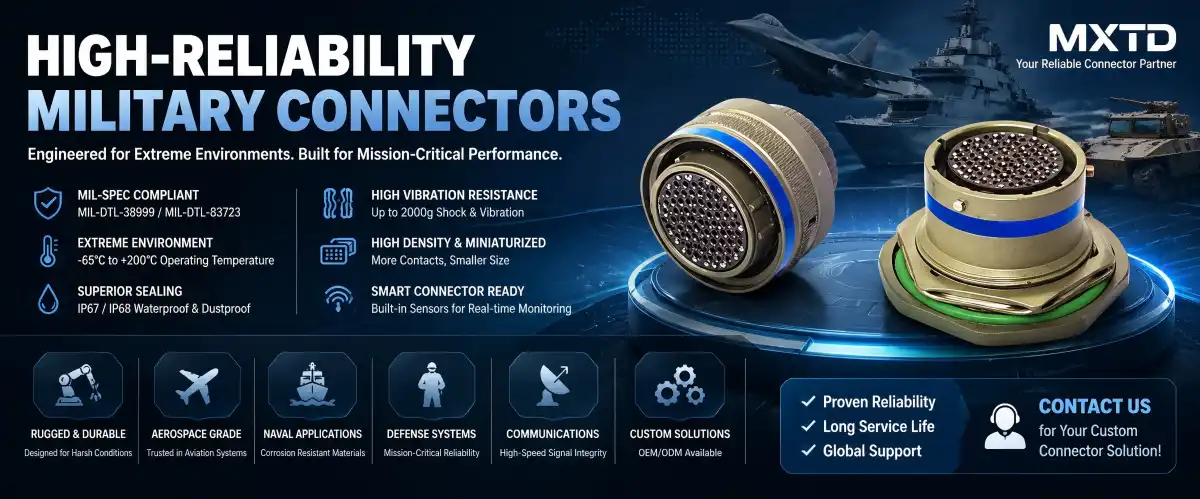
High-reliability military connectors are a special type of interconnect option that is made to work in harsh circumstances that would damage regular commercial parts. In security systems where failure is not a choice, these precise devices act as key connections.
What Distinguishes Military Connectors from Commercial Alternatives
The main difference between High-reliability military connectors and civilian connections is how they are designed and how rigorously they are tested. To get qualified, these connections have to go through a lot of tests that mimic years of combat stress, such as being exposed to salt spray, rapid temperature cycling, and sustained vibration. Commercial joints work well in controlled settings, but they don't have the right closing and material requirements for use on the battlefield. For military use, materials must have been tested and shown to work in temperatures ranging from -65°C to +200°C. Commercial versions, on the other hand, usually only work in a smaller range of temperatures. Precious metal covering, usually gold over nickel, is used on the contact systems to make sure that they keep working properly electrically and don't rust over many years of use.
Critical MIL Standards Governing Connector Design
The High-reliability military connector world is dominated by two standards: MIL-DTL-38999 and MIL-DTL-83723. The MIL-DTL-38999 line describes circular threaded connectors that are widely used in ships, cars on the ground, and airplanes. These connections have bayonet coupling methods and can handle different contact setups for tasks like sending high-speed data or distributing power. MIL-DTL-83723 covers subminiature circular connectors made for uses where weight and space are very important, like in aircraft and portable combat gear. Both standards set strict testing procedures, such as rules for insertion-extraction cycles, dielectric withstanding voltage, and stable contact resistance. Following these military standards ensures that all defense systems can talk to each other and gives buying teams faith in the performance and longevity of parts.
Material Science Behind Durability and Environmental Sealing
The materials used to make High-reliability military connectors have a direct effect on how well they work when they are stressed. Most shell parts are made of aluminum alloys, stainless steel, or specialized titanium alloys that are chosen for their high strength-to-weight ratios and ability to fight corrosion. Copper metals with controlled conductivity and spring properties are used in contact pins and sockets to make sure that the electrical performance stays the same even after thousands of joining cycles. Environmental sealing systems use fluorosilicone or fluorocarbon elastomers that stay flexible and seal well even when the temperature is very high or very low.
Latest Technological Advancements in Military Connector Design
High-reliability military connector technology developments are changing what can be used in tough environments. New improvements aim to improve performance while handling issues related to size, weight, and power use.
Advanced Alloys and Protective Coating Technologies
Nickel-cobalt superalloys and ceramic composite coatings are examples of advances in materials engineering that have made things last longer in harsh marine settings. When different metals in High-reliability military connector systems come into contact with each other, these new surface processes make barrier layers that stop galvanic corrosion. Atomic layer deposition methods use very thin protective films at the molecular level to make things more resistant to the environment without changing the size limits. Some companies now use diamond-like carbon layers on the contact areas of their products to keep them from wearing down after many mating cycles.
Miniaturization Without Compromising Reliability
Platform limitations in robotic aerial vehicles, wearable soldier systems, and tiny weapons have led to a move toward smaller form factors. Engineers have made micro-circular connectors that have more than 100 pins per square inch of contacts and still work properly to carry power and signals. Modern cutting methods allow for the precise production of small contact systems that meet the same standards for contact resistance as full-size High-reliability military connectors. Hermetic sealing technologies taken from semiconductor packaging now keep the insides of tiny connectors dry and free of particles and wetness. These small plugs pass the same MIL-STD-810 outdoor tests as their bigger counterparts.
Smart Diagnostics and Embedded Sensor Integration
Condition tracking features that give real-time working data are now built into designs for progressive connectors. Temperature monitors built into the bodies of connectors let system workers know when temperatures aren't normal, which happens before contacts or insulation break down. Some high-tech connectors have strain gauges that keep an eye on mechanical loads while they are being installed and used. This keeps damage from happening because screws are being over-torqued or cables are being pulled too hard. Some makers have put near-field communication chips inside connector shells. This lets the system automatically check the configuration and keep track of the repair records.
Comparing Military Connector Solutions: Performance, Brands, and Standards
Understanding the performance qualities and market placement of available choices is necessary to choose the right High-reliability military connector solutions. In different types of applications, different types of connection groups work best.
Performance Analysis of Leading Connector Families
With waterproof ratings up to IP68, the MIL-DTL-38999 series III connectors are the workhorse of High-reliability military connector systems. They have been tested and shown to work reliably in mild to harsh conditions. These threaded coupling connectors are very good at withstanding vibrations, and they can be used with a wide range of insert setups, from simple power distribution to complex signal mixing with coaxial and fiber optic contacts. The MIL-DTL-83723 line offers similar environmental protection in a much smaller package. This makes them perfect for applications with limited room where every cubic inch counts. Their quick-disconnect coupling system makes it easy to switch out tools quickly in the field. When you compare these groups, you have to choose between contact density, sealing strength in harsh environments, and ease of upkeep in the field. The 83723 series is better for protected but limited room installations, like aircraft bays and movable test equipment, while the 38999 series usually lasts longer in open settings that are exposed to the elements all the time.
Industry-Leading Manufacturers and Their Specializations
Amphenol Aerospace has a strong name for making special High-reliability military connector solutions that solve problems with integrating different platforms. They can make everything from standard catalog items to totally personalized systems with specific contact arrangements and sealing needs for the environment. ITT Cannon came up with many of the first military connector designs and keeps a lot of approval paperwork to help with the upkeep of old systems. Souriau, which is part of Eaton, makes high-temperature links for engine monitoring and exhaust systems that don't work with regular materials. TE Connectivity has a wide range of products, but its ruggedized data transmission connectors that serve current network-centric military systems are its specialty. Glenair mainly makes backshell accessories and wire termination systems that work with connector kits to make full interconnect solutions. When custom changes or application-specific testing are needed, knowing these maker specialties helps sourcing teams match the skills of suppliers to the needs of the project.
Certification Requirements and Quality Benchmarks
When buying High-reliability military connectors, you have to pay close attention to their approval status and factory certification. According to the military standard, products must have qualification test results that show they passed. Customers can look at these reports to see proof that the products met the requirements. AS9100 certification, the aircraft quality management standard that ensures process controls and traceability throughout production, should be maintained by manufacturing sites. Some defense programs need sellers to have more cybersecurity certifications, especially when connections have electronic parts or can be programmed. Concerns about counterfeit parts have made supply chain verification more important. Many procurement groups now require wholesalers to keep their AS6496 accreditation for aircraft counterfeit protection. When reviewing sources, ask to see proof of their quality systems, how they calibrate their test tools, and how they keep track of their materials. These quality standards give customers peace of mind that the goods they buy will work as promised for as long as they are in use.
Procurement Insights for High-Reliability Military Connectors
Effective High-reliability military connector sourcing methods balance technical needs with real supply chain issues. Knowing how buying works can help you avoid common mistakes.
Sourcing Strategies and Supplier Evaluation Criteria
A thorough evaluation of the seller is the first step in a successful connector purchase. Check more than just the product specs. See how technical the providers are and see if they are ready to offer application engineering help. At MXTD, our engineering team answers technical questions within an hour because they know that getting clear on specs quickly saves money and time. Check with providers to make sure they can give both standard catalog items and customized versions when changes are needed for specific applications. Resilience in the supply chain is important. If suppliers keep enough safety stock of widely stated setups, they can meet urgent program needs without having to wait for longer lead times.
Lead Times, Customization Options, and Minimum Orders
When bought through authorized wholesalers, standard High-reliability military connectors from well-known brands usually ship within four to eight weeks. Lead times may go up to twelve to sixteen weeks for custom configurations that need special insert arrangements, finishing requirements, or non-standard environmental sealing. This depends on how deep the manufacturing queue is. Some suppliers have minimum order amounts that make it impossible for prototype projects or small production runs to happen. We keep a stock of commonly requested connector types so that we can ship right away for pressing needs. Our minimum order amounts are also flexible so that they can be used for both prototype development and mass production. At MXTD, custom manufacturing is a collaborative process.
Cost Factors and Value Assessment
The price of a High-reliability military connector depends on a lot of factors besides just how much it costs to make. The makeup of the raw materials has a big effect on the price. For example, connectors with valuable metal contacts and exotic alloy shells cost a lot more, but they work well in harsh settings, so the extra cost is worth it. Costs for testing and certification are spread out over a large number of orders, which makes special orders for small amounts more expensive than store items. Different providers have very different markups for distribution, and some keep their businesses very lean, which lets them offer low prices. When figuring out value, you shouldn't just look at the unit price, but also the total cost of ownership. Field failures that lead to guarantee claims, emergency replacement costs, and platform downtime are less likely to happen when connectors are of higher quality and have better contact retention and weather sealing. MXTD's pricing structure shows our position as a cost-effective option to high-end brand connectors.
Strategic Recommendations: Selecting the Right Military Connector for Your Application
To choose the best High-reliability military connector, you need to carefully compare the technical needs with the options that are offered. Several key factors need to be carefully thought through.
Matching Connector Specifications to Operational Requirements
Start by writing down the conditions that your High-reliability military connector will have to work in throughout its lifetime. Extreme temperatures, vibration patterns, exposure to damp, and chemical interactions all affect the choice of material and the closing needs that must be met. Electrical standards like voltage ratings, current capacities, signal frequencies, and electromagnetic compatibility limit the number of good connector types. Selecting a connector style is based on mechanical factors like the number of mating cycles needed, the load that the wire needs to hold, and how easy it is to do upkeep in the field. Acceptable form factors are limited by things like available mounting room, weight limits, and the ability to work with current equipment.
Future-Proofing Through Emerging Technology Adoption
Connector choices made today should be able to adapt to how technology will change over the life of the platform. Think about getting connections that can handle higher data rates than what is needed right now. This will leave room for future improvements to sensors and communications. As system designs change, modular contact systems that let you change the assignments of signal and power pins in the field offer freedom. Connectors that have built-in monitoring tools put platforms in a position for predictive maintenance strategies that defense logistics groups are using more and more. When looking at new connector technologies, you should weigh the benefits of innovation against the risks of technology growth. Early use of designs that haven't been tested can cause approval delays and dependability issues in the field, and making conservative choices may limit future improvements in capability.
Partnership Value: Technical Support and Long-Term Collaboration
The connection with the supplier is just as important as the goods. Quick technical help speeds up the merging of designs and fixes problems in the field as they happen. Suppliers that offer application engineering help make the best choices for connectors early in the design process, when it costs the least to make changes. As platforms go into production, projects stay on track thanks to suppliers who deliver on time and with uniform quality. Long-term partnerships let sellers guess what you'll need by keeping an inventory of commonly bought combinations and making it easier to process repeat orders. MXTD has over twelve years of experience in making precision connectors and testing tools that work with aerospace, military, and research institutions. Our skilled research and development team makes both standard goods that meet industry standards and custom solutions that are made to fit the needs of each application.
Conclusion
The High-reliability military connector business keeps moving forward by using new materials, making things smaller, and incorporating smart technology. The latest trends focus on longer working life in harsh settings, smaller and lighter designs, and built-in diagnostics that help with predictive maintenance. When procurement teams look at connector options, they should compare the technical specs to the practical needs and think about the supplier's skills, quality standards, and long-term support. The best connector choices strike a mix between current speed needs and future scalability. This makes sure that platforms can adapt to changes in technology as they are used. Defense projects get the reliable interconnect solutions their mission-critical systems need by working with experienced suppliers that offer both standard goods and the ability to make changes to them.
FAQ
What skills do High-reliability military connectors need to have?
High-reliability military connectors have to pass approval tests that are based on MIL-DTL standards. These tests show how well the connectors work in harsh conditions like changing temperatures, vibrations, dampness, salt spray, and mechanical shocks. Customers should be able to look at qualification paperwork that proves the connection design meets all the requirements spelled out in the specifications.
How can I tell if a connection is real and stay away from fakes?
For counterfeit protection, only buy from authorized dealers who are AS6496 certified. With every sale, you should ask for material tracking documents and proof of conformance. Check the credentials of the seller using maker authorization lists, and look over the goods you receive to make sure they have the right markings and that the paperwork is correct.
Can High-reliability military connectors be changed to fit different needs?
A lot of High-reliability military connectors can be customized to have different insert arrangements, different plating choices, different weather sealing, and different wire terminations. Talk about the standards as early as possible in the design process, since some changes could affect the qualification status and need more testing.
How often do High-reliability military connectors need to be serviced?
Check joints for damage, rust, or debris buildup on a regular basis. Use approved liquids and soft brushes to clean your contacts. Make sure that the torque on threaded connection devices is correct. Replace joints that have worn contacts, broken binding surfaces, or insulation that has been worn down. Keep track of what was found during inspections and what was done to fix things.
Partner with MXTD for Your High-Reliability Military Connector Requirements
Xi'an Mingxi Taida Information Technology Co., Ltd. offers complete interconnect options that include standard goods in the industry as well as the ability to make changes to fit your needs. Precision High-reliability military connectors, PXIe chassis systems, and combined testing tools for aircraft, defense, and research use are all things we know how to make. We keep a ready supply of commonly ordered setups on hand, and we also offer ODM and OEM customization to meet the specific needs of each application. Because we promise to respond quickly, we answer technical questions within an hour and make the production schedule for special orders clear. As a reliable provider of High-reliability military connectors, we offer cheaper options to name-brand products that don't skimp on quality or performance. Specialized transportation services use packaging that is resistant to wetness, shock, and static electricity to keep precision parts safe while they are in transit. You can see how much we care about our customers' success by using our free software updates, remote video technical help, and full warranty coverage. Get in touch with our team at manager03@mxtdinfo.com to talk about how MXTD can meet your connection needs with its proven knowledge and quick service.
References
1. Smith, J.R., "Military Connector Technology: Standards and Applications," Defense Electronics Handbook, 2022.
2. Anderson, M.K., "Material Science Advances in Harsh Environment Interconnects," Journal of Aerospace Engineering, Vol. 35, No. 4, 2023.
3. Williams, P.T., "MIL-DTL-38999 Connector Systems: Design and Qualification," Society of Automotive Engineers Technical Paper Series, 2021.
4. Chen, L.H., "Reliability Assessment of Military Circular Connectors Under Extreme Conditions," IEEE Transactions on Components and Packaging Technologies, Vol. 46, No. 2, 2023.
5. Roberts, D.M., "Supply Chain Management for Defense Electronics Components," Aerospace Manufacturing Journal, Spring 2023.
6. Thompson, K.E., "Emerging Technologies in Military Interconnect Systems," International Conference on Military Electronics Proceedings, 2022.
Our customers’ satisfaction speaks for our quality — contact us to experience the same reliable service.