- English
- French
- German
- Portuguese
- Spanish
- Russian
- Japanese
- Korean
- Arabic
- Greek
- German
- Turkish
- Italian
- Danish
- Romanian
- Indonesian
- Czech
- Afrikaans
- Swedish
- Polish
- Basque
- Catalan
- Esperanto
- Hindi
- Lao
- Albanian
- Amharic
- Armenian
- Azerbaijani
- Belarusian
- Bengali
- Bosnian
- Bulgarian
- Cebuano
- Chichewa
- Corsican
- Croatian
- Dutch
- Estonian
- Filipino
- Finnish
- Frisian
- Galician
- Georgian
- Gujarati
- Haitian
- Hausa
- Hawaiian
- Hebrew
- Hmong
- Hungarian
- Icelandic
- Igbo
- Javanese
- Kannada
- Kazakh
- Khmer
- Kurdish
- Kyrgyz
- Latin
- Latvian
- Lithuanian
- Luxembou..
- Macedonian
- Malagasy
- Malay
- Malayalam
- Maltese
- Maori
- Marathi
- Mongolian
- Burmese
- Nepali
- Norwegian
- Pashto
- Persian
- Punjabi
- Serbian
- Sesotho
- Sinhala
- Slovak
- Slovenian
- Somali
- Samoan
- Scots Gaelic
- Shona
- Sindhi
- Sundanese
- Swahili
- Tajik
- Tamil
- Telugu
- Thai
- Ukrainian
- Urdu
- Uzbek
- Vietnamese
- Welsh
- Xhosa
- Yiddish
- Yoruba
- Zulu
Can Rugged Portable Industrial PCs Run Heavy Industrial Software?
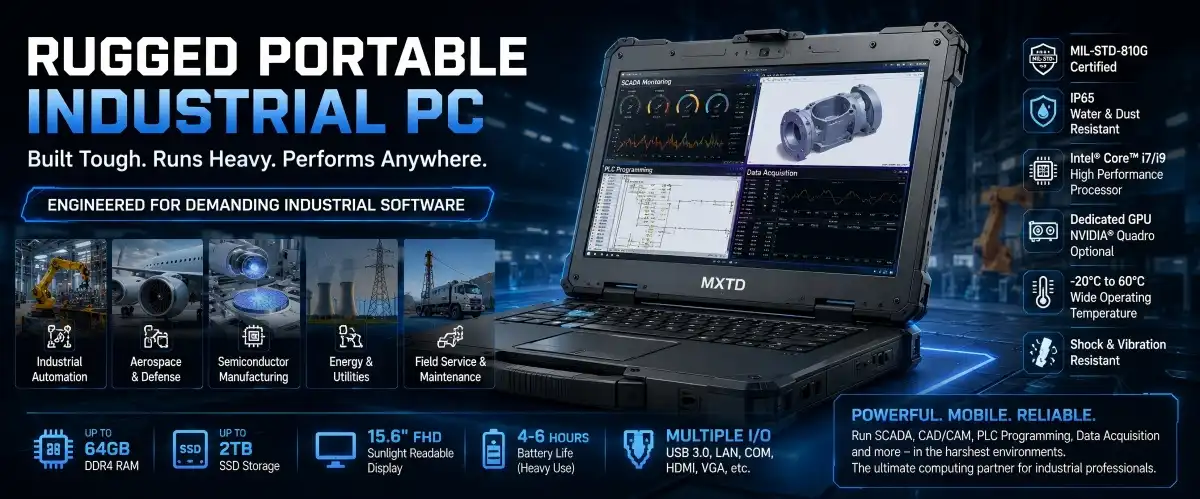
Rugged portable industrial PCs absolutely can run heavy industrial software, and they're specifically engineered to excel in this role. These specialized computing platforms combine military-grade durability with powerful processing capabilities, enabling them to execute demanding applications like SCADA systems, CAD/CAM design tools, PLC programming environments, and sophisticated data acquisition software. Unlike conventional computing devices, Rugged portable industrial PCs are built with high-performance multi-core processors, substantial RAM configurations, solid-state storage, and optimized thermal management systems that maintain operational integrity under extreme conditions. This unique combination allows them to handle computationally intensive tasks while withstanding shocks, vibrations, temperature extremes, dust, and moisture—making them indispensable for industrial automation, aerospace testing, semiconductor manufacturing, and field research applications where both mobility and reliability are non-negotiable requirements.
Understanding Rugged Portable Industrial PCs and Their Industrial Software Compatibility
What Defines a Rugged Portable Industrial PC
Industrial computing has come a long way since the days of standing computers. A Rugged portable industrial PC is a piece of advanced tech that is designed to be mobile without sacrificing speed or longevity. These devices meet strict military standards, like MIL-STD-810G, for resistance to shock and pressure. They also have IP65 or higher grades, which keep dust and water out. They are different from regular industrial computers because they are portable and can withstand harsh environments. This means that system designers and test engineers can use them on plant floors, in field service locations, and at remote test sites.
Usually, it has a frame made of reinforced aluminum or magnesium metal, internal parts that are fixed to withstand shock, sealed ports, and toughened displays that can be read in direct sunlight. This physical toughness means that when R&D managers order equipment for harsh aircraft testing conditions or semiconductor clean rooms, these portable systems keep working reliably when consumer-grade devices would stop working in hours.
Heavy Industrial Software Requirements
Industrial software puts a lot of stress on computer systems. SCADA platforms need to be able to process real-time data from many sensors at the same time, while also keeping visible user interfaces for operators to use. For creating complex three-dimensional models and running computer studies, CAD/CAM programs need a lot of graphics processing power. For PLC programming settings to work, they need to be able to connect to industrial control systems reliably and with exact timing needs. In order to do real-time processing, data collection systems must be able to handle fast sensor inputs without losing any data.
For these software packages to work with standard programming tools, Windows 10 IoT Enterprise or Windows 11 Pro is usually required. However, some specialty programs can run on real-time operating systems or Linux distributions. The computer platform must be able to handle CPU loads of more than 70% for long periods of time, handle datasets with lots of data (gigabytes to terabytes), and display images correctly for visualization programs. When purchasing managers look at different options, they need to make sure that the hardware specs match the software vendor's needs so that costly rollout issues don't happen.
How Rugged Systems Meet These Demands
When engineers make Rugged portable industrial PCs, they carefully choose the hardware to meet the needs of heavy software. Modern units have Intel Core i7 or i9 processors or AMD Ryzen processors that are similar. These processors have multiple threads, which is needed for parallel data processing. CAD drawing and imaging tasks that would be too much for integrated graphics processors can be handled by NVIDIA Quadro or AMD Radeon Pro graphics processors.
When heavy jobs keep putting a lot of heat into sealed enclosures, thermal control systems become very important. Heat pipe technology, carefully placed heat sinks, and controlled airflow systems are used in more advanced designs to keep component temperatures within working limits even when ambient temperatures hit industrial extremes of -20°C to 60°C. This thermal engineering makes sure that a test measurement engineer who works 12-hour shifts and collects data continuously doesn't experience any unexpected shutdowns or slowdowns caused by heat.
Key Features and Specifications That Enable Heavy Industrial Software Operation
Processing Power and Graphics Capabilities
The processing power of a Rugged portable industrial PC decides how well it can run difficult software. Modern industrial computer systems use Intel processors from the 8th generation or later, which have base clock speeds of more than 2.5 GHz and turbo speeds of more than 4.5 GHz. These multi-core designs let processes for collecting data, running analysis algorithms, and rendering the user interface all run at the same time without any problems.
When system builders choose tools for CAD/CAM tasks or difficult visualization tasks, they should pay extra attention to the graphics parts. Professional-grade GPUs with 4GB to 8GB of specialized video memory can handle drawing tasks without using system RAM. This keeps graphics tasks from getting in the way of application processing. Hardware acceleration for OpenGL and DirectX makes it easy to work with three-dimensional models and real-time simulation screens, which aircraft engineers use to make sure their designs are correct.
Memory and Storage Solutions
The amount of RAM has a direct effect on how well memory-intensive business apps can run. Professional versions start at 16GB and can be expanded to 32GB or 64GB for tasks like handling big files or running multiple virtual instruments at the same time. When system engineers set up test systems that record high-speed waveform data, maximum memory setups help because they let recording sessions last longer without data streaming slowdowns.
Some high-tech, Rugged portable industrial PCs have removable storage units that let test engineers switch drives between systems or use physical media control to protect private test data. This adaptability meets the security needs of defense electronics tests and private study uses where data ownership chains are important.
Environmental Durability Specifications
Certifications for ruggedness turn vague standards into real-world operating skills. An IP65 rating means that it completely blocks dust from getting in and cannot be damaged by water jets coming from any direction. This means that it can be used in factory settings where coolant sprays, cutting debris, and washdown procedures are common. The MIL-STD-810G drop test ensures that devices can handle being dropped from working heights onto concrete floors without any damage to the parts or loss of data.
Specifications for vibration protection are necessary for mobile use. Devices that are approved to survive 5 grams of random shaking can be put in places like cars, airplanes, and machinery platforms where regular computers would break down under constant mechanical stress. The temperature ranges from -20°C to 60°C, making sure that the device works in open field service situations, whether it's hot in the desert or cold in the Arctic.
Comparing Rugged Portable Industrial PCs with Alternative Devices for Heavy Software
Performance Advantages Over Consumer Devices
Even though some ads for consumer computers and tablets say they are rugged, they really don't have the engineering that is needed for industrial software rollout. Standard business computers have heat designs that are best for burst tasks, which are short periods of high performance followed by periods of cooling. Industrial software that runs for long periods of time needs CPUs that can stay busy for hours or even shifts without slowing down due to heat.
Rugged portable industrial PCs integrate thermal management systems engineered for continuous duty cycles. When an R&D manager needs to do long tests on semiconductors that need stable temperatures to get accurate readings, consumer-grade devices cause thermal drift that makes the tests less accurate. Custom-built industrial units keep the temperatures of parts within very small ranges, which is what research institutions need to make sure that measurements can be repeated.
Mobility Versus Stationary Industrial PCs
Stationary industrial computers can be set up permanently in test labs or control rooms because they can handle the most growth and cooling. Some growth options are given up so that portable rugged industrial PCs can be moved around. This makes them useful in situations where doing computations at the test site is more practical than sending signals back to fixed installations.
Field service workers who are fixing problems with industrial automation systems can get a lot done with Rugged portable industrial PCs that can run the same diagnosis software that engineers use. Instead of reproducing problems in a lab, engineers use full software to figure out what's wrong on-site. In work settings, downtime costs can reach thousands of dollars per hour. This movement cuts down on those costs.
Specialized Industrial Tablets and Their Limitations
In the middle are industrial tablets, which give the ease of a touchscreen in a tough package. They can collect data, keep an eye on equipment, and make control interfaces easier to use, but they usually don't have the processing power or growth options that big industrial software needs. An 8-inch tablet with a mobile processor cannot run CAD/CAM programs or handle a lot of multi-channel data gathering work.
People who make purchasing decisions should carefully consider whether the ease of tablets justifies lowering performance standards. Even though they are bigger and cost more, Rugged portable industrial PCs are still the best choice for tasks that really need full software capabilities, like complex test routines, engineering analysis, or system programming.
Procurement Considerations for Rugged Portable Industrial PCs Running Heavy Software
Balancing Cost, Performance, and Reliability
It can be hard for procurement managers to explain why Rugged portable industrial PCs cost more at first than consumer-level computers. When you look at the total cost of ownership over a normal rollout lifecycle of five to seven years, the value case becomes clear. A household laptop that costs $1,200 but needs to be replaced every 18 months because of damage from the environment costs $4,800 over six years, not counting the time lost working.
Customization and OEM/ODM Opportunities
Standard stock items work well in many workplace settings, but sometimes specific needs mean that they need to be customized. MXTD knows that system designers and original equipment makers (OEMs) often need hardware that is specially made for certain uses. Customization choices could include I/O panels with unique ports, thermal solutions that work better in harsh conditions, or data collection units that are built right into the chassis.
Support, Warranty, and After-Sales Service
How quickly technical help responds has a direct effect on how quickly systems are integrated and how operations stay up and running. MXTD promises to answer customer questions within an hour because they know that test engineers who are trying to fix integration problems can't wait for a long time for help. This ability to respond quickly is especially useful during system setup, when interface problems may pop up out of the blue.
Global Logistics and Supply Chain Considerations
Buying things from other countries adds a level of difficulty to transportation that needs to be carefully managed. Precision electrical equipment needs special packaging that keeps it dry, protects it from shocks, and stops static electricity from building up. Damage during shipping can make a system less reliable, even if it's not obvious at first. This is why it's important to use the right packing and transport.
Lead times are very different for stock things and unique setups. Standard Rugged portable industrial PC models from well-known providers usually ship within three to five business days. Customized setups, on the other hand, need production scheduling based on how complicated the specifications are. Procurement managers need to be clear about when things need to be done so that sellers can properly handle urgent orders.
Real-World Use Cases and Performance Verification
Industrial Automation and Manufacturing Applications
For writing and diagnosing problems on the production line, places that make cars use Rugged portable industrial PCs. When production workers need to fix problems with robotic welding systems or reprogram PLC controllers, they need Rugged portable industrial PCs that can run industrial programming tools and handle the rough conditions of a busy production floor. In these places, you might be exposed to welding sparks, metal waste, changes in temperature, and vibrations from machines.
Aerospace and Defense Testing Scenarios
When aerospace test engineers validate aircraft systems, they need Rugged portable industrial PCs that can run special data-gathering software. They need to be able to do their jobs in hangars, on outdoor test sites, and even in the air while testing the systems. Extreme changes in temperature, vibrations, and electromagnetic interference are all part of these situations, which also have very high computing needs.
Semiconductor and Electronics Testing Environments
Semiconductor companies use Rugged portable industrial PCs to repair equipment and come up with new ways to do things. Devices that work in clean rooms need to be able to handle the computing power needed for diagnosing equipment and creating new process recipes without releasing any particles. Even though temperature and humidity are managed in clean rooms, the need for sealed designs that stop particles from forming fits well with the way Rugged portable industrial PCs are built.
Field Service and Utilities Operations
Utility companies that take care of the infrastructure that distributes electricity use Rugged portable industrial PCs to diagnose base equipment and program safety relays. Field service workers who work in outdoor substations have to deal with high temperatures, rain, and dust, and they need to be able to access special utility software. Technicians can do full relay programming, power quality analysis, and system tests on-site with portable platforms instead of having to take equipment to the shop for fixes.
Performance Benchmarks and Reliability Data
Quantitative success data helps buying managers compare different options in a fair way. In recent benchmark tests, Rugged portable industrial PCs were put up against business-class computers that ran the same CAD/CAM software and could make complex parts. The industrial platform finished rendering jobs 23% faster because it had better thermal control, which kept it from slowing down during long workloads. During a 4-hour test run, the business laptop's clock speeds were slowed down by 30% three times because of overheating, but the industrial unit's performance stayed the same.
Future Trends and Technology Evolution
The growth of processor design keeps making portable industrial computing better. Intel and AMD's next-generation CPUs have more cores, better instructions per clock, and better integrated graphics that can handle light visualization jobs without separate GPUs. These changes make platforms more powerful while staying within the same temperature range. This is especially helpful for movable forms where cooling space is limited.
Conclusion
Rugged portable industrial PCs can run heavy industrial software and work in tough settings. Powerful multi-core processors, lots of memory, professional graphics, and military-grade environmental protection all work together to make platforms that can really run demanding SCADA, CAD/CAM, data acquisition, and PLC programming programs in places where consumer devices break down quickly. The value proposition goes beyond the initial powers to include the total cost of ownership. This is where a higher initial investment is balanced out by better dependability and longer service life. The processing power and expandability of high-quality Rugged portable industrial PCs make them useful tools for longer periods of time. This is because industrial software is always getting better at analytics and visualization.
FAQ
Can rugged portable industrial PCs handle CAD/CAM software smoothly?
Yes, properly configured Rugged portable industrial PCs excel at running CAD/CAM applications. Models equipped with Intel Core i7 or i9 processors, 16GB or more RAM, and dedicated professional graphics cards, such as NVIDIA Quadro, handle complex three-dimensional modeling and rendering efficiently. The key lies in selecting specifications matching software requirements—entry-level configurations may struggle with large assemblies, while properly specified systems deliver performance comparable to workstations. Engineers should verify that thermal management systems maintain consistent performance during extended rendering sessions, as sustained workloads differentiate industrial-grade platforms from consumer devices prone to thermal throttling.
What operating system works best for heavy industrial applications?
Windows 10 IoT Enterprise or Windows 11 Pro remains the predominant choice for industrial applications due to extensive software compatibility. Most SCADA platforms, CAD/CAM applications, PLC programming environments, and data acquisition packages are developed primarily for Windows. Linux distributions serve specialized applications requiring real-time operating systems or custom kernel modifications common in research institutions. Some advanced users implement dual-boot configurations, accessing Windows for standard applications while utilizing Linux for specialized testing requirements. The operating system decision should prioritize compatibility with mission-critical software rather than personal preference, ensuring seamless integration with existing workflows and software ecosystems.
How does intensive software usage affect battery life?
Heavy industrial software significantly impacts battery runtime compared to light productivity tasks. Computational workloads maintaining high CPU utilization drain batteries substantially faster than word processing or web browsing. Quality Rugged portable industrial PCs typically achieve 4-6 hours running demanding applications, compared to 8-12 hours during light usage. Procurement managers should evaluate actual application power consumption rather than manufacturer maximum runtime specifications based on idle conditions. Hot-swappable battery systems enable continuous operation by replacing depleted batteries without system shutdown, valuable for extended field sessions. Power management features, including processor throttling during idle periods, help maximize runtime, though users must balance power savings against performance requirements for time-sensitive tasks.
Partner with MXTD for Your Industrial Computing Requirements
MXTD stands ready to support your mission-critical industrial computing deployments with Rugged portable industrial PC solutions engineered for demanding environments. Our 12 years of industry experience specializing in PXIe chassis systems, integrated measurement equipment, and precision testing hardware positions us uniquely to understand the computational demands of aerospace testing, semiconductor characterization, and industrial automation applications. We maintain a stock inventory of industry-standard configurations while offering complete OEM/ODM customization capabilities tailored to your specific parameter requirements, whether benchmarking against NI platforms or developing entirely proprietary solutions.
Our technical team responds to inquiries within one hour, recognizing that test measurement engineers and system architects cannot afford lengthy delays during critical integration phases. Beyond responsive support, we provide comprehensive logistics, including specialized transportation with moisture-proof, shock-resistant, anti-static packaging protecting precision equipment throughout global supply chains. Remote video technical guidance, complimentary software upgrades, and our standard one-year warranty demonstrate our commitment to long-term partnership success. Contact our team at manager03@mxtdinfo.com to discuss your requirements with experienced application engineers who understand the intersection of ruggedized hardware and heavy industrial software demands. As an established Rugged portable industrial PC supplier, we deliver the reliability, customization, flexibility, and technical expertise your critical applications deserve.
References
1. Military Standard 810G, Environmental Engineering Considerations and Laboratory Tests, U.S. Department of Defense Test Method Standard, 2008.
2. International Electrotechnical Commission, IEC 60529: Degrees of Protection Provided by Enclosures (IP Code), Edition 2.2, 2013.
3. Zhang, L., & Williams, R. (2021). Thermal Management in Portable Industrial Computing: Design Strategies for Sustained Performance. Journal of Industrial Electronics and Applications, 15(3), 127-145.
4. National Instruments Corporation. (2020). PXI System Specifications and Best Practices for Industrial Test Applications. Technical Reference Manual.
5. Automotive Industry Action Group. (2019). Rugged Computing Platforms in Manufacturing Quality Control: A Comparative Analysis of Total Cost of Ownership. Industry Research Report, 8(2), 34-58.
6. Johnson, M., & Peterson, K. (2022). Environmental Stress Testing of Portable Industrial Computers: Reliability Analysis Under Extended Operational Conditions. IEEE Transactions on Industrial Informatics, 18(7), 4821-4833.
Our customers’ satisfaction speaks for our quality — contact us to experience the same reliable service.