- English
- French
- German
- Portuguese
- Spanish
- Russian
- Japanese
- Korean
- Arabic
- Greek
- German
- Turkish
- Italian
- Danish
- Romanian
- Indonesian
- Czech
- Afrikaans
- Swedish
- Polish
- Basque
- Catalan
- Esperanto
- Hindi
- Lao
- Albanian
- Amharic
- Armenian
- Azerbaijani
- Belarusian
- Bengali
- Bosnian
- Bulgarian
- Cebuano
- Chichewa
- Corsican
- Croatian
- Dutch
- Estonian
- Filipino
- Finnish
- Frisian
- Galician
- Georgian
- Gujarati
- Haitian
- Hausa
- Hawaiian
- Hebrew
- Hmong
- Hungarian
- Icelandic
- Igbo
- Javanese
- Kannada
- Kazakh
- Khmer
- Kurdish
- Kyrgyz
- Latin
- Latvian
- Lithuanian
- Luxembou..
- Macedonian
- Malagasy
- Malay
- Malayalam
- Maltese
- Maori
- Marathi
- Mongolian
- Burmese
- Nepali
- Norwegian
- Pashto
- Persian
- Punjabi
- Serbian
- Sesotho
- Sinhala
- Slovak
- Slovenian
- Somali
- Samoan
- Scots Gaelic
- Shona
- Sindhi
- Sundanese
- Swahili
- Tajik
- Tamil
- Telugu
- Thai
- Ukrainian
- Urdu
- Uzbek
- Vietnamese
- Welsh
- Xhosa
- Yiddish
- Yoruba
- Zulu
Are RF Coaxial Airtight Connectors Suitable for Vacuum Systems?
RF Coaxial Airtight Connector solutions work great with vacuum systems as long as they are properly configured. These unique parts offer great airtight sealing with leak rates as low as ≤1×10⁻³ Pa·cm³/s. This keeps the signal pure across frequencies and stops atmosphere contamination. The RF Coaxial Airtight Connector uses precision-engineered metal alloys and glass insulation to make vacuum barriers that work well without affecting electrical performance. When used in aerospace testing chambers, equipment for making semiconductors, or research labs that work in vacuums, these connectors keep the environment separate and send microwave signals consistently. This makes them essential for demanding industrial applications.
Introduction
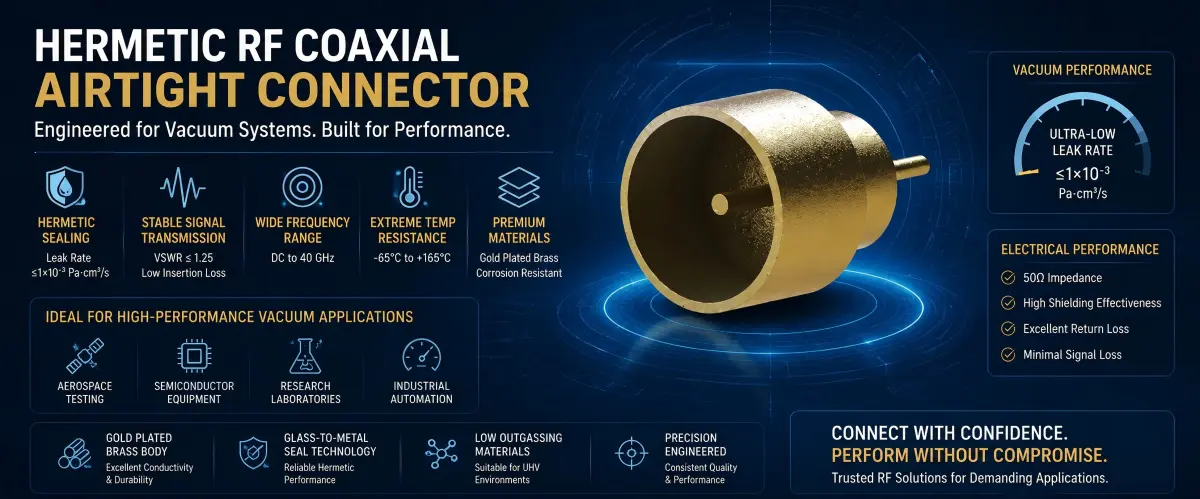
Every part of a vacuum system designed for aerospace tests, semiconductor production, or advanced research must be completely reliable. It only takes one broken seal to ruin months of research or make expensive tools useless. Because of this, R&D managers and test engineers are under a lot of pressure to find parts that won't break when partial pressures drop and environmental demands rise.
Vacuum-compatible RF feedthroughs are an important point where the quality of the electromagnetic data meets the needs for hermetic closing. Standard coaxial connections are made for normal situations. Vacuum-rated solutions, on the other hand, must stop gas from passing through while keeping impedance matching and insertion loss as low as possible. It's even harder when working temperatures change from very cold to very hot, or when systems need to be reliable for a long time without being able to be serviced.
This guide is made for procurement managers and system engineers who are looking at hermetically sealed RF interconnects for vacuum settings and need help. We look at things like performance requirements, supplier selection factors, material science issues, and real-life application situations. As always, our major goal is to help technical leaders find the right RF Coaxial Airtight Connector that meets both engineering needs and budget limits. This will help projects succeed in areas like industrial automation, defense systems, and precise measurement.
Understanding RF Coaxial Airtight Connectors in Vacuum Environments
Core Construction and Sealing Mechanisms
Standard threaded RF connections and hermetically sealed microwave plugs are built in very different ways. The vacuum-compatible versions of the RF Coaxial Airtight Connector have glass-to-metal plugs that stop gas from moving at the molecular level. High-temperature sintering methods are used to join specially made low-expansion metals with carefully planned glass compositions in this sealing method. When this happens, the interface makes a permanent bond that can survive differences in temperature growth from -65°C to +165°C.
Differentiating Airtight and Hermetic Performance Levels
It is common for technical specs to mix up the terms "airtight" and "hermetic," but they actually refer to different levels of performance. Airtight seals stop large amounts of gas from moving through them and keep the pressure level at a level that is good for industrial processes. Hermetic seals have much lower leak rates (10⁻⁹ mbar·L/s) than are needed for ultra-high vacuum systems in semiconductor lithography or space modeling rooms. Qualified vacuum feedthroughs undergo helium mass spectrometry leak tests to ensure parts with leak rates of less than 1×10⁻³ Pa·cm³/s are achieved.
Environmental Protection and Signal Integrity Benefits
Using the right vacuum-rated interconnects gives your system more benefits than just shielding. Moisture avoidance stops dielectric breakdown and corrosion of center wires, which increases the useful life of parts in harsh settings. This safety is especially helpful in systems that go from a vacuum to normal air, because condensation would damage regular connections otherwise. Due to the stable dielectric features of glass shielding, signal quality gets better. Glass doesn't change its electrical properties like polymer insulators do, even when the temperature and humidity change.
Key Technical Considerations for Vacuum System Applications
Material Science and Outgassing Prevention
The types of materials used in vacuum systems have a direct effect on the amount of contamination and the final pressure that can be reached. Standard brass connection bodies and zinc-plated parts let out large amounts of gas, which makes pump-down times longer and base pressures higher. Vacuum-qualified RF Coaxial Airtight Connector options have housings made of 300-series stainless steel and nickel or gold finishes on the outside that give off very little gas.
Critical Performance Specifications
There are a number of requirements that need to be carefully checked when looking at vacuum-compatible radio interconnects. To keep reflections from messing up signal readings, characteristic impedance must stay at 50±2Ω across all frequency bands. The required airtightness level of ≤1×10⁻³ Pa·cm³/s works for high vacuum ranges, but ultra-high vacuum systems might need even stricter requirements. Dielectric withstand voltage ratings above 300V keep the voltage across the insulator from breaking down, while insulation resistance greater than 5000MΩ proves that the center wire is effectively isolated from ground.
Testing Protocols and Quality Verification
RF Coaxial Airtight Connector manufacturers use thorough testing methods to check both the electrical performance and the quality of the airtight seal. Helium leak detection is still the usual way to check a seal because it is sensitive enough to find leakage at the molecular level. Parts that pass this check get certificates that show how much leakage they had and how the tests were done. Swept-frequency readings of insertion loss, return loss, and VSWR across the connector's intended working span should be part of its electrical characterization to reveal where impedance changes and dielectric losses happen.
Selecting the Right RF Coaxial Airtight Connector for Your Vacuum System
Application-Specific Requirements Analysis
The connection needs of vacuum system users are very different. When working at intermediate vacuum levels (10⁻³ to 10⁻⁶ mbar), semiconductor process equipment puts chemical resistance and temperature stability ahead of complete leak tightness. Aerospace weather test tanks need to be able to handle a wider range of temperatures and be reliable when the pressure changes quickly. System planners should write down all of these application-specific factors in detail to select the optimal RF Coaxial Airtight Connector.
Comparative Evaluation Criteria
When you look at completely sealed RF options from different companies, you can tell them apart in more ways than just the specs. Yield rates and quality stability are affected by how old the manufacturing process is, especially for glass-to-metal sealing operations. If a supplier has written down their quality systems and tracking methods, you can be more sure that the performance will be the same from batch to batch. The ability to provide technical help has a big effect on the success of a project, especially when unique vacuum systems are being integrated.
Custom Solutions and OEM Capabilities
A lot of the time, vacuum system designers have needs that standard stock parts can't meet. Custom designs are often needed because of non-standard flange connections, specific frequency bands, or different mounting shapes. This ability to be customized is shown by MXTD, which offers a wide range of OEM and ODM services that allow for parameter-specific changes. Their engineering team works with customers to make sure that connection designs are the best they can be for different vacuum chamber setups, frequency needs, or environmental conditions.
Cost and Supply Chain Factors
Pricing Models and Total Cost Analysis
Due to their unique materials, precise production methods, and strict testing requirements, vacuum-qualified RF Coaxial Airtight Connector components are more expensive than normal atmospheric connections. When it comes to frequency range, power handling, and hermeticity levels, unit costs change a lot. Instead of just comparing unit prices, procurement managers should look at the total cost of ownership, which includes things like how reliable the product is, how long the guarantee lasts, and how easy it is to get technical help.
Supplier Reliability and Logistics Considerations
RF Coaxial Airtight Connector plays an important role in many systems, so supply chain stability is very important. Long-term success can be judged by looking at a supplier's financial health, production capacity, and quality system certifications. MXTD solves transportation problems by using special packaging designed for transporting precision instruments. This packaging includes moisture barriers, shock-resistant padding, and anti-static materials that protect parts during international shipping, ensuring that the precision microwave connectors arrive without damage.
Warranty and Technical Support Infrastructure
Support after delivery is what sets professional sellers apart from stock vendors. Comprehensive guarantee programs that cover flaws in the manufacturing process protect you financially if a part fails. Standard in the industry is a one-year guarantee, but some providers offer longer coverage for large customers. Customers can get better system designs and installation problems solved by suppliers who offer online video assistance, application notes, and engineering advice, lowering the overall risk of the project.
Case Studies and Practical Applications
Aerospace Environmental Testing Implementation
A large aerospace company working on the next generation of satellite systems needed solid RF Coaxial Airtight Connector feedthroughs for thermal vacuum tanks that simulated space conditions. The engineering team asked for coaxial feedthroughs that were covered with glass and had iron-tungsten-magnesium center conductors that were perfectly matched to the way glass expands and contracts. These parts survived more than 500 thermal cycles without a noticeable drop in leak rate, meeting standards for airtightness during long test runs.
Semiconductor Fabrication Equipment Enhancement
A company that makes semiconductor equipment had problems with vacuum systems getting dirty due to normal PTFE-insulated RF connections giving off gas. Changing to glass-dielectric sealed connections got rid of the source of the outgassing and made them more resistant to chemicals. The building, which was made of only metal and clay, did not break down in reactive plasma settings. Within three production runs, higher component prices were supported by higher wafer yields, showing a real return on investment.
Research Laboratory Particle Accelerator Integration
A university's physics department was updating a particle accelerator beamline and needed to send stable RF power into areas with very high vacuum levels, close to 10⁻⁹ mbar. The engineering problems were solved by custom-made vacuum feedthroughs with longer mounting flanges, which also kept leak rates below 1×10⁻⁹ mbar·L/s. Once it was set up, the beamline met the design vacuum requirements and kept stable pressure levels during long testing runs, allowing for precise control of the RF field inside the accelerator structure.
Conclusion
Choosing the right RF Coaxial Airtight Connector for vacuum systems has a direct effect on how well the system works, how reliable it is, and how successful the project is. These special parts connect the atmosphere and the vacuum, which is an important gap between them. Material science, sealing technology, electrical specs, and weather compatibility are just some of the technical issues that need to be carefully weighed against the needs of the particular application. Properly choosing components has measurable benefits in the real world, such as higher system reliability and more accurate measurements.
FAQ
Can These Connectors Function in Ultra-High Vacuum Environments?
When properly designed and installed, high-quality hermetic RF Coaxial Airtight Connector feedthroughs work well in ultra-high vacuum situations. After the system is properly set up, parts with leak rates of 1×10⁻⁹ mbar·L/s or less can handle pressure levels as low as 10⁻¹⁰ mbar. The glass-to-metal sealing technology and carefully chosen materials keep outgassing to a minimum, which lets research and chip uses meet strict vacuum requirements.
What Testing Standards Apply to Vacuum RF Connectors?
Helium mass spectrometry is used in MIL-STD-202 Method 112 to test airtight seals in a standard way. This method measures leak rates with a level of accuracy good enough to make parts suitable for use in aircraft and the military. Other standards, like MIL-STD-348, talk about RF performance traits. Reliable suppliers give test certificates for each production batch that show it meets all the standards and performance factors that were tested.
How Do Material Choices Impact Connector Performance?
The choice of material has a big effect on both how well it works in a vacuum and how long it lasts. Polymer insulators can outgas, but glass dielectrics don't. When metal wires and glass have matched thermal expansion factors, seal stress doesn't happen during thermal cycling. Surface treatments, such as gold finishing, make things more conductive and resistant to rust. All of these material science factors together decide whether connectors work as expected over the course of their useful life.
Source Reliable Vacuum-Compatible RF Feedthroughs from MXTD
Xi'an Mingxi Taida Information Technology Co., Ltd. offers tried-and-true hermetic sealing options for tough vacuum uses in the semiconductor, aerospace, and research fields. As a seasoned RF Coaxial Airtight Connector maker, we provide both standard products that are tested against well-known platforms and fully personalized OEM/ODM designs that meet your exact parameter needs. The airtightness of our glass-dielectric connections is ≤1×10⁻³ Pa·cm³/s, and they keep their 50±2Ω resistance from -65°C to +165°C. We answer technical questions within an hour and support fast prototyping by keeping a stock of standard setups. You can email our engineering team at manager03@mxtdinfo.com to talk about your vacuum system needs, get full product datasheets, or get quotes for custom connector options.
References
1. Weston, G. F. (1985). Ultrahigh Vacuum Practice. London: Butterworth-Heinemann Scientific Publications.
2. O'Hanlon, J. F. (2003). A User's Guide to Vacuum Technology (3rd ed.). Hoboken: John Wiley & Sons.
3. Chambers, A., Fitch, R. K., & Halliday, B. S. (1998). Basic Vacuum Technology (2nd ed.). Bristol: Institute of Physics Publishing.
4. Hablanian, M. H. (1997). High-Vacuum Technology: A Practical Guide (2nd ed.). New York: Marcel Dekker.
5. Roth, A. (1990). Vacuum Sealing Techniques. New York: American Institute of Physics.
6. Redhead, P. A., Hobson, J. P., & Kornelsen, E. V. (1993). The Physical Basis of Ultrahigh Vacuum. Woodbury: American Institute of Physics.
Our customers’ satisfaction speaks for our quality — contact us to experience the same reliable service.