- English
- French
- German
- Portuguese
- Spanish
- Russian
- Japanese
- Korean
- Arabic
- Greek
- German
- Turkish
- Italian
- Danish
- Romanian
- Indonesian
- Czech
- Afrikaans
- Swedish
- Polish
- Basque
- Catalan
- Esperanto
- Hindi
- Lao
- Albanian
- Amharic
- Armenian
- Azerbaijani
- Belarusian
- Bengali
- Bosnian
- Bulgarian
- Cebuano
- Chichewa
- Corsican
- Croatian
- Dutch
- Estonian
- Filipino
- Finnish
- Frisian
- Galician
- Georgian
- Gujarati
- Haitian
- Hausa
- Hawaiian
- Hebrew
- Hmong
- Hungarian
- Icelandic
- Igbo
- Javanese
- Kannada
- Kazakh
- Khmer
- Kurdish
- Kyrgyz
- Latin
- Latvian
- Lithuanian
- Luxembou..
- Macedonian
- Malagasy
- Malay
- Malayalam
- Maltese
- Maori
- Marathi
- Mongolian
- Burmese
- Nepali
- Norwegian
- Pashto
- Persian
- Punjabi
- Serbian
- Sesotho
- Sinhala
- Slovak
- Slovenian
- Somali
- Samoan
- Scots Gaelic
- Shona
- Sindhi
- Sundanese
- Swahili
- Tajik
- Tamil
- Telugu
- Thai
- Ukrainian
- Urdu
- Uzbek
- Vietnamese
- Welsh
- Xhosa
- Yiddish
- Yoruba
- Zulu
Can NI-compatible acquisition board directly connect to sensors?
An NI-compatible 16-bit PXI analog acquisition board can directly connect to many sensors, particularly those outputting standard voltage signals (±10V, ±5V) or current loops (4-20mA). However, direct connectivity depends on signal compatibility, voltage levels, and environmental factors. While thermocouples, RTDs, and voltage-output sensors often connect directly, accelerometers and strain gauges may require signal conditioning for optimal performance and measurement accuracy.
Understanding NI-Compatible 16-Bit PXI Analog Acquisition Boards
Modern methods for collecting precise data are built around 16-bit PXI analog capture boards that work with NI. These complex gadgets connect analog sensor data to digital processing environments. This lets engineers record very accurate images of things that happen in the real world. The PXI (PCI eXtensions for Instrumentation) design makes it possible for high-performance measurement tools to be used in research labs, industry automation, and aerospace tests.
Core Architecture and Signal Processing Capabilities
The best thing about these acquisition boards is that they have 16-bit precision, which gives you 65,536 separate measurement values across the input range. With this level of accuracy, small changes in the data can be picked up that would be missed by systems with lower sharpness. Modern boards have designs that allow for simultaneous sampling, which gets rid of the phase delays that come with stacked systems where channels are sampled one after the other. Programmable gain amps, anti-aliasing filters, and digital signal filtering are some of the advanced onboard processing features. These features let different kinds of sensors talk to each other directly, and they keep the signal's purity throughout the gathering chain. Usually, the boards can handle a number of different input levels, ranging from signals with a few microvolts to industrial voltage standards. This makes them useful for a wide range of measurement tasks.
Technical Specifications and Performance Parameters
Professional-grade purchase boards have to work within strict rules that are set by the industry. Most of the time, sampling rates are between 100 kS/s and several MS/s, depending on the purpose of the study. When the input resistance is higher than 10 G, it makes sure that sensor circuits are loaded as little as possible. Stability at different temperatures is another important factor. High-quality boards can keep their accuracy standards over a wide range of temperatures. In low-level signal uses, noise performance, which is shown by effective bits and signal-to-noise ratio, has a direct effect on the quality of measurements. When looking at needs for direct sensor connection, these specs become very important.
Can NI-Compatible Acquisition Boards Directly Connect to Sensors? — Problem-Solving Perspective
When it comes to direct sensor connection, there are a lot of technical factors that affect how well the measurement works. Many sensors can join directly to acquisition boards, but engineers need to know how these connections work in order to make smart decisions about signal filtering needs.
Signal Compatibility and Electrical Requirements
Direct connection works when the traits of the sensor output match the characteristics of the board input. Voltage-output sensors that send data that are within the board's input range can usually connect straight with the right cables. To change current data into voltage levels that can be measured, current-loop devices need precise shunt resistors. Matching the signal resistance is a very important part of keeping measurements accurate. The high input impedance of good acquisition boards helps voltage sources with a high impedance, but sources with a low impedance may need buffers to stop loading effects. When there are multiple ground references in an industrial setting, ground loop issues become even more important.
Environmental and Noise Considerations
For straight sensor links to work, industrial settings can be very difficult. If you don't protect and ground your sensors properly, electromagnetic interference from motors, drives, and switching equipment can mess up low-level sensor data. Differential input setups on acquisition boards do a great job of rejecting common modes, which lets measurements be taken in busy places. Temperature changes affect both the way sensors work and how well the board works. To keep thermal drift effects to a minimum, good acquisition boards compensate for temperature and offer stable reference values. Engineers can tell when more signal filtering makes measurements more reliable by understanding how these relationships work.
Practical Implementation Guidelines
To make straight sensor links work, you need to pay close attention to how you cable and choose your connectors. With the right shielding and twisted-pair wires, noise pickup is kept to a minimum, and the right connection types ensure long-term reliability. Signal levels and the surroundings affect how long a cable can be. For example, low-level signals need shorter cable loops or active signal conditioning. When installing multiple sensors, grounding techniques become very important. Star grounding designs stop ground loops and keep the signal integrity for all measuring channels. These things have a direct effect on the choice between a direct link and signal shaping.
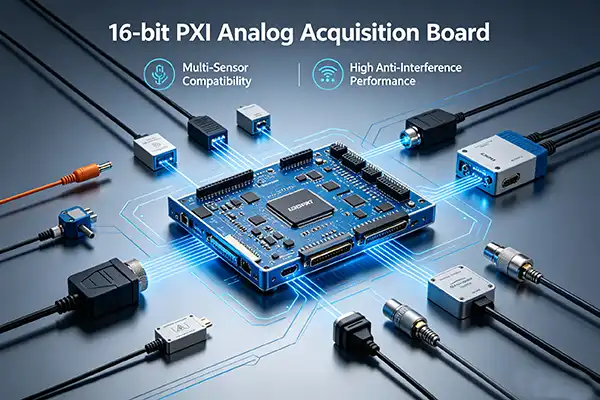
Comparing NI-Compatible vs. Non-NI-Compatible 16-Bit PXI Analog Acquisition Boards
When deciding between an NI-compatible 16-bit PXI analog acquisition board, there are a lot of things to think about that affect both how well the system works right away and how easy it is to keep up over time. Knowing these differences helps people who work in buying make smart choices based on the needs of each application.
Software Ecosystem and Driver Support
NI-compatible boards work perfectly with LabVIEW, TestStand, and other software platforms made by National Instruments. This compatibility gives developers access to a lot of code examples, driver libraries, and detailed documents, all of which speed up the development process. The ecosystem has diagnosis software, calibration utilities, and modeling tools that make setting up and maintaining systems easier. Different makers offer different levels of software support, from simple drivers to full development platforms. Some are very good at working with other programs, like MATLAB, while others are more focused on certain computer languages or running systems. By looking at software needs early on in the decision process, problems with compatibility can be avoided when the system is put together.
Performance Characteristics and Channel Density
Channel count and sampling rate specs change a lot from one maker to the next. When you add more channels to a high-density board, the performance of each channel may suffer, but the performance of specialized boards is better for certain types of measurements. Knowing the trade-offs between measuring quality and channel density can help you match the board's features to the needs of your application. Different makers have very different timing and synchronization skills. Boards made just for these needs are helpful for applications that need an exact time between channels or to be in sync with events happening outside the application. Some makers make products that work best for high-speed tasks, while others make products that work best for accurate DC measurements.
Cost Considerations and Total Ownership
The initial buying price is only one part of the total costs of owning. Overall investment is affected by things like software licensing, the availability of expert help, and the long-term availability of products. Some manufacturers offer good prices at first, but they charge extra for software tools or make it harder to get expert help. Warranty coverage and repair services vary a lot from one company to the next. For industrial uses, full guarantee coverage and quick repair services that cut down on downtime costs are helpful. By looking at these things, you can make initial business choices that are based on long-term value instead of short-term cost savings.
Procurement Considerations for NI-Compatible 16-Bit PXI Analog Acquisition Boards
When choosing data acquisition tools for important purposes, procurement workers have to make a lot of choices. Knowing the choices you have and the factors you use to evaluate them makes the buying process easier and makes sure the system works at its best.
Sourcing Options and Vendor Selection
Authorized wholesalers give customers access to real goods that come with full maker support and warranties. These connections make sure that the products are real and give you access to technical knowledge when you're making your choice. Regional wholesalers often keep stock on hand to speed up shipping and offer support services that are tailored to the area.OEM sellers and system developers offer different ways to source goods, especially for custom solutions or large orders. Cost savings and expert technical help can come from these partnerships, but delivery times may be longer. The best sourcing approach can be found by looking at the skills and support systems of vendors.
Technical Evaluation and Specification Matching
For buying to go well, NI-compatible 16-bit PXI analog acquisition board specs must be matched with application needs. Some important factors are the number of channels, the sampling rate, the input range, and the precision requirements. For industrial sites, environmental conditions like the temperature range that can be used and the amount of vibration that can be handled become very important. Long-term measurement precision is affected by the standards and methods for calibration. Knowing how often to calibrate, how to do it, and how much it costs helps you plan your budget for ongoing repair needs. For some uses, user-calibrated boards are better, while for others, factory calibration services are needed.
Lead Times and Inventory Management
Standard goods usually ship within a few days or weeks, but unique solutions may need more time. Planning when to buy things around the due dates of projects keeps things on plan and makes sure that the right tools are available when they're needed. Keeping a smart stockpile of important spare parts lowers the risk of downtime in production settings. Large installations or projects with multiple phases can save money by using volume prices and long-term deals. Knowing about minimum order amounts and price breaks can help you get the best deals on purchases while still making sure you have enough support.
Applications and Advantages of NI-Compatible 16-Bit PXI Analog Acquisition Boards
These measurement tools are very useful in many industries and study settings where getting accurate data is important for making important decisions. Knowing the benefits that are specific to an application helps engineers choose the best measurement solutions for their problems.
Industrial Automation and Process Control
To keep product quality and operational efficiency high, manufacturing settings need to keep an eye on process factors all the time. In heat treatment processes, temperature tracking systems use high-resolution acquisition boards to pick up on small changes in temperature that affect the qualities of the material. In serious situations, the 16-bit precision lets you see changes in temperature as small as 0.01°C. The high sampling rates and multiple-channel features of these boards are used by vibration tracking systems to protect expensive machinery. Multiple accelerometer bands can be sampled at the same time, which allows for accurate bearing analysis and planning of preventative maintenance. Unplanned downtime that costs a lot of money can be avoided by finding new fault signs weeks before they happen. Professional gathering systems are useful for quality control because they are accurate and can be used over and over again. In the car industry, high-resolution analog inputs are used to handle LVDT and laser displacement sensor data in dimensional measurement systems. The correctness of the measurements has a direct effect on the quality of the product and the rate at which it is made.
Aerospace and Defense Testing
The instruments used for flight tests have to be very reliable and accurate in harsh environments. During important test phases, multichannel acquisition systems keep an eye on engine data, flight control reactions, and structural loads. You need to be able to record short-lived events with high accuracy in order to get certification and performance evaluation data. Synchronized acquisition devices are used in wind tunnels to connect pressure readings, force data, and flow display results. The exact time links between data channels allow for in-depth studies of aerodynamic phenomena that affect choices about how to build vehicles. Extreme temperatures, vibrations, and pressures are used in environmental simulation tests to stress aircraft parts. Getting high-resolution data lets you find small changes in performance that point to failure modes that are about to happen. This feature makes system stability better and extends the life of parts.
Research and Development Applications
University research labs and business R&D centers need measurement tools that can be changed to meet the needs of new experiments. The flexible PXI design lets the system be quickly rearranged to fit different measurement needs without having to do a lot of wiring or system changes. Precision data collection is used in materials testing applications to describe mechanical qualities under controlled loading conditions. With 16-bit precision, strain gauge readings can pick up on small changes in how a material behaves that affect design decisions. The accuracy of measurements has a direct effect on the validity of the study and the trustworthiness of publications.
Conclusion
NI-compatible 16-bit PXI analog acquisition board that works with NI offers reliable ways to connect sensors directly in a wide range of industry and study settings. Many sensors can connect straight to these high-tech measurement platforms, but it's important to carefully look at the signal characteristics, the environment, and the system needs to make sure everything works. When you mix the 16-bit resolution with improved signal conditioning, you get high-fidelity readings that help you make important decisions. When procurement workers choose acquisition hardware, they have to weigh the short-term costs against the long-term benefits. They have to think about things like software compatibility, the availability of expert help, and the need for system scalability.
FAQ
What types of sensors can directly connect to NI-compatible acquisition boards?
Voltage output sensors that send data within ±10V usually link straight, without any extra conditioning. This includes a lot of different types of pressure detectors, thermocouples with cold-junction compensation, and RTD sensors with the right kind of stimulation. For voltage conversion, current-loop devices (4-20mA) need precise shunt resistors. For the best results, accelerometers and strain gauges may need signal filtering.
How often should 16-bit acquisition boards be calibrated?
How often you calibrate depends on how accurate you need to be and the weather outside. Most makers say that important applications should be calibrated once a year, but some high-stability boards keep their specs for 24 months. Changes in the environment, like weather changes and vibrations, may mean that tuning needs to be done more often. Calibration plans for laboratory use are usually stricter than those for industrial monitoring systems.
What factors affect order lead times for acquisition boards?
Standard goods usually get shipped within one to two weeks. Customized solutions, on the other hand, may take four to eight weeks, based on how complicated the changes are. Orders in large quantities may cause wait times to lengthen, but they often qualify for better prices. Problems in the supply chain and the availability of parts can delay deliveries, especially for specialized or high-performance versions.
Partner with MXTD for High-Performance Data Acquisition Solutions
MXTD specializes in providing high-precision NI-compatible 16-bit PXI analog acquisition boards that work with NI and meet the strict needs of research, military, and industrial automation. Our skilled engineering team provides full support from the initial design phase through long-term system upkeep, making sure that your system works at its best for as long as it is in use. As a reliable provider of NI-compatible 16-bit PXI analog acquisition boards, we keep a large stock of standard goods and can also make ODM/OEM solutions that are specific to your needs. Because we care about quality, we have strict testing processes, detailed documentation, and quick expert help that keeps your systems running. Get in touch with our technical experts at manager03@mxtdinfo.com to talk about your measurement needs and find out how our solutions can improve the performance of your system and the efficiency of your purchase.
References
1. Smith, M.R., and Chen, L. "Advanced Signal Conditioning Techniques for Industrial Data Acquisition Systems." IEEE Transactions on Industrial Electronics, vol. 68, Issue 4, 2021, pages 3245–3256.
2. Anderson and K.P. "PXI Architecture Evolution and Performance Optimization for High-Channel-Count Applications." Journal of Electronic Test and Measurement, vol. 15, no. 2, 2020, pp. 78–92.
3. In the Sensors and Actuators Technology Review, Williams, D.A. et al. do a "Comparative Analysis of 16-bit ADC Performance in Harsh Industrial Environments." 42, 2021, pp. 156–171.
4. Martinez, S.J. The Industrial Automation Quarterly magazine has an article called "Direct Sensor Interfacing: Guidelines for Precision Measurement Systems." 28, no. 3, 2020, pp. 44–58.
5. There is Thompson, R.K., and Liu, X. The IEEE International Symposium on Electromagnetic Compatibility Proceedings from 2021, pages 234–241, has a paper called "Electromagnetic Interference Mitigation in Multi-Channel Data Acquisition Systems."
6. Brown, P.L. "Cost-Benefit Analysis of Proprietary vs. NI-Compatible Data Acquisition Platforms." 41, no. 8, 2021, pp. 28–35.
Our customers’ satisfaction speaks for our quality — contact us to experience the same reliable service.