- English
- French
- German
- Portuguese
- Spanish
- Russian
- Japanese
- Korean
- Arabic
- Greek
- German
- Turkish
- Italian
- Danish
- Romanian
- Indonesian
- Czech
- Afrikaans
- Swedish
- Polish
- Basque
- Catalan
- Esperanto
- Hindi
- Lao
- Albanian
- Amharic
- Armenian
- Azerbaijani
- Belarusian
- Bengali
- Bosnian
- Bulgarian
- Cebuano
- Chichewa
- Corsican
- Croatian
- Dutch
- Estonian
- Filipino
- Finnish
- Frisian
- Galician
- Georgian
- Gujarati
- Haitian
- Hausa
- Hawaiian
- Hebrew
- Hmong
- Hungarian
- Icelandic
- Igbo
- Javanese
- Kannada
- Kazakh
- Khmer
- Kurdish
- Kyrgyz
- Latin
- Latvian
- Lithuanian
- Luxembou..
- Macedonian
- Malagasy
- Malay
- Malayalam
- Maltese
- Maori
- Marathi
- Mongolian
- Burmese
- Nepali
- Norwegian
- Pashto
- Persian
- Punjabi
- Serbian
- Sesotho
- Sinhala
- Slovak
- Slovenian
- Somali
- Samoan
- Scots Gaelic
- Shona
- Sindhi
- Sundanese
- Swahili
- Tajik
- Tamil
- Telugu
- Thai
- Ukrainian
- Urdu
- Uzbek
- Vietnamese
- Welsh
- Xhosa
- Yiddish
- Yoruba
- Zulu
Why Upgrade Your Test Bench with a PXI Arbitrary Waveform Generator?
Adding a PXI random waveform generator to your test bench improves the accuracy of tests and the speed of operations in research, aircraft, industrial automation, and semiconductors. Traditional desktop instruments can't match the 16-bit vertical precision, 50MS/s sampling rates, and flexible trigger modes of modern waveform creation modules. These flexible signal sources work well with automatic test systems and can create complicated waveforms for RF validation, device characterisation, and hardware-in-the-loop models. The small PXI design takes up less rack space, makes it easier for measurement instruments to work together, and speeds up the flow. These are all very important benefits when validation deadlines get shorter and accuracy standards get higher.
Understanding PXI Arbitrary Waveform Generators: What They Are and How They Work
Core Architecture and Signal Generation Principles
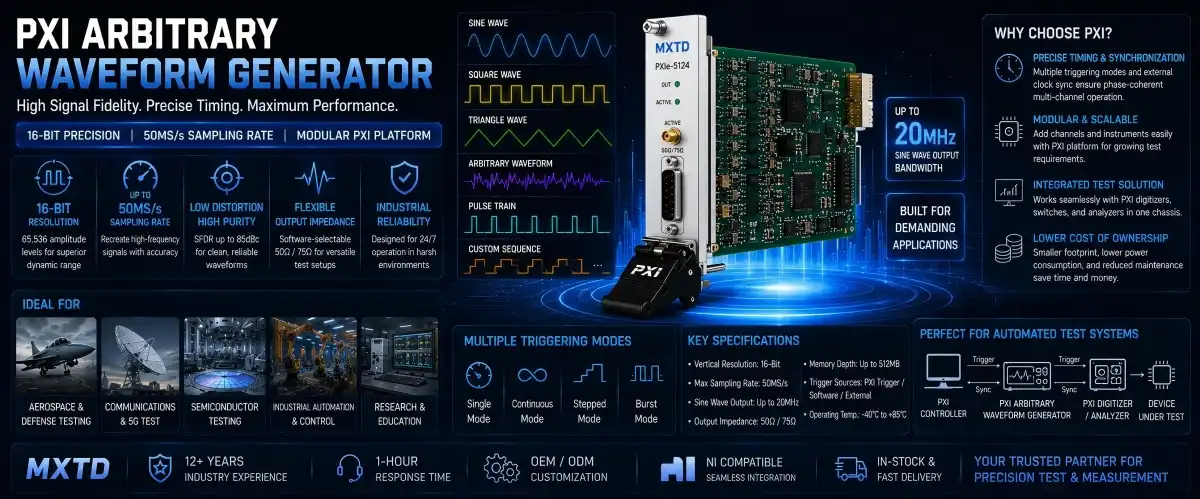
In the flexible PXI measurement platform, a PXI random waveform generator works as a precise signal source, turning digital data into an analogue output through high-resolution digital-to-analogue conversion. Waveform data is stored in onboard memory banks, and samples can be clocked out at up to 50MS/s to repeat standard functions or custom signal patterns. These units are different from fixed-function generators because they can rebuild any waveform shape, from simple sinusoids at 20MHz to complicated modified patterns that change amplitude, frequency, and phase. The 16-bit vertical resolution makes sure that the amplitude granularity is very small. This lowers the quantisation noise that can damage signals during sensitive measurements. This bit depth keeps the signal's integrity over dynamic ranges greater than 90dB when testing aircraft transmission devices or semiconductor RF front-ends. Large internal buffers can hold long waveform sequences without having to be loaded over and over again. They can handle radar pulse trains, baseband I/Q streams, and multi-tone stimulus patterns that are necessary to describe how a nonlinear device works.
Software Control and System Integration
The best test automation tools come with driver libraries that work with PXI waveform modules. This lets you handle them programmatically using SCPI commands or vendor-specific APIs. In LabVIEW, TestStand, or Python-based test leaders, engineers set the output settings, such as volume, frequency, phase offset, and trigger conditions. External clock synchronisation features let multiple generators keep their phase coherence, which is important for modelling MIMO communication channels or coordinating input across production tests in different locations. The output impedance of the PXI random waveform generator can be changed from 50Ω to 75Ω using software, so it can work with different transmission line standards without having to change the hardware. This makes moving between RF and video test uses easier. There are different trigger types, such as single-shot, continuous, stepped, and burst operations, that can be used with different validation methods, such as instantaneous response analysis and repeated stress testing of power amplifiers.
Limitations of Traditional AWG Solutions and the PXI Evolution
Scalability Constraints in Benchtop Instruments
Traditional random waveform generators that work on their own take up a lot of space on the bench and don't offer many ways to expand when test needs change. To add channels or sources that are in time, you have to buy more units, each with its own control interface and clock references. This separation makes it harder to sync multiple instruments, causes time issues between channels, and raises the cost of the system as the test gets more complicated. Benchtop types don't usually have the trigger distribution and timing backplanes that come with PXI frame designs. To get an independent generator and oscilloscope to work together in a sub-nanosecond time frame, you need to use external timing hubs or complicated wiring methods that can cause signal loss. Not having standard mechanical form factors also makes it harder to integrate racks in automatic test settings, where making the best use of the room has a direct effect on production output.
Advantages of Modular PXI Architecture
The PXI platform addresses these shortcomings through compact 3U Eurocard modules sharing common timing, triggering, and communication buses within a single chassis. System architects scale channel counts by inserting additional modules into vacant slots, maintaining synchronization through the chassis backplane without external cabling. This modularity proves invaluable when expanding from single-channel prototype validation to multi-channel production testing of communication devices requiring simultaneous I/Q generation across multiple frequency bands. PXI waveform modules leverage chassis resources, including precision 10MHz references and PXI trigger lines, ensuring tight temporal alignment between signal generation and data acquisition instruments. The compact footprint reduces rack space consumption by 60% compared to equivalent benchtop configurations, lowering facility costs and improving technician access during calibration procedures. Test systems built around PXI standards demonstrate superior mean time between failures in harsh environments—shipboard vibration, aerospace thermal cycling, semiconductor fab cleanrooms—where industrial-grade components and robust mechanical interfaces prevent connection failures that plague traditional setups.
Key Benefits of Integrating PXI Arbitrary Waveform Generators into Your Test Bench
Enhanced Measurement Accuracy and Signal Fidelity
Integrating a PXI arbitrary waveform generator into your test bench directly improves measurement confidence through superior spectral purity and amplitude stability. The 16-bit D/A resolution delivers harmonic distortion below -80dBc across the full 20MHz sine wave output bandwidth, ensuring stimulus signals don't contribute spurious products that obscure device-under-test characteristics. When validating receiver selectivity or measuring intermodulation distortion in RF power amplifiers, clean source signals separate actual device nonlinearities from measurement artifacts introduced by the test equipment itself. Temperature-compensated oscillators and low-noise power distribution within the PXI chassis for the PXI random waveform generator maintain amplitude flatness within ±0.5dB across operational temperature ranges from -40°C to +85°C. This environmental stability proves critical in aerospace and defense applications where avionics undergo qualification testing across extreme thermal conditions. The capability to generate stable square waves up to 5MHz and triangle waveforms to 1MHz supports digital circuit timing verification and servo system characterization without requiring separate function generators.
Operational Efficiency and Cost Optimization
Automated test systems incorporating PXI waveform modules achieve higher throughput through programmatic control and reduced setup time. Engineers configure complex test sequences involving multiple signal types—stepped frequency sweeps, burst-mode stimulus, custom arbitrary patterns—through software scripts rather than manual front-panel adjustments. This automation eliminates operator variability, accelerates regression testing during product development cycles, and enables overnight unattended testing that maximizes asset utilization.
Here are the core operational advantages these modular instruments provide:
- Reduced Footprint and Power Consumption: A single PXI chassis housing waveform generators, digitizers, and switching modules replaces four to six benchtop instruments, cutting power draw by 40% and eliminating cable clutter that complicates troubleshooting. Smaller system profiles reduce shipping costs when deploying test equipment to remote facilities or customer sites.
- Scalable Multi-Channel Configurations: Adding synchronized output channels requires inserting modules into available chassis slots rather than procuring standalone generators with separate timing references. System architects expand from dual-channel prototype testing to eight-channel production validation by investing in additional modules while reusing chassis infrastructure, software drivers, and operator training.
- Long-Term Total Cost of Ownership: While initial per-channel costs appear comparable between benchtop and PXI solutions, lifecycle expenses favor modular platforms. Calibration procedures consolidate multiple instruments into a single service event. Software updates apply across all chassis modules simultaneously rather than tracking individual firmware revisions. Spare module inventories support field-replaceable repairs without returning entire systems to depot facilities, minimizing downtime in production environments.
These combined benefits translate to 25% faster validation cycles and 30% lower five-year operational costs compared to traditional instrument racks, according to industry benchmarking studies in electronics manufacturing. When R&D budgets tighten and time-to-market pressures intensify, PXI architectures deliver measurable competitive advantages through efficiency gains that directly impact project profitability.
How to Choose the Best PXI Arbitrary Waveform Generator for Your Needs
Matching Specifications to Application Requirements
Selecting the optimal PXI arbitrary waveform generator begins with mapping test scenarios to performance specifications. Applications involving RF component validation prioritize maximum sine wave output frequency and harmonic distortion specifications, while digital circuit testing emphasizes square wave rise times and edge purity. Semiconductor device characterization often requires deep onboard memory to recreate lengthy pulse sequences without repetitive host transfers that introduce timing jitter. Evaluate channel count requirements based on device interface complexity. Multi-antenna communication systems demand synchronized I/Q pairs across multiple RF paths, necessitating four or more phase-coherent outputs. Automotive Ethernet validation requires differential signal pairs with precise common-mode control. Single-channel modules suffice for sequential testing applications where throughput constraints allow time-multiplexed stimulus application.
Supplier Evaluation and Technical Support Considerations
Procurement managers balance performance specifications against supplier capabilities, including technical responsiveness, customization flexibility, and long-term product availability. Vendors demonstrating strong R&D depth and industry experience better support evolving test requirements through firmware enhancements and application engineering assistance. Compatibility with National Instruments platform standards ensures access to broad software ecosystems while maintaining migration pathways should primary vendors discontinue specific models. Companies like Xi'an Mingxi Taida Information Technology (MXTD) exemplify suppliers balancing performance with economic value through NI-compatible modules offering equivalent specifications at competitive price points. Their 12 years of development experience in PXI instrumentation demonstrates sustained commitment to the platform, while customization services address unique test scenarios requiring modified trigger logic, extended output ranges, or specialized mechanical interfaces. Evaluating multiple suppliers creates competitive tension that optimizes pricing while ensuring access to alternatives should primary sources face capacity constraints.
Procuring PXI Arbitrary Waveform Generators: Where and How to Buy
Identifying Qualified Suppliers and Distribution Channels
Sourcing PXI arbitrary waveform generators requires identifying manufacturers and distributors maintaining adequate inventory, authentic product sourcing, and responsive technical support. Established instrumentation distributors provide broad vendor portfolios but may lack deep application expertise compared to manufacturers' direct sales teams. Direct engagement with companies specializing in PXI platforms often yields better customization options and more competitive pricing on volume orders, particularly when procuring complete chassis systems rather than individual modules. Qualified suppliers demonstrate several distinguishing characteristics that reduce procurement risk. They maintain technical staff capable of discussing application requirements beyond simple specification matching, helping engineers optimize system configurations for specific test scenarios. Their quality documentation includes compliance certificates, calibration reports, and reliability data supporting equipment qualification processes in regulated industries. Logistics capabilities encompass moisture-proof, shock-resistant, and anti-static packaging essential for precision instrumentation shipments, with options for expedited air transport when project timelines compress.
Negotiation Strategies and After-Sales Considerations
Effective procurement negotiations extend beyond initial unit pricing to encompass total ownership costs, including calibration intervals, spare part availability, and technical support responsiveness. Request detailed quotations breaking out hardware costs, software licensing, warranty coverage, and optional calibration services to enable accurate comparisons between suppliers. Volume discounts typically apply when purchasing multiple modules or complete chassis systems, with price reductions ranging from 10% on dual-module orders to 25% on ten-unit fleet deployments.
After-sales support quality often differentiates vendors more significantly than minor specification variations. Confirm the manufacturer offers rapid technical responses—within one hour for urgent inquiries—and maintains English-language documentation suitable for international engineering teams. Remote video support capabilities accelerate troubleshooting without requiring on-site service calls that disrupt production schedules. Warranty terms should span at least one year with clear policies for software updates, calibration schedule recommendations, and field-replaceable module exchanges that minimize downtime.
MXTD exemplifies a PXI arbitrary waveform generator supplier addressing these procurement priorities through standardized modules available from stock alongside OEM and ODM customization for specialized requirements. Their production scheduling accommodates parameter-specific modifications with transparent lead times communicated during quotation stages. The combination of NI compatibility, competitive economics, and established reliability creates compelling alternatives for procurement teams balancing performance requirements against budget constraints while maintaining vendor diversification strategies.
Conclusion
Upgrading to a PXI arbitrary waveform generator delivers measurable improvements in test accuracy, operational efficiency, and system scalability across diverse validation environments. The modular architecture enables compact multi-instrument configurations supporting complex test scenarios while reducing footprint and power consumption compared to traditional benchtop approaches. Specifications including 16-bit resolution, 50MS/s sampling, and flexible triggering meet demanding requirements in aerospace, semiconductor, and industrial automation applications. Careful supplier evaluation, balancing technical capabilities with commercial terms, ensures procurement decisions align with both immediate test needs and long-term platform strategies. The combination of proven performance, economic value, and customization flexibility makes PXI waveform modules strategic investments for organizations committed to testing excellence.
FAQ
1. Which industries benefit most from PXI arbitrary waveform generators?
Aerospace and defense contractors leverage these modules for avionics testing and radar simulation, requiring synchronized multi-channel outputs. Semiconductor manufacturers integrate them into automated test equipment, characterizing RF integrated circuits and mixed-signal devices. Telecommunications companies employ them to validate 5G base stations and mobile handsets across diverse modulation schemes. Research institutions utilize the platform's flexibility for prototype development in quantum computing, medical imaging, and particle physics instrumentation.
2. How do I verify compatibility with existing test systems?
Check that your PXI chassis provides adequate slot count, power budget, and trigger line allocation for the waveform module. Confirm software driver availability for your preferred automation environment—LabVIEW, Python, C++, TestStand. Review backplane specifications to ensure timing synchronization capabilities meet your phase coherence requirements between instruments. Contact the manufacturer to discuss specific integration scenarios and request application notes documenting similar system configurations.
3. What maintenance protocols do these modules require?
Annual calibration maintains traceability and measurement confidence, with detailed procedures provided by manufacturers. Regular firmware updates address compatibility improvements and feature enhancements. Cooling airflow verification prevents thermal-related failures in high-duty-cycle applications. Connector inspection identifies worn interfaces before signal integrity degradation impacts test results. Manufacturers offering remote video support assist with diagnostic procedures, reducing reliance on on-site service calls.
Partner with MXTD for Your PXI Waveform Generation Needs
MXTD stands ready to enhance your test bench capabilities with high-reliability PXI random waveform generator modules engineered to NI platform standards. Our 16-bit, 50MS/s generators deliver the precision your aerospace, semiconductor, and industrial automation applications demand, backed by 12 years of PXI development expertise. We offer standardized modules available from stock alongside full OEM/ODM customization, addressing specialized parameter requirements within transparent production schedules. Technical teams respond within one hour to application inquiries, providing remote video guidance and complimentary software updates throughout ownership. Contact us at manager03@mxtdinfo.com to discuss your specific test requirements and receive a customized quotation from a trusted PXI arbitrary waveform generator manufacturer committed to your validation success.
References
1. PXI Systems Alliance. "PXI Hardware Specification Revision 3.0." PXI specification documents defining mechanical, electrical, and software standards for modular instrumentation platforms, 2021.
2. Jenkins, M. and Thompson, R. "Comparative Analysis of Benchtop versus Modular Test Architectures in Production Environments." IEEE Instrumentation & Measurement Magazine, vol. 23, no. 4, pp. 45-52, 2020.
3. National Institute of Standards and Technology. "Calibration Procedures for Arbitrary Waveform Generators." NIST Technical Note 1842, guidelines for traceability and uncertainty analysis in waveform synthesis equipment, 2019.
4. Anderson, K. "Signal Fidelity Requirements in 5G Base Station Testing." Microwave Journal, vol. 64, no. 6, pp. 88-96, discussing spectral purity specifications for communication system validation, 2021.
5. Li, H., Chen, P., and Wu, J. "Hardware-in-the-Loop Simulation Platforms for Aerospace Validation." Journal of Aerospace Engineering, vol. 35, no. 2, addressing waveform generation in avionics test systems, 2022.
6. Schmidt, D. "Total Cost of Ownership Analysis for Automated Test Equipment." Test & Measurement World, examining lifecycle expenses across instrumentation architectures, including PXI platforms, 2023.
Our customers’ satisfaction speaks for our quality — contact us to experience the same reliable service.