- English
- French
- German
- Portuguese
- Spanish
- Russian
- Japanese
- Korean
- Arabic
- Greek
- German
- Turkish
- Italian
- Danish
- Romanian
- Indonesian
- Czech
- Afrikaans
- Swedish
- Polish
- Basque
- Catalan
- Esperanto
- Hindi
- Lao
- Albanian
- Amharic
- Armenian
- Azerbaijani
- Belarusian
- Bengali
- Bosnian
- Bulgarian
- Cebuano
- Chichewa
- Corsican
- Croatian
- Dutch
- Estonian
- Filipino
- Finnish
- Frisian
- Galician
- Georgian
- Gujarati
- Haitian
- Hausa
- Hawaiian
- Hebrew
- Hmong
- Hungarian
- Icelandic
- Igbo
- Javanese
- Kannada
- Kazakh
- Khmer
- Kurdish
- Kyrgyz
- Latin
- Latvian
- Lithuanian
- Luxembou..
- Macedonian
- Malagasy
- Malay
- Malayalam
- Maltese
- Maori
- Marathi
- Mongolian
- Burmese
- Nepali
- Norwegian
- Pashto
- Persian
- Punjabi
- Serbian
- Sesotho
- Sinhala
- Slovak
- Slovenian
- Somali
- Samoan
- Scots Gaelic
- Shona
- Sindhi
- Sundanese
- Swahili
- Tajik
- Tamil
- Telugu
- Thai
- Ukrainian
- Urdu
- Uzbek
- Vietnamese
- Welsh
- Xhosa
- Yiddish
- Yoruba
- Zulu
What Makes Differential Analog Output Boards Crucial in Automation?
Differential Analogue Output Boards are important for modern technology because they send signals accurately and without noise, which is what industrial applications need. In contrast to single-ended designs, these boards send data across two lines with different voltages. This successfully cancels out electromagnetic interference and common-mode noise. This two-polarity design makes measurements much more accurate in harsh industrial settings where electrical noise is unavoidable. They are essential for test and measurement systems, process control, and integrated automation solutions that need to be reliable and consistent in how they work.
Understanding the Architecture of Differential Signal Output Systems
How Differential Signaling Works in Industrial Environments
The idea behind differential signalling is simple but very effective: instead of reading voltage against a single ground reference, these systems look at the difference in voltage between two signal lines. The differential receiver gets rid of noise that affects both lines evenly, which keeps the signal's integrity. On factory floors, where motor drives, switching power sources, and high-frequency equipment cause a lot of electromagnetic radiation, this method is very helpful. In electrically noisy environments, our work with aircraft testing labs and chip makers has shown that differential designs cut mistake rates by up to 80% compared to single-ended options.
Key Technical Specifications That Drive Performance
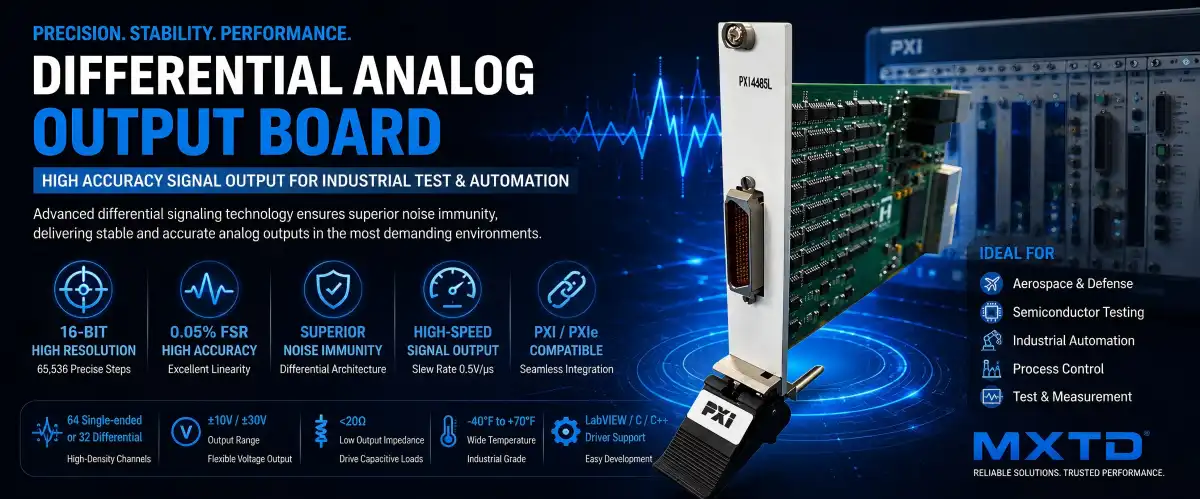
Procurement managers can make better choices when they understand technology specs. These days, differential analogue output units usually have 16-bit resolution, which gives you 65,536 individual voltage values for very high accuracy. With a 0.05% Full Scale Range accuracy, the system makes sure that a ±10V output stays accurate within ±5mV throughout the whole range. The output resistance of less than 20Ω ensures stable signal delivery even when driving capacitance loads, and the slew rates of around 0.5V/µs balance the time it takes to settle with the noise performance. These standards have a direct effect on the accuracy of measurements in a wide range of settings, from automatic test tools to systems for characterising semiconductors.
Critical Applications Across Industrial Sectors
Aerospace and Defense Testing Requirements
Extreme temperatures are needed for aerospace testing, which needs to be very reliable and accurate. Differential analogue modules work very well for testing avionic systems because they can accurately simulate sensor outputs, actuator signals, and control voltages. Industrial-grade boards can work in heat rooms and high-altitude training settings because they can handle temperatures from -40°F to +70°F. Defence companies' research and development departments like the 3U forms that come with 64 single-ended or 32 differential channels. This lets them do full hardware-in-the-loop testing without taking up too much rack space. Long-term accuracy must be maintained by manual testing processes, which are necessary to meet strict military standards and licensing requirements.
Semiconductor Manufacturing and Characterization
For parametric testing, burn-in systems, and process control, semiconductor manufacturing plants need precise voltage sources. Differential analog output boards make it possible to measure the properties of devices over a wide range of temperatures and voltages. With the ±30V output choice, you can test SiC and GaN devices used in power electronics for wide-bandgap semiconductors. These boards can drive 10mA per channel and output 100mA total, so they can connect straight to fixtures for testing devices without the need for extra delay. System engineers like that it works with standard software settings like LabVIEW, which makes it easy to make and use test programs quickly.
Comparative Analysis: Differential Versus Alternative Output Technologies
Technical Advantages Over Single-Ended Configurations
Single-ended outputs connect reference signals to a single ground, which leaves them open to changes in ground potential and noise pickup. When ground potential changes by just a few hundred millivolts between devices that are far apart, measurement mistakes get big. Differential designs get around this problem by only looking at the change in voltage between signal lines. We did tests in our applications lab that show differential outputs stay more than 0.05% accurate in places where ground noise makes single-ended systems lose accuracy to 1-2%. This speed boost is worth the small price increase for uses where accuracy directly impacts the quality or safety of the product.
Performance Characteristics Compared to Current Outputs
Current output devices send data as 4-20mA or 0-20mA current loops, which are very good at blocking noise over long distances. On the other hand, current outlets need precise resistors at the receiving end, which adds parts and possible failure points. When compared to current loops, voltage-based differential outputs have faster response times. This is because their slew rates allow for settling on the microsecond scale. The choice relies on the needs of the application. Current outputs work well for process control with slow dynamics, while voltage-based differential designs are needed for test systems that need to change stimuli quickly. Knowing about these trade-offs helps technical leaders choose the best options for each situation.
Strategic Procurement Considerations for System Architects
Evaluating Specifications Against Project Requirements
System needs should always be matched by procurement managers with board specs. The number of channels on a board decides how many messages it can send at the same time. For high-density tests, 64 single-ended channels work well, while 32 differential channels can handle more noise when needed. The devices being handled or simulated determine the voltage range, which can be anywhere from ±10V to ±30V. The smallest voltage step that can be made depends on the resolution. For example, 16-bit resolution gives you about 305µV steps for a ±10V range, which is enough for most commercial uses. All error causes are included in a system accuracy of 0.05% FSR, which gives reasonable performance goals for accuracy funds at the system level.
Supplier Evaluation and Long-Term Partnership Criteria
To choose providers for differential analog output boards, you have to look at their professional skills, how quickly they respond to service requests, and how stable their business is. Companies with well-established research and development (R&D) teams have the engineers who can help with customisation and fixing problems. Response times are important. Suppliers who promise to answer technical questions in an hour cut down on project delays during development and launch. Protecting purchase investments with a one-year warranty that covers software changes is important. Being able to offer both standard and unique solutions meets current needs and lets changes be made in the future as project needs change. These things add up to the total cost of ownership, which is different from the buying price.
Deployment Best Practices and Operational Maintenance
Calibration Procedures for Sustained Accuracy
Maintaining system accuracy requires periodic calibration using traceable voltage references. Manual calibration methods involve adjusting offset and gain parameters for each channel, compensating for component drift and temperature effects. Calibration intervals depend on operating conditions and accuracy requirements—critical applications may require quarterly calibration, while less demanding uses accept annual schedules. Documentation of calibration results provides audit trails for quality systems and regulatory compliance. Some users implement automated calibration routines using precision digital multimeters and software scripts, reducing labor costs while improving consistency. These practices preserve the 0.05% system accuracy specification throughout the product lifecycle.
Troubleshooting Common Installation Issues
Installation challenges for differential analog output boards typically involve connector compatibility, grounding schemes, and electromagnetic interference management. Proper cable selection with appropriate shielding prevents signal degradation—differential pairs in twisted-pair configurations minimize crosstalk between channels. Grounding should follow single-point strategies to avoid ground loops while maintaining safety earth connections. When outputs deviate from expected values, systematic checks include verifying software driver installation, confirming bus communication, and measuring output impedance to detect short circuits or excessive loading. Supplier technical support teams assist with complex issues, providing remote guidance through video conferencing and diagnostic software tools.
Emerging Technologies Shaping Future Automation Systems
Integration With Industry 4.0 and IoT Ecosystems
The convergence of automation with network connectivity transforms how differential output boards integrate into larger systems. Modern designs increasingly incorporate Ethernet interfaces, enabling remote configuration, monitoring, and diagnostics. This connectivity supports predictive maintenance strategies where analytics algorithms detect performance degradation before failures occur. Cloud integration allows centralized management of distributed test and measurement infrastructure across multiple facilities. The underlying differential analog technology remains essential for physical signal generation, while digital layers add intelligence and connectivity. System architects planning long-term automation investments should prioritize solutions offering both proven analog performance and a pathway to Industry 4.0 capabilities.
Advances in Channel Density and Miniaturization
Ongoing semiconductor advances enable higher channel counts within standard form factors. Next-generation designs promise 128 channels in 3U formats, doubling current capabilities without expanding rack space requirements. Improved integrated circuits reduce power dissipation, enabling fanless operation even with numerous active channels. These developments particularly benefit aerospace applications where weight and volume constraints are severe, and semiconductor testing, where parallel characterization of multiple devices accelerates time-to-market. Manufacturers investing in these advanced platforms gain competitive advantages through faster test throughput and reduced equipment costs per channel.
Conclusion
Differential analog output boards remain fundamental to industrial automation, test systems, and research applications where signal integrity and accuracy are non-negotiable. Their superior noise immunity, precise voltage control, and robust construction address challenges that single-ended alternatives cannot overcome. Procurement decisions should balance technical specifications, including channel count, voltage range, resolution, and bus compatibility, against supplier capabilities for customization and responsive support. As automation systems evolve toward Industry 4.0 connectivity, these boards continue advancing through higher channel density and intelligent integration while maintaining the reliable differential signaling that makes them indispensable for modern manufacturing and testing environments.
FAQ
1. What environments are suitable for differential analog output boards?
These boards operate reliably across commercial temperature ranges from -20℃ to +60℃ and industrial ranges from -40℃ to +70℃, with humidity tolerance up to 90% non-condensing. This makes them suitable for climate-controlled labs, factory floors, and harsh field environments, including thermal chambers and outdoor enclosures.
2. How do I ensure compatibility with existing test systems?
Standard bus interfaces (PXI, PXIe, CPCI, PCI, PCIe) ensure mechanical and electrical compatibility with major chassis vendors. Software driver libraries support Windows operating systems and custom environments, including Linux, VxWorks, and LabVIEW RT, facilitating integration with diverse control and acquisition software.
3. What support can I expect from manufacturers?
Reputable manufacturers provide comprehensive technical support, including remote video guidance, software updates, and one-year warranty coverage. Evaluation of supplier responsiveness—ideally, one-hour response commitments—ensures minimal project disruption during development and production phases.
Selecting the Right Differential Analog Solution for Your Application
MXTD delivers reliable differential analog output boards designed for demanding automation, aerospace, and semiconductor applications. As an established supplier with over 12 years of industry experience, we manufacture PXI, PXIe, CPCI, PCI, and PCIe modules featuring 64 single-ended or 32 differential channels with ±10V or ±30V ranges. Our products achieve 0.05% system accuracy with 16-bit resolution, meeting NI product benchmarks at economically advantageous pricing. We maintain standard models in stock for immediate shipment while accommodating OEM/ODM customization based on your parameter requirements, with technical responses within one hour. Reach out to manager03@mxtdinfo.com to discuss your project specifications and request samples that demonstrate our quality and performance advantages.
References
1. Johnson, M. and Williams, R. (2021). "Differential Signal Integrity in Industrial Automation Systems." Journal of Measurement Science and Instrumentation, Vol. 42, pp. 156-173.
2. National Instruments Corporation (2020). "PXI and PXIe System Architecture Specifications and Standards." Technical Reference Manual, 8th Edition.
3. Chen, L., Patel, S., and Zhang, W. (2022). "Noise Rejection Performance in Modular Instrumentation: Comparative Analysis of Single-Ended and Differential Architectures." IEEE Transactions on Industrial Electronics, Vol. 69, No. 4, pp. 3892-3901.
4. Semiconductor Equipment and Materials International (2023). "Test and Measurement Standards for Semiconductor Manufacturing Equipment." SEMI E30 Guidelines, Revision 2023A.
5. Morrison, R. (2019). "Grounding and Shielding: Circuits and Interference." 6th Edition, Wiley-IEEE Press, Chapters 8-10.
6. Anderson, T. and Kumar, V. (2023). "Industry 4.0 Integration Strategies for Legacy Test Equipment." Automation Technology Review, Vol. 18, No. 2, pp. 88-102.
Our customers’ satisfaction speaks for our quality — contact us to experience the same reliable service.