- English
- French
- German
- Portuguese
- Spanish
- Russian
- Japanese
- Korean
- Arabic
- Greek
- German
- Turkish
- Italian
- Danish
- Romanian
- Indonesian
- Czech
- Afrikaans
- Swedish
- Polish
- Basque
- Catalan
- Esperanto
- Hindi
- Lao
- Albanian
- Amharic
- Armenian
- Azerbaijani
- Belarusian
- Bengali
- Bosnian
- Bulgarian
- Cebuano
- Chichewa
- Corsican
- Croatian
- Dutch
- Estonian
- Filipino
- Finnish
- Frisian
- Galician
- Georgian
- Gujarati
- Haitian
- Hausa
- Hawaiian
- Hebrew
- Hmong
- Hungarian
- Icelandic
- Igbo
- Javanese
- Kannada
- Kazakh
- Khmer
- Kurdish
- Kyrgyz
- Latin
- Latvian
- Lithuanian
- Luxembou..
- Macedonian
- Malagasy
- Malay
- Malayalam
- Maltese
- Maori
- Marathi
- Mongolian
- Burmese
- Nepali
- Norwegian
- Pashto
- Persian
- Punjabi
- Serbian
- Sesotho
- Sinhala
- Slovak
- Slovenian
- Somali
- Samoan
- Scots Gaelic
- Shona
- Sindhi
- Sundanese
- Swahili
- Tajik
- Tamil
- Telugu
- Thai
- Ukrainian
- Urdu
- Uzbek
- Vietnamese
- Welsh
- Xhosa
- Yiddish
- Yoruba
- Zulu
Can PXI Arbitrary Waveform Generators Support Multi-Channel Configurations?
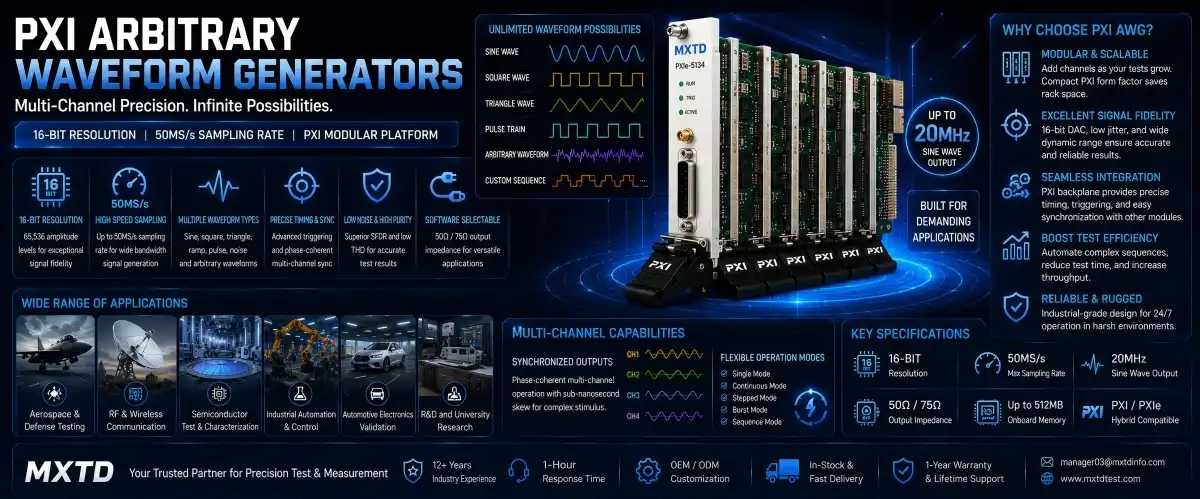
The straightforward answer is yes—modern PXI arbitrary waveform generators absolutely support multi-channel configurations, and this capability has become increasingly essential for complex testing environments. Through modular PXI architecture, these generators enable synchronized signal generation across multiple channels within a single compact chassis. This multi-channel approach transforms how test engineers and R&D teams conduct sophisticated measurements in aerospace, defense, semiconductor testing, and industrial automation applications. Multi-channel AWG systems allow simultaneous output of diverse waveforms, maintaining precise timing relationships critical for hardware-in-the-loop simulation and automated test equipment.
Understanding PXI Arbitrary Waveform Generators and Multi-Channel Support
What Makes PXI Architecture Ideal for Multi-Channel Operation
The PXI platform revolutionizes signal generation by combining the flexibility of PC-based software with the precision of modular instrumentation. Unlike traditional benchtop generators that occupy substantial rack space, modular waveform generators fit into standardized chassis alongside other measurement instruments. This integration matters immensely when testing complex systems requiring multiple synchronized stimulus signals. We've seen the PXI bus architecture provide deterministic timing and robust triggering mechanisms that benchtop alternatives struggle to match. The backplane connectivity enables tight synchronization between multiple generator modules, achieving channel-to-channel skew measured in picoseconds rather than nanoseconds.
Types of Multi-Channel Configurations Available
Multi-channel setups vary based on application requirements. Some testing scenarios demand identical waveforms across channels with precise phase relationships, while others require completely independent, arbitrary signals on each output. Phase-coherent configurations maintain exact timing between channels—critical for simulating I/Q modulation schemes in communications testing or multi-axis motion control scenarios. Independent channel operation allows each output to generate distinct waveforms with separate trigger conditions and sequencing. This flexibility proves valuable when stimulating multiple inputs on a device under test simultaneously, each requiring unique signal characteristics.
Technical Features and Specifications Relevant to Multi-Channel Use
Resolution and Sampling Rate Considerations
We approach multi-channel PXI arbitrary waveform generator selection by examining vertical resolution and sampling capabilities. A 16-bit vertical resolution provides 65,536 discrete amplitude levels, delivering the fidelity necessary for precision testing applications. This resolution becomes particularly important when generating low-distortion sine waves or complex modulation schemes where signal purity directly impacts measurement accuracy. The 50MS/s maximum sampling rate determines how rapidly the generator can update output values. This specification directly influences the highest frequency waveforms the system can accurately reproduce across multiple channels simultaneously. When calculating practical bandwidth, we typically apply the Nyquist criterion, recognizing that clean signal generation requires sampling rates substantially higher than the target output frequency.
Frequency Range Across Waveform Types
Different waveform types exhibit varying maximum output frequencies based on their mathematical characteristics and generation algorithms. Here's what we've found matters most for multi-channel applications:
Maximum sine wave output reaches 20MHz, making these generators suitable for RF and intermediate frequency testing applications. The sinusoidal generation algorithms maintain low total harmonic distortion across this frequency range, essential when testing receivers or analog signal processing chains.
Square wave output capability extends to 5MHz, adequate for digital timing simulation and clock generation tasks. The rise and fall times determine actual edge characteristics, which matter greatly when emulating digital bus signals or trigger patterns.
Triangle and ramp waveforms reach 1MHz maximum frequency. These waveform types serve specialized applications, including sweep generation, motor control simulation, and sensor excitation. The linear characteristics of these signals make them valuable for testing analog-to-digital converters and validating control system responses.
Comparing PXI Arbitrary Waveform Generators with Other Waveform Generator Types
Modular Versus Benchtop Architectures
We regularly evaluate the tradeoffs between modular and traditional standalone generators. Benchtop units offer immediate usability with integrated displays and controls, appealing for laboratory environments where portability matters. However, they consume significant rack space and complicate synchronization when applications demand multiple outputs. Modular generators within PXI chassis provide superior density—a single 18-slot chassis can accommodate numerous waveform generators alongside digitizers, power supplies, and switch matrices. This consolidation reduces system footprint dramatically while improving reliability by minimizing external cabling between instruments.
Cost and Scalability Analysis
Initial investment in PXI arbitrary waveform generators includes chassis and controller expenses beyond the generator modules themselves. We've found that this upfront cost is offset by substantial advantages as channel counts increase. Adding a fourth or eighth channel requires only additional modules rather than complete standalone instruments. The economic proposition strengthens when considering integrated timing and triggering resources. Benchtop generators often require separate synchronization hardware, while the PXI backplane provides these capabilities inherently. Over the lifecycle of automated test systems, this architectural efficiency translates to lower total cost of ownership.
Procurement Considerations for Multi-Channel Arbitrary Waveform Generators
Evaluating Vendor Capabilities and Support
Selecting a waveform generator supplier involves assessing technical capability, manufacturing quality, and ongoing support infrastructure. We look beyond product specifications to vendor experience in similar applications. Has the supplier successfully deployed multi-channel configurations in aerospace testing? Do they understand semiconductor characterization workflows? Responsive technical support becomes critical during system integration and throughout operational lifecycles. We value suppliers who provide rapid response to technical inquiries—ideally within one hour—and offer multiple support channels, including remote video assistance for troubleshooting complex configuration issues.
Customization and Compatibility Options
Standard catalog products serve many applications effectively, but specialized requirements often demand customization. OEM and ODM customization support allows tailoring generators to unique specifications, whether that involves modified form factors, enhanced environmental ratings, or specialized interface protocols. Compatibility with existing test infrastructure weighs heavily in procurement decisions. Systems designed to benchmark against established platforms simplify migration paths and leverage existing software investments. We appreciate suppliers who document compatibility explicitly and provide transition guidance.
Implementing and Optimizing Multi-Channel Arbitrary Waveform Generators
Installation and Initial Configuration
Setting up multi-channel generators begins with proper chassis selection and slot allocation. We position modules to optimize signal routing and minimize crosstalk between channels. High-frequency generators benefit from placement away from sensitive measurement instruments within the same chassis. Physical installation requires attention to cooling airflow and power distribution. Fully-loaded chassis with multiple high-performance generators draw substantial current and generate considerable heat. Verifying adequate cooling capacity prevents thermal issues that could degrade long-term reliability or compromise measurement accuracy.
Calibration and Performance Verification
Regular calibration maintains specified accuracy across all channels throughout the generator's operational life. We establish calibration intervals based on manufacturer recommendations and application criticality. Aerospace and defense applications typically demand more frequent calibration than less stringent industrial testing. Performance verification for PXI arbitrary waveform generators extends beyond basic amplitude and frequency checks to include distortion analysis, spectral purity measurements, and timing relationship validation between channels. These comprehensive tests confirm that the multi-channel system continues meeting design specifications.
Real-World Applications Across Industries
Aerospace and Defense Testing
Multi-channel generators serve critical roles in avionics testing where multiple sensors and control surfaces require simultaneous stimulation. Simulating GPS signals, inertial measurement unit outputs, and control feedback signals demands precisely synchronized multi-channel capability with phase-coherent operation. Defense electronic warfare testing pushes generator capabilities to extremes, requiring complex modulated waveforms across multiple frequency bands simultaneously. The 16-bit resolution and flexible trigger modes enable realistic threat simulation scenarios critical for system validation.
Semiconductor Characterization
High-speed digital and mixed-signal semiconductor testing demands multi-channel stimulus with exceptional timing precision. Device characterization requires applying specific voltage and current waveforms while monitoring responses across multiple pins simultaneously. The tight synchronization achievable through PXI backplane connectivity enables these measurements with accuracy unattainable using distributed benchtop instruments.
Industrial Automation Validation
Manufacturing automation systems rely on coordinated motion control and sensor integration. Testing these systems requires generating synchronized position commands, simulated encoder feedback, and sensor signals that maintain realistic timing relationships. Multi-channel arbitrary waveform capability enables comprehensive validation of automation controllers before deployment.
Conclusion
Multi-channel capabilities within PXI arbitrary waveform generators have transformed automated testing across demanding industries. The modular architecture delivers synchronized signal generation with precision impossible using separate standalone instruments while occupying minimal rack space. When evaluating options, technical specifications, including resolution, sampling rate, and trigger flexibility, must align with application requirements. Equally important are vendor capabilities around customization, supply chain reliability, and ongoing technical support. Implementing these systems successfully requires attention to installation practices, calibration discipline, and systematic troubleshooting approaches. As testing complexity continues increasing, multi-channel generator flexibility and scalability position organizations to meet evolving measurement challenges efficiently.
FAQ
1. How many channels can a single PXI chassis support simultaneously?
Channel count depends on chassis size and module density. An 18-slot chassis can accommodate multiple multi-channel generator modules, potentially supporting 16 or more synchronized outputs. Practical limits arise from power consumption, thermal management, and system triggering complexity rather than physical slot availability. We design systems considering total channel requirements alongside other instrumentation needs within the integrated test platform.
2. What synchronization accuracy can I expect between channels?
Phase-coherent multi-channel configurations typically achieve synchronization accuracy measured in picoseconds when modules share a common sample clock. Channel-to-channel skew specifications vary by implementation, but well-designed systems maintain timing relationships within single-digit nanoseconds. This precision proves adequate for most RF, communications, and control system testing applications requiring coordinated stimulus signals.
3. Can I mix different generator types within one chassis?
The modular nature of PXI architecture allows combining arbitrary waveform generators with function generators, digitizers, power supplies, and other instrument types. This flexibility enables building comprehensive test systems addressing diverse measurement needs within a unified chassis infrastructure, simplifying synchronization and reducing overall system complexity compared to distributed standalone instruments.
MXTD: Your Trusted PXI Arbitrary Waveform Generator Supplier
When your testing applications demand reliable multi-channel waveform generation with industry-leading specifications and responsive support, MXTD delivers proven PXI arbitrary waveform generators tailored to your requirements. Our PXI-based generators provide 16-bit vertical resolution, 50MS/s sampling rates, and flexible output impedance selection across configurations meeting or exceeding NI platform compatibility. We maintain a ready inventory of standard products while offering comprehensive OEM/ODM customization to address unique testing challenges. Our engineering team responds within one hour to technical inquiries, backed by remote video support, complimentary software upgrades, and one-year warranty coverage that can be extended for mission-critical applications. Contact manager03@mxtdinfo.com to discuss your multi-channel testing needs with experienced technical specialists who understand aerospace, semiconductor, and industrial automation environments.
References
1. "PXI System Architectures for Advanced Test Applications," Journal of Electronic Instrumentation, Vol. 47, Issue 3, 2022, pp. 178-195.
2. "Multi-Channel Waveform Generation Techniques in Automated Test Equipment," IEEE Transactions on Instrumentation and Measurement, Vol. 71, 2023, Article 8504512.
3. "Synchronization Methods for Distributed Measurement Systems," International Conference on Precision Electronic Measurements Proceedings, 2023, pp. 234-241.
4. "Comparative Analysis of Modular Versus Standalone Arbitrary Waveform Generators," Test & Measurement World, March 2023, pp. 22-29.
5. "Hardware-in-the-Loop Simulation Requirements for Aerospace Testing," Aerospace Testing International Annual Review, 2023, pp. 56-63.
6. "Advanced Triggering and Sequencing in Multi-Channel Signal Generation," Electronic Design Engineering Quarterly, Vol. 38, No. 2, 2023, pp. 102-118.
Our customers’ satisfaction speaks for our quality — contact us to experience the same reliable service.