- English
- French
- German
- Portuguese
- Spanish
- Russian
- Japanese
- Korean
- Arabic
- Greek
- German
- Turkish
- Italian
- Danish
- Romanian
- Indonesian
- Czech
- Afrikaans
- Swedish
- Polish
- Basque
- Catalan
- Esperanto
- Hindi
- Lao
- Albanian
- Amharic
- Armenian
- Azerbaijani
- Belarusian
- Bengali
- Bosnian
- Bulgarian
- Cebuano
- Chichewa
- Corsican
- Croatian
- Dutch
- Estonian
- Filipino
- Finnish
- Frisian
- Galician
- Georgian
- Gujarati
- Haitian
- Hausa
- Hawaiian
- Hebrew
- Hmong
- Hungarian
- Icelandic
- Igbo
- Javanese
- Kannada
- Kazakh
- Khmer
- Kurdish
- Kyrgyz
- Latin
- Latvian
- Lithuanian
- Luxembou..
- Macedonian
- Malagasy
- Malay
- Malayalam
- Maltese
- Maori
- Marathi
- Mongolian
- Burmese
- Nepali
- Norwegian
- Pashto
- Persian
- Punjabi
- Serbian
- Sesotho
- Sinhala
- Slovak
- Slovenian
- Somali
- Samoan
- Scots Gaelic
- Shona
- Sindhi
- Sundanese
- Swahili
- Tajik
- Tamil
- Telugu
- Thai
- Ukrainian
- Urdu
- Uzbek
- Vietnamese
- Welsh
- Xhosa
- Yiddish
- Yoruba
- Zulu
Why Upgrade Your Legacy Systems With a Serial Port Conversion Card?
By adding a serial port conversion card to old systems, you can make them immediately compatible with new computer designs without having to update the whole infrastructure. With these special interface adapters, RS-232, RS-422, and RS-485 devices can talk to modern PCI or PXIe systems without any problems. This saves money and gets rid of compatibility issues. Galvanic isolation features protect sensitive electronics in electrically noisy settings, making sure data integrity in mission-critical measurement and control applications. These features are very helpful for industries that need high reliability.
Understanding the Need to Upgrade Legacy Systems
Why Legacy Serial Communication Poses Integration Challenges
Modern industrial test systems depend more and more on PXI Express designs and newer operating systems that don't support standard serial ports by default. As standard serial ports become less useful, the costs of maintaining manufacturing plants and research labs with equipment that is decades old are going up. This change in technology creates practical risks when calibrating equipment, collecting data, or controlling a process that relies on a solid serial connection that most processors no longer offer.
Defining Serial Interface Conversion Technology
A serial port conversion card changes RS-232, RS-422, or RS-485 data into versions that can be used with modern system buses like PCI or PXIe. Basic USB-to-serial devices cause delay and driver stability issues. Dedicated conversion cards, on the other hand, are built directly into the system backplane and offer better performance through DMA transfers and large buffers. This way of building reduces the amount of work that needs to be done by the CPU while keeping the exact time that is needed for synchronised measurement uses in aircraft testing and chip validation.
How Serial Port Conversion Cards Work and Their Benefits
Technical Architecture of Interface Conversion
In order to convert data, specialised UART processors with deep FIFOs are used in an RF serial port conversion card to hold incoming serial data streams before changing the signals to the host bus protocol. High-performance cards like the PXI50101 series have 128-byte FIFO buffers that keep data from being lost during burst transfers. These buffers allow non-standard baud rates of up to 3 Mbps for RS-422/RS-485 implementations. Isolation transformers keep the interface channels and the system ground plane up to 2000V away from each other galvanically. This is very important in industrial settings where ground potential differences can damage electronics that aren't secured.
Core Advantages Driving Adoption in Industrial Settings
Organizations implementing interface conversion technology achieve several quantifiable benefits that directly impact operational efficiency and equipment reliability. Understanding these advantages helps procurement teams justify investment and select appropriate hardware specifications.
Here are the measurable benefits conversion cards deliver:
- Multi-Protocol Versatility: Four-port cards support simultaneous RS-232, RS-422, and RS-485 communication with independent configuration per channel, enabling consolidated connectivity for diverse legacy equipment through a single PCI or PXIe slot rather than multiple competing adapters.
- Electrical Protection: Integrated isolation circuitry prevents ground loop currents and voltage transients from propagating between connected devices, reducing unplanned downtime caused by electrical damage in high-EMI manufacturing environments common to aerospace component testing and semiconductor fabrication.
- Deterministic Performance: Direct bus integration with DMA capability ensures predictable latency and throughput characteristics essential for closed-loop control systems where timing jitter above microsecond thresholds compromises process stability.
- Cost Containment: Avoiding premature equipment retirement preserves capital while standardizing on conversion card platforms reduces spare parts inventory complexity compared to maintaining diverse legacy computer systems solely for interface availability.
These capabilities address fundamental pain points that system integrators and test engineers encounter when maintaining hybrid technology environments with a serial port conversion card. The combination of electrical robustness and protocol flexibility makes conversion cards indispensable for organizations balancing legacy asset utilization with modern system architecture requirements.
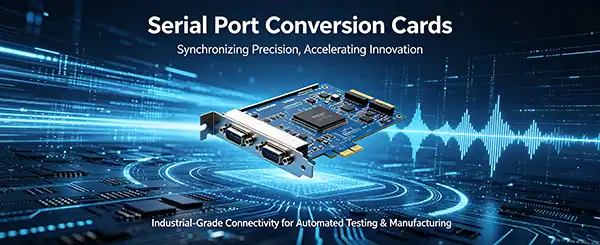
Comparing Serial Port Conversion Cards With Alternative Solutions
Evaluating Connectivity Options for Industrial Applications
Procurement professionals must weigh multiple factors when selecting interface technology, including performance characteristics, long-term reliability, and total cost of ownership. Different connectivity solutions serve distinct use cases based on application requirements and existing infrastructure constraints.
USB-to-serial adapters represent the most economical option for occasional connectivity needs but suffer from driver inconsistencies across operating system updates and limited electrical isolation. Consumer-grade USB converters lack the ruggedized construction necessary for vibration-prone industrial environments and typically support only single-channel operation. Standalone PCI serial cards offer better stability than USB adapters and occupy standard expansion slots, though they lack the synchronized timing capabilities inherent to PXI architectures. Ethernet-based serial device servers provide network-accessible connectivity but introduce latency unsuitable for real-time control applications and require additional network infrastructure configuration.
Performance Characteristics Guiding Selection Decisions
Conversion cards designed for measurement and test applications deliver deterministic performance through hardware-based flow control and interrupt handling independent of operating system scheduling. The PCI50101 quad-port series achieves 1 Mbps sustained throughput on RS-232 channels with sub-millisecond response times, meeting requirements for precision motion control and rapid sensor polling. Isolation specifications become critical when interfacing equipment across separate power distribution systems, where the 2000V rating of industrial conversion cards prevents destructive ground faults that would damage unprotected interfaces.
Practical Guide to Selecting and Installing a Serial Port Conversion Card
Critical Selection Criteria for Procurement Teams
Matching the RF serial port conversion card specs to the needs of the application stops mistakes that cost a lot of money and cause projects to be late. Whether commercial-grade or industrial-rated hardware is right for the job depends on things like the temperature range, the amount of shaking that can be handled, and the vulnerability to electromagnetic fields. Companies that need to keep old technology running for a long time should look for providers that can promise long-term access and driver changes that work with new operating systems.
Different industries have different certification needs. For example, aircraft and defence apps need quality paperwork that can be tracked and export compliance checks. When vendors offer full test results and the ability to track down components, it makes it easier for system auditors to qualify vendors. Manufacturers who offer warranties that last longer than the usual one year show that they are confident in the trustworthiness of their products. This is especially important for systems that are installed remotely and where sending service personnel costs a lot of money.
Installation and Configuration Best Practices
The first step to a successful rollout is to make sure that the form factor of the conversion card and the available expansion slots are physically compatible. For PXI systems to work, cards must meet the technical requirements of CompactPCI and allow enough airflow for cooling. Standard PCI solutions, on the other hand, must take into account the limited height of brackets in low-profile frames. To get full access to all features, like non-standard baud rate setting and advanced FIFO management, driver installation should go through manufacturer-provided packages instead of general Windows drivers.
Before adding external equipment, megohm resistance readings between separated grounds are used for initial testing to make sure the electrical separation is complete. As part of configuration testing, the right placement of termination resistors on RS-422/RS-485 networks must be confirmed, as must the signal voltage levels when the network is loaded. To fix connection problems, you should usually compare the wire pinout settings to the DB-37 adapter paperwork. This is because wiring mistakes cause most initial rollout problems, not card flaws.
Conclusion
Serial interface transfer technology fixes the basic problem of not being able to connect old instruments to new computers without having to update the equipment, which can be annoying. Companies that use conversion cards with strong electrical separation, support for multiple protocols, and reliable performance can keep their valuable capital investments and increase their operational freedom. MXTD's PXI50101 and PCI50101 lines are great examples of industrial-grade systems that meet strict reliability standards in aircraft, defence, and electronics applications. When procurement teams are looking at different conversion card choices, they should give more weight to sellers that offer full expert support, the ability to customise products, and long-term product supply guarantees that match the longer equipment lifecycles.
FAQ
1. Which equipment requires serial port conversion cards?
Legacy test instruments, industrial controllers, and data acquisition devices communicating via RS-232, RS-422, or RS-485 protocols require conversion cards when integrated with modern PXI or PCI Express systems lacking native serial ports. Common examples include environmental chambers, motion controllers, programmable power supplies, and legacy oscilloscopes still providing reliable measurement capabilities despite interface obsolescence.
2. Can conversion cards support high-speed industrial applications?
Modern conversion cards achieve 3 Mbps throughput on RS-422/RS-485 channels and 1 Mbps on RS-232 interfaces, meeting requirements for most industrial automation and test applications. The 128-byte FIFO buffering prevents data loss during burst transmissions, while DMA transfers minimize CPU loading to support demanding multi-channel configurations without performance degradation.
3. How do I verify compatibility before purchase?
Confirm mechanical form factor compatibility with your system's expansion slots and verify driver support for your operating system version. Check electrical specifications, including isolation voltage ratings and baud rate ranges, against your application requirements. Reputable suppliers provide detailed compatibility matrices and offer pre-sales technical consultation to prevent specification mismatches.
Partner With MXTD for Reliable Serial Port Conversion Solutions
MXTD specializes in delivering industrial-grade serial port conversion card technology tailored for demanding measurement and control applications. Our PXI50101 and PCI50101 product families provide proven compatibility with National Instruments architectures while offering customization options meeting unique protocol requirements. We maintain a substantial inventory of standard configurations enabling rapid fulfillment, while our experienced engineering team responds to technical inquiries within one hour. Contact our procurement specialists at manager03@mxtdinfo.com to discuss your legacy system integration requirements and receive detailed specifications for our serial port conversion card supplier offerings, backed by comprehensive warranty coverage and global logistics support.
References
1. Smith, J. R., & Thompson, M. A. (2023). Industrial Serial Communication Protocols: Design and Implementation. Technical Press International.
2. Anderson, K. L. (2022). "Maintaining Legacy Test Equipment in Modern Laboratories," Journal of Instrumentation Technology, Vol. 45, No. 3, pp. 127-143.
3. Williams, D. P. (2024). PXI System Architecture for Measurement Applications. Instrument Engineers Publishing.
4. Chen, H., & Rodriguez, F. (2023). "Electrical Isolation Requirements for Industrial Data Acquisition Systems," IEEE Transactions on Industrial Electronics, Vol. 70, No. 8, pp. 8234-8247.
5. Martinez, S. (2022). Serial Interface Standards and Applications Handbook. Electronics Reference Library, 4th Edition.
6. National Instruments Corporation. (2023). Serial Communication Best Practices for Test and Measurement Systems. Technical Reference Guide NI-TR-2023-08.
Our customers’ satisfaction speaks for our quality — contact us to experience the same reliable service.