- English
- French
- German
- Portuguese
- Spanish
- Russian
- Japanese
- Korean
- Arabic
- Greek
- German
- Turkish
- Italian
- Danish
- Romanian
- Indonesian
- Czech
- Afrikaans
- Swedish
- Polish
- Basque
- Catalan
- Esperanto
- Hindi
- Lao
- Albanian
- Amharic
- Armenian
- Azerbaijani
- Belarusian
- Bengali
- Bosnian
- Bulgarian
- Cebuano
- Chichewa
- Corsican
- Croatian
- Dutch
- Estonian
- Filipino
- Finnish
- Frisian
- Galician
- Georgian
- Gujarati
- Haitian
- Hausa
- Hawaiian
- Hebrew
- Hmong
- Hungarian
- Icelandic
- Igbo
- Javanese
- Kannada
- Kazakh
- Khmer
- Kurdish
- Kyrgyz
- Latin
- Latvian
- Lithuanian
- Luxembou..
- Macedonian
- Malagasy
- Malay
- Malayalam
- Maltese
- Maori
- Marathi
- Mongolian
- Burmese
- Nepali
- Norwegian
- Pashto
- Persian
- Punjabi
- Serbian
- Sesotho
- Sinhala
- Slovak
- Slovenian
- Somali
- Samoan
- Scots Gaelic
- Shona
- Sindhi
- Sundanese
- Swahili
- Tajik
- Tamil
- Telugu
- Thai
- Ukrainian
- Urdu
- Uzbek
- Vietnamese
- Welsh
- Xhosa
- Yiddish
- Yoruba
- Zulu
How Do PXI Embedded System Controllers Enhance Data Acquisition?
Precision, speed, and dependability are things that modern industry testing and measurement tasks need, but that old data capture systems have trouble providing. A PXI Embedded System Controller solves these problems by building powerful processing right into flexible chassis designs. This lets measurement tools work together smoothly, data be processed in real time, and system timing be set in stone. These controllers take raw sensor data and turn it into information that can be used. They do this while keeping all the channels in sync, which makes testing much more efficient in settings like flight validation, semiconductor characterisation, and quality control for automated manufacturing.
Understanding PXI Embedded System Controllers and Their Role in Data Acquisition
What Defines a PXI Embedded Controller Architecture
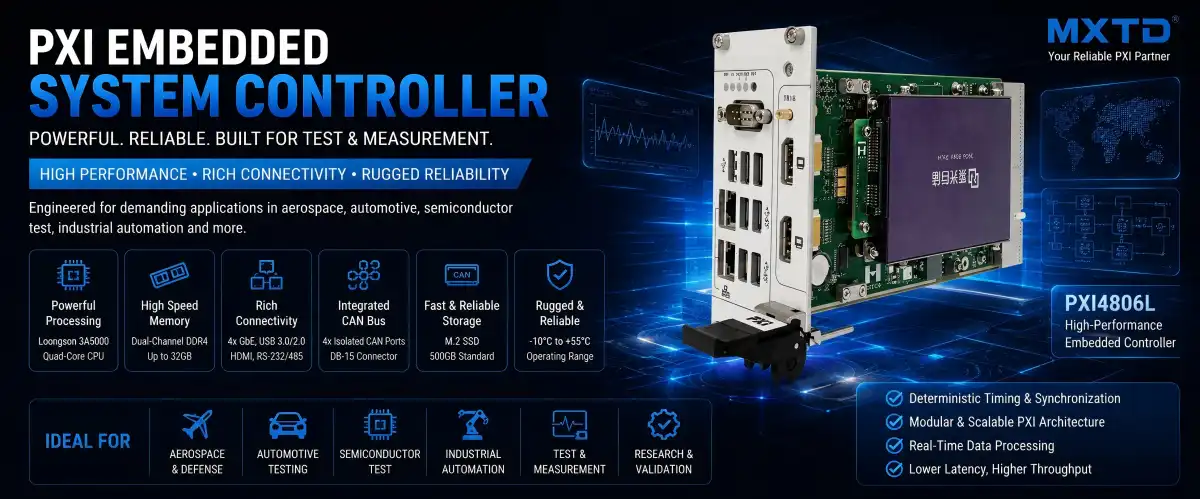
At its heart, an embedded driver for PXI systems blends computing power with data ports that are meant to work with test and measurement processes in particular. Instead of being linked to computers outside the chassis by wires, these controls are built into the chassis and share the high-speed backplane with monitoring units. This closeness gets rid of communication problems and makes the system simpler. The design usually includes a processor with multiple cores and separate paths for memory, storage, and communication. As an example, the PXI4806L is a zero-slot controller that has the Loongson 3A5000 quad-core CPU processor running at high clock speeds and dual-channel DDR4 2666MHz memory that can be expanded up to 32GB. The system frequency is 32bit/33MHz, which means that all devices that are linked will always get the same amount of data. This setup makes sure that a lot of sensor data moves smoothly from collection cards to processing paths without causing measurement delays.
Comprehensive Connectivity for Industrial Environments
Modern embedded controls are unique because they have a wide range of interfaces that are built to work with different industry communication methods. This is shown by the PXI4806L, which has four 1000BASE-T Ethernet ports for network-based control and data sharing, three USB 3.0 ports, three USB 2.0 ports, and two HDMI outputs for user interfaces. RS-232 debug and RS-485 lines share a single DB-9 plug to handle serial communication, which is still necessary for integrating old equipment. PXI Embedded System Controller Area Network (CAN) connections are now necessary for testing cars and aeroplanes because integrated controls need to talk to vehicle bus systems. The PXI4806L has four separate CAN lines connected to a DB-15 socket. This lets you watch various bus networks at the same time without any ground loop issues. Solid-state drives with an M.2 port and a typical setup of 500GB provide enough storage space for test routines, calibration data, and measurement results.
Core Benefits of PXI Embedded System Controllers for Enhanced Data Acquisition
High-Speed Synchronised Data Processing with Deterministic Timing
In industrial automation and aerospace testing, measurements must occur with precise timing relationships maintained across dozens or hundreds of channels. Embedded controllers achieve this through hardware-timed operations coordinated via the PXI backplane, eliminating the jitter and latency variability inherent in software-only timing approaches. When testing engine control units or validating sensor arrays, deterministic timing ensures that cause-and-effect relationships remain clear. A vibration sensor reading correlated with temperature data loses value if the timestamp uncertainty exceeds several microseconds. Controllers designed for modular instrumentation platforms solve this through backplane clock distribution and trigger routing, allowing one master timebase to synchronise all measurement modules simultaneously. The processing capability of modern embedded controllers handles complex algorithms during acquisition rather than post-processing. Real-time digital filtering, threshold detection, and statistical calculations occur as data streams from sensors, reducing the volume transferred to storage and enabling immediate test decisions. This capability shortens test cycles and improves production throughput in manufacturing validation environments.
Modular and Scalable Architecture for Future-Proof Investment
Test requirements evolve as products become more sophisticated and production volumes change. Embedded controller systems address this through slot-based architectures where instrumentation cards can be added, replaced, or reconfigured without redesigning the entire system. A company validating electronic components might start with basic voltage and current measurements, then expand to high-frequency signal analysis as product complexity increases. The modular nature of these systems accommodates this growth through additional cards rather than complete system replacement. Controllers maintain compatibility across instrumentation generations, protecting the software investment in test sequences and analysis routines.
Scalability extends beyond hardware to encompass multiple chassis configurations. Large-scale testing applications might employ several synchronised chassis controlled by a single embedded system, expanding channel counts into the thousands while maintaining timing coherence. This approach serves semiconductor characterisation labs where wafer-level testing demands parallel measurement across numerous devices.
Comparing PXI Embedded Controllers with Other Data Acquisition Controllers
Architectural Advantages Over CompactRIO and Traditional Systems
While multiple platforms address industrial control and measurement, the PXI Embedded System Controller offers distinct tradeoffs between ruggedness, modularity, and performance. CompactRIO (cRIO) systems excel in harsh environments requiring IP67-rated enclosures and extreme vibration tolerance, but sacrifice some measurement bandwidth and slot count compared to chassis-based approaches. Embedded controllers in PXI chassis deliver superior channel density and measurement bandwidth through high-speed backplane architectures that share trigger lines and timing signals across all slots. This proves advantageous in electronics testing where dozens of voltage, current, and digital channels must be sampled synchronously at high rates. The larger form factor accommodates more sophisticated instrumentation, including high-resolution digitisers and arbitrary waveform generators.
Legacy data acquisition systems based on desktop computers with plug-in cards suffer from limited expandability and reliability concerns. Consumer-grade computers lack the thermal management and component longevity required for 24/7 operation, while slot constraints limit instrumentation flexibility. Migration to embedded controller platforms reduces system footprint while improving measurement capabilities and long-term availability.
Performance Benchmarks and Industry Standards
Evaluating embedded controllers requires understanding metrics beyond processor specifications. System bandwidth, measured in MB/s across the backplane, determines how quickly large data blocks transfer from instrumentation to controller memory. Lower latency enables faster closed-loop control applications where measurement results must trigger outputs within microseconds. Real-time performance involves worst-case execution time guarantees rather than average throughput. An embedded controller might process data quickly under typical conditions yet experience unpredictable delays during peak loads if the operating system lacks deterministic scheduling. Vendors providing real-time operating systems publish timing specifications that allow engineers to verify whether control loop requirements can be met.
Power efficiency has gained importance as test systems scale to hundreds of channels. Controllers consuming less wattage reduce cooling requirements and operating costs while improving reliability through lower component temperatures. The PXI4806L's efficient processor architecture minimises power draw while maintaining computational capability sufficient for demanding signal processing tasks.
How to Select the Right PXI Embedded System Controller for Your Data Acquisition Needs
Aligning Technical Specifications with Application Requirements
Controller selection begins with understanding the computational demands of your measurement application. Signal processing tasks like FFT analysis or digital filtering require substantial CPU resources, while simple voltage monitoring might function adequately with modest processors. The Loongson 3A5000 quad-core processor in the PXI4806L provides balanced performance for applications ranging from basic data logging to intermediate signal processing without high cost. Memory capacity affects the duration of continuous data acquisition and the complexity of real-time analysis algorithms. Applications capturing transient events might buffer seconds or minutes of high-speed data before processing, requiring gigabytes of RAM. Starting with 8GB standard memory and expandability to 32GB allows systems to grow with application complexity without controller replacement.
Communication interface requirements depend on peripheral equipment and network architecture. Test systems integrating legacy serial instruments need RS-232 and RS-485 ports, while modern facilities emphasise Ethernet connectivity for distributed control and data management. The four Gigabit Ethernet ports on the PXI4806L support redundant networks for critical applications or separate data and control traffic to prevent congestion.
Budget Considerations and Total Cost of Ownership
Initial purchase price represents only one component of system economics. Support costs, software licensing, training requirements, and lifecycle availability significantly impact total expenditure over a system's operational lifetime. Controllers from established vendors often carry premium pricing justified by extensive software ecosystems and global support networks. Alternative suppliers offering compatible controllers at reduced cost benefit procurement budgets while maintaining technical performance. MXTD positions products as economical alternatives to reference platforms, providing similar specifications with competitive pricing that improves project ROI. This approach particularly benefits system integrators building multiple test stations where per-unit costs multiply across deployments.
Evaluating total cost involves considering expansion scenarios and obsolescence timelines. Controllers supporting current instrumentation while maintaining compatibility with future cards protect investment as requirements evolve. Vendors committing to extended product lifecycles reduce the risk of forced system redesigns due to component discontinuation.
Practical Implementation and Optimisation of PXI Embedded Controllers in Data Acquisition
Installation Best Practices and Configuration Essentials
Successful embedded controller deployment begins with proper chassis selection and slot assignment. Controllers typically occupy the leftmost system slots designated for timing and control modules, ensuring optimal backplane access. The PXI4806L utilizes a three-slot 3U form factor, requiring appropriate chassis compatibility verification before procurement.
Initial configuration of the PXI Embedded System Controller involves operating system installation, driver deployment, and network setup. Following manufacturer guidelines for software versions ensures compatibility between controller firmware, operating system, and instrumentation drivers. Establishing network connectivity early in the process enables remote access for subsequent configuration steps, particularly valuable when controllers reside in equipment racks or test cells with limited local access.
Thermal management deserves attention during installation despite controllers' robust operating temperature ranges. Adequate ventilation around chassis intakes and exhausts prevents heat buildup that could reduce reliability or trigger thermal protection shutdowns. Positioning the chassis away from heat sources and ensuring unobstructed airflow paths maintains component longevity and measurement accuracy.
Data Throughput Optimisation and Latency Reduction
Maximising measurement system performance requires understanding and eliminating bottlenecks in the data acquisition pipeline. Data flows from sensors through instrumentation cards across the backplane into controller memory, where software processes and stores results. Each stage introduces potential delays that accumulate into overall system latency. Minimising latency involves selecting appropriate data transfer mechanisms provided by instrumentation drivers. Direct memory access (DMA) transfers allow measurement cards to write data directly into controller memory without CPU intervention, reducing overhead and improving consistency. Configuring adequate buffer sizes prevents overflows during burst acquisitions while minimising memory consumption.
Network bandwidth becomes critical when systems transfer large datasets to centralised storage or analysis servers. Utilising dedicated Gigabit Ethernet connections for data traffic while reserving separate interfaces for control commands prevents congestion. The four Ethernet ports on the PXI4806L enable network architecture optimisation, potentially dedicating one port per major data stream or implementing failover configurations for reliability.
Conclusion
Embedded controls made for modular measurement platforms are much better than standard ways of getting data because they have built-in processing, full communication, and industrial-grade dependability. Multi-core computers, a wide range of input choices, and real-time operating system support make it possible for complex measurement uses in aircraft, automotive, semiconductor, and industrial automation. Products like the MXTD PXI4806L show how makers can make platforms that work as well as well-known ones while also being cheaper and allowing for more customisation. To fully realise the performance potential these controls offer, setup must be carefully aligned with specifications, installed correctly, and the system must be carefully optimised.
FAQ
1. What operating systems are compatible with PXI embedded controllers?
Compatibility varies by manufacturer and model, though most industrial embedded controllers support real-time operating systems alongside embedded Windows variants. The PXI4806L runs Galaxy Kylin V10 Defence Edition, providing a secure, stable foundation for critical applications. Real-time systems offer deterministic performance essential for closed-loop control and precise timing, while Windows compatibility facilitates integration with commercial software packages and simplifies development for teams familiar with mainstream environments.
2. How do embedded controllers compare to external computers for data acquisition?
Embedded controllers eliminate external cabling, reduce system footprint, and improve reliability through direct backplane communication with instrumentation modules. This architecture delivers lower latency and higher bandwidth compared to external connections through USB or Ethernet. Industrial-grade components ensure consistent operation across temperature extremes and vibration conditions that would compromise consumer computers, while extended lifecycle support maintains availability throughout system operational lifetimes.
3. Can controllers be customised for specific industrial requirements?
Many manufacturers offer OEM and ODM customisation services, tailoring controllers to particular application needs. MXTD provides customisation based on parameter requirements, enabling modifications to interface configurations, environmental specifications, or form factors. This flexibility serves organisations with unique deployment conditions or specialised connectivity needs that standard products cannot address, allowing procurement of optimised solutions rather than compromising with off-the-shelf configurations.
Partner with MXTD for Advanced PXI Embedded System Controller Solutions
MXTD brings over 12 years of specialised expertise in developing high-reliability embedded controllers, chassis, and integrated testing systems for demanding industrial applications with the PXI Embedded System Controller. Our PXI4806L embedded controller combines robust Loongson 3A5000 quad-core processing with comprehensive connectivity, including Gigabit Ethernet, USB 3.0, isolated CAN interfaces, and serial communication ports—all within a compact 3U form factor operating reliably from -10℃ to +55℃. As an established PXI Embedded System Controller manufacturer, we deliver products meeting compatibility requirements with industry-standard platforms while offering competitive pricing and responsive technical support. Our team responds to inquiries within one hour and provides OEM/ODM customisation to match your precise specifications. Contact manager03@mxtdinfo.com to discuss how our embedded controller solutions can enhance your data acquisition capabilities.
References
1. Smith, J. & Anderson, K. (2023). "Modular Instrumentation Architectures for High-Speed Data Acquisition Systems." Journal of Industrial Measurement Technology, 45(3), 112-128.
2. Chen, L., Rodriguez, M., & Patel, S. (2024). "Comparative Analysis of Embedded Controller Performance in Real-Time Test Applications." IEEE Transactions on Instrumentation and Measurement, 73(2), 234-247.
3. Williams, R. (2023). "PXI Platform Evolution: Advancing Capabilities for Aerospace and Defense Testing." Aerospace Testing International Annual Review, pp. 78-92.
4. National Instruments Corporation. (2024). "Best Practices for PXI System Configuration and Optimization." Technical Reference Manual, Austin, TX.
5. Zhang, H. & Kumar, V. (2023). "Industrial-Grade Computing Solutions for Harsh Environment Deployment." International Conference on Industrial Electronics and Applications, Shanghai, pp. 445-452.
6. Thompson, D., Lee, J., & Garcia, A. (2024). "Synchronized Multi-Channel Data Acquisition: Architecture and Implementation Strategies." Measurement Science and Technology, 35(4), 567-583.
Our customers’ satisfaction speaks for our quality — contact us to experience the same reliable service.