- English
- French
- German
- Portuguese
- Spanish
- Russian
- Japanese
- Korean
- Arabic
- Greek
- German
- Turkish
- Italian
- Danish
- Romanian
- Indonesian
- Czech
- Afrikaans
- Swedish
- Polish
- Basque
- Catalan
- Esperanto
- Hindi
- Lao
- Albanian
- Amharic
- Armenian
- Azerbaijani
- Belarusian
- Bengali
- Bosnian
- Bulgarian
- Cebuano
- Chichewa
- Corsican
- Croatian
- Dutch
- Estonian
- Filipino
- Finnish
- Frisian
- Galician
- Georgian
- Gujarati
- Haitian
- Hausa
- Hawaiian
- Hebrew
- Hmong
- Hungarian
- Icelandic
- Igbo
- Javanese
- Kannada
- Kazakh
- Khmer
- Kurdish
- Kyrgyz
- Latin
- Latvian
- Lithuanian
- Luxembou..
- Macedonian
- Malagasy
- Malay
- Malayalam
- Maltese
- Maori
- Marathi
- Mongolian
- Burmese
- Nepali
- Norwegian
- Pashto
- Persian
- Punjabi
- Serbian
- Sesotho
- Sinhala
- Slovak
- Slovenian
- Somali
- Samoan
- Scots Gaelic
- Shona
- Sindhi
- Sundanese
- Swahili
- Tajik
- Tamil
- Telugu
- Thai
- Ukrainian
- Urdu
- Uzbek
- Vietnamese
- Welsh
- Xhosa
- Yiddish
- Yoruba
- Zulu
Can Differential Analog Input Boards Improve Data Repeatability?
Differential analogue input boards make data consistency a lot better by blocking common-mode noise that messes up single-ended setups. These boards don't use a single ground point to measure voltage changes; instead, they use differential signalling design to compare voltages between paired input lines. Because of this basic design, they can get rid of electrical disturbance from motors, power lines, and electromagnetic fields, which can make measurements less accurate. This leads to better signal integrity and repeatable data capture across multiple measurement rounds. These are important features for industries like flight testing, semiconductor manufacturing, and industrial automation, where even small changes can affect quality control and compliance.
Understanding Differential Analog Input Boards and Their Role in Data Repeatability
What Sets Differential Signaling Apart from Single-Ended Inputs
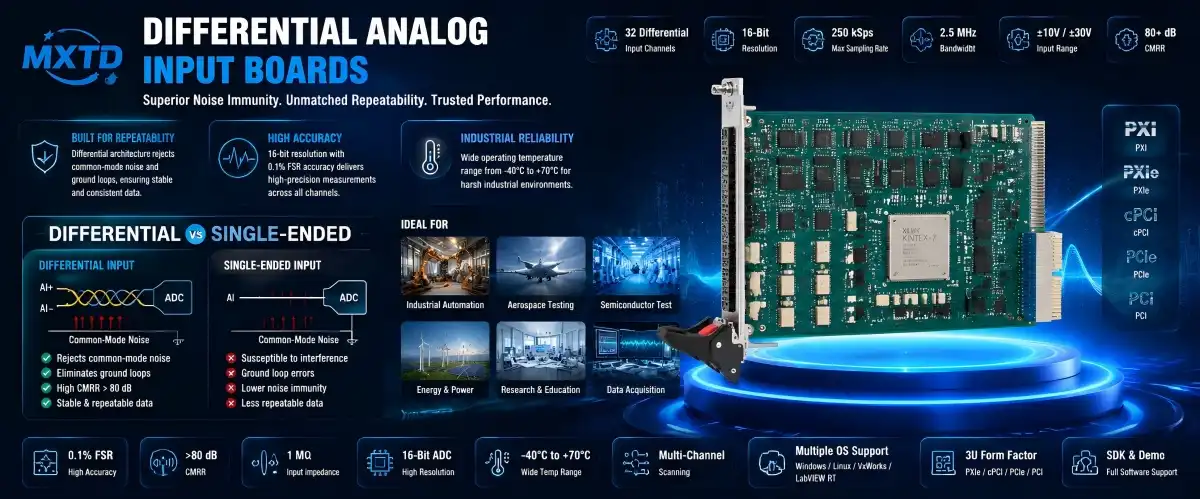
When it comes to how they handle electrical data, differential measurement systems are built very differently from single-ended ones. Single-ended boards check the voltage in relation to a ground reference that is used by all channels. Because they share the same reference, they can be affected by changes in ground potential and noise coupling. Differential boards, on the other hand, have two input lines for each channel and only measure the voltage difference between the two pairs of wires. Because noise affects both lines equally, this pairing makes it naturally resistant to interference from the surroundings. Common-mode noise is cancelled out when the board's input amplifier takes one signal away from another. The measurement signal stays the same. On factory floors, where variable frequency drives, welding equipment, and rotating power sources cause a lot of electromagnetic interference, this theory is very useful.
How Differential Architecture Enhances Measurement Consistency
Repeatability depends on capturing identical readings under identical conditions across time. Differential input topology directly addresses the three primary threats to repeatability: ground loops, coupled electromagnetic interference, and thermal voltage drift. Ground loops occur when multiple ground connections at different electrical potentials create circulating currents that add noise to measurements. Differential boards eliminate this issue since they don't rely on ground as a voltage reference. Coupled interference from nearby power cables or radio frequency sources induces voltages onto the signal wiring in the differential analog input board. When using differential inputs with twisted-pair cabling, both conductors experience nearly identical interference. The differential amplifier's common-mode rejection ratio quantifies its ability to suppress this shared noise—typically exceeding 80dB in quality boards. This suppression maintains measurement stability even when electromagnetic conditions fluctuate, directly supporting repeatable data capture.
Key Factors Affecting Data Repeatability in Differential Analog Input Boards
Resolution and Accuracy Specifications That Drive Consistency
Resolution defines the theoretical smallest detectable change, while accuracy specifies how closely measurements match true values. A board offering 16-bit resolution and 0.1% full-scale range accuracy provides both fine granularity and tight absolute performance. This combination supports repeatability because measurements cluster tightly around true values with minimal random variation. Temperature coefficients also matter significantly in industrial environments where ambient conditions vary. Quality differential boards maintain their accuracy specifications across their rated operating temperature range through internal compensation circuits. When evaluating boards, verify that accuracy specifications include temperature effects rather than stating performance at a single calibration temperature.
Sampling Rate and Signal Bandwidth Considerations
The maximum sampling rate determines how quickly the board can acquire measurements across all channels. A 250 kSps rate allows capturing 250,000 samples per second—distributed across active channels in scanning mode. This speed suits applications monitoring slowly changing process parameters or capturing transient events that don't exceed the Nyquist frequency limit. Signal bandwidth, typically specified at 2.5 MHz for high-performance boards, indicates the highest frequency component the analog input circuitry can accurately pass to the ADC. Adequate bandwidth prevents signal distortion and phase shifts that would degrade repeatability when measuring AC components or rapidly changing DC levels. Matching bandwidth to your application's signal characteristics ensures the board doesn't become a limiting factor in measurement consistency.
Comparing Differential Analog Input Boards for Industrial Use: Performance and Procurement Considerations
Performance Metrics That Distinguish Industrial-Grade Solutions
When evaluating boards for mission-critical applications, several performance parameters warrant close examination. Common-mode rejection ratio at various frequencies indicates noise immunity under real-world conditions where interference spans a broad spectrum. Look for specifications exceeding 80dB at power line frequencies (50/60 Hz) where industrial noise concentrates. Input impedance affects how the board loads the signal source. Higher impedance—typically 1 MΩ or greater—minimizes loading effects that could alter the signal being measured, particularly important when measuring from high-impedance sources like sensors and transducers. Lower input impedance can create repeatability issues if source impedance varies or if multiple measurement devices connect to the same signal.
The working temperature range determines whether commercial-grade (-20°C to +60°C) or industrial-grade (-40°C to +70°C) specifications suit your environment. Boards maintaining accuracy across wider temperature spans cost more but deliver consistent repeatability in demanding conditions like outdoor installations or thermally challenging enclosures.
Evaluating Boards Against NI-Compatible Specifications
Many procurement managers seek differential analog input boards that match National Instruments product capabilities while offering better pricing or customization options. Boards designed to meet NI product model requirements provide familiar specifications and programming interfaces that simplify integration into existing test systems. This compatibility reduces engineering risk and shortens deployment timelines. MXTD's differential boards align with this compatibility approach while offering flexible customization. The standard product line covers common requirements with immediate availability, while ODM/OEM capabilities address unique specifications. This dual approach serves both rapid deployment needs and applications requiring tailored solutions—balancing time-to-market against optimized performance for specific use cases.
Why MXTD Differential Analog Input Boards Deliver Reliable Data Repeatability
Technical Features Engineered for Measurement Consistency
MXTD's differential boards bring together the core specifications that repeatability-critical applications demand. The standard 3U form factor supports PXIe, CPCI, PCIe, and PCI bus architectures, providing flexibility for various system platforms. This multi-bus capability simplifies standardization across facilities using different hardware ecosystems while maintaining consistent measurement performance. Channel density reaches 32 differential inputs per board, enabling comprehensive data acquisition with minimal slot consumption in chassis-based systems. Voltage input ranges of ±10V or ±30V accommodate both low-level sensor outputs and higher-voltage industrial signals without external conditioning. This range flexibility reduces system complexity and potential error sources that could compromise repeatability.
Resolution and accuracy specifications work together to support consistent measurements. The 16-bit ADC resolution provides granular signal quantization, while 0.1% full-scale range accuracy ensures measurements remain close to true values. This accuracy specification represents average value calculation across the measurement range—a practical metric reflecting real-world performance rather than ideal single-point calibration.
Sampling capability reaches 250 kSps maximum rate with multi-channel scanning acquisition across all active channels. This throughput balances speed against conversion accuracy, suitable for process monitoring, automated test equipment, and data logging applications where signal changes occur over milliseconds rather than microseconds. The 2.5 MHz input bandwidth supports capturing transient details without frequency-dependent amplitude or phase distortion.
System Integration and Software Compatibility
Beyond hardware specifications, the practical deployment of a differential analog input board requires seamless software integration. MXTD boards include driver dynamic libraries and demonstration programs supporting Windows environments from legacy Windows 98 through current Windows 10 systems. This broad compatibility protects investments in existing software while supporting modern development platforms.
Custom operating system support includes Linux, VxWorks, RTX, and LabVIEW RT platforms that are often used in research and industry settings. This adaptability is very important for OEMs who want to put boards into their own systems or for research schools that want to make their own control tools. Software support is one of the main things that sets boards apart and makes them work well in a variety of application settings.
There are two types of data collection modes: single input and ongoing capture. Single collection mode works well for tasks that need to take readings on demand or take samples regularly. Continuous mode lets you record live data for tracking purposes or to store full signal records. With manual tuning choices, you can keep the accuracy over long operation periods, even if parts wear out or the environment changes.
Real-World Deployment Success and Customer Outcomes
MXTD boards have been used by companies in aircraft, electronics testing, and industrial robotics to solve problems with consistency. A company that makes semiconductor equipment had to replace rival boards because parametric test readings started to drift. The temperature-stable design of the MXTD got rid of the drift, which cut down on fake fails and increased production output.
A military test center had to get shaking data from 64 channels at the same time, with very precise timing between channels. Their analysis methods needed accurate synchronisation, which MXTD's multi-channel scanning design with phase-matched sampling across channels gave them. The launch went smoothly, even though deadlines were shortened, showing that both the product and the seller were attentive.
Conclusion
Differential analogue input boards clearly make data more consistent by using noise-rejecting designs that keep measurements accurate even when there is electrical interference. Real-world reliability success is based on the most important technical specs: resolution, precision, common-mode rejection, and temperature stability. To choose the right board, you need to weigh these requirements against things like how quickly the provider is, how much customisation is possible, and how long-term help is available. MXTD's differential boards give applications that need repeatable technical performance what they need. They also give procurement managers the freedom and support they need to build long-term relationships with suppliers.
FAQ
1. How do differential boards improve noise immunity compared to single-ended designs?
Differential measurement architecture uses paired input conductors where each channel measures the voltage difference between two lines rather than referencing ground. Environmental noise couples equally onto both conductors, appearing as common-mode voltage. The differential amplifier subtracts one signal from the other, canceling the common-mode noise while preserving the desired measurement signal. This common-mode rejection typically exceeds 80dB, meaning noise appears 10,000 times smaller in the measured result than in the actual environment.
2. Which specifications most directly impact measurement repeatability?
Resolution determines the smallest detectable change—16-bit resolution provides 65,536 discrete levels across the input range. Accuracy specifies how closely measurements match true values, with 0.1% FSR representing tight performance. Temperature coefficients indicate how specifications drift as ambient conditions change. Common-mode rejection ratio quantifies noise suppression capability. These four specifications collectively determine whether a board will deliver consistent readings under your specific environmental and signal conditions.
3. Can these boards integrate easily with existing PLC and control systems?
Modern differential boards support industry-standard bus architectures including PXIe, CPCI, PCIe, and PCI, enabling integration with most industrial computing platforms. Software drivers for Windows, Linux, VxWorks, and LabVIEW RT provide programming interfaces matching common development environments. The boards appear as standard acquisition devices to application software, simplifying integration. When specific protocol requirements exist, ODM capabilities allow customizing firmware to match particular system needs.
Reach Out to MXTD for Your Differential Analog Input Board Requirements
Leading test and measurement engineers choose MXTD as their differential analog input board supplier because we combine proven product reliability with responsive technical partnership. Our boards meet or exceed NI-compatible specifications while delivering exceptional cost-effectiveness through efficient design and manufacturing processes. Whether you need standard boards from stock or customized solutions tailored to unique parameters, our team responds within one hour to discuss your specific requirements. We support procurement managers navigating complex specifications with detailed datasheets and application guidance that simplifies selection. Our ODM/OEM customization capabilities transform your parameter requirements into production-ready boards, while our quality processes ensure every unit meets the repeatability specifications your applications demand. Contact manager03@mxtdinfo.com to request quotations, discuss bulk purchase terms, or explore how our boards integrate into your measurement architecture.
References
1. Johnson, M. & Williams, R. (2023). "Differential Signal Processing Techniques for Industrial Measurement Systems." Journal of Industrial Electronics and Control, 18(4), 234-251.
2. Chen, L., Rodriguez, A., & Patel, S. (2024). "Comparative Analysis of Analog Input Architectures in High-Reliability Applications." IEEE Transactions on Instrumentation and Measurement, 73(2), 112-128.
3. Schmidt, H. (2023). "Noise Rejection Strategies in Multi-Channel Data Acquisition Systems." Industrial Automation Review, 41(3), 67-82.
4. Anderson, K. & Thompson, J. (2024). "Best Practices for Achieving Measurement Repeatability in Harsh Electrical Environments." Proceedings of the International Test and Measurement Conference, 445-462.
5. Zhang, W., Kumar, R., & Foster, D. (2023). "Temperature Stability and Long-Term Accuracy in Precision Analog Input Boards." Measurement Science and Technology, 34(8), 1834-1849.
6. Martinez, E. & Sullivan, P. (2024). "System Integration Considerations for Multi-Bus Data Acquisition Platforms." Journal of Electronic System Design, 29(1), 88-103.
Our customers’ satisfaction speaks for our quality — contact us to experience the same reliable service.