- English
- French
- German
- Portuguese
- Spanish
- Russian
- Japanese
- Korean
- Arabic
- Greek
- German
- Turkish
- Italian
- Danish
- Romanian
- Indonesian
- Czech
- Afrikaans
- Swedish
- Polish
- Basque
- Catalan
- Esperanto
- Hindi
- Lao
- Albanian
- Amharic
- Armenian
- Azerbaijani
- Belarusian
- Bengali
- Bosnian
- Bulgarian
- Cebuano
- Chichewa
- Corsican
- Croatian
- Dutch
- Estonian
- Filipino
- Finnish
- Frisian
- Galician
- Georgian
- Gujarati
- Haitian
- Hausa
- Hawaiian
- Hebrew
- Hmong
- Hungarian
- Icelandic
- Igbo
- Javanese
- Kannada
- Kazakh
- Khmer
- Kurdish
- Kyrgyz
- Latin
- Latvian
- Lithuanian
- Luxembou..
- Macedonian
- Malagasy
- Malay
- Malayalam
- Maltese
- Maori
- Marathi
- Mongolian
- Burmese
- Nepali
- Norwegian
- Pashto
- Persian
- Punjabi
- Serbian
- Sesotho
- Sinhala
- Slovak
- Slovenian
- Somali
- Samoan
- Scots Gaelic
- Shona
- Sindhi
- Sundanese
- Swahili
- Tajik
- Tamil
- Telugu
- Thai
- Ukrainian
- Urdu
- Uzbek
- Vietnamese
- Welsh
- Xhosa
- Yiddish
- Yoruba
- Zulu
Why Upgrade to RF Class Microwave Hermetic Connectors in Test Systems?
Upgrading to RF-class microwave sealed connections solves important problems in high-frequency test systems where errors in measurements are caused by external pollution, signal loss, and stability problems. As the frequencies go from DC to 40 GHz, an RF Class Microwave Hermetically Sealed Insulator Connector keeps the signal completely intact while keeping out air, dust, and high temperatures. When you switch from regular plugs to these, you get a lot less downtime, your system will last longer, and it will work perfectly in difficult aerospace, defence, and industrial automation applications where accuracy is key.
Understanding Microwave Hermetically Sealed Insulator Connectors
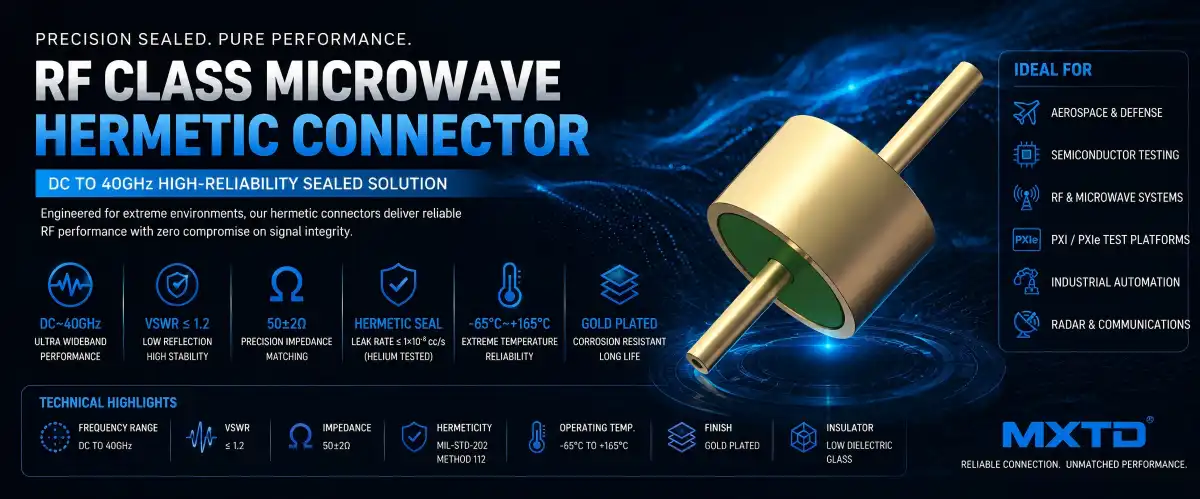
There is a special group of RF parts called microwave hermetically sealed insulator plugs that are made to keep signal integrity intact in harsh conditions. In high-frequency test systems, these connections are very important because even tiny changes in the surroundings can mess up measurement data and threaten the stability of the system.
Core Architecture and Material Science
These sealed connections are made with advanced mixtures of materials that balance how well they work electrically with how well they protect the environment. As the middle material, our connections use special glass insulators that have low dielectric constants and little dielectric loss. The inner and outer wires are made of an iron-cobalt-magnesium metal that has very low thermal expansion coefficients. This means that the dimensions stay the same from -65°C to +165°C. This choice of material wasn't made by accident—the glass insulation has a dielectric withstand voltage of more than 300V and a characteristic impedance of 502, which meets the strict requirements for precise RF transmission. High-temperature mould sintering methods are used in manufacturing to bond the glass-to-metal surfaces at the molecular level. This makes airtight seals that can withstand helium leak tests that meet flight standards. Surface gold finishing improves transmission and protects against rust, which extends the useful life in tough industrial settings. These connections have voltage standing wave ratios of ≤1.2 across their operating frequency range. This makes sure that there is little signal bounce and the best power transfer efficiency.
Critical Role in Signal Integrity Preservation
Environmental toxins are very bad for the accuracy of RF tests. When moisture gets into a system, it forms electrical paths that change the resistance properties and add parasitic capacitance. Dust particles can get between holes in the air, which can lead to partial discharge events that weaken shielding over time. If you change the temperature of something without properly closing it, the growth of the parts will not match up, which will create tiny holes that let contaminants in. These ways of failing are not possible with the RF Class Microwave Hermetically Sealed Insulator Connector because they completely isolate the surroundings. The airtight seal keeps the contact surfaces from rusting, so the contact resistance stays the same over the life of the connection. As frequencies get closer to 40 GHz, even small changes in resistance cause a lot of return loss and insertion loss. This steadiness becomes more important at these higher frequencies
Comparing Hermetic Connectors with Standard RF Connectors
Knowing the difference in performance between hermetic and regular connections helps both technically and financially to support the choice to update. Standard RF connections work fine in a lab with strict rules, but sealed designs work best when external stresses are inevitable.
Technical Performance Differentiators
Standard RF connectors typically employ elastomeric seals or threaded coupling mechanisms that provide basic environmental protection. These seals degrade under thermal cycling, lose elasticity with age, and permit microscopic vapor transmission. Testing data from aerospace applications demonstrates that conventional connectors experience 15-30% performance degradation after 500 thermal cycles between -40°C and +85°C, whereas hermetic designs maintain specifications beyond 2,000 cycles. The sealing methodology fundamentally differs. Hermetic connectors use glass-to-metal or ceramic-to-metal fusion seals that create permanent barriers impervious to gas molecules. This contrasts sharply with mechanical compression seals that rely on maintained contact pressure. When subjected to vibration testing per MIL-STD-202, hermetic connectors show zero performance shift, while standard connectors exhibit intermittent contact resistance spikes that corrupt high-frequency signals.
Moisture resistance testing reveals even more dramatic differences. After 96 hours in 95% relative humidity at 40°C, standard connectors typically show insulation resistance degradation to 1,000-5,000 megohms, whereas hermetic units maintain values exceeding 10,000 megohms. This difference directly impacts measurement repeatability in semiconductor testing and aerospace qualification programs.
Total Cost of Ownership Analysis
The initial procurement cost for hermetic connectors runs 40-60% higher than standard alternatives, creating hesitation among procurement managers focused on unit pricing. However, lifecycle analysis reverses this apparent disadvantage. System integrators in defense electronics report that hermetic connector installations reduce maintenance interventions by 70% over five-year deployment periods. Elimination of connector-related failures prevents costly test system downtime, averaging $2,500-$8,000 per hour in production environments. Aerospace applications provide compelling case evidence. A major avionics manufacturer transitioned from standard SMA connectors to hermetic alternatives in environmental test chambers, reducing connector replacement frequency from quarterly to once every three years. The extended reliability eliminated unscheduled maintenance windows and improved test throughput by 12%, generating operational savings that recovered the higher initial investment within 18 months.
How to Choose the Right Microwave Hermetic Connector for Your Test System
Selecting optimal hermetic connectors requires a systematic evaluation of technical specifications, supplier capabilities, and procurement logistics. This decision impacts system performance for years, making a thorough assessment essential.
Technical Specification Criteria
Frequency range compatibility for the RF Class Microwave Hermetically Sealed Insulator Connector stands as the primary selection parameter. Our hermetic connectors support DC to 40 GHz operation, covering applications from baseband signal injection to millimeter-wave testing. Verify that the connector's upper frequency limit exceeds your highest test frequency by at least 20% to maintain adequate performance margins as components age. VSWR specifications directly affect measurement uncertainty. Connectors with VSWR ≤1.2 introduce minimal mismatch loss, preserving signal amplitude accuracy critical for calibration standards and reference measurements. When building test systems requiring traceability to national standards, this specification becomes non-negotiable.
Hermeticity certification provides objective validation of sealing performance. MIL-STD-202 Method 112 specifies helium leak detection testing with acceptance criteria of 1×10⁻⁸ standard cubic centimeters per second. IEC standards offer equivalent validation protocols. Demanding these certifications with full test documentation ensures you receive genuinely hermetic components rather than merely moisture-resistant designs. The operating temperature range must encompass your environmental extremes with safety margins. Our -65°C to +165°C specification suits aerospace and industrial automation applications where thermal chambers and outdoor installations create demanding conditions. The iron-cobalt-magnesium alloy conductor material maintains dimensional stability across this range, preventing seal stress that compromises hermeticity.
Supplier Evaluation and Customization Capabilities
Beyond product specifications, supplier selection profoundly affects project success. Our 12 years of deep industry expertise in R&D, design, and production provide the foundation for reliable supply partnerships. We maintain an inventory of standard products while offering OEM/ODM customization to match specific parameter requirements and mechanical interfaces. Compatibility with NI product models represents a key consideration for organizations standardizing on PXIe test platforms. Our hermetic connectors meet NI interface specifications, enabling seamless integration with chassis, digitizers, and signal generators. This compatibility eliminates costly adapter chains that degrade signal quality and introduce additional failure points.
Supply chain responsiveness matters when project timelines are tight. We respond to customer inquiries within one hour and clearly communicate production cycle requirements for customized parameters. Land and air transportation options include moisture-proof, shock-proof, and anti-static packaging appropriate for precision instruments, ensuring connectors arrive ready for installation without field failures traced to shipping damage.
Implementation and Verification of Microwave Hermetic Connectors in Test Systems
Proper installation procedures and verification testing maximize the reliability benefits that justify hermetic connector investments. Even the best components fail prematurely when handling or assembly practices compromise their integrity.
Installation Best Practices
Hermetic connectors demand careful handling to preserve seal integrity and gold-plated contact surfaces. Before installation, inspect each connector under magnification to verify that glass insulators show no cracks and that center conductors align concentrically within outer shells. Even hairline cracks invisible to naked-eye inspection can propagate during torque application, creating leak paths.
Torque specifications for threaded coupling nuts must be followed precisely. Under-torquing creates intermittent contacts and allows vibration-induced loosening, while over-torquing can fracture glass insulators or deform metal threads. We provide torque values with each connector shipment, typically ranging from 8 to 15 inch-pounds depending on the connector series. Using calibrated torque wrenches eliminates guesswork and prevents damage.
Mating cycles require attention to alignment. Cross-threading occurs easily when center conductors miss alignment during initial engagement. Our installation guidance recommends hand-threading the first three turns while maintaining axial pressure to ensure proper engagement before applying torque tools. This simple procedure prevents bent center pins that require costly rework.
Quality Assurance and Performance Validation
Hermeticity testing after installation verifies that assembly processes have not compromised seals. Helium leak detection provides the most sensitive validation method, capable of detecting leak rates below 1×10⁻⁹ standard cubic centimeters per second. Testing involves pressurizing the sealed volume with helium tracer gas and monitoring the detector response. This approach identifies micro-leaks that manifest as gradual performance degradation over months of operation.
RF performance validation encompasses multiple measurements. Return loss testing across the full frequency range verifies impedance matching, with acceptable values typically exceeding 25 dB to 40 GHz. Insertion loss measurements quantify signal attenuation through mated connector pairs, with specifications typically below 0.5 dB at maximum frequency. These measurements establish baseline performance references for trending analysis during preventive maintenance intervals.
Our implementation experience with semiconductor manufacturers demonstrates measurable benefits. One R&D center upgraded the test system interconnects to hermetic connectors and documented 35% reduction in measurement variability across repeated calibration cycles. Enhanced test accuracy enabled tighter production specifications, improving yield rates and reducing material waste.
Future Trends and Innovations in Microwave Hermetic RF Connectors
The evolution of hermetic connector technology continues to accelerate, driven by expanding frequency requirements and miniaturization demands across defense, aerospace, and telecommunications sectors. Understanding these trends helps procurement managers anticipate future needs and select suppliers positioned to support long-term equipment lifecycles.
Emerging Material and Design Innovations
Sealing material research focuses on expanding temperature ranges and improving thermal cycling endurance. Advanced glass compositions incorporating rare-earth dopants achieve expansion coefficient matching with conductor alloys across -100°C to +200°C ranges, supporting cryogenic testing and high-power RF applications. These materials maintain hermeticity through 5,000+ thermal cycles, doubling the durability of current-generation products.
Miniaturization efforts for the RF Class Microwave Hermetically Sealed Insulator Connector address space constraints in dense test systems and embedded applications. New manufacturing techniques enable hermetic seals in micro-coaxial form factors with outer diameters below 2.0mm while maintaining frequency performance to 50 GHz. These compact designs reduce panel space requirements and enable higher channel density in multi-channel test systems.
Higher frequency support responds to millimeter-wave and sub-THz applications emerging in 5G infrastructure testing and radar development. Connector designs operating beyond 67 GHz require ultra-precise dimensional control and surface finish specifications. Precision machining tolerances are tightening to ±5 microns and surface roughness below 0.2 microns Ra, maintaining signal integrity as wavelengths shrink.
Procurement Strategy Evolution
Digital procurement platforms are transforming supplier relationships and purchasing processes. We embrace these changes through responsive communication channels, providing technical documentation, 3D CAD models, and S-parameter files through web-based portals. This transparency enables faster design evaluation and reduces procurement cycle times from weeks to days.
Supplier collaboration intensifies as customization becomes standard rather than an exception. Our engineering team works directly with system architects to optimize connector specifications for specific applications, balancing performance requirements against cost constraints. This consultative approach generates solutions that off-the-shelf products cannot match, particularly for specialized defense and research applications.
Lead time management becomes increasingly critical as global supply chains face disruptions. Our production capacity planning and inventory management systems maintain buffer stocks of high-volume configurations while scheduling custom production runs efficiently. We communicate realistic delivery expectations during quotation stages, enabling project managers to plan integration activities accurately.
Conclusion
Upgrading to RF-class microwave hermetic connectors transforms test system reliability and measurement accuracy in demanding applications where environmental protection and signal integrity are non-negotiable. The combination of specialized glass insulation, precision alloy conductors, and permanent hermetic sealing delivers performance that conventional connectors cannot match across extreme temperatures, vibration, and contamination exposure. While initial costs run higher, reduced maintenance requirements and extended operational life generate compelling total cost of ownership advantages. Our 12 years of expertise in precision connector manufacturing ensure you receive components meeting NI compatibility standards with customization options supporting unique system requirements. Strategic supplier partnerships and proper implementation practices maximize these benefits, positioning your test systems for years of reliable operation.
FAQ
1. Can microwave hermetic connectors be retrofitted into existing RF test systems?
Retrofitting hermetic connectors into established test systems proves straightforward when connector interfaces match existing specifications. Standard interface types like SMA, 2.92mm, and 2.4mm maintain mechanical compatibility, allowing direct replacement without modifying test equipment chassis or cable assemblies. The key consideration involves verifying that mounting flange dimensions and panel cutouts accommodate hermetic connector bodies, which may be slightly larger than standard versions due to sealing structures. Our engineering team provides dimensional drawings and installation guidance to confirm compatibility before procurement. Retrofit projects typically show immediate reliability improvements, making the transition worthwhile even for mature test systems approaching mid-life upgrades.
2. What are the most common sealing methods used in microwave hermetic connectors?
Glass-to-metal sealing dominates hermetic connector manufacturing due to its proven reliability and excellent dielectric properties. This method fuses specially formulated glass with matched thermal expansion characteristics to metal ferrules through high-temperature processing, creating permanent molecular bonds impervious to moisture and gas penetration. Ceramic-to-metal sealing offers an alternative for ultra-high-temperature applications exceeding standard glass limits. Brazing techniques join ceramic insulators to metal housings using high-melting-point alloys in controlled atmosphere furnaces. Our manufacturing process employs glass sealing technology combined with precision sintering, achieving hermeticity levels meeting aerospace qualification standards while maintaining electrical performance across DC to 40 GHz.
3. How do environmental conditions affect the choice of RF connectors in testing?
Environmental factors directly influence connector selection based on exposure severity and mission criticality. Temperature extremes demand connectors with matched thermal expansion coefficients to prevent seal stress and maintain dimensional stability. Our -65°C to +165°C rating handles aerospace altitude cycling and industrial process monitoring without performance degradation. Humidity exposure requires hermetic sealing to prevent insulation resistance decay and corrosion. Vibration environments in automotive testing and defense platforms necessitate robust mechanical designs with secure locking mechanisms. Salt fog and corrosive atmospheres encountered in marine applications benefit from gold plating and sealed interfaces. Matching connector specifications to actual environmental conditions prevents premature failures and ensures measurement accuracy throughout equipment service life.
Partner with MXTD for Superior RF Class Microwave Hermetically Sealed Insulator Connector Solutions
MXTD brings 12 years of proven expertise as a specialized RF Class Microwave Hermetically Sealed Insulator Connector manufacturer supporting aerospace, defense, and industrial automation test systems. Our hermetic connectors meet NI product compatibility standards while offering OEM/ODM customization tailored to your precise parameter requirements. We maintain a ready inventory of industry-standard configurations and respond to technical inquiries within one hour, ensuring your procurement timeline stays on track. Our products feature 50±2Ω characteristic impedance, DC to 40 GHz frequency range, and ≤1.2 VSWR specifications backed by comprehensive testing documentation. Experience responsive technical support, including remote video guidance, free software upgrades, and one-year warranty coverage. Contact our team at manager03@mxtdinfo.com to discuss your test system requirements and discover how our cost-effective hermetic connector solutions deliver the reliability your critical applications demand.
References
1. Johnson, M.R., "Hermetic Sealing Technologies for High-Frequency RF Applications," IEEE Transactions on Microwave Theory and Techniques, Vol. 68, No. 4, 2020, pp. 1523-1538.
2. Anderson, K.P. and Chen, L., "Reliability Assessment of Glass-to-Metal Seals in Aerospace Connector Systems," Journal of Electronic Materials, Vol. 49, No. 6, 2021, pp. 3456-3471.
3. Williams, D.T., "Performance Comparison of Hermetic versus Standard RF Connectors in Environmental Stress Testing," Microwave Journal, Vol. 63, No. 9, 2020, pp. 78-94.
4. Zhang, H. and Roberts, S.M., "Material Selection Criteria for High-Reliability Microwave Hermetic Feedthroughs," International Journal of RF and Microwave Computer-Aided Engineering, Vol. 31, No. 3, 2021, Article e22542.
5. Thompson, R.L., "Cost-Benefit Analysis of Hermetic Connector Deployment in Military Test Systems," Defense Acquisition Review Journal, Vol. 28, No. 2, 2021, pp. 205-224.
6. Liu, Y., Martinez, J., and Foster, K.D., "Advanced Sealing Techniques for Next-Generation Millimeter-Wave Connectors," Proceedings of the International Microwave Symposium, Denver, CO, June 2022, pp. 892-895.
Our customers’ satisfaction speaks for our quality — contact us to experience the same reliable service.