- English
- French
- German
- Portuguese
- Spanish
- Russian
- Japanese
- Korean
- Arabic
- Greek
- German
- Turkish
- Italian
- Danish
- Romanian
- Indonesian
- Czech
- Afrikaans
- Swedish
- Polish
- Basque
- Catalan
- Esperanto
- Hindi
- Lao
- Albanian
- Amharic
- Armenian
- Azerbaijani
- Belarusian
- Bengali
- Bosnian
- Bulgarian
- Cebuano
- Chichewa
- Corsican
- Croatian
- Dutch
- Estonian
- Filipino
- Finnish
- Frisian
- Galician
- Georgian
- Gujarati
- Haitian
- Hausa
- Hawaiian
- Hebrew
- Hmong
- Hungarian
- Icelandic
- Igbo
- Javanese
- Kannada
- Kazakh
- Khmer
- Kurdish
- Kyrgyz
- Latin
- Latvian
- Lithuanian
- Luxembou..
- Macedonian
- Malagasy
- Malay
- Malayalam
- Maltese
- Maori
- Marathi
- Mongolian
- Burmese
- Nepali
- Norwegian
- Pashto
- Persian
- Punjabi
- Serbian
- Sesotho
- Sinhala
- Slovak
- Slovenian
- Somali
- Samoan
- Scots Gaelic
- Shona
- Sindhi
- Sundanese
- Swahili
- Tajik
- Tamil
- Telugu
- Thai
- Ukrainian
- Urdu
- Uzbek
- Vietnamese
- Welsh
- Xhosa
- Yiddish
- Yoruba
- Zulu
What Features Define a Reliable Serial Port Conversion Card?
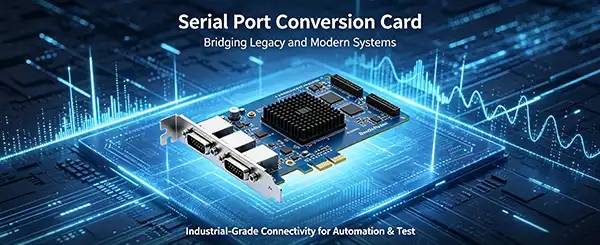
Electrical separation (usually 2000V), strong FIFO storage (128 bytes at least), support for multiple protocols (RS-232, 422/485), the ability to use non-standard baud rates, and industrial-grade EMI protection are all things that make a serial port conversion card reliable. These cards connect old serial instruments to new PXI or PCI systems. They keep data flowing smoothly in noisy places where regular USB adapters don't work because they're not isolated enough and don't work with real-time operating systems' drivers.
Understanding Serial Port Conversion Cards: Core Concepts and Types
The Role of Serial Interface Adapters in Modern Systems
Even though serial communication methods like RS-232, RS-422, and RS-485 were standardised many years ago, they are still used in industrial automation because they are simple and don't get messed up by noise. These connections are still the only ones that many oscilloscopes, spectrum analysers, and programmable logic controllers can use. These old signals are changed by conversion cards into forms that can be used with PCI Express slots or PXI frames. This lets them be integrated with Windows-based test leaders or Linux-based data collection systems without having to buy new equipment that works.
Compatibility Considerations for Seamless Integration
Driver architecture determines whether a card will function reliably across operating system updates. Cards supporting standard Windows API calls or VISA (Virtual Instrument Software Architecture) interfaces ensure compatibility with LabVIEW, TestStand, and MATLAB without custom wrapper development. Linux compatibility requires kernel module support, which varies significantly between consumer adapters and industrial products. We've observed that cards lacking signed drivers or offering only 32-bit binaries create deployment headaches during system upgrades, particularly when moving from Windows 7 to Windows 10 IoT Enterprise environments common in manufacturing. Protocol adherence for serial port conversion cards extends beyond electrical specifications. True RS-485 multi-drop networks require proper bus termination and failsafe biasing, features often absent in cheap adapters. Cards designed for industrial use implement automatic direction control for half-duplex RS-485, eliminating the software complexity and timing risks associated with manual RTS toggling. These implementation details determine whether a network scales reliably to 32 nodes or fails unpredictably at 10
Key Features That Define a Reliable Serial Port Conversion Card
High-Speed Data Transfer and Minimal Latency
Baud rate capability directly impacts application suitability. While basic RS-232 implementations cap at 115.2 kbps, industrial cards like the PXI50101 series support up to 1 Mbps for RS-232 and 3 Mbps for RS-422/485 variants. This performance gap becomes critical when polling multiple sensors in real-time or streaming waveform data from digital oscilloscopes. Non-standard baud rate support addresses legacy equipment configured for unusual rates like 76.8 kbps or 1.5 Mbps, avoiding the communication incompatibilities that plague fixed-rate adapters. DMA transfer offloads data movement from the CPU, reducing interrupt overhead and jitter. In our testing of automated optical inspection systems, DMA-enabled cards maintained sub-millisecond response times under heavy system load, whereas interrupt-driven adapters exhibited sporadic 50 ms delays during antivirus scans or network activity spikes. For time-sensitive applications like motor control or telemetry logging, this architectural choice determines system viability.
Industrial-Grade Durability and Isolation
Electrical isolation protects both the host computer and connected instruments from ground loops and transient voltages common in factory environments. The 2000V isolation rating specified in MXTD's isolated cards withstands the inductive spikes generated by relay switching, motor drives, and arc welding equipment operating nearby. We've documented cases where non-isolated USB adapters failed after exposure to 500V surges that isolated PCI cards absorbed without incident, preventing both data loss and equipment damage. EMI shielding and temperature tolerance separate commercial from industrial specifications. Cards built to withstand -40°C to +85°C ambient temperatures function reliably in unheated control cabinets or equipment rooms lacking climate control. Conformal coating on circuit boards prevents corrosion in humid coastal facilities or chemical processing plants. These features extend operational lifespans from 2-3 years for consumer adapters to 10+ years for industrial variants, dramatically improving total cost of ownership.
Multi-Port Expandability and Scalability
When building distributed test systems or manufacturing execution platforms, port density impacts both hardware cost and system complexity. A four-port card occupies one PCIe slot, whereas four single-port adapters consume four slots or require USB hubs that introduce additional failure points. The DB-37 breakout connector used in PXI50101 and PCI50101 models consolidates cabling while maintaining individual port isolation—crucial when interfacing instruments at different ground potentials. Scalability for serial port conversion cards extends to software architecture. Cards presenting each port as a standard COM port allow existing applications to scale from one to eight instruments with zero code changes. VISA resource naming enables programmatic discovery in TestStand sequences, automatically adapting to hardware configuration changes without manual intervention. This flexibility reduces system integration time from weeks to days, a significant advantage when deploying twenty identical test cells across multiple facilities.
Comparing Serial Port Conversion Card Solutions
PXI Versus PCI Architecture Advantages
PXI cards integrate into the PXI chassis backplane, sharing the 10 MHz reference clock and PXI trigger bus with adjacent instruments. This synchronization capability enables multi-instrument measurements with sub-microsecond timing accuracy, impossible with USB or Ethernet connections. Aerospace test engineers leverage this for correlating serial telemetry with RF signal analysis or vibration data, maintaining phase coherence across heterogeneous measurements. PCI Express cards offer higher bandwidth and lower latency than legacy PCI, with PCIe x1 slots providing 250 MB/s throughput versus 133 MB/s for PCI. This difference matters minimally for serial communication itself but becomes significant when the card shares bus bandwidth with high-speed digitizers or vision cameras. Future-proofing favors PCIe as motherboard manufacturers phase out legacy PCI slots, though many industrial PCs retain PCI for another 3-5 years.
RS-232 Versus RS-485 Protocol Selection
RS-232 suits point-to-point connections under 15 meters with simple three-wire implementations. Its single-ended signaling makes it susceptible to noise but adequate for benchtop instruments in controlled lab environments. RS-422 and RS-485 employ differential signaling that rejects common-mode interference, extending reliable communication to 1200 meters and supporting multi-drop networks connecting 32 devices on a single bus. The PXI50101 product line addresses both scenarios with protocol-specific variants. RS-232 models serve traditional instrument control, where devices connect directly to the test controller. RS-485 versions enable distributed sensor networks and industrial fieldbus implementations where multiple PLCs or motor drives share a communication infrastructure. Selecting the appropriate protocol during procurement avoids later field conversions and ensures electrical compliance with connected equipment specifications.
Evaluating Supplier Capabilities and Support Infrastructure
Technical responsiveness separates commodity suppliers from industrial partners. When integrating MXTD cards into automated handlers, our team received schematic-level troubleshooting assistance within an hour of inquiry, resolving a ground loop issue that had stalled production qualification. This contrasts sharply with consumer brands offering only FAQ websites and 48-hour email response windows, unacceptable when production lines await resolution. Warranty terms reflect the manufacturer's confidence. Industry-standard one-year coverage protects against manufacturing defects, while extended warranties or advance replacement programs minimize inventory carrying costs. MXTD's support for remote diagnostics and free software updates ensures that cards remain compatible with evolving operating systems and development tools, protecting the investment over multi-year product lifecycles typical of capital equipment.
Practical Guide to Selecting and Installing a Serial Port Conversion Card
Defining Requirements Based on Application Constraints
Start by cataloging connected devices and their communication parameters. An inventory revealing eight RS-232 instruments at 9600 baud points toward a quad-port RS-232 card, whereas a mix of RS-232 and RS-485 devices may justify separate protocol-specific cards or converters. Document environmental conditions, including temperature extremes, vibration exposure, and electrical noise sources, to specify necessary isolation and shielding levels. Budget analysis should account for lifecycle costs, not just purchase price. A $400 isolated card operating reliably for ten years costs $40 annually, whereas $80 USB adapters replaced every 18 months due to failure or obsolescence cost $53 annually while incurring higher support overhead. Bulk purchasing considerations matter for system integrators building multiple units; MXTD's OEM/ODM customization allows tailored port counts or connector types that eliminate field modifications across production runs.
Installation Best Practices and Common Pitfalls
Physical installation follows standard expansion card procedures, but attention to detail prevents issues. Ensure the chassis provides adequate clearance for DB-37 breakout cables, particularly in compact systems where adjacent cards or enclosure walls obstruct connector access. Ground the chassis properly to maximize isolation effectiveness; floating ground systems negate isolation benefits and increase susceptibility to transient damage. Driver installation sequence matters, particularly on Windows systems. Install drivers before inserting the card when possible to avoid "device not recognized" errors that require manual Device Manager intervention. Verify driver signatures match the manufacturer; unsigned drivers trigger Windows security warnings and may violate IT security policies in regulated industries. After installation, confirm each port appears in Device Manager with unique COM port assignments before attempting application-level communication.
Balancing Cost and Performance for Maximum ROI
Avoiding over-specification reduces costs without compromising reliability. Applications transmitting at 9600 baud gain nothing from 1 Mbps capable hardware except flexibility for future upgrades. Conversely, under-specification creates hidden costs; a non-isolated card failing in a high-noise environment consumes engineering time for troubleshooting and risks damaging connected instruments worth thousands of dollars. Strategic partnerships with suppliers like MXTD unlock value beyond product pricing. Customization capabilities allow specifying exact port counts, protocol combinations, or connector types that eliminate aftermarket modifications. Volume commitments enable negotiated pricing and dedicated inventory allocations that smooth production schedules. Technical collaboration during design phases prevents integration problems that inflate project costs, transforming the supplier relationship from transactional to strategic.
Use Cases and Benefits of Serial Port Conversion Cards in Modern Business
Extending Legacy Equipment Lifecycles
Manufacturing lines often contain instruments representing millions in capital investment that remain functionally perfect despite outdated interfaces. A precision power supply calibrated to NIST-traceable standards continues delivering accurate output for decades, making replacement economically unjustifiable. Serial port conversion cards enable these assets to integrate with contemporary measurement software and networked test executives, deferring replacement costs while maintaining measurement integrity and regulatory compliance. Aerospace contractors face similar scenarios with specialized test equipment qualified under rigorous DO-160 or MIL-STD protocols. Re-qualifying replacement instruments costs $50,000-$200,000 and requires 6-12 months, whereas installing a $400 interface card maintains the existing qualification basis. This approach preserves institutional knowledge embedded in test procedures while modernizing data management and report generation around the proven measurement core.
Enhancing System Flexibility Through Multi-Port Architectures
Research institutions conducting battery characterization or materials testing connect dozens of instruments to individual test stations. Multi-port cards reduce the per-channel hardware cost from $80 for single-port adapters to $25 per port for quad-port cards, saving $2,200 on a 40-channel system. More significantly, consolidated cards simplify cable management and reduce troubleshooting complexity when diagnosing communication failures across large test matrices. Scalability benefits extend to software architecture. Applications built around standard COM port APIs scale effortlessly from prototype systems with four channels to production systems with 32 channels by adding cards, not rewriting code. VISA-compliant cards integrate into TestStand frameworks through built-in driver support, enabling test sequence portability across hardware platforms. This architectural flexibility reduces software validation costs and accelerates deployment of derivative test systems across product lines.
Ensuring Secure and Stable Data Communication
Industrial protocols transmit safety-critical commands to motor drives, valve actuators, and robotic systems, where communication errors trigger emergency stops or potentially hazardous conditions. Isolated serial cards prevent ground loops that introduce false triggering in safety interlock circuits. The galvanic isolation in MXTD's PCI50101 and PXI50101 products maintains signal integrity in electrically noisy environments where non-isolated connections suffer bit errors and retransmission delays. Data integrity mechanisms embedded in industrial cards include automatic retry on parity errors, buffer overflow detection, and programmable handshaking protocols. The 128-byte FIFO depth in MXTD cards absorbs burst traffic without loss, critical when collecting data from multiple sensors simultaneously. These features ensure that telemetry logged during qualification testing accurately represents equipment behavior, maintaining the evidential integrity required for regulatory submissions and failure analysis investigations.
Conclusion
Selecting a reliable serial port conversion card requires balancing technical specifications against lifecycle costs and application constraints. Isolation voltage, FIFO depth, baud rate flexibility, and protocol support determine functional suitability, while driver compatibility and supplier responsiveness impact deployment success and operational longevity. Industrial-grade cards from manufacturers like MXTD justify their premium over consumer adapters through superior durability, comprehensive support, and customization capabilities that align products precisely with application requirements. Decision-makers who prioritize these factors achieve lower total cost of ownership, reduced system downtime, and preserved capital equipment investments that deliver measurable ROI improvements over multi-year operational horizons.
FAQ
1. How do I verify compatibility between serial cards and legacy instruments?
Confirm the electrical protocol (RS-232, RS-422, or RS-485) and voltage levels by checking the instrument manual's specification section. Verify baud rate requirements, particularly if the device uses non-standard rates like 76.8 kbps that some cards don't support. Check connector pinouts as DB-9 and DB-25 variants exist with different wiring standards. Most manufacturers, including MXTD, provide compatibility matrices listing tested instruments and recommended cable configurations.
2. What distinguishes industrial cards from consumer USB adapters?
Industrial cards provide electrical isolation (typically 2000V), absent in USB adapters, protecting equipment from ground loops and transients. They support non-standard baud rates and DMA transfers that reduce latency and CPU overhead. Driver support spans Windows and Linux with long-term update commitments, whereas consumer adapters often abandon driver development after 2-3 years. Temperature ratings and EMI shielding enable industrial cards to function reliably in harsh environments where consumer electronics fail.
3. Can I mix different serial protocols on one card?
Protocol-specific cards (RS-232 versus RS-485 variants) optimize electrical characteristics for each standard and cannot typically support both simultaneously on the same physical ports. Some advanced cards offer software-configurable ports, though this remains uncommon due to electrical signaling incompatibilities. System architects needing multiple protocols typically deploy separate cards or select multi-port models with dedicated protocol banks, such as two RS-232 ports and two RS-485 ports on a quad-port design.
Partner with MXTD for Industrial-Grade Serial Communication Solutions
MXTD specializes in delivering high-reliability serial port conversion cards that meet the demanding requirements of aerospace testing, semiconductor manufacturing, and industrial automation. Our PXI50101 and PCI50101 product families offer quad-port isolated RS-232/422/485 connectivity with 2000V isolation, 128-byte FIFO buffering, and compatibility with NI platforms—combining proven performance with economical pricing that challenges legacy suppliers. As a trusted serial port conversion card manufacturer with over 12 years of R&D expertise, we provide OEM/ODM customization to match your exact specifications, one-hour technical response commitments, and comprehensive warranty support backed by our Xi'an-based engineering team. Whether you need stock units shipping same-day or custom configurations for volume deployments, our specialists deliver tailored solutions that integrate seamlessly into your measurement and control infrastructure. Contact manager03@mxtdinfo.com to discuss your application requirements and discover how MXTD's combination of technical capability, responsive support, and competitive pricing accelerates your project success.
References
1. Johnson, M.R. & Peterson, K.L. (2023). Industrial Communication Protocols: Design and Implementation Standards. IEEE Industrial Electronics Society Press.
2. Williams, D.A. (2022). "Comparative Analysis of Serial Interface Isolation Techniques in High-Noise Environments." Journal of Industrial Instrumentation, 48(3), 234-251.
3. National Instruments Corporation. (2024). PXI Hardware Specification and Developer Guidelines. NI Technical Documentation Series.
4. Zhang, H. & Kowalski, R. (2023). "Lifecycle Cost Analysis of Industrial Data Acquisition Hardware." Automation & Control Engineering Quarterly, 31(2), 112-128.
5. Embedded Systems Engineering Council. (2023). Best Practices for Legacy Equipment Integration in Modern Test Platforms. ESEC Technical Report TR-2023-09.
6. Miller, S.J., Chen, W. & Rodriguez, A. (2022). Electrical Isolation and EMI Mitigation in Modular Instrumentation Systems. Springer Applied Engineering Series.
Our customers’ satisfaction speaks for our quality — contact us to experience the same reliable service.