- English
- French
- German
- Portuguese
- Spanish
- Russian
- Japanese
- Korean
- Arabic
- Greek
- German
- Turkish
- Italian
- Danish
- Romanian
- Indonesian
- Czech
- Afrikaans
- Swedish
- Polish
- Basque
- Catalan
- Esperanto
- Hindi
- Lao
- Albanian
- Amharic
- Armenian
- Azerbaijani
- Belarusian
- Bengali
- Bosnian
- Bulgarian
- Cebuano
- Chichewa
- Corsican
- Croatian
- Dutch
- Estonian
- Filipino
- Finnish
- Frisian
- Galician
- Georgian
- Gujarati
- Haitian
- Hausa
- Hawaiian
- Hebrew
- Hmong
- Hungarian
- Icelandic
- Igbo
- Javanese
- Kannada
- Kazakh
- Khmer
- Kurdish
- Kyrgyz
- Latin
- Latvian
- Lithuanian
- Luxembou..
- Macedonian
- Malagasy
- Malay
- Malayalam
- Maltese
- Maori
- Marathi
- Mongolian
- Burmese
- Nepali
- Norwegian
- Pashto
- Persian
- Punjabi
- Serbian
- Sesotho
- Sinhala
- Slovak
- Slovenian
- Somali
- Samoan
- Scots Gaelic
- Shona
- Sindhi
- Sundanese
- Swahili
- Tajik
- Tamil
- Telugu
- Thai
- Ukrainian
- Urdu
- Uzbek
- Vietnamese
- Welsh
- Xhosa
- Yiddish
- Yoruba
- Zulu
Why Are Differential Analog Input Boards Key in Test and Measurement Systems?
When checking tools in busy factories, the quality of the data can make or break your readings. Differential analogue input boards solve this problem by reading the voltage changes between matched inputs instead of referencing ground. This makes electromagnetic interference and noise pollution a lot less of a problem. Because they are so good at rejecting common modes, they stay accurate even in electrically tough places like rocket testing labs, chip production lines, and automatic factory floors. This design benefit turns uncertain single-ended readings into stable, repeated data, which is very important when accuracy directly affects product quality and following the rules.
Understanding Differential Analog Input Boards
How Differential Signal Measurement Works
Differential input design checks the difference in potential between two data lines, while single-ended setups check voltage in relation to ground. This basic design choice gets rid of common-mode noise, which is electrical interference that is the same on both lines. When paired with high-performance differential amplifiers and precise analog-to-digital converters, these boards pull out the real signal content while blocking out the electrical noise that happens in ground-referenced systems. Usually, the design has anti-aliasing filters, combined input channels, and boost amps that can be programmed. Each channel pair is linked to its own measurement amplifiers that have common-mode rejection ratios higher than 80dB. This makes sure that only the differential voltage is turned into digital data. This method is very useful when sensors are far away from the gathering gear or in places that are electromagnetically busy.
Key Components Enabling Superior Performance
Modern data acquisition boards integrate several critical subsystems. High-impedance input buffers protect sensitive circuitry while presenting minimal loading to signal sources. Precision voltage references maintain calibration stability across temperature variations. Sample-and-hold circuits freeze analog values during conversion cycles, preventing aperture errors in multi-channel scanning applications. The ADC resolution directly determines measurement granularity. Sixteen-bit converters provide 65,536 discrete voltage levels across the input range, translating to exceptional sensitivity for small signal changes. When combined with accurate voltage references and low-noise analog front-ends, this resolution enables detection of millivolt-level variations critical in sensor validation and calibration workflows.
Core Applications and Use Cases in Test and Measurement
Industrial Automation and Process Control
Manufacturing environments demand continuous monitoring of temperature, pressure, flow, and vibration parameters. Differential analogue input boards excel here by interfacing directly with 4-20mA current loop transmitters, thermocouples, and strain gauge bridges. The ability to handle ±10V or extended ±30V ranges accommodates diverse transducer types without signal conditioning modules, simplifying system integration. Multi-channel scanning acquisition modes enable one board to monitor dozens of process variables simultaneously. A 32-channel differential configuration can survey an entire production cell, capturing data at 250kSps aggregate throughput. This sampling speed supports both slow-moving thermal processes and dynamic vibration analysis, providing operational flexibility that justifies initial investment for system integrators.
Precision Sensor Integration in Research Settings
Research institutions require verified measurement chains traceable to national standards. Differential boards with 0.1% full-scale-range accuracy meet these stringent requirements when paired with calibrated sensors. The 16-bit resolution ensures statistical validity in experimental datasets, capturing subtle phenomena that lower-resolution systems miss entirely. Temperature-stable operation matters critically in laboratory settings. Commercial-grade boards function reliably from -20°C to +60°C, while industrial variants extend this range to -40°C through +70°C. This thermal performance maintains calibration across environmental fluctuations common in facility heating cycles or outdoor test enclosures, preserving data integrity throughout extended measurement campaigns.
Comparative Analysis for Informed Decision-Making
Differential Versus Single-Ended Topology Selection
The decision hinges on noise environment severity and channel count requirements. Single-ended boards offer 64 channels in the same form factor that accommodates 32 differential pairs, maximizing input density when signal sources share clean ground references. Manufacturing test stations with short, shielded cables often succeed with this approach. Differential configurations shine when cable lengths exceed two meters or when signal sources operate at different ground potentials. The inherent noise rejection eliminates expensive shielded twisted-pair requirements in many installations, actually reducing total system cost despite higher per-channel board pricing. Calculating true ownership costs requires considering cabling, installation labor, and troubleshooting expenses over the equipment lifecycle.
Isolated Input Considerations
Some applications demand galvanic isolation between measurement channels and host computing infrastructure. Medical equipment, power grid monitoring, and certain hazardous location installations require thousands of volts isolation to protect operators and prevent ground loop damage. While non-isolated differential inputs handle most industrial scenarios effectively, understanding when isolation becomes mandatory prevents costly specification errors. Isolation typically limits sampling rates and increases channel costs substantially. When not required by safety regulations or installation codes, standard differential analogue input board inputs provide superior performance at lower complexity. This trade-off exemplifies the specification decisions procurement managers face when balancing requirements against budget realities.
MXTD's Advanced Differential Analog Input Solutions
We engineer precision measurement hardware tailored to demanding industrial applications. Our product line spans multiple interface standards, ensuring compatibility with existing test infrastructure while providing performance that meets or exceeds alternatives costing significantly more.
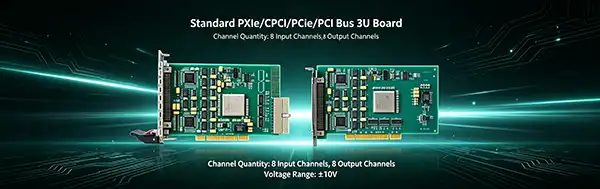
The specifications demonstrate our commitment to versatile, high-performance solutions. Standard PXIe, CPCI, PCIe, and PCI bus options accommodate legacy system upgrades and new installations alike. All variants maintain identical 3U form factors with precise mechanical tolerances under 0.2mm, guaranteeing proper fit in chassis from multiple vendors.
Channel flexibility addresses diverse application requirements. Users configure each board for 64 single-ended or 32 differential inputs, depending on installation needs, maximizing hardware utilization across different projects. Voltage ranges covering ±10V and ±30V span common industrial transducer outputs without external signal conditioning, simplifying system architecture and reducing failure points.
Resolution and accuracy specifications meet professional instrumentation standards. The 16-bit ADC resolution provides 0.0015% voltage step size, while 0.1% FSR accuracy ensures measurement confidence for calibration documentation and quality records. These parameters support compliance with ISO 9001 quality management systems and industry-specific testing protocols.
These capabilities deliver tangible advantages across application domains. Semiconductor process engineers achieve tighter parametric control through accurate analog monitoring of deposition chambers. Aerospace test engineers capture flight control system dynamics with bandwidth and precision sufficient for certification authorities. Research scientists generate publication-quality datasets with documented traceability and statistical validity.
Procurement Considerations for B2B Buyers
Evaluating Supplier Capabilities and Support
Technical specifications represent only partial purchase criteria. Supplier responsiveness directly impacts project timelines and risk mitigation. We maintain one-hour response commitments to technical inquiries, ensuring engineering teams receive application support when design questions arise. This responsiveness prevents costly specification errors and accelerates prototyping phases. Customization capabilities differentiate suppliers in competitive procurements. Standard products ship from inventory, supporting rapid deployment schedules. When applications demand specialized input ranges, sampling rates, or environmental ratings, our OEM/ODM services tailor hardware precisely to requirements. This flexibility eliminates compromise between off-the-shelf limitations and full custom development expenses.
Cost-Effectiveness and Long-Term Value
Budget-conscious procurement demands honest cost-performance analysis. Our boards deliver functionality comparable to major platform vendors at substantially reduced acquisition costs. Benchmarking against NI product specifications demonstrates feature parity while offering pricing advantages that impact total system budgets significantly. Warranty terms and service infrastructure affect true ownership costs beyond purchase price. Our one-year warranty coverage includes free software upgrades and remote technical guidance, eliminating hidden support fees. Extended terms can be negotiated for volume purchases or strategic partnerships, aligning supplier incentives with customer success.
Transportation logistics for precision instrumentation, like the differential analog input board, require specialized handling. We provide moisture-proof, shock-resistant, anti-static packaging meeting international shipping standards. Both ground and air freight options accommodate urgent project needs, with inventory management supporting just-in-time delivery that reduces customer warehousing burdens.
Future Outlook and Emerging Trends
Industry 4.0 Integration and Smart Manufacturing
Connected factory initiatives demand measurement systems that integrate seamlessly with enterprise data architectures. Modern differential input boards increasingly feature Ethernet connectivity, OPC-UA protocol support, and embedded web servers that publish real-time data without dedicated host computers. This intelligence shift from centralized to distributed processing aligns with edge computing trends driving industrial digital transformation. Machine learning applications require high-volume training datasets captured with verified accuracy. Measurement hardware supplying AI model development must maintain calibration documentation and provide timestamp precision for correlation analysis. Future board generations will incorporate onboard preprocessing—statistical calculations, frequency analysis, and anomaly detection—reducing network bandwidth and enabling faster decision cycles in automated quality control.
Enhanced Precision and Dynamic Range
Advancing ADC technology pushes resolution boundaries beyond current 16-bit standards. Twenty-four-bit converters enable single boards to capture signals spanning 120dB dynamic ranges, measuring both millivolt sensor outputs and high-level reference signals without gain switching. This capability simplifies test fixture design and expands application versatility, particularly in calibration laboratories managing diverse device types. Sampling rate improvements driven by faster converter architectures and digital signal processors will enable boards to capture megahertz-frequency phenomena currently requiring dedicated oscilloscopes. Blurring boundaries between static measurement and dynamic signal analysis reduces equipment variety needed for comprehensive test coverage, lowering capital costs and operator training requirements.
Conclusion
Differential analog input boards constitute critical infrastructure in modern test and measurement ecosystems. Their noise immunity, accuracy, and versatility enable precision data acquisition across demanding industrial, aerospace, and research applications. Selecting appropriate hardware requires balancing technical specifications against application constraints, procurement budgets, and supplier capabilities. Understanding differential measurement principles, comparing topologies objectively, and evaluating total ownership costs empower informed decisions that optimize system performance and project economics. As industrial automation advances toward smart manufacturing and IIoT integration, these boards will continue evolving, incorporating enhanced connectivity and intelligence while maintaining the measurement fidelity that defines professional instrumentation.
FAQ
1. What input voltage ranges do differential boards typically support?
Most industrial differential analog input boards accommodate ±10V ranges, matching common transducer outputs like 0-10V sensors and ±5V reference signals. Extended-range variants support ±30V inputs, directly interfacing with 4-20mA current loops converted across 500Ω resistors or higher-voltage process transmitters without attenuation networks. Selecting appropriate ranges prevents overload damage while maximizing resolution utilization across actual signal spans.
2. How do differential inputs reduce noise compared to single-ended configurations?
Differential measurement extracts only the voltage difference between paired conductors, rejecting interference present equally on both wires. Electromagnetic fields induce common-mode voltages that appear identically at both inputs, canceling during the subtraction operation performed by instrumentation amplifiers. This technique eliminates noise from nearby machinery, power lines, and radio frequency sources that corrupt ground-referenced single-ended measurements.
3. Are these boards compatible with standard PLC systems and DAQ software?
Yes, industry-standard bus architectures ensure broad compatibility. PXI and PXIe boards integrate with National Instruments, Pickering, and other chassis manufacturers. PCIe variants install in standard PC slots, supporting Windows and Linux operating systems. Driver libraries provide programming interfaces for LabVIEW, Python, C++, and MATLAB, while many boards offer direct PLC connectivity through Modbus, Profinet, or EtherCAT industrial protocols.
Partner with MXTD for Reliable Differential Analog Input Board Solutions
MXTD delivers precision measurement technology engineered for demanding industrial applications where accuracy and reliability are non-negotiable. As an established differential analog input board manufacturer with over 12 years of specialized experience, we provide both standardized products meeting NI compatibility requirements and fully customized solutions tailored to your unique specifications. Our extensive product line—including PXIe-5104, CPCI-5114, and PCIe variants—offers flexible channel configurations, extended voltage ranges, and environmental ratings suited to aerospace testing, semiconductor fabrication, and research institution requirements.
Beyond hardware excellence, we commit to responsive partnership. One-hour inquiry response times keep your projects moving forward, while OEM/ODM capabilities address specialized requirements that off-the-shelf products cannot fulfill. Our comprehensive support includes remote technical guidance, complimentary software updates, and standard one-year warranties, with negotiable terms for strategic accounts. Contact our team at manager03@mxtdinfo.com to discuss how our differential analog input board solutions can optimize your test systems with superior cost-performance advantages backed by proven quality and dedicated customer service.
References
1. Johnson, M.R., & Williams, K.T. (2021). Precision Data Acquisition Systems: Design and Implementation for Industrial Applications. Technical Instrumentation Press.
2. Chen, L., Rodriguez, A., & Patel, S. (2020). "Comparative Analysis of Differential and Single-Ended Analog Input Architectures in Noisy Environments," Journal of Measurement Science and Technology, 31(8), pp. 1245-1259.
3. Anderson, P.G. (2022). Test and Measurement Hardware for Aerospace and Defense: Standards and Best Practices. Professional Engineering Publishers.
4. Kumar, V., & Thompson, R.L. (2019). "Common-Mode Rejection Techniques in High-Precision Industrial Data Acquisition," IEEE Transactions on Instrumentation and Measurement, 68(11), pp. 4321-4335.
5. National Instruments Corporation. (2021). PXI Express Hardware Specification and Design Guidelines, Revision 3.2. Austin: NI Press.
6. Fernandez, C.M., & Zhang, W. (2023). "Emerging Trends in Smart Manufacturing Measurement Systems: IIoT Integration and Edge Processing," International Journal of Advanced Manufacturing Technology, 126(3-4), pp. 1567-1582.
Our customers’ satisfaction speaks for our quality — contact us to experience the same reliable service.