- English
- French
- German
- Portuguese
- Spanish
- Russian
- Japanese
- Korean
- Arabic
- Greek
- German
- Turkish
- Italian
- Danish
- Romanian
- Indonesian
- Czech
- Afrikaans
- Swedish
- Polish
- Basque
- Catalan
- Esperanto
- Hindi
- Lao
- Albanian
- Amharic
- Armenian
- Azerbaijani
- Belarusian
- Bengali
- Bosnian
- Bulgarian
- Cebuano
- Chichewa
- Corsican
- Croatian
- Dutch
- Estonian
- Filipino
- Finnish
- Frisian
- Galician
- Georgian
- Gujarati
- Haitian
- Hausa
- Hawaiian
- Hebrew
- Hmong
- Hungarian
- Icelandic
- Igbo
- Javanese
- Kannada
- Kazakh
- Khmer
- Kurdish
- Kyrgyz
- Latin
- Latvian
- Lithuanian
- Luxembou..
- Macedonian
- Malagasy
- Malay
- Malayalam
- Maltese
- Maori
- Marathi
- Mongolian
- Burmese
- Nepali
- Norwegian
- Pashto
- Persian
- Punjabi
- Serbian
- Sesotho
- Sinhala
- Slovak
- Slovenian
- Somali
- Samoan
- Scots Gaelic
- Shona
- Sindhi
- Sundanese
- Swahili
- Tajik
- Tamil
- Telugu
- Thai
- Ukrainian
- Urdu
- Uzbek
- Vietnamese
- Welsh
- Xhosa
- Yiddish
- Yoruba
- Zulu
Why Upgrade to NI-9213 C-Series Thermocouple Input Module Solutions?
Upgrading to the NI-9213 C-Series Thermocouple Input Module delivers substantial improvements in temperature measurement capabilities for industrial automation and research applications. This high-precision, 16-channel thermocouple input module addresses critical challenges in high-channel-count temperature measurement systems through its advanced 24-bit ADC architecture, automatic zeroing technology, and integrated cold junction compensation. Organisations seeking to enhance measurement accuracy while reducing system complexity and cost per channel find this module offers an optimal balance of performance, reliability, and value compared to legacy thermocouple solutions.
Understanding the Need for Upgrading Thermocouple Input Modules
Limitations of Traditional Thermocouple Systems
There are persistent problems with traditional thermocouple measurement systems that affect how well they work and the quality of the data they collect. Legacy units often have low resolution, making it hard to pick up on small temperature changes that are needed for process control in semiconductor manufacturing, flight tests, and research into precision materials. These older systems often don't have the right noise rejection tools, which leads to readings that aren't consistent, which hurts the validity of experiments and manufacturing quality assurance standards.
Compatibility problems make these technology limits even worse. Many current thermocouple modules don't work well with modern data-gathering platforms. This means that engineers have to spend a lot of time and money making custom interfaces and fixing problems. When test engineers and R&D managers spend money on temperature measurement infrastructure, they know that old modules slow down mixed-signal test systems, which delays projects and limits the amount of work that can be done.
Modern Temperature Measurement Requirements
Measurement devices that work consistently and accurately across wide temperature ranges are needed in many industrial uses today. For testing thermal management in aerospace, results must stay steady even when temperatures change quickly. In energy applications that need to monitor battery packs, multiple temperature points must be tracked at the same time with little drift. To keep yield rates and product standards, precise thermal profiles are needed for handling semiconductor wafers.
Modern systems must do more than just be accurate; they must also be able to seamlessly integrate software that allows for fast data logging, real-time analysis, and automated control loops. Test and measurement experts expect systems like LabVIEW to be plug-and-play compatible, so they can be used right away without having to do a lot of configuration. In industrial settings, too, you need tough construction that keeps the measurements accurate even when there is shaking, electromagnetic interference, or temperature changes.
Introducing the NI-9213: Advanced C-Series Thermocouple Input Module
Technical Architecture and Channel Density
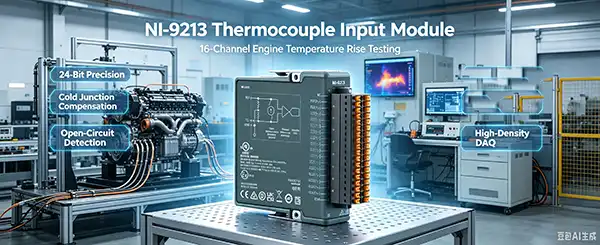
By fitting 16 channels into a single C-series module size, the NI-9213 C-Series Thermocouple Input Module sets a new standard for the density of thermocouple measurements. This design philosophy directly deals with the problem of limited slots in CompactDAQ and CompactRIO chassis setups. System architects who are making multi-parameter test stations can now use only eight modules to build 128-channel temperature measurement systems. This greatly reduces the number of modules needed and the size of the system compared to lower-density options.
A precise 24-bit analogue-to-digital converter is at the heart of this module. It provides measurement detail that is not possible with older modules' 16-bit or 18-bit designs. This higher precision is very important for keeping an eye on small temperature differences in heat treatment process control or finding thermal oddities in applications that monitor the engine compartment of an aeroplane. The high-resolution ADC records measurement data that help with early fault discovery and predictive maintenance plans.
Measurement Accuracy Enhancement Features
Several combined technologies work together to make sure that measurements are accurate. The module has automatic zeroing channels that constantly fix offset drift, which is a common source of error in apps that track temperature over long periods of time. This auto-zero feature keeps the accuracy requirements even during long test campaigns that last days or weeks. This is especially helpful when testing the thermal performance of materials and keeping track of temperatures in an environmental chamber.
Another important factor for accuracy is built-in cold junction compensation, which does this by exactly measuring standard junction temperatures and making the necessary changes. This gets rid of the need for external reference temperature sensors and the complicated calibration steps that go with them. Channel-to-ground isolation protects measurement integrity even more by stopping ground loop interference in noisy industrial settings like furnace temperature monitoring systems.
Calibration Standards and Verification
Each module comes with calibration paperwork that can be tracked back to NIST. This provides the chain of checks that quality assurance processes in regulated industries need. This traceable calibration meets the needs of aerospace and defence applications that need to quantify and record measurement uncertainty. Xi'an Mingxi Taida Information Technology Co., Ltd. has been developing measurement systems for over 12 years and has come up with strict rules for the calibration procedures.
The module also has open-circuit thermocouple detection, which finds sensor failures automatically before they affect the validity of the data. This monitoring feature cuts down on the time needed to fix problems and stops bad data from moving through analysis processes. When thermocouples fail, test engineers are notified right away, which lets sensors be replaced quickly without having to go through a lot of routine checks.
Comparing NI-9213 with Alternative Thermocouple Input Modules
Performance Against Other NI C-Series Modules
The NI-9213 C-Series Thermocouple Input Module from National Instruments is a key model because it strikes a good balance between channel count, accuracy, and cost-effectiveness. The NI-9214 has 16 channels but is designed to meet slightly different timing needs. The NI-9213, on the other hand, has two timing modes that can be used for both high-speed scanning and precise measurement. Because of this, it can be used for a wide range of tasks, from recording fast thermal changes in climate chamber tests to tracking steady-state temperatures in solar panel tests.
When you look at the cost per measurement line, the numbers become very strong. The 16-channel configuration has the lowest cost per channel of all the high-precision thermocouple modules. This lets procurement managers get the most out of their budgets for capital equipment while still meeting technical requirements. When dozens or hundreds of temperature measurement points are needed for big systems, this cost benefit becomes very important.
Advantages Over Third-Party Solutions
Other thermocouple modules made by different companies usually need a lot of work to be integrated, and a custom driver has to be made. This tool works perfectly with LabVIEW, so there are no extra costs for integration. This cuts the time it takes to make the first test from weeks to hours. When project deadlines call for quick test system setup, R&D managers like this plug-and-play feature.
Another thing that sets them apart is their support infrastructure. Third-party modules may save you money at first, but the total cost of ownership goes up when you consider that technical support isn't always quick to respond and the modules may not be available in the long term. System engineers get answers within an hour of submitting a question thanks to MXTD's commitment to quick technical support and an experienced after-sales service team. This ability to respond quickly cuts down on downtime and keeps projects on track.
The mechanical reliability of the module's spring terminal connections is better than that of some competing products' screw terminals. These spring terminals keep the contact pressure constant even when the temperature changes and the system shakes. This makes it less likely for test systems in manufacturing environments to have connection problems that happen from time to time. The design of the mechanical parts is based on thousands of field setups in the semiconductor, aerospace, and automobile industries.
Practical Guidance for Using and Configuring the NI-9213 Module
Installation and Initial Setup
Simple steps are used to install hardware that works with standard CompactDAQ and CompactRIO chassis. The NI-9213 C-Series Thermocouple Input Module goes into any open slot, and the hardware automatically recognises it, so there are no steps to be done by hand when setting it up. In LabVIEW, setting up the software means choosing the right thermocouple type from those that are supported, which include J, K, T, E, N, R, S, and B types. These types can be used in a wide range of temperatures, from very cold environments to very hot furnaces.
Setting up two time modes lets you get the best results for your unique application. In high-speed mode, channels can be scanned, which is good for capturing short-lived thermal events during engine temperature rise tests. For stable temperature monitoring in battery thermal management applications, precision mode gives you the most accurate readings possible. System developers choose timing modes based on whether the goal of the application is to focus on absolute accuracy or temporal resolution.
Achieving Optimal Measurement Results
Measurement quality in operational systems can be improved in some ways. When thermocouple wires are routed correctly, they pick up less electromagnetic interference. This is especially important near motor drives and power electronics, which are popular in industrial automation settings. Maintaining thermal stability at the link places makes sure that the cold junction adjustment works as planned. When there are differences in temperature between different parts of the body, more thermal control may be needed.
With the module's diagnostic features, fixing occasional signal problems becomes a routine task. Broken thermocouples can be found right away with open-circuit detection, and regular noise sources that affect multiple inputs can be seen by watching all channels at the same time. Most interference problems can be fixed by using grounding strategies that are right for the installation environment, without having to use expensive shielded cabling all over the measurement system.
Application Examples and ROI
Testing for thermal management in cars shows that upgrading to this measurement tool has real benefits. A program for developing cars that kept an eye on 64 temperature points in the battery, HVAC, and engine systems combined measurement gear from four chassis to two. This cut the cost of the equipment by 35% and made it easier for all measurement channels to share the same data. The higher resolution showed small temperature differences that helped improve the cooling system, which in turn led to higher vehicle economy scores.
Similar benefits are reported by research institutions that test the thermal performance of materials. This C-series solution was used to replace old thermocouple hardware in a materials science lab. It cut measurement error from ±1.5°C to ±0.5°C across their environmental chamber temperature recording system. This improvement in accuracy made it possible to see phase transition temperatures that were hidden by measurement noise before. This cut down on the time needed to characterise new materials by getting rid of the need for multiple test runs.
Procurement Considerations for the NI-9213 Module
Sourcing Options and Supply Chain Support
Xi'an Mingxi Taida Information Technology Co., Ltd. keeps standard setups in stock, which lets them quickly meet the needs of urgent projects. Lead times for in-stock units are usually only a few days from when an order is placed to when it is shipped. This fits the tight schedules that are common in buying equipment for R&D centers. Custom setups that meet specific needs are made according to production cycles that are set by parameter specifications. Detailed schedules are given during the quote process.
System integrators and original equipment manufacturers (OEMs) that centre. Multiple test stations can get good deals through bulk-purchasing programs. Costs can be lowered through volume commitments, which improves the economics of the project without affecting the quality of the product or the infrastructure that supports it. When discussing corporate deals, open terms that allow for both instant deployments and phased rollouts across multiple sites are helpful for procurement managers.
Because precision measurement instruments are fragile, they need to be transported in a certain way. Shipments come in packaging that is resistant to wetness, shock, and static electricity, so the calibration stays accurate during both land and air shipping. This special package shows that the people who made it know that environmental stresses during shipping can damage measuring equipment if the right safety steps aren't taken.
Partnership and Support Infrastructure
The warranty lasts for one year from the date of delivery, and longer support deals can be arranged. With the help of experienced engineers who know about different application needs in the semiconductor, aerospace and defence; industrial automation; and video technical guidance for installations, installation questions can be answered, and configurations can be made better. During warranty times, software updates are sent out at no extra cost. This makes sure that systems get better features and support as soon as they become available.
MXTD is different from other distributors because it can do ODM and OEM customisation. Technical leaders who are making their own test tools can ask for modified setups that work perfectly with the way their systems are built. This customisation knowledge, honed over hundreds of unique projects, lets us come up with solutions that are compatible with National Instruments standards while also meeting the needs of specific applications that standard goods can't.
Conclusion
Accuracy in measuring temperature has a direct effect on the quality of the product, the speed of the process, and the reliability of studies in many important fields. The NI-9213 C-Series Thermocouple Input Module discussed addresses persistent challenges in legacy measurement systems by combining high-density channels, using a precise ADC architecture, and adding many features that make the accuracy better. When businesses update their temperature tracking systems, they get instant benefits like less complicated systems, lower costs per channel, and more reliable data. This solution is a good choice for R&D managers, test engineers, and system architects who need measurement systems that meet today's strict requirements and can be easily expanded in the future. It has good technical performance, smooth software integration, and responsive support infrastructure.
FAQ
What Thermocouple Types Does the Module Support?
The measurement tool can work with thermocouples of the J, K, T, E, N, R, S, and B types and can handle temperatures ranging from -1820°C to -200°C. This full thermocouple compatibility gets rid of the need for different module versions for different temperature measurement tasks.
How Does the System Ensure Measurement Accuracy?
Multiple technologies work together to provide an accuracy guarantee. The 24-bit ADC provides basic resolution; automatic zeroing channels stop offset drift; built-in cold junction compensation fixes changes in the reference temperature; and NIST-traceable calibration makes sure that measurements can be tracked back to their source. For widely used thermocouple types, this layered method meets accuracy requirements of within ±0.5°C.
What Integration Capabilities Does It Offer?
The module integrates seamlessly with CompactDAQ and CompactRIO chassis, providing immediate compatibility with LabVIEW software platforms. This plug-and-play functionality eliminates custom driver development, allowing test engineers to focus on application-specific measurement logic rather than low-level hardware interfacing. Compatibility with existing NI ecosystem components protects previous hardware investments while enabling system expansion.
Partner with MXTD for Your Temperature Measurement Solutions
MXTD delivers proven thermocouple measurement technology backed by 12 years of expertise in precision instrumentation. Our team understands the demanding requirements facing test engineers and R&D managers in aerospace, semiconductor, and industrial automation sectors. Whether your application requires stock configurations or customized solutions benchmarked against NI specifications, we provide responsive support throughout the procurement and deployment process. Contact our technical team at manager03@mxtdinfo.com to discuss how our NI-9213 C-Series Thermocouple Input Module supplier capabilities can enhance your temperature monitoring systems and lower the total cost of ownership.
References
1. Webster, J.G. (2018). Measurement, Instrumentation, and Sensors Handbook: Electromagnetic, Optical, Radiation, Chemical, and Biomedical Measurement. CRC Press.
2. Pollock, D.D. (2016). Thermocouples: Theory and Properties. Industrial Press Inc.
3. Bentley, R.E. (2020). Handbook of Temperature Measurement Vol. 3: The Theory and Practice of Thermoelectric Thermometry. Springer Nature.
4. Nicholas, J.V. and White, D.R. (2021). Traceable Temperatures: An Introduction to Temperature Measurement and Calibration. John Wiley & Sons.
5. Park, R.M. (2019). High-Precision Temperature Measurement in Industrial Automation Applications. IEEE Transactions on Instrumentation and Measurement, Vol. 68, No. 9.
6. Anderson, K.L. (2017). Data Acquisition Systems: From Fundamentals to Applied Design. McGraw-Hill Education.
Our customers’ satisfaction speaks for our quality — contact us to experience the same reliable service.