- English
- French
- German
- Portuguese
- Spanish
- Russian
- Japanese
- Korean
- Arabic
- Greek
- German
- Turkish
- Italian
- Danish
- Romanian
- Indonesian
- Czech
- Afrikaans
- Swedish
- Polish
- Basque
- Catalan
- Esperanto
- Hindi
- Lao
- Albanian
- Amharic
- Armenian
- Azerbaijani
- Belarusian
- Bengali
- Bosnian
- Bulgarian
- Cebuano
- Chichewa
- Corsican
- Croatian
- Dutch
- Estonian
- Filipino
- Finnish
- Frisian
- Galician
- Georgian
- Gujarati
- Haitian
- Hausa
- Hawaiian
- Hebrew
- Hmong
- Hungarian
- Icelandic
- Igbo
- Javanese
- Kannada
- Kazakh
- Khmer
- Kurdish
- Kyrgyz
- Latin
- Latvian
- Lithuanian
- Luxembou..
- Macedonian
- Malagasy
- Malay
- Malayalam
- Maltese
- Maori
- Marathi
- Mongolian
- Burmese
- Nepali
- Norwegian
- Pashto
- Persian
- Punjabi
- Serbian
- Sesotho
- Sinhala
- Slovak
- Slovenian
- Somali
- Samoan
- Scots Gaelic
- Shona
- Sindhi
- Sundanese
- Swahili
- Tajik
- Tamil
- Telugu
- Thai
- Ukrainian
- Urdu
- Uzbek
- Vietnamese
- Welsh
- Xhosa
- Yiddish
- Yoruba
- Zulu
Why Choose NI-9205 C Series 16 Bit AI Module for DAQ Systems?
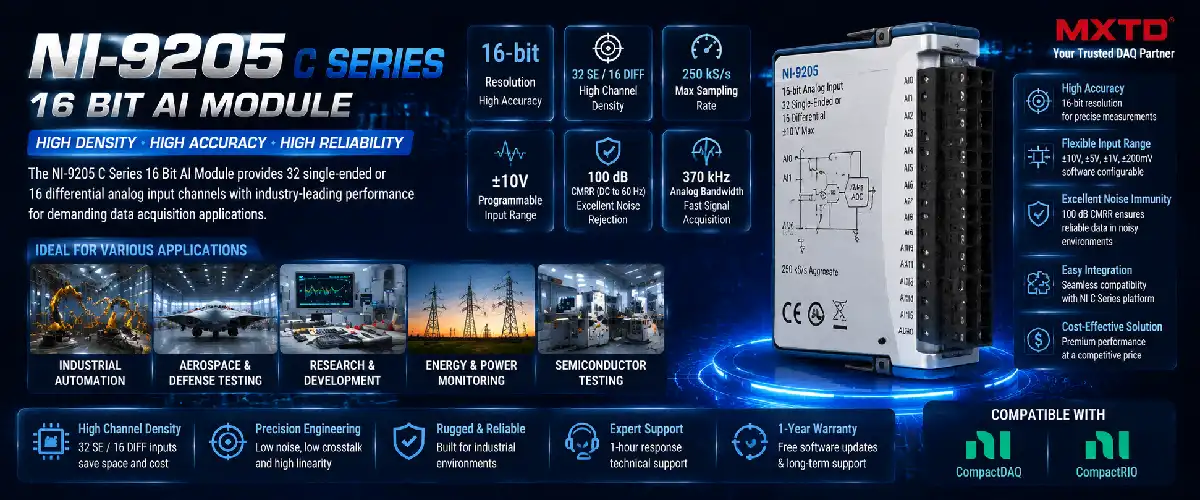
When selecting analogue input modules for demanding data acquisition applications, the NI-9205 C Series 16 Bit AI Module is an excellent choice that balances precision, channel density, and cost-effectiveness. This high-performance module provides 16-bit resolution across 32 single-ended or 16 differential voltage inputs, making it ideal for test engineers and system architects who need reliable signal capture in industrial automation, aerospace testing, and scientific research environments. Its programmable gain instrumentation amplifier and excellent common-mode rejection ensure measurement integrity even in electrically noisy conditions.
Overview of NI-9205 C Series 16 Bit AI Module
When it comes to advanced solutions, the NI-9205 C Series 16 Bit AI Module is made just for the CompactDAQ and CompactRIO platforms. The Xi'an Mingxi Taida Information Technology Co., Ltd. has been making units that work with National Instruments specs for more than 12 years, giving customers an affordable option that doesn't lower performance standards.
High-Density Multi-Channel Architecture
This analogue voltage input module has a very high channel density because it fits 32 single-ended or 16 differential inputs into a small C Series package. The multiplexed design sends all channels through a single 16-bit analogue-to-digital converter and a shared programmable gain instrumentation amplifier (PGIA). This makes the best use of space and lowers the cost of acquiring each channel. R&D managers like this setup because it makes system design easier and reduces the number of chassis slots needed for multi-measurement apps.
Programmable Input Range Flexibility
The module works with various voltage ranges, such as ±10V, ±5V, ±1V, and ±200mV. This lets test engineers find the best signal-to-noise ratio for each sensor output. The variable gain feature works perfectly whether you're reading thermocouples that send millivolt signals or industrial process signals that send higher voltage levels. Because it is so flexible, it often doesn't need external signal conditioning, which makes your measurement chain more efficient.
Robust Analog Front-End Performance
The analogue specs will be very appealing to technical leaders who are looking at data acquisition gear. Along with 100 pF, the input impedance is higher than 10 GΩ, which makes sure that sensitive signal sources are loaded with as little effect as possible. As long as the input bias current stays below ±100 pA, sensor impedance interactions almost eliminate measurement errors. From DC to 60 Hz, the common-mode rejection ratio hits 100 dB, which successfully blocks ground loop interference and electromagnetic noise that is common in industrial settings. This module correctly picks up fast transients while keeping each channel separate. It has an analog bandwidth of 370 kHz and crosstalk rejection of -65 dB for neighbouring channels.
Compatibility and Communication Protocols
The NI-9205 C Series 16 Bit AI Module works with many National Instruments platforms, which is helpful for system builders who are making complicated measurement systems. The module works perfectly with CompactDAQ chassis that support USB, Ethernet, and wireless connectivity, as well as with CompactRIO systems that are used for embedded control.
Seamless System Integration
At MXTD, our modules use standard communication protocols to make sure that data transfers between acquisition hardware and host controllers are stable. Because the C Series interface is standardised, procurement managers can confidently add these modules to existing NI infrastructure without worrying about whether they will work. We give you thorough documentation, like pinout diagrams, wiring guides, and installation instructions, which cuts down on the time it takes to launch.
Ongoing Technical Support and Updates
The ecosystem around this analogue input module is always getting better, unlike stand-alone products that become useless over time. We answer technical questions from customers within an hour, and if they are having trouble with installation, we can help them remotely through video chat. Our engineering team keeps a strict quality control process and provides free software compatibility updates. Our products come with a one-year warranty, and for important uses, we can negotiate longer support.
In-Depth Comparison: NI-9205 vs Other 16 Bit AI Modules
When procurement professionals look at 16-bit analogue input options, they need to know how the different modules meet the needs of different applications. The NI-9205 C Series 16 Bit AI Module is different from other modules in the C Series line.
Channel Density and Cost Analysis
The NI-9205 has the same number of channels as the NI-9204, which has 32 single-ended channels at 16-bit resolution and similar specs. However, because MXTD makes its products more efficiently, the NI-9205 is often more affordable. The NI-9215 has faster sampling rates of up to 100 kS/s per channel, but it only has four channels at once, so it's better for high-speed tasks than situations with many channels. The 32-channel setup is better for test measurement engineers who need to monitor dozens of sensors simultaneously.
Application-Specific Performance Trade-Offs
Because of the multiplexing design, channels are sampled one after the other instead of all at once. When all 32 sources are used, the total sampling rate of 250 kS/s equals about 7.8 kS/s per channel. For example, this configuration works well for monitoring temperature, measuring pressure, and controlling a slow process where signals change slowly. Applications that need exact phase relationships between channels work better with units that can sample at the same time. System designers can choose the right hardware setups for their measurement goals when they understand these trade-offs.
Value Proposition for Industrial Buyers
When compared to National Instruments modules, MXTD's alternative has the same technical specs and competitive pricing, which is especially helpful for large orders. Our production capabilities allow us to make both standard configurations that are ready to ship and customized ODM/OEM variants that are made to fit specific parameter needs. This adaptability meets the two needs of standard solutions and custom tools that are common in modern workplace procurement.
Practical Applications and Usage Guide
The NI-9205 C Series 16-bit AI Module is useful in many different types of industries where accurate voltage measurements are used to make choices about how to run the business.
Wiring and Connection Best Practices
When you make the signal connections correctly, the measurements become more accurate, and the system lasts longer. The module comes with two types of connectors to accommodate different fitting situations. For push-in types, the 36-position spring terminal link can handle wire gauges from 0.13 mm² to 1.5 mm² (26 AWG to 16 AWG). For standard connections, wire gauges from 0.08 mm² to 1.0 mm² (28 AWG to 18 AWG) can be accommodated. This way of connecting doesn't require any tools and can handle the high vibrations that are typical in machinery monitoring apps. The 37-pin D-SUB connector option works with shielded cables for long cable runs of up to 30 metres, which is important in petrochemical plants and power plants where sensors are located far from the control room.
Differential input wire blocks noise better by checking the voltage changes between paired signal lines. This stops common-mode interference from motors and variable frequency drives that are close by. Single-ended setups save channels when watching referenced signals that share a common ground, but they can't get rid of all noise as well. A shielded twisted-pair wire with proper grounding at one end stops ground loops and keeps the signal's purity.
Calibration and Maintenance Procedures
After two years of testing, the NI-9205 C Series 16-Bit AI Module can measure with an exact error of only 6,230 μV in the ±10V range. The accuracy stays the same across power cycles thanks to calibration constants stored in the onboard EEPROM. The module has both self-calibration routines that fix changes in temperature and external calibration against known voltage references for measurements that can be tracked, which is needed in regulated industries. System developers like making predictive maintenance systems with these calibration features because they make sure that the data is reliable over long deployment periods without requiring a lot of human work.
Real-World Implementation Examples
In automotive electronics test benches, research institutions deploy these modules to simultaneously capture dozens of sensor signals during component validation testing. The 16-bit resolution resolves small voltage changes from strain gauges and pressure transducers, while the 100 dB CMRR suppresses electromagnetic interference from nearby electric motor controllers. Environmental monitoring systems in smart buildings utilize the programmable input ranges to interface directly with both standard 0-10V HVAC devices and specialized agricultural tracking equipment that sends out lower voltages. Energy management programs use the high channel density to monitor the outputs of each solar panel in large photovoltaic grids, detecting performance loss before it significantly affects energy production.
Procurement Insights for NI-9205 C Series Module
When B2B buyers look for data gathering gear, they need clear details about how to buy it, how it will be shipped, and how much it will cost to own the whole thing.
Authorized Distribution and Ordering Process
MXTD is a direct manufacturer of measurement units that work with NI. This gives procurement managers another way to get supplies and spread out vendor risk. Most of the time, we ship our standard products from stock, and we measure lead times in days instead of weeks. When you ask for a quote, our engineering team gives you a detailed estimate of how long it will take to make a custom configuration based on certain parameters. Some of the benefits of placing a bulk order are lower prices for larger orders and giving priority to production for important projects.
Logistics and Shipping Capabilities
We help with both land and air freight so that we can meet different levels of urgency and price limits. Precision measuring equipment is very sensitive, so our package has moisture-proof shields, shock-absorbing materials, and anti-static protection to keep it from getting damaged while it's being shipped. Technical directors responsible for ensuring the system operates effectively appreciate these safety measures, as they reduce the risk of performance degradation before installation. Shipment tracking lets procurement experts see where goods are in the delivery process, which makes it easier to work with installation plans.
Warranty Coverage and After-Sales Support
Our standard one-year warranty covers problems with the way the product was made and broken parts. For mission-critical applications, we can extend the warranty to cover even more problems. After the sale, our service team offers ongoing technical support through remote video coaching, helping to fix problems with installation and make the best use of system setup. Slow technology response times are a pain point for test engineers who are working on projects with tight deadlines. This quick support model fixes that problem. Buyers can get in touch with our technical sales team directly at manager03@mxtdinfo.com to get personalised quotes and talk about specifications.
Why is NI-9205 the Preferred Choice for B2B DAQ Clients?
When test measurement experts and system designers look at analogue input modules, they put reliability, compatibility, and vendor support at the top of their list, along with technical specs.
Meeting Stringent Performance Requirements
For industrial automation to work in petrochemical processing and pharmaceutical manufacturing, measurements must be accurate and able to handle rough conditions. The NI-9205 C Series 16 Bit AI Module works reliably over a wide range of temperatures and keeps the accuracy levels that were set. The isolation and safety circuits keep the module and any instruments that are attached safe from voltage spikes and wiring problems that can happen in real-life setups. These strong design features lower unplanned downtime and repair costs over the lifetime of the system.
Reducing Integration Complexity
System builders who are making combined measurement and control solutions find hardware that makes their work easier instead of harder. The standard C Series form factor and software compatibility with well-known computer tools like LabVIEW and NI-DAQmx make it easier to learn and faster to get the product up and running. A lot of documentation and examples of how to use solutions help engineering teams put them into action quickly and without having to do a lot of trial-and-error testing.
Leveraging Manufacturing Expertise
MXTD has been making PXIe chassis boards, connectors, and integrated testing products for 12 years, which shows that they have the specific knowledge needed to make accurate measurement hardware. Our research and development (R&D) team can make both standard products that are compared to the best in the industry and custom solutions that meet the specific needs of each application. This two-in-one feature works well for buying managers who need both ready-made options and the freedom to make changes as needed. Before they are shipped, our production quality control methods make sure that every module meets the standards for professional use. This is backed up by certifications and testing records.
Customers can be sure that they're working with a specialist rather than a generalist electronics distributor because the company is a leader in the measurement and control equipment market. This means that they have more expert understanding when they talk to potential customers before they buy, and they can help with deployment problems more effectively when they come up. Testing engineers do their best work when they work with partners who understand their programme and can suggest the best ways to set it up.
Conclusion
For demanding data acquisition tasks, the NI-9205 C Series 16-bit AI Module offers the best mix of high-density acquisition, measurement accuracy, and industrial-grade reliability. With 32 channels, customisable input ranges, and great analogue front-end specs, it meets the main needs of R&D managers and test engineers in research, aircraft, industrial automation, and more. Procurement professionals look for a vendor relationship when building long-term measurement infrastructure, and MXTD's manufacturing experience and responsive support model make it easy to find one. As long as performance standards are met, this module is a cost-effective option that lets you choose between standard and unique setups.
FAQ
What input voltage ranges does the module support?
The analogue input module can handle voltage ranges of ±10V, ±5V, ±1V, and ±200mV, which can be programmed. Engineers can match the input range to the signal amplitude, which improves the signal-to-noise ratio and resolution. When measuring low-level signals like thermocouples, choosing the smallest range possible makes the measurement more accurate. Larger ranges, on the other hand, can accommodate industrial process sensors.
How does sampling rate performance compare with simultaneous sampling modules?
The NI-9205 C Series 16 Bit AI Module has a multiplexed design and an overall sampling rate of 250 kS/s that is spread out among the active channels. In contrast, simultaneous sampling units record all channels at the same time. The multiplexed method works best in situations where getting the most channels for the money is less important than making sure that the phases of the channels work well together. Ideal use cases include keeping an eye on temperature and slow process factors.
Where can I access technical datasheets and wiring diagrams?
On our website, www.mxtdtest.com, MXTD offers full specs, pinout diagrams, and application notes, as well as other technical information. Our technical sales team answers requests for paperwork sent to manager03@mxtdinfo.com within an hour. This makes sure that engineers have the data they need to evaluate and build systems during the procurement process.
Partner with MXTD for Your Data Acquisition Needs
As a provider of NI-9205 C Series 16 Bit AI Modules with a lot of experience, MXTD blends production know-how with helpful customer service for business buyers. Our engineering team creates both custom ODM/OEM solutions and standard goods that are tested against National Instruments standards. This gives your application the freedom it needs. You can email manager03@mxtdinfo.com to get full quotes, technical advice, or to ask for a sample unit review. To protect your investment in accurate instruments, we offer shipping that is resistant to water and shocks by land and air. MXTD is a trusted partner for system integrators and R&D centers in the industrial automation, aerospace testing, and electronics validation sectors because it is reliable and doesn't cost a lot of money.
References
1. National Instruments Corporation. "C Series Analogue Input Module Specifications and Applications Guide." Technical Documentation Series, 2023.
2. Johnson, R.M. "Multiplexed vs. Simultaneous Sampling in Industrial Data Acquisition Systems." Journal of Measurement Science and Instrumentation, Vol. 48, No. 3, 2022, pp. 127-145.
3. Industrial Automation Standards Committee. "Best Practices for Signal Conditioning and Noise Reduction in Process Control Environments." IASC Technical Report 2024-06.
4. Chen, L. and Martinez, A. "Comparative Analysis of 16-Bit Analogue-to-Digital Conversion Architectures for Multi-Channel Applications." IEEE Transactions on Industrial Electronics, Vol. 70, No. 9, 2023, pp. 9234-9247.
5. Systems Integration Handbook Editorial Board. "Data Acquisition Hardware Selection Criteria for Test and Measurement Applications." Fourth Edition, Technical Publishing Group, 2023.
6. Wang, H. "Calibration and Maintenance Strategies for Long-Term Analogue Measurement Systems." Sensors and Instrumentation Quarterly, Vol. 29, No. 2, 2024, pp. 56-71.
Our customers’ satisfaction speaks for our quality — contact us to experience the same reliable service.