- English
- French
- German
- Portuguese
- Spanish
- Russian
- Japanese
- Korean
- Arabic
- Greek
- German
- Turkish
- Italian
- Danish
- Romanian
- Indonesian
- Czech
- Afrikaans
- Swedish
- Polish
- Basque
- Catalan
- Esperanto
- Hindi
- Lao
- Albanian
- Amharic
- Armenian
- Azerbaijani
- Belarusian
- Bengali
- Bosnian
- Bulgarian
- Cebuano
- Chichewa
- Corsican
- Croatian
- Dutch
- Estonian
- Filipino
- Finnish
- Frisian
- Galician
- Georgian
- Gujarati
- Haitian
- Hausa
- Hawaiian
- Hebrew
- Hmong
- Hungarian
- Icelandic
- Igbo
- Javanese
- Kannada
- Kazakh
- Khmer
- Kurdish
- Kyrgyz
- Latin
- Latvian
- Lithuanian
- Luxembou..
- Macedonian
- Malagasy
- Malay
- Malayalam
- Maltese
- Maori
- Marathi
- Mongolian
- Burmese
- Nepali
- Norwegian
- Pashto
- Persian
- Punjabi
- Serbian
- Sesotho
- Sinhala
- Slovak
- Slovenian
- Somali
- Samoan
- Scots Gaelic
- Shona
- Sindhi
- Sundanese
- Swahili
- Tajik
- Tamil
- Telugu
- Thai
- Ukrainian
- Urdu
- Uzbek
- Vietnamese
- Welsh
- Xhosa
- Yiddish
- Yoruba
- Zulu
Why Choose an NI PXIe Compatible Hybrid Slot Chassis for Testing?
In industrial robotics or aircraft applications where testing needs to be done in difficult settings, the NI PXIe-compatible hybrid slot chassis is a huge help. These cases combine PXIe and PCIe slot designs into a single testing platform. This lets engineers use mixed-module setups that don't slow down or lose accuracy. An NI PXIe compatible hybrid slot chassis gets rid of the problems that come with single-architecture systems by allowing multiple instrument cards and measurement modules at the same time. This makes it a must-have for R&D teams that are in charge of handling multi-domain testing methods. This adaptability directly leads to shorter setup times, better system growth, and more accurate measurements in a wide range of challenging situations.
Understanding NI PXIe Compatible Hybrid Slot Chassis
What Defines a Hybrid Slot Chassis
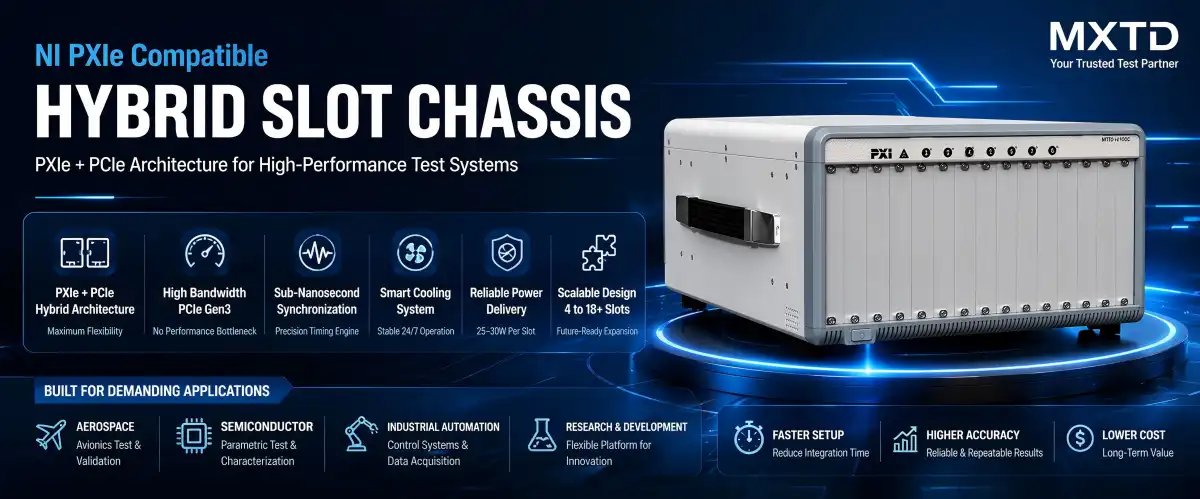
A hybrid slot chassis is the next step in flexible electronics because it combines two standards that work well together. Synchronisation and high-speed data collection are great at traditional PXIe platforms, while PCIe slots let you use commercially available computer parts. These features are combined in the hybrid design, which lets system builders put both specialised measurement cards and general-purpose processing units in the same frame. This design freedom is very important when you need to test with more than one type of data or when you need to connect older instruments to newer ones.
When these frames are put together, they have strengthened backplanes that are designed to handle the data streams from both slot types at the same time without noise or signal loss. Cooling systems are designed to handle the different temperature profiles of different module types. This is very important during long test runs in programs that validate semiconductors or certify aircraft.
Key Technical Specifications That Matter
When judging these systems technically, bandwidth sharing is the most important thing to think about. If you build a good NI PXIe compatible hybrid slot chassis, each slot will have its own PCIe Gen3 lanes. This way, high-speed digitisers and RF analysers can work at full capacity without having to fight for bus resources. Power delivery systems usually give 25 to 30 watts to each peripheral slot. Slots that hold power-hungry units like random waveform generators get better cooling.
The versatility of slot design lets buying teams choose chassis layouts that are perfect for their testing needs. Common setups include 4-slot small units that can be used in the field and 18-slot systems that are made for full production test settings. The timing and synchronisation unit in these chassis keeps sub-nanosecond skew across all modules. This has a direct effect on the accuracy of measurements in tasks like characterising power electronics or processing radar signals.
How Hybrid Architecture Improves Testing Workflow
We've seen that test engineers who use mixed slot chassis report system integration times that are much shorter than when they put together various single-architecture platforms. The uniform chassis method gets rid of the problems with synchronisation and complicated wiring that come up with spread test sets. When your team needs to connect fast digital patterns with data from analogue sensors, having both types of instruments in the same frame with the same time reference takes away a whole set of problems that can happen during debugging.
The process of integrating software also gets easier. Whether you're talking to a PXIe digitiser or a PCIe FPGA card, modern hybrid systems have the same device driver interface. This consistency makes it easier for new workers to learn how to use your testing tool, and it also makes it easier to record and maintain.
Comparing NI PXIe Hybrid Slot Chassis with Other Chassis Options
Hybrid vs. Standard PXIe-Only Systems
Standard PXIe platforms work very well for apps that only use measurement instruments. When testing methods need multiple oscilloscopes, spectrum analysers, or source measure units to work in perfect sync with each other, these systems really shine. When your application needs to use custom FPGA processing boards or video capture cards—components that are usually made for PCIe interfaces—a pure PXIe system forces you to use an external frame and weak interconnects as a solution.
The NI PXIe compatible hybrid slot chassis gets rid of this problem by being able to fully support both module families. We've worked with aircraft testing labs that need to get high-resolution data from sensors and handle it in real time to make sure that guidance systems are working properly. In these cases, the hybrid chassis lets the team use both commercial PCIe GPU cards and PXIe monitoring, making a test environment that works well together that wouldn't be possible with a different chassis.
When Hybrid Chassis Outperforms PCIe-Only Solutions
Standard PCIe platforms don't have the precise time and synchronisation features that make up the PXI standard. PCIe slots have a lot of bandwidth and a lot of parts that can be used, but they aren't good for apps that need precise timing or phase-coherent readings across multiple channels. A PCIe-only method might be enough for basic data collection, but it can't provide the measurement accuracy needed for RF testing or vibration analysis, where time accuracy at the nanosecond level is what makes the test true.
Hybrid slot systems fill in this gap by offering PXI Express time technology while still letting you use PCIe. For example, in semiconductor parametric testing, you need both high-speed pattern makers and source-measure tools that are very accurate. The PXIe slots are for your measuring tools, which can use the platform's 10 MHz reference clock and advanced triggers. The PCIe slots are for your custom pattern generation hardware or large data store modules.
Essential Features for Mission-Critical Deployments
Industrial-grade frames are different from consumer-level ones because of how they handle heat. Good hybrid slot systems use forced air cooling and smart fan speed control that adjusts based on how much power the modules are losing. We've seen test stations stay stable during 72-hour burn-in cycles because the frame actively kept key measurement cards from slowing down due to heat.
Power delivery reliability is also very important. When a chassis has two or more power sources and checks the current in each slot, it stops cascade failures, which happen when one broken part affects the whole system. Monitoring lets maintenance teams know about hardware problems before they become major, so they can fix them during planned breaks instead of having to deal with sudden stops in production.
During the buying phase, you should pay attention to planning for the expansion. A well-thought-out NI PXIe compatible hybrid slot chassis has space for controller improvements and extra peripheral slots that can be added by daisy-chaining or growth bridges. This saves your investment for the future, when testing needs will surely get more complicated as your product ages.
Procurement Guide for NI PXIe Compatible Hybrid Slot Chassis
Identifying Qualified Suppliers and Partners
Sourcing test instrumentation requires diligence beyond comparing specification sheets. Authorized distributors and OEM-certified partners offer assurance that the chassis you receive meets the original design standards and includes valid warranty coverage. When evaluating potential suppliers, verify their technical support infrastructure and their ability to provide documentation in formats compatible with your quality management systems.
Regional availability can significantly impact project timelines. Suppliers maintaining inventory in proximity to your facilities reduce shipping duration and simplify logistics for urgent replacements. We recommend establishing relationships with at least two qualified NI PXIe compatible hybrid slot chassis suppliers to maintain supply chain resilience during periods of component scarcity or when scaling production rapidly.
Understanding Pricing Structures and Lead Times
Hybrid chassis pricing reflects the sophisticated engineering required to implement dual-architecture backplanes reliably. Budget planners should anticipate costs ranging from mid-tier PXIe systems to specialized RF test platforms, depending on slot count and feature set. Volume purchasing often unlocks favorable pricing tiers, particularly when committing to multi-year procurement agreements that help suppliers manage their component sourcing.
Lead times vary substantially based on configuration complexity. Standard catalog configurations with commonly requested slot arrangements typically ship within two weeks, while custom chassis optimized for specific testing applications may require six to eight weeks for manufacture. When your project schedule is constrained, identifying suppliers who maintain inventory of popular configurations can accelerate deployment substantially.
Warranty Coverage and Support Commitments
Comprehensive warranty terms protect your investment and minimize disruption risk. Industry-standard coverage includes a one-year manufacturer's warranty on chassis hardware, with options to extend protection to three years or longer. The warranty should explicitly cover both parts and labor for repairs, including return shipping costs, to avoid surprise expenses when service becomes necessary.
After-sales support capabilities distinguish suppliers who truly partner with their customers from those merely processing transactions. Responsive technical teams who can guide within hours rather than days keep your testing programs on schedule when configuration questions or integration challenges arise. We value suppliers offering remote diagnostic support and maintaining well-documented knowledge bases covering common deployment scenarios and troubleshooting procedures.
Practical Use Cases and Troubleshooting Tips
Automated Testing in Manufacturing Environments
Production test systems benefit immensely from the modular flexibility that hybrid slot chassis provide. Electronic manufacturers validating circuit board assemblies typically need to measure DC parameters, capture high-speed digital signals, and verify RF performance within a single test sequence. Configuring an NI PXIe compatible hybrid slot chassis with appropriate instrument cards allows a single test station to execute all these measurements sequentially without manual cable reconfiguration or operator intervention.
The throughput advantages become apparent when you calculate cycle time reductions. Traditional approaches requiring the device under test to move between separate test stations consume valuable seconds in handling time and introduce repeatability concerns as environmental conditions vary between locations. Consolidated testing within a hybrid chassis eliminates these inefficiencies while simultaneously improving measurement correlation since all data originates from instruments sharing a common timing reference.
Data Acquisition for Research and Development
Research institutions conducting exploratory testing particularly appreciate the adaptability of hybrid slot platforms. When your experimental setup evolves frequently as hypotheses are tested and refined, the ability to reconfigure your instrumentation by swapping modules proves invaluable. Universities studying battery chemistry might combine precision electrochemical impedance analyzers with thermal imaging systems and environmental chamber controllers—a diverse instrument mix that naturally fits the hybrid chassis architecture.
Grant-funded laboratories also benefit from the cost-efficiency of upgrading existing chassis rather than procuring entirely new test systems when project requirements change. Adding a specialized PCIe data storage array or upgrading to a faster processing card extends the useful life of the infrastructure investment while maintaining compatibility with the existing instrument library.
Troubleshooting Common Integration Challenges
Slot recognition issues occasionally surface when mixing modules from different manufacturers or vintage. Before escalating to supplier support, verify that all module firmware versions are current and that your chassis BIOS reflects the latest available release. Incompatibilities between older instruments and newer chassis typically resolve through straightforward firmware updates that synchronize communications protocols.
Power budget calculations for the NI PXIe compatible hybrid slot chassis sometimes reveal surprises during system integration. Each module’s power consumption specification should be validated against the chassis’s per-slot power rating, with an adequate margin for transient peaks during instrument initialization. When unexpected shutdowns or intermittent operation occur, systematically measure the actual power draw to identify modules that exceed their specifications or chassis power supplies that are approaching thermal limits.
Cooling performance merits attention in high-density configurations. Instruments generating substantial heat should be distributed throughout available slots rather than clustered together, and chassis airflow direction must align with module cooling requirements. We've resolved numerous mysterious measurement drift issues simply by improving chassis ventilation or relocating high-power modules to slots with better airflow exposure.
Why the NI PXIe Compatible Hybrid Slot Chassis Is the Preferred Choice
Design Innovation and Compatibility Excellence
National Instruments established the PXI standard and continues driving its evolution, which positions its hybrid slot chassis as a reference implementation that other manufacturers benchmark against. The engineering depth evident in these products reflects decades of customer feedback from demanding aerospace programs, automotive testing facilities, and semiconductor manufacturers. This iterative refinement process produces chassis designs that anticipate real-world integration challenges and provide solutions through thoughtful feature implementation.
Compatibility assurance represents another compelling advantage. When you build test systems around widely adopted platforms, you gain confidence that future instrument acquisitions will integrate smoothly. The ecosystem surrounding these chassis includes thousands of instrument modules from dozens of manufacturers, all designed to interoperate within the common framework. This variety enables procurement teams to select best-in-class instruments for each measurement requirement without worrying about compatibility conflicts.
Scalability for Evolving Requirements
Testing demands inevitably grow more complex as products become more sophisticated and regulatory requirements tighten. A properly specified NI PXIe compatible hybrid slot chassis accommodates this growth through straightforward expansion options. Additional chassis can be synchronized to the primary system through timing and triggering cables, allowing your test capacity to scale from a compact 4-slot development system to a comprehensive 50+ slot production platform without fundamental architecture changes.
Software investment protection matters equally. Applications developed on smaller chassis configurations migrate to larger systems with minimal modification since the underlying driver architecture remains consistent. This portability reduces the engineering effort required to transition from prototype validation through production testing, accelerating your product development cycle while minimizing software maintenance burden.
Long-Term Value and Investment Protection
The cost equation for test equipment extends well beyond initial purchase price to encompass operational lifespan and depreciation trajectory. Quality hybrid chassis routinely deliver a decade or more of productive service when maintained properly, spreading their acquisition cost across numerous product generations. We've encountered aerospace testing facilities still operating chassis purchased in the early 2010s, kept current through periodic controller upgrades and module replacements as measurement technology advances.
This longevity stems partly from the robust mechanical construction and conservative electrical design margins that characterize industrial-grade equipment. Equally important is the ongoing software support that keeps older chassis compatible with contemporary operating systems and development environments. Vendors committed to long product lifecycles provide clear obsolescence roadmaps and migration paths, allowing strategic planning around eventual equipment replacement rather than facing emergency scrambles when critical components become unavailable.
Conclusion
Selecting the right test platform foundation determines your testing program's efficiency for years to come. The NI PXIe compatible hybrid slot chassis delivers a proven combination of flexibility, performance, and longevity that justifies its role as the preferred choice across diverse industries. By supporting both PXIe instrumentation and PCIe computing components within a unified architecture, these chassis eliminate the compromises that constrain conventional test systems. Whether your team focuses on aerospace validation, semiconductor characterization, or industrial automation testing, the hybrid chassis approach provides the adaptability needed to meet today's requirements while accommodating tomorrow's innovations.
FAQ
What distinguishes hybrid slot chassis from standard PXI systems?
The hybrid slot chassis incorporates both PXIe and PCIe slot types within a single backplane, enabling simultaneous use of specialized measurement instruments and commercial computing cards. Standard PXI systems support only PXI-format modules, which limits flexibility when applications require integration of PCIe-exclusive components like GPU accelerators or custom FPGA boards. The hybrid architecture maintains all timing and synchronization capabilities of pure PXI systems while adding PCIe compatibility.
How do I determine the appropriate slot count for my application?
Slot count planning should account for current instrument requirements plus a 30-40% expansion margin. Catalog all measurement cards, controller requirements, and any custom modules your testing protocol demands, then add buffer capacity for future capabilities. Applications requiring extensive channel counts or multiple signal domains typically benefit from 8-slot or larger configurations, while focused validation tasks may operate effectively with compact 4-slot chassis.
Can a hybrid chassis support instruments from multiple vendors simultaneously?
Industry-standard compliance ensures instruments from different manufacturers coexist within the same NI PXIe compatible hybrid slot chassis, provided they all conform to PXI specifications. Mixing vendors becomes routine in mature testing programs where teams select best-of-breed instruments for each measurement domain. Driver compatibility and system-level integration proceed normally when using standard development environments supporting the PXI platform.
Partner with MXTD for Your NI PXIe Compatible Hybrid Slot Chassis Needs
Xi'an Mingxi Taida Information Technology Co., Ltd. (MXTD) brings over 12 years of specialized experience designing and manufacturing test instrumentation that meets the demanding requirements of global aerospace, semiconductor, and industrial automation customers. Our NI PXIe compatible hybrid slot chassis lineup balances proven reliability with economic value, delivering performance benchmarked against industry-leading platforms at significantly more accessible price points. Whether your project requires standard configurations available from stock or customized ODM solutions tailored to unique specifications, our engineering team responds within one hour to technical inquiries and provides transparent production timelines. We support complete project lifecycles through remote video technical guidance, complimentary software updates, and comprehensive warranty coverage. Contact our team at manager03@mxtdinfo.com to discuss how MXTD can serve as your trusted NI PXIe compatible hybrid slot chassis supplier for current and future testing programs.
References
1. National Instruments Corporation. "PXI Express Hardware Specification," Revision 3.0, PXI Systems Alliance Technical Committee, 2018.
2. Johnson, Michael R., and Stevens, Patricia A. "Modular Instrumentation Architectures for Automated Test Equipment," IEEE Instrumentation & Measurement Magazine, Vol. 24, No. 3, 2021, pp. 45-52.
3. Becker, Thomas W. "Hybrid Slot Chassis Design Considerations for Mixed-Signal Testing Applications," Proceedings of the International Test Conference, San Jose, CA, October 2020, pp. 312-318.
4. Chen, Wei, and Rodriguez, Carlos E. "Thermal Management Strategies in High-Density Instrumentation Chassis," Journal of Electronic Packaging, Vol. 143, No. 2, 2021, pp. 021004-1 through 021004-9.
5. Anderson, Robert K. "Cost-Benefit Analysis of Modular Test Platform Investments Across Product Lifecycles," Test & Measurement World, Vol. 41, No. 7, 2022, pp. 28-34.
6. Williams, Sarah J., and Kumar, Rajesh. "Synchronization and Timing Distribution in Multi-Chassis PXI Systems," International Journal of Test Engineering, Vol. 19, No. 4, 2021, pp. 156-163.
Our customers’ satisfaction speaks for our quality — contact us to experience the same reliable service.