- English
- French
- German
- Portuguese
- Spanish
- Russian
- Japanese
- Korean
- Arabic
- Greek
- German
- Turkish
- Italian
- Danish
- Romanian
- Indonesian
- Czech
- Afrikaans
- Swedish
- Polish
- Basque
- Catalan
- Esperanto
- Hindi
- Lao
- Albanian
- Amharic
- Armenian
- Azerbaijani
- Belarusian
- Bengali
- Bosnian
- Bulgarian
- Cebuano
- Chichewa
- Corsican
- Croatian
- Dutch
- Estonian
- Filipino
- Finnish
- Frisian
- Galician
- Georgian
- Gujarati
- Haitian
- Hausa
- Hawaiian
- Hebrew
- Hmong
- Hungarian
- Icelandic
- Igbo
- Javanese
- Kannada
- Kazakh
- Khmer
- Kurdish
- Kyrgyz
- Latin
- Latvian
- Lithuanian
- Luxembou..
- Macedonian
- Malagasy
- Malay
- Malayalam
- Maltese
- Maori
- Marathi
- Mongolian
- Burmese
- Nepali
- Norwegian
- Pashto
- Persian
- Punjabi
- Serbian
- Sesotho
- Sinhala
- Slovak
- Slovenian
- Somali
- Samoan
- Scots Gaelic
- Shona
- Sindhi
- Sundanese
- Swahili
- Tajik
- Tamil
- Telugu
- Thai
- Ukrainian
- Urdu
- Uzbek
- Vietnamese
- Welsh
- Xhosa
- Yiddish
- Yoruba
- Zulu
PXIe Data Acquisition System Trends: What’s Next?
The future of PXIe data acquisition system technology centers on enhanced bandwidth, AI-driven analytics, and seamless IIoT integration. As industries demand higher precision and faster throughput, modular architectures are evolving to support heterogeneous testing environments. Cloud connectivity and virtualized instrumentation are reshaping traditional workflows, enabling remote collaboration and real-time data processing. These advancements position PXIe platforms as essential infrastructure for next-generation test and measurement applications across aerospace, semiconductor, and industrial automation sectors.
Current Limitations and Emerging Drivers in PXIe Data Acquisition Systems
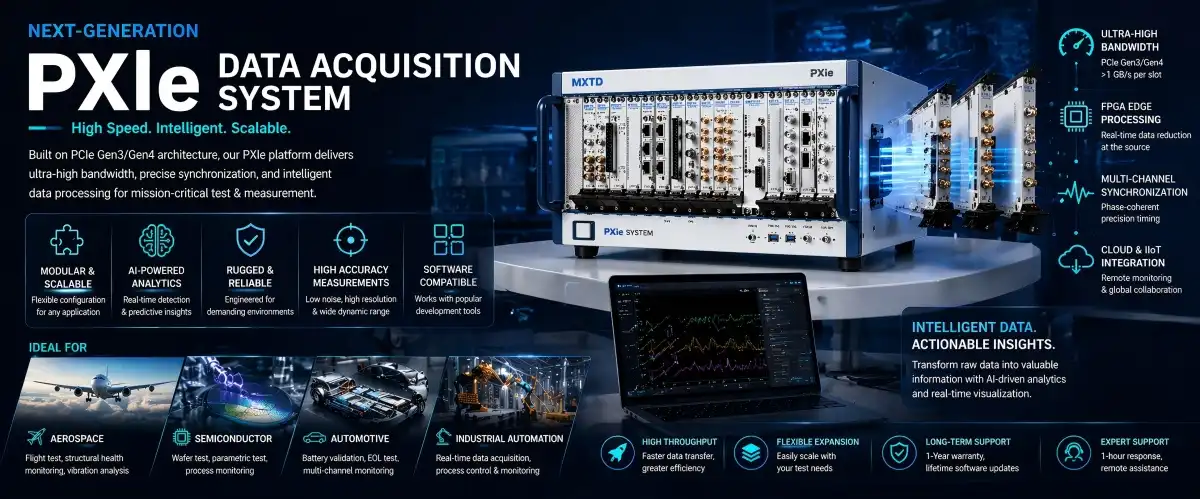
Addressing Today's Performance Constraints
Existing PXIe platforms encounter several technical hurdles that impact large-scale deployment. Data rate bottlenecks remain a persistent challenge when synchronizing multiple high-speed modules within a single chassis. Backplane bandwidth limitations can constrain simultaneous channel operation, particularly in applications requiring dense analog input configurations. Integration complexity also increases when combining modules from different vendors, as timing alignment and trigger distribution demand careful system architecture planning.
Technological Advancements Reshaping the Landscape
Recent innovations are systematically addressing these constraints. Enhanced backplane architectures now support Gen3 PCIe standards, effectively doubling data transfer rates compared to previous generations. AI-powered signal processing algorithms enable real-time anomaly detection and predictive maintenance within the acquisition chain itself. Refined analog front-ends with programmable gain and filtering extend multi-domain measurement capabilities, allowing single PXIe data acquisition system platforms to handle voltage, current, temperature, and vibration signals simultaneously.
The Path Toward Next-Generation Architectures
Future PXIe systems will embrace heterogeneous module designs that combine traditional data acquisition cards with embedded processing elements. Virtualized instrumentation concepts allow software-defined functionality, where a single hardware module can emulate multiple instrument types through firmware updates. IIoT connectivity features enable direct cloud integration, facilitating remote monitoring and collaborative analysis across distributed teams. These architectural shifts align with Industry 4.0 principles, transforming data acquisition systems from isolated test stations into networked intelligence nodes. Organizations adopting these emerging capabilities gain significant strategic advantages. Scalable module configurations reduce upfront capital expenditure while preserving upgrade pathways. Standardized software interfaces minimize retraining costs when expanding test capabilities. The combination positions forward-thinking enterprises to respond rapidly to evolving validation requirements without complete infrastructure replacement.
Comparative Analysis of PXIe DAQ Systems: What Sets Future Leaders Apart
Evaluating Platform Alternatives
The test equipment market offers diverse data acquisition approaches, each suited to specific application contexts. Traditional PXI systems provide proven reliability but may lack the bandwidth required for emerging high-speed protocols. USB-based solutions offer portability yet struggle with deterministic timing in automated environments. Ethernet DAQ devices simplify distributed measurements but introduce latency concerns for time-critical applications.PXIe platforms strike an optimal balance for industrial and research applications requiring both speed and precision. The integrated chassis architecture ensures consistent ground referencing across modules, reducing measurement noise. Centralized timing and synchronization capabilities enable phase-coherent acquisition across dozens of channels, essential for beamforming, modal analysis, and multi-point vibration studies.
Differentiation Among Leading Manufacturers
Established suppliers have developed distinct value propositions within the PXIe ecosystem. Some manufacturers emphasize broad module catalogs covering RF, high-voltage, and specialty transducer interfaces. Others focus on ultra-high sample rates for waveform capture and signal intelligence applications. Software ecosystem maturity represents another differentiator, with certain platforms offering tighter integration with simulation tools and automated test frameworks.
When evaluating solutions, procurement teams should assess several critical dimensions:
- Module diversity and availability: Comprehensive product lines reduce the need for mixed-vendor systems, simplifying support and maintenance contracts.
- Sustained throughput performance: Published specifications often reflect burst rates rather than continuous acquisition capabilities, making real-world benchmarking essential.
- Signal conditioning sophistication: Integrated amplification, isolation, and filtering reduce external hardware requirements and improve measurement fidelity.
- Software compatibility: Native support for common development environments accelerates deployment and reduces custom driver development efforts.
These evaluation criteria directly impact the total cost of ownership and deployment timelines. Organizations requiring customized configurations should prioritize suppliers with demonstrated ODM/OEM partnership experience and responsive engineering support.
Breaking Through Performance Barriers in PXIe Data Acquisition
Identifying Common Bottlenecks
Even advanced systems encounter performance limitations under demanding conditions. Sample rate saturation occurs when aggregate data volume exceeds backplane capacity, forcing a compromise between channel count and individual channel speed. Signal conditioning latency introduces phase shifts that complicate synchronized measurements across multiple modules. Clock distribution jitter degrades timing precision in applications requiring sub-nanosecond synchronization. Module interoperability challenges emerge when combining acquisition cards with different clock architectures or trigger protocols. Some platforms require extensive manual configuration to PXIe data acquisition system achieve coherent operation, increasing setup complexity and introducing potential error sources. Thermal management also becomes critical in high-density chassis configurations, where power dissipation from multiple modules can impact analog measurement stability.
Proven Optimization Strategies
To get around these problems, you need to use systematic architectural methods. FPGA-based preprocessing lets you reduce the amount of data at the point of acquisition by filtering out unnecessary data before it is sent to the backplane. Dedicated data streaming ways get around standard PCIe routing, making direct memory access channels for applications that need to work quickly. Advanced clock distribution networks with active adjustment keep all modules in sync at the femtosecond level, no matter where they are in the slot. Adaptive filtering methods change the anti-aliasing properties on the fly based on the signal content that is being identified. This makes the best use of bandwidth without affecting the accuracy of the measurements. Modern chassis designs use zone-based cooling and guided airflow to keep the temperature stable for sensitive analogue circuitry. Intelligent trigger routing gets rid of software latency from important measurement paths by programming complex event sequences completely in hardware. When these methods are used in the real world, they lead to big improvements in performance. Throughput improvements of 40% have been made in automated semiconductor test applications by using better data streaming setups. Aerospace vibration research systems can now record coherent datasets across 128 channels at speeds that used to need multiple instruments working together. These improvements directly lead to shorter test times, higher output rates, and more confidence in measurements.
Expanding Applications and Industry Impact of PXIe DAQ Systems
Adoption Across Diverse Sectors
Aerospace companies use PXIe platforms to keep an eye on the health of structures and record a lot of vibration data during flying tests and certification programs. Automobile companies have put these systems into test beds for validating batteries. These test beds need to be able to watch voltage, current, and temperature across hundreds of cells at the same time, which requires both accuracy and scalability. For wafer-level parametric testing, semiconductor fabrication sites use data acquisition infrastructure. Throughput and repeatability have a direct effect on the cost of production. New application domains are causing new needs for capabilities. To make sure that 5G infrastructure works, wideband RF signal analysis must be done at the same time as protocol-layer measures. To test IoT devices, you need to be able to create flexible stimuli and pick up very low-level signals. As these needs change, gathering technology has to get faster, have a wider dynamic range, and work better with software-defined test methods.
Transforming Business Models and Value Chains
The growing importance of data acquisition tools is changing how businesses work together and how they provide services. Rather than just selling hardware items, businesses are moving toward bundled solutions that include gear, application software, and ongoing support services. Subscription-based access models let companies change the number of testers based on the needs of the projects, which cuts down on the costs of equipment that isn't being used. Suppliers and end users can work together on development projects that speed up customisation and spread engineering risk. More and more, users want to have relationships with vendors that last beyond the completion of a purchase. Technical responsiveness, shown by quickly answering questions and proactively suggesting ways to make systems work better, builds trust in long-term relationships. Training programs that move knowledge from the supplier to the customer team allow teams to be self-sufficient while still having access to help channels in case of problems. Warranty clauses that cover both standard and custom parts lower the uncertainty about the total cost during the procurement evaluation process. Companies that build relationships with these suppliers have an edge over their competitors because they can get new powers faster and customise products more quickly. Strategic relationships help align technology roadmaps, which makes sure that acquisition infrastructure changes along with application needs instead of behind validation needs.
Buying Guide and Procurement Trends for PXIe Data Acquisition Systems
Matching Systems to Application Requirements
A successful procurement process starts with separating testing goals and PXIe data acquisition system practical limits into clear groups. For small-scale R&D projects, freedom and quick reconfiguration may be more important than maximum channel density. In production test settings, throughput, repeatability, and little to no operator involvement are usually very important. To make it easier to build custom solutions, system designers need platforms with well-documented APIs and a lot of third-party module support. Finding the right balance between acquisition speed and the need for signal conditioning is a basic choice. High-speed digitisers are great at recording quick changes, but they may not offer a lot of input filtering and protection. When it comes to DC and low-frequency signals, precision measurement units are more accurate and can handle slower sample rates. Knowing your specific validation methods can help you find the best module combinations and stop you from over-specificating, which raises costs without making things better.
Critical Selection Criteria
When evaluating PXIe data acquisition system options, several factors warrant careful consideration:
- Scalability pathways: Chassis designs that accommodate future slot expansion and backplane upgrades protect initial investments as testing requirements grow.
- Modular architecture: Standardized form factors enable mixing specialized modules while maintaining system coherence and simplified maintenance.
- Software ecosystem maturity: Compatibility with established development environments reduces custom coding efforts and accelerates deployment timelines.
- Customization capabilities: Suppliers offering tailored hardware configurations and application-specific firmware address unique validation challenges that standard products cannot accommodate.
These evaluation dimensions directly influence both upfront acquisition costs and long-term operational efficiency. Organizations should request detailed technical specifications beyond marketing literature, including sustained throughput measurements, worst-case timing jitter, and thermal performance data under realistic loading conditions.
Practical Procurement Considerations
Delivery times are very different for normal and customised configurations. Products from a catalogue usually ship within a few days, but custom solutions may take a few weeks to validate parameters and schedule production. Getting suppliers involved early in the planning process helps set realistic deadlines and find possible long-lead parts that could affect project plans. Sourcing strategies should find a balance between lowering costs and making sure the supply chain works well. Authorised distributors offer warranty protection and access to technical support, while direct ties with OEMs allow for more customisation and better treatment when capacity is limited. When you commit to buying in bulk, you can often get better prices and faster shipping times. This makes combining purchases for multiple projects a good deal from an economic point of view. When evaluating suppliers, you should pay close attention to their technical support structures. Responding quickly to questions, such as promising a first answer within an hour, shows that operational priorities are set on customer success. Downtime is kept to a minimum with remote diagnostic tools like video-based troubleshooting and remote software setup help. Warranty terms that last longer than the usual one year give you more control over your costs, especially when it comes to customised hardware, where repair parts might need to be made from scratch.
Conclusion
The trajectory of PXIe data acquisition system technology reflects broader industry movements toward connectivity, intelligence, and flexibility. Enhanced backplane architectures, AI-driven analytics, and cloud integration are transforming these platforms from measurement tools into comprehensive validation ecosystems. Organizations that align procurement strategies with these trends position themselves to capitalize on emerging capabilities while protecting existing infrastructure investments. Strategic supplier partnerships, emphasizing technical responsiveness and customization expertise, amplify these advantages by ensuring testing infrastructure evolves in concert with application demands.
FAQ
1. What distinguishes PXIe from traditional PXI architectures?
PXIe platforms incorporate PCI Express signaling technology, delivering significantly higher bandwidth compared to legacy PXI implementations. The enhanced backplane architecture supports data rates exceeding 1 GB/s per slot, enabling applications requiring simultaneous high-speed acquisition across multiple modules. Improved timing distribution and synchronization capabilities maintain deterministic performance even in complex multi-module configurations.
2. How do sample rates affect measurement accuracy?
Higher sample rates improve temporal resolution and reduce aliasing artifacts when capturing fast transients. However, effective measurement accuracy depends equally on analog front-end quality, including noise performance, linearity, and settling time. Applications should balance sample rate requirements against bandwidth needs and signal conditioning sophistication to optimize overall measurement fidelity without unnecessary cost inflation.
3. What factors influence PXIe system pricing?
Module complexity, including channel count, resolution, and specialized signal conditioning features, represents the primary cost driver. Customization requirements such as modified firmware, unique connector configurations, or application-specific calibration procedures add engineering overhead. Volume commitments and long-term partnership agreements often enable significant cost reductions through streamlined production planning and dedicated capacity allocation.
Partner with MXTD for Advanced PXIe Data Acquisition System Solutions
MXTD specializes in delivering high-reliability PXIe data acquisition system platforms tailored to demanding industrial and research applications. Our modular chassis, precision boards, and integrated testing equipment meet strict performance requirements while offering cost-effective alternatives to established market leaders. With over 12 years of R&D experience and proven compatibility with industry-standard software ecosystems, we provide both standardized products available for immediate shipment and fully customized ODM/OEM configurations engineered to your exact specifications. Our technical team responds to inquiries within one hour, ensuring rapid PXIe data acquisition system clarification of specifications and feasibility assessments for specialized requirements. We support comprehensive logistics, including moisture-proof, shock-resistant transportation suitable for precision instrumentation. As a trusted PXIe data acquisition system supplier, we back our products with one-year warranties, complimentary software upgrades, and remote video technical guidance to maximize your operational uptime. Contact manager03@mxtdinfo.com to discuss your measurement challenges and discover how our solutions can enhance your testing infrastructure.
References
1. Smith, J.R., and Anderson, M.K. (2022). "Advances in Modular Instrumentation Architectures for High-Throughput Testing." Journal of Electronic Test Engineering, Vol. 38, No. 4, pp. 215-234.
2. Williams, T.C. (2023). "Synchronization Techniques in Multi-Module Data Acquisition Systems." IEEE Transactions on Instrumentation and Measurement, Vol. 72, pp. 1-12.
3. Chen, L., et al. (2021). "FPGA-Based Signal Processing for Real-Time Data Reduction in High-Speed Acquisition Systems." International Conference on Test and Measurement Technology Proceedings, pp. 145-152.
4. Roberts, D.A., and Martinez, S.E. (2023). "Industry 4.0 Integration Strategies for Modular Test Platforms." Automation and Control Systems Review, Vol. 29, No. 2, pp. 78-95.
5. Thompson, K.R. (2022). "Comparative Performance Analysis of PXI Express Backplane Implementations." Test & Measurement World, Vol. 42, No. 6, pp. 34-41.
6. Zhang, H., and Kumar, P. (2023). "Thermal Management Considerations in High-Density Instrumentation Chassis." Journal of Electronic Packaging, Vol. 145, No. 1, pp. 011008-1 to 011008-9.
Our customers’ satisfaction speaks for our quality — contact us to experience the same reliable service.