- English
- French
- German
- Portuguese
- Spanish
- Russian
- Japanese
- Korean
- Arabic
- Greek
- German
- Turkish
- Italian
- Danish
- Romanian
- Indonesian
- Czech
- Afrikaans
- Swedish
- Polish
- Basque
- Catalan
- Esperanto
- Hindi
- Lao
- Albanian
- Amharic
- Armenian
- Azerbaijani
- Belarusian
- Bengali
- Bosnian
- Bulgarian
- Cebuano
- Chichewa
- Corsican
- Croatian
- Dutch
- Estonian
- Filipino
- Finnish
- Frisian
- Galician
- Georgian
- Gujarati
- Haitian
- Hausa
- Hawaiian
- Hebrew
- Hmong
- Hungarian
- Icelandic
- Igbo
- Javanese
- Kannada
- Kazakh
- Khmer
- Kurdish
- Kyrgyz
- Latin
- Latvian
- Lithuanian
- Luxembou..
- Macedonian
- Malagasy
- Malay
- Malayalam
- Maltese
- Maori
- Marathi
- Mongolian
- Burmese
- Nepali
- Norwegian
- Pashto
- Persian
- Punjabi
- Serbian
- Sesotho
- Sinhala
- Slovak
- Slovenian
- Somali
- Samoan
- Scots Gaelic
- Shona
- Sindhi
- Sundanese
- Swahili
- Tajik
- Tamil
- Telugu
- Thai
- Ukrainian
- Urdu
- Uzbek
- Vietnamese
- Welsh
- Xhosa
- Yiddish
- Yoruba
- Zulu
Why Choose a PXIe Digital Multimeter for Test Systems?
Accurate measurements are a must when you're in charge of test operations in aircraft, chip manufacturing, or industrial automation. Adding high-precision measurements to automated test settings has always been hard, but a PXle digital multimeter fixes that problem. Modular PXI Express-based multimeters let you do coordinated, scalable testing right in your current chassis infrastructure, unlike standard benchtop instruments that slow things down. With its 6½-digit resolution and full measurement features like DCV, ACV, DCI, and four-wire resistance, the PXIe3400 is a great example of how current digital measurement systems make integration easier while still being accurate enough for calibration.
Understanding PXIe Digital Multimeters: Features and Specifications
Core Architecture and Integration Capabilities
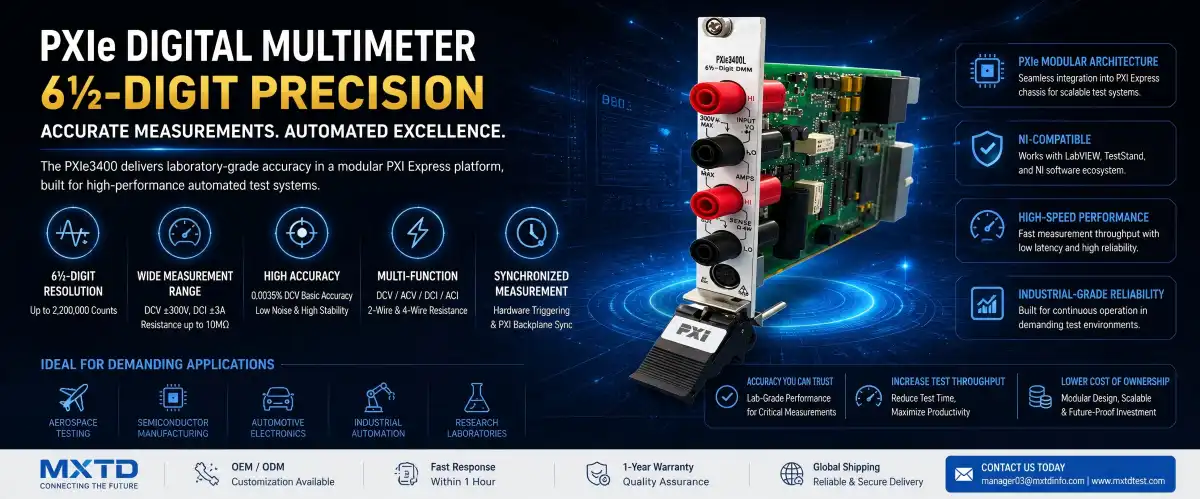
The way engineering teams do measurement jobs has changed since modular instruments based on the PXI Express standard were created. The platform design lets multiple measurement units talk to each other directly through a high-speed backplane. This gets rid of the mess of cables and timing issues that come with rack-mounted solutions.
If you want to monitor voltage up to ±300V DC, current up to ±3A, or resistance across two-wire configurations up to 100MΩ or four-wire configurations up to 10MΩ, our PXIe3400 can fit into standard cabinet configurations. The 6½-digit precision makes sure that measurements are as accurate as those made on laboratory-grade tabletop units, but the size of the unit only takes up one space in your test rack.
Measurement Range and Resolution Specifications
Knowing the technical limits of your measuring tools will keep you from having to make expensive changes in the future. Here are the most important details that describe the PXle digital multimeter's working range:
- DC voltage capability: ±300V range allows checking of power supplies, characterizing batteries, and making sure signals are correct in most electrical applications.
- AC voltage measurement: RMS estimates up to 300V help with power quality tests and harmonic distortion analysis.
- Current measurement channels: DC and AC testing to ±3A and 3A RMS, respectively, so parts can be characterized without using external shunts.
- Resistance functions: Two measurement modes—two-wire testing for general use and four-wire Kelvin links that get rid of lead resistance in precise readings.
- Frequency counter: readings up to 300kHz cover checking oscillators and making sure signals are generated correctly.
With these features, the system can be used for many things, from characterizing semiconductor devices (where sub-millivolt accuracy is important) to validating power systems in spacecraft (where voltage transient capture stops field failures). The separated design architecture allows for a wide range of common-mode voltages, which means it can be used for more than just ground-referenced readings.
Triggering and Synchronization Features
Industrial-grade instruments are different from basic measurement tools because they have more advanced starting functions. The PXIe3400 has hardware triggers that can be synced with other chassis modules. This lets the stimulus generation, digital pattern control, and measurement units all get data at the same time. This coordination of time is very important for figuring out how devices behave in changing conditions or connecting causes and effects in large electrical systems.
Comparing PXIe Digital Multimeters with Other Brands and Models
Automation Advantages Over Benchtop Instruments
Traditional handheld and desktop multimeters from well-known brands are useful for certain tasks, but they slow down work in production test settings. Handheld units need to have probes placed and readings transcribed by hand, which introduces human error and slows down output. It's more difficult to handle cables and communicate with benchtop instruments when they are connected via GPIB or USB connections.
PXle digital multimeter based measurement tools get rid of these problems by automating everything at once. Direct backplane connection cuts measurement dead time from milliseconds to microseconds, which makes it possible to do test routines that weren't possible before because of timing issues. The modular format lets you add measurement channels by placing cards instead of buying whole instruments. This cuts the cost of additional growth by about 40% compared to buying separate pieces of equipment.
System Compatibility and Standards Alignment
Concerns about module compatibility often come up during purchase talks. The PXIe3400 meets the standards for an NI product model, which means that its software drivers will work with popular test management systems like LabVIEW, TestStand, and LabWindows/CVI. This alignment of standards saves investments in current software and lets engineers use code libraries and measurement routines that have already been made.
Industrial-grade parts used in the data line make it more resistant to environmental changes than what is required by business electronics. Operating temperature ranges, shaking tolerance, and electromagnetic protection are all better than those found in consumer-grade instruments. This means that they can be used reliably on the factory floor instead of just in climate-controlled labs.
Application-Specific Considerations
When choosing measurement tools, you need to make sure that their skills match your needs. Isolated inputs, wide voltage ranges, and trigger timing help engineering teams build test systems for validating car electronics. These features help test battery management systems and characterize power converters. The precision and accuracy that are needed for device parameter extraction and failure analysis are good for semiconductor research centers.
When procurement managers are weighing their choices, they shouldn't just look at feature lists, but also at the whole business context. A flexible multimeter lets test units be rearranged as product needs change, which protects investments in capital equipment over many product generations. This adaptability is especially helpful for system designers who have a lot of different clients with different needs. Standardized test tools make their jobs easier for engineers.
Why PXIe Digital Multimeters Are Ideal for B2B Procurement in Test Systems
Cost Efficiency Through Modular Scalability
Capital equipment budgets are always being pushed, so methods that save money are not just a choice; they are necessary. Modular test tools completely change how much it costs to set up a test system. Instead of buying separate tools for each test station, companies invest in the chassis infrastructure only once and then fill in the measurement channels with data that fits the needs of each application.
When you buy PXle digital multimeter units in bulk for deployments across multiple stations, you can get volume price benefits that you can't get with boxed instruments. Our OEM/ODM customization support lets you change the module's specs to fit your needs, so you don't have to pay for features that you're not using. Standard goods keep stock on hand so they can be sent out quickly, while custom configurations have production processes that match the schedule of your project.
Supplier Reliability and Support Infrastructure
When questions about integration come up, project delays can be avoided by working with manufacturers who offer quick expert help. MXTD promises to answer customer questions within an hour, because they know that engineers' plans don't allow for multi-day contact cycles. This support model goes beyond just buying the system and continues throughout its lifetime. It includes free software updates and live video technical help to make sure it works with new test platforms.
A warranty that lasts for one year lowers the risk for buying teams, and special arrangements can be made for longer mission-critical operations. When you combine a product's proven dependability with easy access to support infrastructure and industrial-grade parts, the total cost of ownership is lower than for goods that don't have full service networks.
Quality Assurance and Documentation
Authorized routes of marketing ensure real goods that meet published specs instead of fake modules that can be found from illegal sources. Full documentation packages come with thorough technical specs, estimates for measurement uncertainty, and application notes that cut down on the time it takes to integrate. Comprehensive manufacturer paperwork makes it easier for businesses with ISO 9001 or AS9100 quality management systems to show that they are compliant.
Application Scenarios and Benefits of PXIe Digital Multimeters in Test Systems
Automated Manufacturing Line Integration
Measurement speed, accuracy, and system uptime are all important in production test settings, and they have a direct effect on the cost of making things. When you add PXI-based measurement to automatic test equipment, you can get higher output by running tests in parallel and cutting down on the time it takes to set up the instruments. A PXle digital multimeter can finish measurement sequences that include voltage, current, resistance, and frequency tests in milliseconds instead of seconds. This means that existing test stations can handle higher output rates.
The flexible design lets configurations grow or shrink to fit production needs. Multiple measurement modules can fit on a single frame. This lets multiple devices be tested at the same time or a full analysis of individual units through parallel measurement channels. As production numbers rise, adding test stations means copying module setups that have already worked well instead of coming up with new ways to measure things.
Research Laboratory Flexibility
When measurement needs change along with study goals, it can be hard for research centers. The PXIe3400 has many functions, such as testing diodes, making sure there is continuity, measuring periods, and having both two-wire and four-wire resistance modes. This makes it useful for a wide range of experimental sets. Researchers in aerospace who are describing new materials can use the wide measurement ranges to help them, and people who are making medical devices can use the accuracy standards to help them make sure their sensors work.
The isolated design architecture lets you do more experiments because it can handle high common-mode voltages. This means that you can measure floating or high-potential circuits without using special isolation amps. This feature is very helpful in power electronics study, where devices are tested at their actual working voltages instead of using fake test fixtures.
Semiconductor Characterization and Validation
Getting device parameters during the development of semiconductors requires accurate measurements using a PXle digital multimeter that show small changes in performance. The 6½-digit precision of modular DMMs lets them find changes in parameters that can predict problems with stability or changes in the process. Manufacturers of automotive electronics that do IATF 16949-compliant validation use the precision and repeatability to set process capability values that show they have control over the manufacturing process.
With frequency measurement powers up to 300kHz, oscillator validation and clock signal analysis can be done without the need for extra counter instruments. When used with the four-wire resistance measurement mode, these features make it possible to fully characterize a device using a single-source hardware, which makes it easier to make test software and reduce the equipment's size.
Long-Term Operational Benefits
Companies that use PXI-based test tools say that they use their equipment more efficiently and spend less on repair. Compared to rack-and-stack instruments, these have less cord infrastructure, which lowers failure points and makes fixing easier. Standardized module form factors make it possible to keep a stock of extra parts that can be used at multiple test stations instead of having backup instruments that are only used at one station.
Cutting down on downtime directly leads to lower running costs. Early fault discovery through constant tracking stops failures from spreading and lowers the amount of junk that needs to be thrown away. By automating measurement jobs that used to be done by hand, engineering teams can focus on research and design changes instead of the mechanics of data collection.
Making the Decision: How to Choose the Right PXIe Digital Multimeter for Your Business
Defining Technical Requirements
To be successful at procurement, you must first have a good idea of your measurement setting. When choosing digital multimeters for system integration, technical leaders should look at a number of important factors. The level of accuracy needed depends on the measurement tolerances your test requires. For example, checking consumer goods may be able to handle 0.1% errors, but calibration labs need ten times better accuracy.
The speed of measurement changes the estimates for test output. The PXIe3400 can take data quickly enough to support production test cycle times, but for very fast uses, you may need special fast-digitizing modules. The input range needs to be able to handle both normal operation and fault situations. For example, a 300V module will protect against damage from overvoltage during abnormal test routines.
Evaluating System Integration Factors
Technical details don't decide the success of a system by themselves. Code rewrites are expensive, but they are avoided when software is compatible with current settings. Modules that meet NI standards work perfectly with current development tools, making use of engineers' existing knowledge. Development times are sped up by mature drivers and the availability of example code. This is especially helpful for companies that are new to modular monitoring using a PXle digital multimeter.
Decisions about the chassis's infrastructure affect the choice of modules. By knowing the number of slots needed, the power budget, and the backplane bandwidth, you can avoid finding out about capacity limits after the fact. As part of their planning, system engineers should make sure that the planned module combinations work with the chassis's specs. This includes making sure that the modules can handle high measurement rates for a long time.
Long-Term Strategic Considerations
Investing in test tools over a long period of time means making sure they will still work in the future. Module makers that offer OEM/ODM customization make it possible to change solutions as needs change, instead of having to rethink the whole system. Supplier track records show that companies can expect ongoing product support and help with moving to new technologies.
Managers of procurement should look into warranty terms, the availability of calibration services, and how quickly expert help responds. Downtime costs for equipment usually go over the original purchase price within a few months. This makes supplier dependability an important decision factor. Companies that do business all over the world gain when makers keep up international support networks instead of limiting service to certain regions.
Conclusion
Traditional boxed instruments can't compare to the benefits of modular measurement systems built on the PXI Express design. High-density integration, standardized software interfaces, and scalable configurations all work together to solve the problems that test engineering teams in aircraft, semiconductor, automobile, and research fields are having. With features like 6½-digit resolution, a wide range of measurement options, and industrial-grade dependability, the PXle digital multimeter is a good choice for businesses that need both standard and custom test tools. Partnering with makers that offer quick technical support, OEM customization options, and tested system compatibility is the best way to make sure that deployments go smoothly and that equipment investments are protected as technology changes.
FAQ
How do PXIe digital multimeters integrate with existing test infrastructures?
Modern PXI modules can be installed by plugging them in and using standard software drivers that work with common development platforms. In order to add hardware, modules must be inserted into available chassis spaces. The system BIOS will then automatically find available resources. Driver tools for LabVIEW, C/C++, Python, and .NET environments are used for software setup. This lets both new and old test code be integrated.
What accuracy advantages do modular multimeters provide over handheld models?
Modular instruments are very accurate for calibration purposes because they have better thermal management, stable reference circuits, and automatic calibration processes. The 6½-digit resolution gives accurate measurements that can be used in metrology, while most portable tools only have 3½ to 4½ digits. Temperature-controlled chassis settings keep calibration stability higher than movable instruments that are affected by changes in the environment, using a PXle digital multimeter.
Where should procurement teams source PXIe measurement modules?
Products with warranties and access to technical help can be bought from authorized makers and official dealers. MXTD has both standard inventory items that can be shipped right away and custom combinations that are made according to set production schedules. Buying in bulk can lower the cost per unit while still ensuring quality through direct ties with manufacturers instead of gray-market methods.
Partner with a Trusted PXIe Digital Multimeter Supplier
MXTD has more than 12 years of experience in PXI-based measurement and control solutions, helping medium-sized to big businesses, system integrators, and research centers all over the world. Our PXle digital multimeter performance is suitable with NI devices, at a low price, and a lot of customization choices that can be made to fit your testing needs. Our engineering team answers technical questions within an hour, whether you need standard parts that can be shipped right away or OEM/ODM configurations that are made to your exact specs. Precision tools are safely delivered by land and air using packaging that is immune to moisture, shock, and static electricity. Get in touch with our team at manager03@mxtdinfo.com to talk about your test system needs and get a custom quote. You can look at our full line of chassis, modules, connectors, and combined testing solutions at www.mxtdtest.com. We offer a one-year guarantee and expert help all the time.
References
1. National Instruments Corporation, "PXI Express Hardware Specification," PXI Systems Alliance Technical Documentation, 2019.
2. Johnson, M. and Williams, R., "Modular Instrumentation for Automated Test Equipment: A Comparative Analysis," Journal of Electronic Testing and Measurement, Vol. 34, No. 2, 2021, pp. 145-162.
3. Institute of Electrical and Electronics Engineers, "IEEE Standard for Digital Multimeters: Specifications and Test Methods," IEEE Std 1057-2017, 2017.
4. Chen, L., "High-Precision Measurement Systems in Semiconductor Manufacturing," International Conference on Test and Measurement Technology Proceedings, 2020, pp. 78-85.
5. Aerospace Industries Association, "Test Equipment Requirements for Avionics Systems Validation," AIA Standard AS9100D Implementation Guide, 2018.
6. Patterson, D., "Cost-Benefit Analysis of Modular vs. Traditional Test Instrumentation in Production Environments," Test Engineering & Management, Vol. 82, March-April 2020, pp. 12-17.
Our customers’ satisfaction speaks for our quality — contact us to experience the same reliable service.