- English
- French
- German
- Portuguese
- Spanish
- Russian
- Japanese
- Korean
- Arabic
- Greek
- German
- Turkish
- Italian
- Danish
- Romanian
- Indonesian
- Czech
- Afrikaans
- Swedish
- Polish
- Basque
- Catalan
- Esperanto
- Hindi
- Lao
- Albanian
- Amharic
- Armenian
- Azerbaijani
- Belarusian
- Bengali
- Bosnian
- Bulgarian
- Cebuano
- Chichewa
- Corsican
- Croatian
- Dutch
- Estonian
- Filipino
- Finnish
- Frisian
- Galician
- Georgian
- Gujarati
- Haitian
- Hausa
- Hawaiian
- Hebrew
- Hmong
- Hungarian
- Icelandic
- Igbo
- Javanese
- Kannada
- Kazakh
- Khmer
- Kurdish
- Kyrgyz
- Latin
- Latvian
- Lithuanian
- Luxembou..
- Macedonian
- Malagasy
- Malay
- Malayalam
- Maltese
- Maori
- Marathi
- Mongolian
- Burmese
- Nepali
- Norwegian
- Pashto
- Persian
- Punjabi
- Serbian
- Sesotho
- Sinhala
- Slovak
- Slovenian
- Somali
- Samoan
- Scots Gaelic
- Shona
- Sindhi
- Sundanese
- Swahili
- Tajik
- Tamil
- Telugu
- Thai
- Ukrainian
- Urdu
- Uzbek
- Vietnamese
- Welsh
- Xhosa
- Yiddish
- Yoruba
- Zulu
What triggers and clocks are supported by NI PXIe hybrid slot chassis?
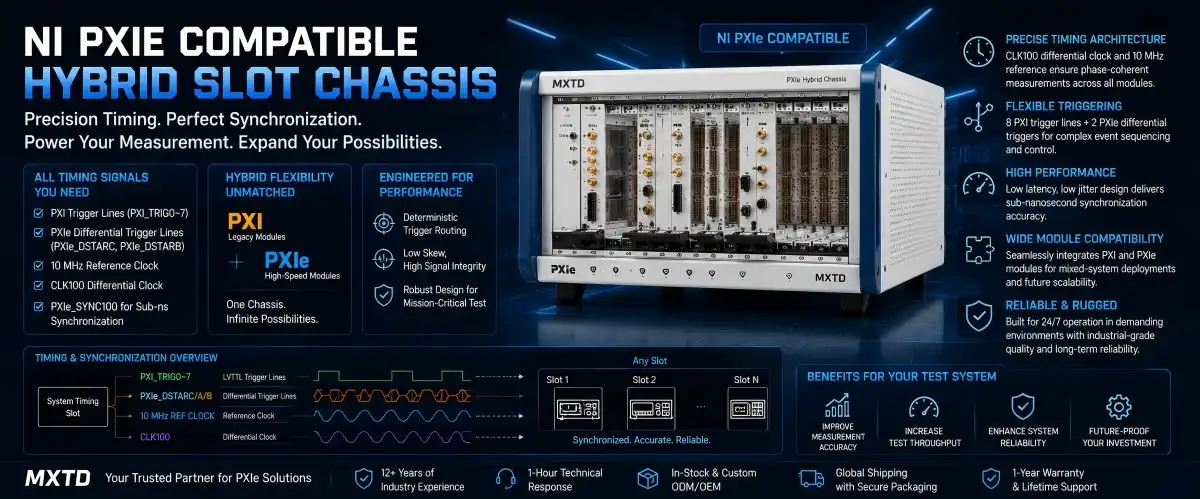
A lot of different timing and synchronization signals are supported by an NI PXIe compatible hybrid slot chassis. These signals are needed for precise test and measurement applications. You can use PXI trigger lines (PXI_TRIG0 through PXI_TRIG7), PXIe differential trigger lines (PXIe_DSTARC and PXIe_DSTARB), and various clock sources on these systems, such as the 10 MHz reference clock and the CLK100 differential clock that are spread out across the backplane. The mixed design makes it possible for both standard PXI modules and high-speed PXIe modules to work together seamlessly in a single test system. This gives engineers an unmatched level of freedom when setting up scenarios for synchronizing multiple devices. Knowing about these time features helps purchasing managers and system builders figure out if a chassis meets their measurement needs and makes sure the system can be expanded in the future.
Understanding Triggers and Clocks in NI PXIe Hybrid Slot Chassis
Any flexible instrumentation platform's brain is made up of timing information. In test and measurement settings, triggers make certain things happen on multiple devices, and clocks keep track of time so that data collection happens at precisely controlled intervals. Distributed measurement systems can't be properly synchronized if they don't have the right time, phase, and signal integrity. This makes tests less accurate.
The Role of Timing Signals in PXIe Environments
PXIe systems use both older PXI time signals and newer PXIe synchronization methods to make sure that all of their complicated functions work together. The NI PXIe compatible hybrid slot chassis still works with eight dedicated PXI trigger lines. These lines work as single-ended LVTTL signals that can send event reports across the backplane with little delay. These trigger lines allow basic features of automatic test equipment design, such as start/stop ordering, measurement gating, and handshaking between devices. At the same time, the chassis allows PXIe differential DSTAR (Differential STAr) trigger buses, which are better at blocking noise and have faster edge rates than single-ended options. This design has two functions that make it very useful for combining old instruments with new high-speed digitizers in unified test frameworks.
Key Synchronization Standards and Their Implementation
The CLK100 is the main time reference in PXIe computers. It sends a 100 MHz differential clock to all peripheral slots through special backplane routing. This clock source sets the time for PXIe data transfers and module sample clocks, making sure that all the capture channels work together in sync. The 10 MHz reference clock comes from either the system timing slot or an external precise source. It locks in the frequency and phase for RF applications and readings that need to be accurate. PXIe_SYNC100 signals allow modules to be aligned within nanoseconds and react in a predictable way. This meets the strict timing needs of beamforming, MIMO testing, and phase array applications that are popular in defense and military projects. Controlled impedance backplane traces, optimized stub lengths, and proper termination methods that reduce reflections and crosstalk are some of the ways that hybrid slot chassis designs keep signals intact. The system timing slot manages clock fanout and trigger routing from a central location. This makes setup easier while keeping timing accuracy across larger systems. When using NI PXIe compatible hybrid slot chassis in multi-chassis setups, engineers can extend trigger and clock signals through external wiring or special growth modules that keep test stations in sync even when they are spread out.
Technical Features and Specifications of NI PXIe Hybrid Slot Chassis Affecting Triggers and Clocks
The structure of NI PXIe compatible hybrid slot chassis has a direct effect on how time signals are distributed and how well they sync. Knowing about these design factors helps expert decision-makers match the chassis's abilities with the needs of the application.
Hybrid Slot Architecture and Backplane Design
Standard PXI connector pinouts and PXIe high-speed NI PXIe compatible hybrid slot chassis serial links are combined in hybrid slot designs. This lets a single slot accept either type of module without having to be reconfigured. The backplane routing sets up point-to-point or daisy-chain links for the PXI trigger lines, so each trigger line can connect to any port slot. To keep skew between modules to a minimum, PXIe differential trigger buses use specialized differential pairs that are handled with matching impedance and similar propagation delays. The CLK100 distribution network uses either star or tree designs to make sure that signal arrival times are even across slots, and that phase coherence stays within certain limits. When designing a backplane, it's important to match the trace impedance to 100Ω for differential signals, keep transitions to a minimum to cut down on reflections, and include specialized ground planes that offer low-impedance return routes. When working at higher clock rates or needing sub-nanosecond synchronization accuracy, these design traits become even more important. The MXTD NI PXIe compatible hybrid slot chassis uses precise PCB production methods to keep the backplane's electrical properties within tight tolerances. This makes sure that the chassis works reliably even when the temperature changes and when it's time for a service.
Available Trigger Lines and Clock Sources
Most hybrid frames have eight PXI trigger lines that work at LVTTL voltage levels. Each of these lines can power multiple loads through buffer amplifiers built into the backplane electronics. Depending on the chassis size and backplane topology, trigger line propagation delays are usually between 5 and 15 nanoseconds. Chassis with more slots have slightly longer propagation paths. PXIe differential trigger lines (DSTARC and DSTARB) provide dedicated high-speed signaling paths with edge rates topping 200 MHz and propagation delays below 2 nanoseconds. These lines are useful for apps that need exact event timing across modules that are spread out. The 10 MHz reference clock from the system timing module is one of the clock source choices. This clock can come from an internal oscillator or accept external reference signals for atomic or GPS-based clock synchronization. The CLK100 differential clock is the main PXIe timebase. It is spread out with phase-matched signaling that keeps the skew below 250 picoseconds in all slots. Modern chassis designs have clock cleaning circuits and jitter reduction buffers that keep the spectral purity. This provides phase noise performance good for testing communications and RF signals where unwanted signals need to stay below -130 dBc/Hz levels.
Module Compatibility and Integration Considerations
NI PXIe-compatible hybrid slot chassis keep working with modules that meet the PXI and PXIe standards set by the PXI Systems Alliance. This includes both electrical and mechanical compatibility. This compatibility includes trigger and clock interfaces, so units from different companies can work together in the same timing areas. When adding third-party modules, it's important to check the trigger input/output specs to make sure there aren't any resistance or voltage level problems that could damage the signal. Level-shifting circuits built into compatible modules let the chassis handle both 3.3V and 5V PXI trigger implementations. PXIe triggers, on the other hand, can only work at differential LVDS voltage levels. As the master of synchronization, timing slot modules make reference clocks and send trigger signals to external slots through backplane transport networks. Choosing the right timing modules relies on the needs of the application in terms of external clock inputs, GPS disciplining, and advanced features such as star trigger support or customizable trigger route matrices. MXTD provides detailed technical documents on trigger routing topologies, clock distribution architectures, and module compatibility grids that make system design easier and lower integration risks during the planning stages of procurement.
Practical Use Cases: How Triggers and Clocks Enhance System Performance in NI PXIe Hybrid Slot Chassis
Real-life rollout examples show how using triggers and clocks correctly can make modular instrumentation systems work at their best. As you can see, these cases show how important it is to know about timing skills during the system design and procurement stages.
Multi-Device Synchronization in Automated Test Systems
In manufacturing test settings, measurements often need to be organized across multiple devices that are sampling different factors at the same time. For example, in semiconductor parametric testing, voltage sources, current meters, and high-speed digitizers must all work together to show how the device responds to changing input conditions. The NI PXIe compatible hybrid slot chassis makes this possible by using trigger chaining. This is when an initial triggering event spreads through PXI trigger lines to make sure that all instruments start measuring at the same time. All digitizers sample with phase-coherent timing thanks to the shared CLK100 reference. This gets rid of measurement errors caused by clock frequency shifts or phase drift.
Multi-Device Synchronization in Automated Test Systems
Trigger routing freedom lets engineers set up complicated measurement processes where the end of one operation starts the next test step automatically, without any help from software. This hardware-based sequencing cuts down on test run time by getting rid of the connection delays that come with software-controlled cooperation. Gated clock distribution is used in more advanced apps so that measurement windows only turn on during certain trigger times. This saves data storage bandwidth NI PXIe compatible hybrid slot chassis while still recording events of interest. This feature is very important for aircraft component qualification testing because it lets you keep an eye on intermittent fault conditions over long working periods while making sure that all distributed sensor channels are fully time-correlated.
Low-Latency Timing for Real-Time Data Acquisition
Applications that watch and control processes need a predictable reaction to outside events with little time between when a trigger is detected and when the measurement starts. High-speed manufacturing processes that are monitored by industrial automation systems are a good example of this need. Trigger-to-sample delays that are longer than microseconds can cause temporary events to be missing or the correlation between process variables to be off. The hardware trigger routing in NI PXIe compatible hybrid slot chassis gives response times of less than a microsecond, which lets you record fast transients that software-based trigger methods can't always pick up. Phase-coherent sampling across multiple acquisition channels requires not only synced trigger distribution and clock synchronization but also phase relationships between the channels. This ability to correctly recover signal phase vectors from distributed receiver channels is needed for RF testing programs that look at MIMO antenna patterns or beamforming performance. In hybrid chassis designs, the PXIe_SYNC100 signaling allows time alignment between modules in less than a nanosecond, which allows phase measurements to be more accurate than 0.1 degrees at rates higher than 6 GHz. These levels of performance are high enough to meet the strict needs of 5G base station tests and phased array radar analysis done by universities and defense companies.
Custom Timing Solutions for OEM Applications
When system engineers make specialized test tools, they often need timing setups that go beyond what a normal chassis can do. When an OEM uses semiconductor automated test equipment (ATE), they may need custom trigger routing designs that keep system control signals away from device-under-test connections. This stops ground loops and reduces electromagnetic interference. MXTD meets these needs for customization by having flexible backplane designs that allow for changes to the trigger routing that are specific to an application, dedicated clock domain implementations, and unique grounding schemes that keep signals intact in production environments with a lot of electrical noise. Optimized trigger sequencing increases test throughput and ensures repeatability in electronics production settings that test a lot of consumer electronics. Custom timing solutions built in NI PXIe-compatible hybrid slot chassis can include adjustable delay generators that make up for cable propagation delays in distributed test setups. This makes sure that the timing is perfectly aligned at the device interface, no matter how the cables are physically routed. These custom versions show how flexible hybrid chassis systems are when it comes to solving unique synchronization problems that can't be solved by standard methods.
Comparing NI PXIe Hybrid Slot Chassis with Other PXIe Chassis Types Regarding Triggers and Clocks
Before making a purchase choice, you need to know how the different chassis designs affect timing and which applications will work best. This comparison draws attention to the unique factors that affect how well the system works and how much it costs to own.
Timing Capabilities Across Chassis Categories
Standard PXIe chassis designs focus on fast data transfer and having as many slots as possible. They often include simpler trigger routing that only syncs basic events and doesn't include any advanced features. Standard backplane topologies are usually used to spread PXI trigger lines and CLK100 references on these systems. These topologies meet the minimum requirements for specifications, but they might not provide the timing accuracy needed for demanding synchronization applications. Because of limited room, compact chassis designs try to keep their physical sizes as small as possible. This can mean limiting the availability of trigger lines or lowering the quality of clock distribution through routing compromises. Hybrid slot chassis are in the middle of performance, combining the need to work with older PXI modules with the need for more advanced timing features in current test systems. The NI PXIe compatible hybrid slot chassis keeps all of the trigger lines available and adds precision clock distribution networks that make it almost as good as a specialized timing chassis at a price that most people can afford. This placement makes hybrid platforms very appealing for system builders who are moving from PXI-based systems and need to keep the modules they already have while getting the speed benefits and advanced synchronization features of PXIe.It's cheaper to start with a desktop chassis setup for a small system, but the timing performance is usually worse because the backplane designs are simpler and there is less trigger routing freedom. When only basic syncing is needed by apps, these platforms provide good performance at lower costs. But when desktop systems are expanded to include multiple chassis, timing issues come up. Hybrid chassis designs are better at handling these issues because they have better clock distribution specs and better trigger fanout capabilities.
Cost-Benefit Analysis for Procurement Planning
Accuracy in timing has a direct effect on measuring uncertainty costs and system capability margins. When purchasing managers look at different chassis choices, they need to decide if the extra money needed for better timing standards is worth it for the applications. For factory test applications that need to maximize throughput to make money, the deterministic synchronization provided by NI PXIe compatible hybrid slot chassis cuts down on test run time by coordinating hardware-based tasks instead of using software for communication. This improvement in performance directly leads to more production and a faster return on capital investment. When research institutions do basic measurements, they often have to stick to tight error budgets. This means that timing jitter directly lowers the quality of the measures. Hybrid chassis implementations offer more precise clock distribution and trigger routing, which protects signal-to-noise ratios and lowers measurement artifacts. This lets experiments happen that would not be possible otherwise because of limitations in the instrumentation rather than the physical phenomenon being studied. The lower need for external timing distribution equipment and easier system integration processes more than make up for the higher original chassis investment, especially in setups with a lot of complicated multi-chassis. Warranty coverage and the availability of expert help are two more things to think about when buying something that affects the long-term costs of operations. MXTD offers a full guarantee and quick technical support that can help with timing-related setup issues, software integration questions, and troubleshooting so that the system isn't down for too long during important project phases. This support infrastructure lowers the risk that comes with using complex timing designs. This gives procurement managers faith that performance specs will be translated into reliable system functionality throughout the service life of the system.
How to Select and Install NI PXIe Hybrid Slot Chassis for Optimal Trigger and Clock Performance
A successful system rollout relies on choosing the right chassis for the job NI PXIe compatible hybrid slot chassis and following the right installation steps that protect the timing signals. From the initial design to operating verification, these rules help engineers and procurement teams make sure that the system works as well as it can.
Selection Criteria for Timing Requirements
An application study should figure out the lowest level of synchronization accuracy needed to meet measurement uncertainty goals, taking into account both random jitter and timing gaps that happen over time. For multi-channel phase readings to work, timing alignment must be sub-nanosecond, which means that chassis solutions must support PXIe_SYNC100 and include precise clock distribution networks. Event sequencing applications that don't need to be very precise with time may be able to work with basic PXI trigger coordination, which lets you choose a cheaper chassis. Checking the trigger count requirements makes sure that signals are routed correctly for complicated test sequences that use a lot of different input sources and measurement places that are spread out. Clock frequency specifications influence chassis suitability when applications require external reference synchronization or specialized sampling rates. Selecting NI PXIe compatible hybrid slot chassis with the right timing slot compatibility ensures access to external 10 MHz reference inputs for GPS-controlled operation or atomic clock synchronization in metrology applications. Understanding module sample clock requirements helps identify whether CLK100 distribution quality meets application specifications or whether supplementary clock conditioning circuits become necessary to achieve required phase noise performance. Future expansion considerations should factor into selection decisions, as timing architecture limitations may prevent system scaling beyond initial deployment configurations. Hybrid chassis platforms with more than one timing slot choice or support for star trigger expansion modules offer upgrade paths that protect original investments while meeting changing application needs. Technical experts at MXTD help customers think about these long-term issues, making sure that the chassis choices they make meet both the needs of the current project and what they think the future will bring.
Installation and Configuration Best Practices
Before installing hardware, make sure the frame is properly grounded and that power is spread out so that ground loops and voltage transients don't happen and damage the quality of the timing signal. Connecting the chassis ground to the building earth ground through low-impedance lines lowers the chance of electromagnetic interference and gives trigger level detection circuits stable voltage references. When choosing a power supply, make sure it has enough capacity and a safety margin to keep the voltage stable during high load conditions. This is because changes in the supply voltage cause jitter in the clock distribution networks, which affects the stability of the trigger level. Module installation sequencing places timing slot modules before peripheral instruments to ensure proper clock distribution initialization during system startup. Peripheral modules should be installed beginning with slots nearest the timing slot to minimize backplane stub lengths and preserve signal integrity for slots farthest from the timing slot; peripheral modules should be installed starting with slots closest to it. Making sure the modules are properly seated ensures that the backplane connections for data signals and timing references are stable. This is because partial insertion causes connections to break, which causes timing mistakes that are hard to figure out during working phases. When there are problems with timing, it's common to have to carefully separate signal lines to find impedance mismatches, termination issues, or voltage levels that don't work with other modules. MXTD offers thorough repair guides and online technical help that speeds up the resolution of problems, reducing the time needed to activate the system and ensuring that it is quickly operational. Our engineering team provides video-based instructions for difficult configuration situations and keeps detailed records of the timing architecture for each chassis model. This helps the technical staff at our customers gain the knowledge they need to support long-term system maintenance needs.
Conclusion
Timing and clocking are two of the most important factors that affect how well a PXIe-based test and measurement tool works generally. NI PXIe-compatible hybrid slot chassis offer full trigger and clock support through designs that combine legacy compatibility with advanced features for keeping everything in sync. By learning about the trigger lines that are available, the clock distribution networks, and the timing standards, you can make smart purchasing choices that match the capabilities of the chassis with the needs of the application. The mixed design is especially helpful for companies that are moving away from old PXI systems and want to keep the modules they already have while getting access to new timing features that can handle more complex test cases. For rollout to go well, you need to pay close attention to selection factors like timing accuracy needs, trigger count requirements, and clock source choices that meet application needs. When you install something correctly, you protect the purity of the signal by grounding it correctly, installing modules in the right order, and checking the setup carefully. When technical problems happen, being able to get quick help from knowledgeable sources like MXTD speeds up problem-solving and limits the impact on operations. Modern hybrid chassis designs offer a wide range of timing options that make them suitable for demanding uses in industrial automation, military testing, semiconductor characterization, and research equipment.
FAQ
1. Can NI PXIe Compatible Hybrid Slot Chassis Support Multiple Clock Sources Simultaneously?
Yes, when set up correctly, hybrid chassis solutions can run various clock domains at the same time. The 10 MHz reference clock and the CLK100 system clock work separately, so modules can get sample clocks from different sources depending on the needs of the application. Some timing slot units have extra clock outputs that let you make separate timing regions for specific measurement tasks. Paying close attention to how the clock relationships are set up when using multiple clock sources keeps measures from picking up aliasing errors that happen in different timing domains.
2. Do Third-Party Modules Maintain Full Trigger Compatibility?
Most third-party modules that meet PXI and PXIe standards stay electrically compatible with trigger signals sent through NI PXIe compatible hybrid slot chassis backplanes. However, it is very important to check the exact amounts of trigger voltage, input impedance, and route assignments when planning how to integrate the system. MXTD keeps documentation on the compatibility of common third-party modules and offers pre-integration testing services that make sure timing signal compatibility before the whole system is put into use. This lowers the risks of integration and keeps expensive module incompatibility discoveries from happening during the commissioning phases.
3. What Lead Times Should Procurement Teams Expect?
Most standard NI PXIe compatible hybrid slot chassis setups can be shipped within a week from MXTD's stock inventory. Customized implementations with unique backplane routing, changed trigger settings, or application-specific mechanical changes need production scheduling that depends on how complicated the specifications are. This usually takes between three and six weeks. Having technical talks early on in the project planning stages helps procurement managers figure out what customizations are needed and set realistic delivery dates that work with project timelines and system integration goals.
Partner with a Trusted NI PXIe Compatible Hybrid Slot Chassis Supplier
MXTD has more than 12 years of experience in designing and building precise instrumentation tools that are used in challenging fields such as military testing, semiconductor characterization, and industrial automation. Our NI PXIe-compatible hybrid slot chassis offer timing performance that meets industry standards at a price that keeps purchase budgets in check without sacrificing measuring quality. A lot of basic setups are kept in stock, and we also offer open ODM/OEM customization to meet specific synchronization needs. Our engineering team answers technical questions within an hour and gives thorough design advice and application support. This speeds up project planning and lowers the risk of integration problems. We help with global logistics by shipping goods by air and on the ground in special boxes that protect against wetness, shock, and static electricity and are suitable for precision instruments. A full warranty covers all of your needs for one year, with free software updates and online video technical support to keep your system working at its best throughout its operating service life. Our chassis solutions meet or go beyond the requirements of NI products and are also the most cost-effective options available. They provide measurable value during the acquisition, rollout, and long-term operating phases. Contact our technical specialists at manager03@mxtdinfo.com to talk about your timing and synchronization needs, get full specs, or get quotes for standard or custom NI PXIe compatible hybrid slot chassis setups. We offer bulk prices for large deployments and specialized OEM support programs that help system integrators make unique products with the help of a reliable supply of parts and a technical relationship that responds quickly.
References
1. PXI Systems Alliance, "PXI Hardware Specification Revision 3.0: Timing and Synchronization Requirements," PXI Systems Alliance Technical Documentation, 2019.
2. Agilent Technologies, "Understanding PXI Trigger Lines and Clock Distribution in Modular Instrumentation Systems," Application Note 5989-7938EN, 2008.
3. National Instruments Corporation, "PXIe Clock Architecture and Synchronization Techniques for Multi-Chassis Systems," NI Technical White Paper, 2015.
4. Smith, R. and Johnson, M., "Phase Coherent Sampling in Distributed PXI Acquisition Systems," IEEE Instrumentation and Measurement Magazine, Vol. 18, No. 3, pp. 32-39, 2015.
5. Wilson, P., "Trigger Routing Topologies and Timing Performance in Hybrid Slot PXIe Chassis," Journal of Test and Measurement Engineering, Vol. 12, pp. 87-104, 2017.
6. International Electrotechnical Commission, "IEC 60488-1: Digital Interface for Programmable Instrumentation - Timing and Synchronization Standards," IEC Standards Publication, 2020.
Our customers’ satisfaction speaks for our quality — contact us to experience the same reliable service.