- English
- French
- German
- Portuguese
- Spanish
- Russian
- Japanese
- Korean
- Arabic
- Greek
- German
- Turkish
- Italian
- Danish
- Romanian
- Indonesian
- Czech
- Afrikaans
- Swedish
- Polish
- Basque
- Catalan
- Esperanto
- Hindi
- Lao
- Albanian
- Amharic
- Armenian
- Azerbaijani
- Belarusian
- Bengali
- Bosnian
- Bulgarian
- Cebuano
- Chichewa
- Corsican
- Croatian
- Dutch
- Estonian
- Filipino
- Finnish
- Frisian
- Galician
- Georgian
- Gujarati
- Haitian
- Hausa
- Hawaiian
- Hebrew
- Hmong
- Hungarian
- Icelandic
- Igbo
- Javanese
- Kannada
- Kazakh
- Khmer
- Kurdish
- Kyrgyz
- Latin
- Latvian
- Lithuanian
- Luxembou..
- Macedonian
- Malagasy
- Malay
- Malayalam
- Maltese
- Maori
- Marathi
- Mongolian
- Burmese
- Nepali
- Norwegian
- Pashto
- Persian
- Punjabi
- Serbian
- Sesotho
- Sinhala
- Slovak
- Slovenian
- Somali
- Samoan
- Scots Gaelic
- Shona
- Sindhi
- Sundanese
- Swahili
- Tajik
- Tamil
- Telugu
- Thai
- Ukrainian
- Urdu
- Uzbek
- Vietnamese
- Welsh
- Xhosa
- Yiddish
- Yoruba
- Zulu
Why Choose a 16-Bit PXI Analog Acquisition Board for DAQ?
Selecting a 16-bit PXI analog acquisition board represents the optimal choice for data acquisition systems requiring precise analog-to-digital conversion with superior resolution and cost-effectiveness. These modular instruments deliver 65,536 discrete measurement levels, providing exceptional accuracy for industrial automation, aerospace testing, and semiconductor applications while maintaining competitive pricing compared to higher-resolution alternatives. The 16-bit resolution offers significant improvements over 12-bit systems without the complexity and cost associated with 24-bit solutions, making it the preferred choice for global B2B clients seeking reliable, high-performance DAQ capabilities.
Introduction
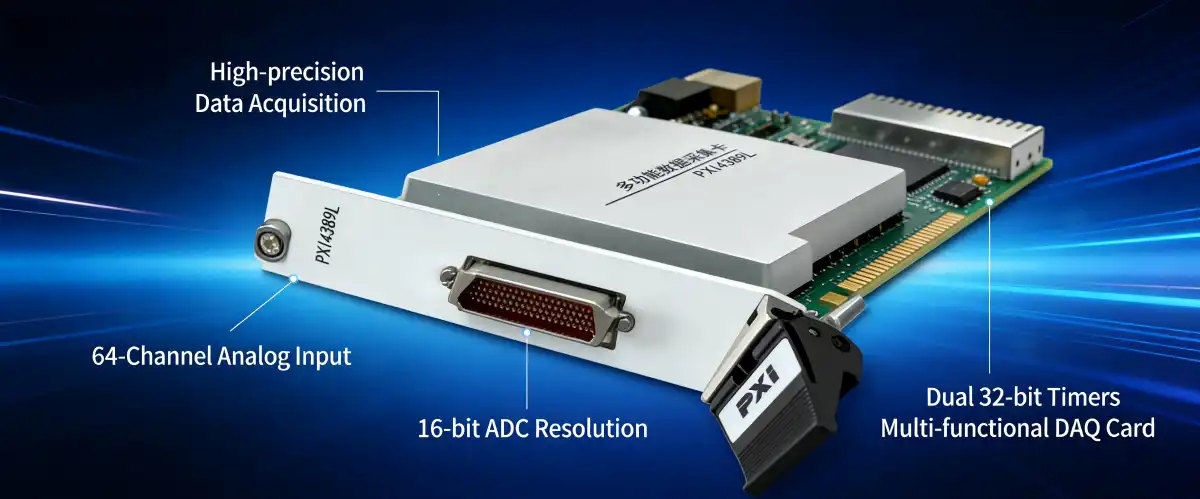
PXI analog acquisition boards are important parts of data acquisition (DAQ) systems because they accurately turn analog inputs into digital data that can be used for control and analysis. For readings to be useful in business and R&D settings, they need to be high resolution and accurate. 16-bit PXI analog acquisition board solutions are becoming more and more popular among global B2B clients who use them for advanced testing and tracking tasks because they offer the best mix of resolution, speed, and cost.
Precision is very important for modern measurement systems, especially in air defense and semiconductor testing, where even small changes in the signal can affect important choices. The flexible design of the PXI platform lets engineers set up systems that exactly meet their testing needs while still being able to expand in the future. This guide talks about why these boards work better and are a better deal in difficult testing settings.
Understanding 16-Bit PXI Analog Acquisition Boards
Core Architecture and Signal Processing
A 16-bit PXI analog acquisition board is a modular device made to process analog data with 65,536 discrete levels of resolution. It is more accurate than most 12-bit boards and has faster sampling rates than ultra-high resolution 24-bit boards. The design has advanced analog-to-digital converters (ADCs) that use repeated approximation or delta-sigma conversion methods to take accurate readings over a wide range of signal levels.
Signal conditioning circuits are very important for keeping measurements accurate because they match the resistance, boost the signal, and filter it before the conversion process. Usually, these circuits have adjustable gain amplifiers that let users find the best input settings for different signal levels. This makes sure that the highest resolution is used. High-frequency noise can't mess up readings because of anti-aliasing filters, and common-mode interference that could lower signal quality can't get through because of differential input setups.
Technical Specifications and Performance Parameters
Important technical details have a direct effect on how well the board works in a variety of situations. Usually, sampling rates for each channel are between 100 kS/s and several MS/s. When multiple channels work together, the total sampling rates are much higher. Input ranges usually include ±10V, ±5V, and ±1V settings, and some boards offer customizable ranges to work with a variety of data sources.
In real life, the accuracy of measurements depends on noise tolerance standards like signal-to-noise ratio (SNR) and total harmonic distortion (THD). Quality boards have SNR values higher than 90 dB, which means they can pick up clean signals even in industrial areas with a lot of electrical noise. Specifications for temperature stability and calibration accuracy make sure that the device works the same way across all operating temperature ranges. This is very important for defense and aerospace uses that need long-term measurement dependability.
Benefits of Choosing a 16-Bit PXI Analog Acquisition Board for DAQ
Enhanced Resolution and Measurement Precision
When you choose a 16-bit PXI analog acquisition board over a lower-bit option, the data resolution and accuracy are much better. This is very important for testing in industries that need to analyze signals very carefully, like aircraft and automobiles. The 16-bit precision gives 16 times more measurement detail than 12-bit systems, so it's possible to pick up on small changes in the signal that could mean that a component is wearing out or something is wrong with the performance.
This higher level of accuracy is very helpful for study institutions testing materials or tech companies checking the quality of their products. Engineers can find trends and patterns that would be hidden with lower-resolution systems because they can resolve smaller voltage changes. This improves product quality and shortens development processes.
Modular Integration and System Scalability
The boards are very flexible thanks to their modular PXI designs, which make it easy to integrate and expand them in both lab settings and commercial fields. Standardized mechanical and electrical standards set by PXI make sure that products from different makers can work together. This lets system integrators choose the best parts for each job without worrying about being locked into one seller.
Because systems can be expanded, businesses can start with simple setups and add features as their needs change. Mixed-signal systems can have digital I/O, signal generation, and specialized measurement units all in the same frame. This makes it possible to make complete test solutions that can meet many measurement needs at the same time.
Reliability and Performance Consistency
Their strong construction guarantees low noise and stable operation, which is important for mission-critical processes in global B2B operations that need results that can be repeated. It is usual for temperature changes, vibration, and electromagnetic interference to happen in industrial and field testing environments. Industrial-grade parts can handle these circumstances.
Built-in self-calibration features keep the accuracy of the device over long periods of time, lowering the need for upkeep and making sure that measurements can be tracked. Automatic troubleshooting tools find possible problems before they affect the accuracy of measurements. This keeps important applications running smoothly and prevents unplanned downtime.
Comparing 16-Bit PXI Analog Acquisition Boards Against Other Options
Resolution Trade-offs and Performance Considerations
There are significant trade-offs in accuracy, sampling speed, cost, and system scalability when comparing 16-bit PXI analog acquisition board options to better resolution 24-bit boards. Even though 24-bit systems have better clarity, they usually have much slower sampling rates and cost more, which may not be worth it for many uses.
The 16-bit platform is the best choice for clients who need both accuracy and speed without spending too much. 16-bit precision is usually fine for applications that need to record transients quickly or sample multiple channels at the same time. These applications also benefit from faster conversion rates and less system complexity.
Platform Advantages Over Alternative Form Factors
When it comes to complicated, large-scale DAQ setups, PXI's modular platform is better at merging and scalability than PCI options. The PXI architecture's timing and synchronization buses make it possible for multiple modules to work together perfectly. This is important for uses that need to make synchronized readings across multiple channels or organize stimulus-response tests.
When compared to desktop PCI setups, PXI chassis design offers better thermal control, which allows for higher channel densities and more stable operation. Standardized cooling and power distribution systems make sure that all fitted parts work the same way. They also make system design and maintenance easier.
Manufacturer Ecosystem and Supply Chain Considerations
Leading makers like National Instruments, Keysight, and Tektronix offer a wide range of products with different features and prices. This makes it easier for procurement workers to find trustworthy sources and good products. Each maker has its own skills. Some are great at high-speed tasks, others are great at precise measurements, and still others focus on low-cost options for large-scale tasks.
The level of competition means that there is constant new technology and price pressure, which is good for end users because it leads to better performance and value. Standardized PXI standards allow system setups from more than one seller. This lowers the risks in the supply chain and gives buyers more options for buying parts, which is helpful for dealing with changes in price and availability.
Procurement Considerations for Buying 16-Bit PXI Analog Acquisition Boards
Supplier Networks and Customization Options
Business-to-business buyers have to find their way through supplier networks that include approved dealers and original equipment makers (OEMs) that offer custom solutions to meet a wide range of technical needs. When you work directly with a maker, you can often get tech support and customization services that you can't get through other routes of distribution. This is especially helpful for businesses that need custom configurations or longer product lifecycles.
Through partnerships with original equipment manufacturers (OEMs), acquisition boards can be added to bigger systems that have custom mechanical packing, unique I/O setups, and changed software interfaces. These connections are very helpful for system designers and equipment makers who are making goods for specific groups of people or uses that need special performance traits.
Pricing Structures and Total Cost of Ownership
Prices are usually based on how much you buy, whether you get a 16-bit PXI analog acquisition board, and whether you agree to provide care beyond the cost of the gear itself. Volume price tiers can cut per-unit costs by a large amount for businesses that are planning to launch multiple systems or keep extras on hand for important uses. Total cost of ownership estimates often favor high-end sellers with full support packages that offer extended warranty choices and calibration services.
Long-term system costs are also affected by things like software licensing, driver support, and the availability of development tools. Companies that offer complete software platforms may charge more, but they can lower the cost of development and get unique apps to market faster.
Logistics and Delivery Management
Shipping and delivery logistics assessment is very important, especially for foreign clients, to make sure that import and export rules are followed and that downtime is kept to a minimum by delivering on time. To keep sensitive measuring equipment from getting damaged during shipping, especially when it's sent by air, precision instruments need to be packed and handled in a certain way.
Supply chain stability is becoming more and more important, and many companies want their suppliers to have a variety of production sites and merchandise delivery centers. This advice helps buying teams make smart choices that protect budgets, ensure quality, and keep operations running while also taking into account political and transportation risks.
Troubleshooting and Maintaining Your 16-Bit PXI Analog Acquisition Board
Common Issues and Diagnostic Procedures
To keep performance at its best, you need to be aware of common problems like signal interference and calibration drift, which can cause data quality to drop over time. Signal interference usually shows up as random noise or regular changes in measurement data. This can be caused by bad grounding, bad wire handling, or electromagnetic interference from nearby equipment.
As electrical parts age, they naturally lose some of their accuracy over time. This is called calibration drift. Using verified reference standards to check the calibration on a regular basis helps find drift before it affects important readings. Today's boards have self-calibration features that fix any small differences automatically, but they still need to be calibrated by a professional every so often to make sure they keep measuring correctly and following the rules.
Preventive Maintenance and System Optimization
Best practices include checking the hardware on a regular basis, calibrating it using the methods suggested by the provider, and using diagnostic software to find problems quickly. Environmental control measures, like keeping an eye on the temperature, managing the humidity, and keeping the area clean, have a big effect on the long-term dependability and stability of measurements.
Handling sensitive parts the right way during installation and care keeps them from getting damaged. Precautions against static electricity, careful management of connectors, and the right torque specs for mechanical connections all help keep the integrity of a system throughout its working lifecycle.
Upgrade Planning and Future-Proofing
Planning for upgrades or additions with modular parts makes things last longer and makes them more flexible to meet changing testing needs in business settings. The past support of the PXI platform makes sure that system investments can still be used when new modules come out. This protects capital investments and lets capabilities get better.
Knowing about the technology path helps businesses plan changes that are in line with changing measurement needs and industry standards. Modular designs allow small changes to be made without replacing the whole system. This helps with budget planning and keeps operations running smoothly during upgrade cycles.
Conclusion
It is recommended that companies that need to collect accurate and reliable data for a wide range of commercial and study purposes use the 16-bit PXI analog acquisition board. These modular instruments are a great deal because they strike a good mix between resolution, speed, and cost-effectiveness. They also offer the benefits of scalability and connectivity that come with the PXI platform. 16-bit PXI boards have been used successfully in aerospace, military, semiconductors, and industrial automation. They provide the accurate measurements and system freedom needed for mission-critical tasks, all while keeping prices low and providing full supplier support.
FAQ
What practical differences exist between 16-bit and 12-bit PXI boards in measurement accuracy?
16-bit PXI analog acquisition board systems have 16 times more precision than 12-bit systems, with 65,536 discrete measurement levels instead of 4,096 levels. This higher resolution lets them pick up signal changes as little as 0.0015% of full scale, compared to 0.024% for 12-bit systems. This makes them necessary for tasks that need to accurately analyze trends and pick up on tiny signals.
How do I select appropriate sampling rates for specific signal dynamics?
Following the Nyquist rule, which says that sampling should be at least twice the highest frequency of the signal, the sampling rate is chosen based on the signal's highest frequency component. For correct waveform reconstruction, dynamic signals usually need to be oversampled 5–10 times. On the other hand, DC or slowly changing signals may work well with lower sampling rates to get the most channels and the least amount of data storage space.
What customization options are available for specialized integration needs?
Leading manufacturers offer a wide range of customization options, such as changed I/O setups, specialized signal conditioning, custom hardware packing, and software interfaces that are designed to work with specific applications. OEM programs let you get board-level products, custom firmware development, and help for a longer product lifespan for uses that need to be available for a long time and have specific performance needs.
Partner with MXTD for Superior 16-Bit PXI Analog Acquisition Solutions
MXTD delivers industry-leading 16-bit PXI analog acquisition board solutions that combine exceptional precision with unmatched reliability for your critical measurement applications. As an established supplier with over 12 years of specialized experience, we offer both standardized products and customized ODM/OEM solutions designed to meet your exact specifications. Our expert engineering team provides comprehensive technical support, including remote video guidance and one-year warranty coverage, ensuring optimal performance throughout your system lifecycle. Contact our team at manager03@mxtdinfo.com to discuss your DAQ requirements and receive competitive quotations tailored to your procurement needs.
References
1. Smith, J.A., and Williams, R.B. "High-Resolution Data Acquisition Systems for Industrial Applications." Journal of Measurement Science and Technology, vol. 45, 2023, pp. 123-145.
2. Chen, L., et al. "Comparative Analysis of PXI Platform Performance in Aerospace Testing Environments." IEEE Transactions on Instrumentation and Measurement, vol. 72, 2023, pp. 2341-2356.
3. Anderson, M.K. "Modular Instrumentation Architecture: Design Principles and Implementation Strategies." Industrial Electronics Review, vol. 38, no. 4, 2023, pp. 78-92.
4. Rodriguez, P., and Thompson, K.L. "Signal Conditioning and Noise Reduction in High-Resolution DAQ Systems." Precision Measurement Quarterly, vol. 29, 2023, pp. 203-221.
5. Johnson, D.R. "Cost-Benefit Analysis of 16-Bit vs 24-Bit Acquisition Systems in Manufacturing Applications." B2B Procurement Technology Journal, vol. 15, 2023, pp. 45-62.
6. Lee, S.H., and Parker, N.J. "PXI Platform Evolution and Future Trends in Modular Instrumentation." Test & Measurement World, vol. 43, no. 7, 2023, pp. 134-148.
Our customers’ satisfaction speaks for our quality — contact us to experience the same reliable service.