- English
- French
- German
- Portuguese
- Spanish
- Russian
- Japanese
- Korean
- Arabic
- Greek
- German
- Turkish
- Italian
- Danish
- Romanian
- Indonesian
- Czech
- Afrikaans
- Swedish
- Polish
- Basque
- Catalan
- Esperanto
- Hindi
- Lao
- Albanian
- Amharic
- Armenian
- Azerbaijani
- Belarusian
- Bengali
- Bosnian
- Bulgarian
- Cebuano
- Chichewa
- Corsican
- Croatian
- Dutch
- Estonian
- Filipino
- Finnish
- Frisian
- Galician
- Georgian
- Gujarati
- Haitian
- Hausa
- Hawaiian
- Hebrew
- Hmong
- Hungarian
- Icelandic
- Igbo
- Javanese
- Kannada
- Kazakh
- Khmer
- Kurdish
- Kyrgyz
- Latin
- Latvian
- Lithuanian
- Luxembou..
- Macedonian
- Malagasy
- Malay
- Malayalam
- Maltese
- Maori
- Marathi
- Mongolian
- Burmese
- Nepali
- Norwegian
- Pashto
- Persian
- Punjabi
- Serbian
- Sesotho
- Sinhala
- Slovak
- Slovenian
- Somali
- Samoan
- Scots Gaelic
- Shona
- Sindhi
- Sundanese
- Swahili
- Tajik
- Tamil
- Telugu
- Thai
- Ukrainian
- Urdu
- Uzbek
- Vietnamese
- Welsh
- Xhosa
- Yiddish
- Yoruba
- Zulu
How to Select the Right PXI Embedded System Controller for Your System?
To choose the best PXI Embedded System Controller, you need to think about the processing needs of your program, the surroundings, and the interaction needs. First, look at the main specs, such as the CPU's speed, memory size, and the variety of I/O options. Match these technical specs to the practical needs of your system, whether it's for flight testing, chip validation, or industrial automation, and make sure they work with current hardware and software frameworks. To get long-term system security and the best testing efficiency, you should look for controls that come with strong seller support, can be customised easily, and have a history of reliability in your industry.
Understanding PXI Embedded System Controllers: Basics and Benefits
What Defines a PXI Controller Architecture
A PXI Embedded System Controller is the main device in modular monitoring systems. It runs test routines and makes sure that data collection works smoothly across all measurement modules. Standard computer parts like processors, memory, and storage are combined with special PXI bus connections that allow for reliable communication and precise time synchronisation in these controls. The design follows the rules set by PCI Extensions for Instrumentation. This makes sure that products from different manufacturers can work together. It also keeps normal PCI protocols compatible.
Core Components Driving Controller Performance
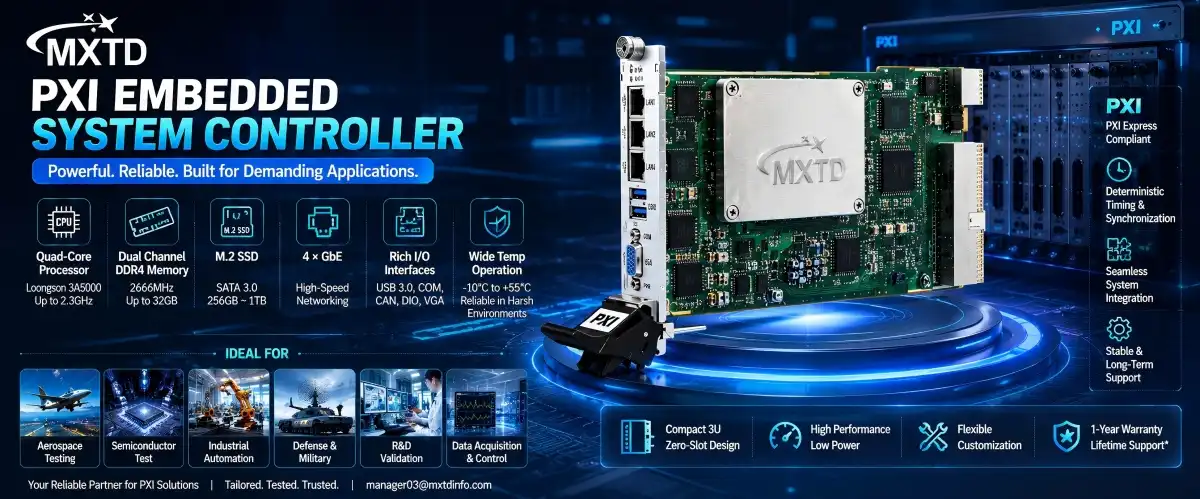
The processing power of a PXI Embedded System Controller tells you how fast your system can run complicated programs, look at measurement data, and handle multiple tasks at once. Multi-core processors are used in modern systems. Dual-core processors are good for basic data logging, while quad-core processors can handle complex signal processing. Memory design is also important. Dual-channel DDR4 setups at 2666MHz provide the bandwidth needed for high-speed data streaming tasks that are widespread in testing semiconductors and characterising RF.
M.2 solid-state drives used in storage devices provide the fast access times needed to run big test programs and log large datasets. Most controllers with SATA protocol M.2 ports can store between 256GB and 1TB of data, which is more than enough for most commercial uses. Connectivity choices determine how flexible an integration is. For example, multiple Gigabit Ethernet ports allow for spread testing designs, and USB 3.0 interfaces let you connect peripherals and send and receive data quickly.
Critical Selection Criteria for PXI Embedded System Controllers
Matching Processor Capabilities to Application Demands
The CPU in your device needs to be able to handle the work without slowing down the system. Multi-core computers with strong floating-point speed are needed for real-time signal analysis, closed-loop control, or handling multiple channels at the same time. The Loongson 3A5000 quad-core processor, which is often used in industrial control systems, is an example of a processor that balances power economy with processing speed. This design allows for parallel processing, which is needed to control sensor networks that are spread out or run complicated test routines on many instruments at the same time.
Processing requirements vary significantly across industries. Semiconductor parametric testing may demand intensive mathematical operations for yield analysis, while aerospace systems prioritize deterministic execution for safety-critical measurements. Evaluate your most demanding test scenarios—calculate expected data rates, algorithm complexity, and concurrent task counts—to determine minimum processor specifications that maintain acceptable execution speeds during peak loads.
Environmental Resilience and Physical Integration
Operating temperature specifications directly constrain where you can deploy equipment. Controllers rated for -10℃ to +55℃ operate reliably in manufacturing floors lacking climate control or outdoor test facilities, subject to seasonal variations. Compare these ratings against your actual installation environment, including ventilation availability and ambient heat sources from adjacent equipment. Storage temperature ranges matter less for permanently installed systems but prove critical for portable test platforms or equipment requiring field deployment.
Physical dimensions and mounting standards determine chassis compatibility. Standard 3U PXI modules occupy three slots in a compliant chassis, leaving the remaining slots available for measurement cards and communication interfaces. Verify slot count requirements early in system design—underestimating physical space needs forces costly chassis upgrades or system reconfigurations. The mechanical form factor also affects thermal dissipation; controllers designed for convection cooling simplify installation but may require additional slot spacing for adequate airflow in densely packed configurations.
Comparing PXI Embedded System Controllers: Making an Informed Decision
Architecture Comparison: PXI Versus Alternative Standards
PXI controllers like the PXI Embedded System Controller dominate modern test applications due to their combination of computational performance, standardized interfaces, and vendor ecosystem maturity. The architecture evolved from CompactPCI but incorporates timing and synchronization capabilities specifically designed for instrumentation applications. Compared to older VXI systems, PXI delivers approximately ten times higher bandwidth through improved bus architectures while occupying significantly less rack space. This density advantage translates directly to capital cost savings in facilities where floor space commands premium pricing.
CompactPCI systems are still better for some tough military uses that need special weather ratings, but most of the measurement and automation ecosystem has moved to PXI platforms. PXI's wider range of instruments cuts down on the need for custom development and speeds up system interaction. It's important to think about whether specialised skills make it worth going against the PXI norm. In most industrial, aircraft, and electronics testing cases, PXI's speed, availability, and support infrastructure are better than those of other systems.
Evaluating Leading Controller Solutions
National Instruments created the PXI standard and has the most installations. They offer a wide range of software tools and detailed documents that make creation easier. Their controls work well with LabVIEW code environments, which speeds up test automation for companies that already use NI platforms. Keysight Technologies uses measurement skills from its old equipment business to make controls that work best in RF and high-frequency settings, where signal purity and time accuracy are very important.
Brand-new companies like MXTD offer cheaper options compared to well-known ones, and they also let you customise their products, which bigger companies usually don't do. Using a Loongson 3A5000 quad-core processor, the PXI4806L controller is a good example of this method. It has performance similar to standard controllers, allows for easy customisation, and has reasonable prices. This model has four Gigabit Ethernet ports, dual-channel DDR4 memory that can be expanded to 32GB, and a full set of serial interfaces, including separated CAN channels. These features meet or go beyond what is needed for most industrial automation and testing tasks.
How to Procure Your PXI Embedded System Controller Efficiently
Sourcing Strategies and Supplier Verification
Authorised distribution outlets make sure that the product is real and that the manufacturer's guarantee covers it. They also give customers access to technical help resources. When looking at possible providers, make sure they are authorised by the makers directly. Unauthorised resellers may offer good deals, but they can't promise real products or keep their insurance promises. In defence and aircraft uses, where fake parts can be dangerous and make it hard to follow the rules, this proof is even more important.
Supplier technical competence influences project success beyond simple product delivery. Distributors employing applications engineers familiar with your industry can recommend optimal configurations, identify compatibility issues early, and suggest cost-effective alternatives meeting specifications. MXTD's commitment to responding within one hour to customer inquiries exemplifies the responsiveness that differentiates capable suppliers from mere product brokers. This rapid engagement accelerates quotation cycles and reduces the ambiguity that delays procurement decisions in complex system designs.
Lead Time Management and Logistics Considerations
Standard product availability for a PXI Embedded System Controller determines project schedule feasibility. Controllers stocked in regional warehouses ship within days, while custom configurations may require weeks or months, depending on design complexity and component sourcing. Establish realistic timelines by requesting detailed production schedules rather than accepting generic lead time estimates. This transparency allows aligning controller procurement with chassis delivery, measurement module availability, and software development milestones to avoid partial system inventories consuming working capital without productive use.
Transportation methods balance cost against urgency and fragility considerations. Air freight delivers within days for time-critical projects but costs substantially more than ocean shipping for international orders. Precision electronic equipment requires protective packaging incorporating moisture barriers, shock absorption, and anti-static materials to prevent damage during transit. Reputable suppliers employ packaging engineered specifically for test instrumentation—foam inserts custom-cut for each product model, humidity indicator cards monitoring environmental exposure, and ruggedized outer containers withstanding commercial shipping handling. Verify these protections explicitly rather than assuming adequate packaging, particularly when procuring from unfamiliar sources.
Negotiation Tactics and Value-Added Services
Volume procurement creates opportunities for preferential pricing and enhanced support terms. When planning multi-unit purchases or establishing long-term supply relationships, request volume discount schedules and negotiate extended warranty periods as part of package agreements. Suppliers often provide concessions on unit pricing in exchange for committed purchase quantities or exclusive supplier designations that simplify their sales forecasting and inventory planning.
Value-added services include more than just supplying products. They also include help with installation, checking the setup, and fixing problems with integration. Remote video coaching lets hiring teams fix setup problems without having to pay for expensive on-site service calls. Software upgrade promises make sure that users can get driver updates and security patches for as long as the system is in use. When putting in place multiple systems in different buildings or when internal technical staff don't have the right PXI platform knowledge, these services come in very handy. You should negotiate these terms when you're first buying the system instead of buying them separately later. Bundled service agreements usually cost less and make it clear who is responsible for all of the system's functions.
Conclusion
To choose the right embedded processor, you have to weigh the technical needs against the available budget while also making sure that the seller will be reliable in the long run. To do a good job of buying, you must first fully understand the computing needs, weather conditions, and interface requirements of your application. When these needs are matched with the controller's specs, like processor capabilities, I/O flexibility, and working temperature ranges, the system can work reliably. It's also important to look at how skilled the provider is, how flexible they are with customisation, and how quickly they respond to help requests. These are all things that affect whether problems turn into small delays or project-threatening problems. The MXTD PXI4806L shows how current controllers can provide strong performance with four-core processing, a wide range of connecting options, such as separate CAN ports, and industrial-grade temperature ratings that are good for tough uses. Strategic buying that uses volume discounts, value-added services, and careful compatibility checks to get the best deal and lower the risk of integration in your automated testing infrastructure.
FAQ
1. What processor specifications should I prioritize when selecting a controller?
Multi-core processors handle parallel operations essential for modern test applications. Quad-core configurations like the Loongson 3A5000 provide adequate performance for most industrial automation and measurement scenarios, supporting simultaneous data acquisition, real-time analysis, and system management tasks. Clock speed matters less than core count for test applications involving distributed processing across multiple instruments. Evaluate your most computationally intensive operations—signal processing algorithms, statistical analysis routines, or closed-loop control calculations—to determine minimum processor requirements, maintaining acceptable execution speeds during peak system loads.
2. How do I verify software compatibility before purchasing?
Contact the controller manufacturer to confirm driver availability for your specific operating system version and measurement hardware. Request documentation listing supported instrument types, communication protocols, and development environments. Testing compatibility using evaluation units or demo systems minimizes risk when deploying unfamiliar controller platforms. Manufacturers offering trial periods or demonstration programs allow validating complete software toolchains before committing to volume purchases, particularly valuable when migrating from legacy systems or adopting new development frameworks.
3. Can controllers be customized for specialized industrial applications?
Many manufacturers provide OEM and ODM customization services, modifying standard designs to meet unique requirements. Customization options include adding specialized communication interfaces, adjusting connector configurations, extending temperature ratings, or incorporating proprietary firmware. MXTD supports tailored solutions addressing specific industrial needs while maintaining compatibility with standard PXI chassis and measurement modules. Discuss customization requirements early in procurement planning to understand feasibility, cost implications, and timeline impacts on overall project schedules.
Partner with MXTD for Your PXI Embedded System Controller Needs
MXTD brings over 12 years of specialized expertise in designing and manufacturing high-reliability test instrumentation for demanding industrial applications. Our PXI4806L Embedded Zero-Slot Controller exemplifies our commitment to delivering cost-effective solutions benchmarked against industry-leading platforms while offering the customization flexibility that large-scale projects require. As an experienced PXI Embedded System Controller manufacturer, we maintain a ready inventory of standard configurations shipping within days, while our engineering team rapidly develops custom variants matching your precise specifications. Our comprehensive support infrastructure includes remote video technical guidance, complimentary software upgrades, and standard one-year warranties with flexible extension options tailored to long-term deployment requirements. Testing and measurement professionals at system integrators, R&D centers, and OEM manufacturers trust MXTD for solutions combining proven reliability with responsive technical partnership. Contact our team at manager03@mxtdinfo.com to discuss how our controllers optimize your automated testing infrastructure to explore our complete portfolio of PXI chassis, measurement modules, and precision connectivity solutions engineered for aerospace, semiconductor, and industrial automation applications.
References
1. National Instruments Corporation. "PXI Express Hardware Specification." PXI Systems Alliance Technical Documentation, Revision 3.0, 2019.
2. Stackpole, B. and Patrick, J. "Modern Test System Architectures for Aerospace and Defense Applications." IEEE Instrumentation & Measurement Magazine, vol. 23, no. 4, pp. 45-52, 2020.
3. Zhang, L. and Kumar, A. "Performance Benchmarking of Embedded Controllers in Modular Instrumentation Systems." Journal of Electronic Testing: Theory and Applications, vol. 36, pp. 637-651, 2020.
4. Wilson, R. "Selecting Industrial Computing Platforms: A Practical Guide for System Integrators." Industrial Automation Press, Third Edition, 2021.
5. Martinez, C. et al. "Thermal Management Strategies for Compact PXI Controllers in Extended Temperature Environments." Proceedings of the International Test Conference, Paper 15.3, pp. 1-8, 2019.
6. Chen, W. and Roberts, M. "Software Compatibility and Long-Term Supportability in Automated Test Equipment." AUTOTESTCON Conference Proceedings, IEEE, pp. 234-241, 2021.
Our customers’ satisfaction speaks for our quality — contact us to experience the same reliable service.