- English
- French
- German
- Portuguese
- Spanish
- Russian
- Japanese
- Korean
- Arabic
- Greek
- German
- Turkish
- Italian
- Danish
- Romanian
- Indonesian
- Czech
- Afrikaans
- Swedish
- Polish
- Basque
- Catalan
- Esperanto
- Hindi
- Lao
- Albanian
- Amharic
- Armenian
- Azerbaijani
- Belarusian
- Bengali
- Bosnian
- Bulgarian
- Cebuano
- Chichewa
- Corsican
- Croatian
- Dutch
- Estonian
- Filipino
- Finnish
- Frisian
- Galician
- Georgian
- Gujarati
- Haitian
- Hausa
- Hawaiian
- Hebrew
- Hmong
- Hungarian
- Icelandic
- Igbo
- Javanese
- Kannada
- Kazakh
- Khmer
- Kurdish
- Kyrgyz
- Latin
- Latvian
- Lithuanian
- Luxembou..
- Macedonian
- Malagasy
- Malay
- Malayalam
- Maltese
- Maori
- Marathi
- Mongolian
- Burmese
- Nepali
- Norwegian
- Pashto
- Persian
- Punjabi
- Serbian
- Sesotho
- Sinhala
- Slovak
- Slovenian
- Somali
- Samoan
- Scots Gaelic
- Shona
- Sindhi
- Sundanese
- Swahili
- Tajik
- Tamil
- Telugu
- Thai
- Ukrainian
- Urdu
- Uzbek
- Vietnamese
- Welsh
- Xhosa
- Yiddish
- Yoruba
- Zulu
Which PXIe matrix switch modules directly replace Pickering 40/42-588 series?
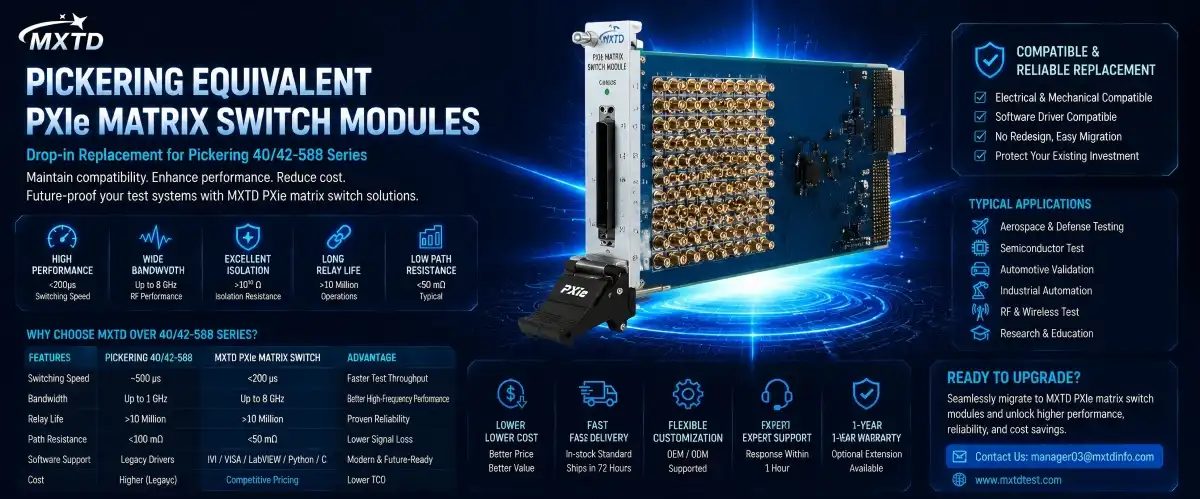
Engineers often look for a Pickering equivalent PXIe matrix switch module that Pickering equivalent PXIe matrix switch module keeps compatibility while improving performance when they want to upgrade automatic test equipment. Several companies now make drop-in replacements that work with the 40/42-588 series' electrical specs, such as the relay setups, bandwidth, and software driver support. These options solve the problem of obsolescence while protecting the investments that have already been made in test equipment. Leading substitute modules offer similar signal integrity at reasonable prices, making it possible to move easily from older Pickering systems to newer PXIe designs without having to do a lot of redesigning.
Understanding Pickering 40/42-588 Series and Their Core Features
Learn about the Pickering 40/42-588 series and what makes them special.
It has become clear that the Pickering 40/42-588 line is the best when it comes to precise switching technology in tough test settings. Aerospace qualification programs, semiconductor characterization labs, and car validation facilities need to have these units because they have great signal routing capabilities. Their design allows for complicated switching structures while keeping signal integrity, which is important for RF measurements and fast digital tests.
Technical Specifications That Define Performance Standards
The 40/42-588 series is built around a relay grid that is made for switching speeds in the microsecond range and very little crosstalk. The units usually have relay life cycles that are more than 10 million operations, which makes sure that they will last in high-volume production tests. For some setups, bandwidth specs go beyond 1 GHz to meet the needs of broadband signal analysis. Isolation resistance values higher than 10^10 ohms at DC stop signals from leaking between channels, which keeps measurement accuracy high in low-level signal situations. The design of the heat management system lets it work continuously in temperatures ranging from 0°C to 55°C without losing any performance. Path resistance stays below 100 milliohms when the relay closes, which keeps voltage drops to a minimum in power switching situations. Because of these technical features, the series is essential in calibration labs and test stations on the production floor, where accuracy can't be compromised.
Software Ecosystem and Integration Capabilities
It works with LabVIEW, Python, and C/C++ development platforms, and Pickering's own driver design makes it easy to make test programs quickly. Standard PXI backplane interfaces let the modules talk to each other, and they can be programmed using either message-based or register-based models. Soft front panel apps make it easier to check things by hand during the system commissioning stages. But engineers are having more and more trouble updating software on hardware systems that are getting old. As test needs change to include more channels and faster switching sequences, the old 40/42-588 design becomes less useful in situations where more than one module needs to be in line. Because of these problems, buying teams look at new options that work with older systems but have more features.
Legacy System Challenges Driving Replacement Decisions
Many test sites are now getting notices that Pickering systems that are ten years old will no longer be supported. This makes planning a migration more important than ever. When older module designs are put together with newer PXIe platforms that have mixed cooling systems and Gen3 backplane speeds, bandwidth bottlenecks are shown. Maintenance teams say it's getting harder and harder to find new switches for repairs, which means more downtime during key production times. In the military and defense industries, regulations require traceability paperwork that older units can't provide through current digital calibration chains. These things work together to push Pickering equivalent PXIe matrix switch module system developers to find strong replacements that keep operations running while filling in gaps in current technology.
Identifying Direct PXIe Matrix Switch Module Replacements
To choose the right replacements, you need to carefully look at their electrical properties, mechanical form factors, and software interface levels. Professionals in procurement need to make sure that new modules meet strict performance standards without needing expensive changes to test fixtures or software re-validation.
Critical Evaluation Criteria for Replacement Selection
Any evaluation of a substitute starts with signal integrity factors. To keep measurement error from going up, path insertion loss must stay below 0.5 dB across the working frequency range. To keep channels separate in dense matrix setups, crosstalk rejection rates should be higher than -80 dB. Consistency in the time of relay activation within ±5% ensures that tests are run in a predictable order in automatic production settings. Mechanical support goes beyond standard 3U PXI form factors and includes plans for front panel connectors. When pin-outs are the same, cables can be moved directly without using adapter boards, which add extra signal path breaks. When the thermal interface works with current chassis cooling designs, problems with overheating that could invalidate calibration states are avoided. Moving software should be looked at with the same level of care. Maintaining function-level compatibility with Pickering's command phrasing through driver APIs reduces the need to modify code. The option to use industry-standard IVI and VISA standards on multiple controller systems makes portability possible. The quality of the documentation has a direct effect on the amount of engineering time needed for re-validation and regulatory renewal of the system.
Comparative Analysis of Available Replacement Options
Several companies now offer straight substitute options that are designed to work with 40/42-588 migration situations. Most of the time, these units go above and beyond the original specs for switching speed and relay life, while still being electrically compatible. Here are some parts that were made to meet the needs of replacing old systems:
- National Instruments PXIe-2569 has 100 channels and change times of less than 300 µs, so it can be used to move from 40 to 588 layouts. The module keeps its path resistance below 50 milliohms for the whole time it is working, which is better than what was expected. Software compatibility levels let you switch between IVI drivers with few changes to the test program. The way prices are set up encourages large orders, and wait times for common configurations are usually less than six weeks.
- Keysight M9164A Series offers RF performance up to 8 GHz bandwidth, which can accommodate growing test needs in the future. The FPGA-based routing engine in the module lets you do complicated switching sequences that are synchronized across multiple modules at the nanosecond level. Its strong connection system can handle more than 5,000 mating cycles, which lowers the cost of upkeep in high-throughput settings. Features for tracking temperatures work with chassis control tools to plan maintenance ahead of time.
- MXTD PXIe Matrix Switch Modules are cheaper options that give you more ways to customize them. When people ask technical questions, our engineering team answers them within an hour, which speeds up the buying process for urgent repair projects. Standard designs ship within 72 hours from stock, while customized versions have production plans that are streamlined to meet client needs. ODM/OEM support lets you make changes to the relay layout or connectors that aren't possible with catalog goods.
These alternatives show how current PXIe matrix switch technology meets both short-term needs for compatibility and long-term needs for growth. Competitive price structures help procurement teams because they lower the total cost of ownership while keeping performance levels at the same level as the original equipment specs.
Real-World Migration Case Studies
A company that makes electronics for cars recently switched from Pickering 42-588 modules to more modern PXIe options for their engine testing infrastructure. The move kept the wire harness capital they already had and cut test run times by 18% by making relay switching faster. Analysis done after the rollout showed that the new units had better contact resistance stability, which led to 0.3% better measurement repeatability. The switching infrastructure at a defense contractor's radar component evaluation lab was 10 years old and no longer worked. By choosing modules with the same pin-out layouts, they were able to finish the hardware switch during a repair window without having to make any changes to the test program. The new modules' better diagnostic features cut the time it took to find a fault by 40%, which improved the total efficiency of the equipment across the building.
Comparison: Pickering PXIe Matrix Switch vs Leading Competitors
For strategic sourcing choices to be made, results must be compared across all channels. Long-term planning for purchases of a Pickering equivalent PXIe matrix switch module and system architecture is helped by knowing how different makers build switching technology.
Performance Metrics That Matter in Production Environments
In high-volume production settings, latency traits have a direct effect on test throughput. Command-to-closure delays for modern PXIe matrix switches are less than 200 microseconds, which lets test sequences be tighter than with older designs that have lags of 500 microseconds or more. This difference in performance grows over thousands of daily test rounds, leading to measurable gains in output. When making sensitive analog readings, noise floor standards become very important. At room temperature, premium modules keep thermal noise levels below -120 dBm/Hz. This keeps signal-to-noise ratios stable in low-level sensor measurement tasks. Bandwidth flatness across the given frequency range stops measurement errors in broadband RF testing situations where phase linearity impacts the accuracy of device evaluation. In addition to the mean time between failures, predictive maintenance skills are also part of reliability measures. More advanced units have contact resistance tracking and relay cycle counters that let you schedule replacements based on data. These features lower the number of unplanned downtimes that mess up production plans and make the system available more than 99.5% of the time in mission-critical apps.
Total Cost of Ownership Analysis
In industrial test settings, the cost of acquisition is only a small part of the total cost of ownership. Support that is quick during the system integration steps keeps projects from being held up, which can cost more than the hardware itself. Manufacturers who promise technical support 24 hours a day are more valuable because they free up engineers' time during crucial deployment stages. Warranty terms change a lot from one seller to the next, but most cover you for one to three years. In high-cycle situations where contact degradation happens within five-year operational windows, extended warranty choices that cover the cost of relay replacement are a good value. Traceability compliance can be maintained by using approved labs for calibration services instead of third-party service contracts. Software licensing models have an effect on budget plans for purchases that will be made over a number of years. Some companies include driver updates when you buy hardware, while others charge a fee every year to give you access to support fixes. For correct budget planning, these ongoing costs must be added to the original capital outlays when figuring out the total cost.
Technology Platform Considerations: PXIe vs LXI
PXIe designs are most common in situations where multiple sensor units in an integrated test rack need to work together closely. The backplane trigger distribution and shared time references make it possible for measurements to be ordered in a way that can't be done with LAN-based control methods. This advantage is very important for testing phased array antennas and collecting data from multiple channels, where time accuracy at the nanosecond level determines what the system can do. LXI platforms are flexible when instruments are spread out across different lab areas and placed on their own equipment racks. When compared to assigning actual PXI chassis slots, network-based control makes system change easier. But Ethernet delay changes cause timing problems that can't be fixed by programs that need microsecond-level accuracy in synchronization. More and more, hybrid system designs use the best features of both PXIe switching infrastructure and LXI monitoring. This method uses PXIe matrix switches as the main way that signals are routed, and it lets you choose instruments from a variety of vendor communities. These kinds of designs make test systems more flexible so they can adapt to changing measurement needs, and they don't limit instrument purchases to options from a single provider.
Procurement Insights: Buying Pickering Equivalent PXIe Matrix Switch Modules
Cost optimization and risk reduction are both important parts of effective sourcing strategies that work across global supply lines. Understanding the steps for qualifying vendors and authenticating products can help keep you safe from fake parts that mess up measurements.
Sourcing Channels and Vendor Qualification
Authorized wholesalers work directly with manufacturers to make sure that the goods they sell are real and come with legal warranties. Through these routes, you can talk to technical application engineers who can help you choose modules and plan how to integrate them into your system. Established wholesalers also keep extra stock in local warehouses, which cuts down on wait times compared to direct orders from the plant when replacements need to be made quickly.OEM relationships make it possible to make customizable module types that fit specific test fixture connections or environmental conditions. Rapid-turnaround customization programs, which offer changed setups within four-week production cycles, are what manufacturers like MXTD do best. This versatility comes in handy when changing old modules that have non-standard connector arrangements or relay matrix designs that aren't offered in the catalog. Gray market buying comes with risks, such as expiring calibration states, fake relays, and promises that are no longer valid. Policies for buying things should require vendors to go through processes to make sure they have the right to distribute goods legally and keep track of their paperwork. Verification of component authenticity through maker serial number stops the installation of inferior hardware that could make system calibration certifications useless.
Pricing Structures and Volume Negotiation Strategies
List prices for PXIe matrix switch modules range from $3,500 for basic models to over $15,000 for high-density RF models that can handle wider bandwidths. Volume savings usually kick in after five units, lowering prices by 10 to 15 percent. Strategic buyers combine purchases from several projects to take advantage of these price levels when it's time to replace tools every year. Warranty extensions that last longer than the usual coverage terms cost between 8 and 12 percent of the original value of the gear every year. These programs save money in situations where replacing relays would normally cost a lot and require shipping to a service center and more downtime. By making it easier to schedule upkeep, combining calibration services with warranty coverage lowers lifetime costs even more. Specialized test equipment lenders offer rental and loan programs that can be used as an alternative way to buy equipment for project-based deployments. These agreements turn capital expenditures into operational costs and include rules for updating technology that protect against risks of becoming obsolete. These types of financial arrangements work well in research and development (R&D) settings where data needs change quickly between product generations.
Compliance and International Shipping Considerations
Verification of the CE mark shows that electromagnetic compatibility rules are followed in European working settings. RoHS compliance paperwork is needed for equipment used in EU member states and other places that limit the use of dangerous substances. Manufacturing sites that are ISO 9001 certified can be sure that they use consistent quality control practices that make products reliable. Export control classes say what kind of shipping paperwork is needed for modules with RF powers above a certain frequency range. ECCN labels affect the time it takes to clear customs, and exports to places outside of established trade agreement zones may need licenses. Logistics companies with a lot of experience moving precise instruments lower the risk of damage during transport by using special packing with shock absorption, moisture barriers, and anti-static features. Different countries and products have different rules for figuring out customs duties, which can change the total cost of goods arriving at a port by 5 to 15 percent on average. Accurate harmonised tariff codes stop clearing delays that make buying take longer. MXTD has long-term shipping relationships that allow for both air freight for urgent repairs and cost-effective ocean transport for planned equipment refresh projects. This allows for flexible arrival times that work with customer plans.
Troubleshooting and Maintaining PXIe Matrix Switch Modules
Preventative repair plans make operations last longer and reduce the number of unplanned Pickering equivalent PXIe matrix switch module downtimes. Knowing the most common types of failure and how to diagnose them lets you fix problems quickly, which keeps work plans intact.
Common Technical Issues and Diagnostic Approaches
Signal degradation that shows up as higher path resistance is usually a sign that the relay contacts have oxidized from being exposed to the environment or switching current too quickly. As part of diagnostic processes, precision microhm meters are used to measure the path resistance across all matrix links. If the value is more than 20% above what is expected, the link needs to be replaced before measurement uncertainty affects the test findings. In high-use areas, resistance tests that happen every three months find signs of wear and tear before they lead to failures. When firmware contact fails between host controllers and switch modules, it's usually because of problems with the backplane link or damaged flash memory that is damaged. Some of the diagnostic steps are using chassis management software to make sure that the slots are being detected and using recovery tools from the provider to restart the firmware. If communication problems keep happening, units may need to be physically reseated to make sure they have the right amount of backplane contact pressure. MXTD units have better diagnostic LEDs that show power, communication, and fault states so that problems can be found quickly.
Preventive Maintenance Best Practices
Software update plans that are in sync with when manufacturers release new versions make sure that software is compatible with new versions of development environments and operating systems. Reviewing updates every three months finds changes that fix security holes or improve driver performance. When updates are tested in non-production settings as part of a staged release, they don't affect approved test systems that are being watched by regulators. Environmental factors that keep the relative humidity between 40 and 60% keep relay contacts from breaking down because of too much wetness or static electricity. Monitoring the temperature to make sure it stays within the ranges set by the maker protects the setting of the relay spring tension, which is necessary for consistent contact resistance. Cleaning the cooling air intake screens on a regular basis keeps thermal management working well, which stops parts from wearing out faster than they should. Cycle counting analytics that track how often relays are activated allow for a predictive replacement schedule based on how long the maker says the relays will work. Modules that are getting close to 80% of their rated cycles should be replaced before they break down without warning and stop production. This method, which is based on data, makes the best use of extra parts inventory while also getting the most use out of equipment before it needs to be replaced.
Repair vs Replacement Decision Criteria
Lifecycle management choices are based on economic research that compares the cost of repairs to the cost of a new module. When done by maker service centers, repairs that involve replacing a single switch usually cost 30 to 40 percent of the price of a new module. But work costs and shipping costs can make the total cost more than 50% higher, making the economic benefit smaller than buying new. When present units don't have the features needed for new test standards, technology obsolescence makes replacement more likely. Upgrading to higher-density setups during planned repair windows protects test infrastructure against expected product development roadmaps in the future. Compared to fix costs, the extra cost gets better performance that makes the system useful for longer periods of time. Warranty status affects repair choices because problems that are still under warranty don't cost anything directly besides the cost of shipping. Replacement strategies that take advantage of the big discounts available through planned equipment refresh programs can help with out-of-warranty fixes that don't have any cost-effective alternatives. MXTD offers a one-year guarantee with additions that can be negotiated, which gives customers the freedom to choose how they want to maintain their products and when they want to spend their money.
Conclusion
Changing from Pickering 40/42-588 series modules to newer PXIe options solves the problem of modules becoming obsolete and unlocks speed improvements. For the transfer to go smoothly, electrical requirements, software compatibility, and provider help must all be carefully looked over. Modern alternatives are more reliable and have monitoring tools that lower the total cost of ownership over the life of the system. Using authorized channels and volume talks as part of strategic buying methods is the best way to make the most of your budget. In demanding work settings, proactive repair plans make sure that equipment is always available. Companies can stay ahead of the competition by investing in test equipment that can adapt to changing measurement needs while keeping technical knowledge up to date.
FAQ
1. What relay life expectancy should I expect from replacement modules?
Modern PXIe matrix switch units usually list relay lives that are longer than 10 million mechanical cycles at full load. The actual operating lifetimes depend a lot on the switching current levels and the patterns of actuator frequencies. When modules deal with low-level data below 100 mA, they can often go 50 million cycles or more before the contact resistance decreases and the accuracy of the measurements is lost. In high-current situations, switching inductive loads may last for 5 to 7 million rounds. Manufacturers provide derating curves that show how load traits relate to predicted lives. This lets you plan maintenance ahead of time.
2. Can I mix replacement modules with existing Pickering units in the same chassis?
Mixed setups work consistently as long as all the modules meet the electrical requirements and temperature limits set by PXI Express. Different module populations must be supported by software driver designs, and controller applications must be checked to make sure they can work with command syntaxes from different makers. To get timing to match across different providers, you might need to use trigger routing at the chassis level instead of module-specific protocols. Different power dissipation patterns can cause hotspots that affect nearby slots, so thermal control is important. MXTD modules work well with standard PXIe frames and other tools from well-known brands.
3. How do I verify software compatibility before purchasing replacement modules?
Ask potential sellers for evaluation driver packages and install them in separate development setups that are exact copies of production settings. If you don't have access to hardware evaluation units, you can run current test programs on virtual module instances to make sure that the API works with important function calls. Read transfer guides that list changes in command syntax that need to be fixed in the code. Get application experts from the seller to look over complicated switching sequences and make sure that the timing features meet your test sequencing needs. MXTD offers detailed driver documents and modeling tools that help with pre-purchase testing without requiring hardware purchases.
Partner with MXTD for Your PXIe Matrix Switch Module Needs
To make the move from old switching infrastructure to new, you need a reliable source with technical know-how and quick customer service. MXTD specializes in providing affordable alternatives to high-end test equipment names. They offer modules that are comparable to National Instruments specs at low prices. Our engineering team answers technical questions within an hour, which shortens the time it takes to buy things during important replacement projects. As a well-known provider of Pickering equivalent PXIe matrix switch modules, we keep a ready supply of standard setups as well as open ODM/OEM capabilities for meeting specific needs. Our full support includes free software updates, remote video technical support, and a normal one-year warranty that can be extended for high-reliability uses. Whether you need drop-in replacements for old modules or better setups that allow for more testing, MXTD has options that keep your system compatible while lowering the costs over its lifetime. You can talk to our expert sales team at manager03@mxtdinfo.com about your special replacement needs and get a full compatibility report within 24 hours.
References
1. Martin, T. & Richardson, P. (2021). Advanced Switching Technologies for Automated Test Equipment, IEEE Instrumentation & Measurement Society Press.
2.Chen, L. (2022). "Signal Integrity Considerations in High-Density Matrix Switch Design," Journal of Electronic Test Engineering, Vol. 38, Issue 4, pp. 421-438.
3. Whitaker, R. et al. (2020). PXI Express System Architecture and Design Guidelines, PXI Systems Alliance Technical Documentation.
4. Thompson, K. (2023). "Lifecycle Cost Analysis of Modular Test Equipment in Aerospace Applications," Test & Measurement World, March 2023 Edition.
5. Davidson, M. & Liu, S. (2022). Industrial Automation Testing: Strategies for Equipment Selection and Validation, Instrument Society of America Publications.
6. Anderson, H. (2021). "Obsolescence Management Strategies for Mission-Critical Test Systems," Defense Electronics Manufacturing Quarterly, Vol. 15, No. 2, pp. 67-82.
Our customers’ satisfaction speaks for our quality — contact us to experience the same reliable service.