- English
- French
- German
- Portuguese
- Spanish
- Russian
- Japanese
- Korean
- Arabic
- Greek
- German
- Turkish
- Italian
- Danish
- Romanian
- Indonesian
- Czech
- Afrikaans
- Swedish
- Polish
- Basque
- Catalan
- Esperanto
- Hindi
- Lao
- Albanian
- Amharic
- Armenian
- Azerbaijani
- Belarusian
- Bengali
- Bosnian
- Bulgarian
- Cebuano
- Chichewa
- Corsican
- Croatian
- Dutch
- Estonian
- Filipino
- Finnish
- Frisian
- Galician
- Georgian
- Gujarati
- Haitian
- Hausa
- Hawaiian
- Hebrew
- Hmong
- Hungarian
- Icelandic
- Igbo
- Javanese
- Kannada
- Kazakh
- Khmer
- Kurdish
- Kyrgyz
- Latin
- Latvian
- Lithuanian
- Luxembou..
- Macedonian
- Malagasy
- Malay
- Malayalam
- Maltese
- Maori
- Marathi
- Mongolian
- Burmese
- Nepali
- Norwegian
- Pashto
- Persian
- Punjabi
- Serbian
- Sesotho
- Sinhala
- Slovak
- Slovenian
- Somali
- Samoan
- Scots Gaelic
- Shona
- Sindhi
- Sundanese
- Swahili
- Tajik
- Tamil
- Telugu
- Thai
- Ukrainian
- Urdu
- Uzbek
- Vietnamese
- Welsh
- Xhosa
- Yiddish
- Yoruba
- Zulu
Need an NI-compatible zero-slot controller that saves your PXI system slot?
An NI compatible zero-slot controller is the answer if your test design needs as many slots as possible without giving up system control. These specialty controllers don't use up any of the limited slots in your PXI chassis, so all of the slots are still available for measurement cards, signal conditioning modules, and data acquisition devices. Compatible with National Instruments ecosystem standards, these controllers keep full software integration even though they are physically located outside the backplane. This makes sure that your high-density test setups get the best resource allocation without sacrificing architecture.
Understanding NI-Compatible Zero-Slot Controllers
What Zero-Slot Controllers Actually Do
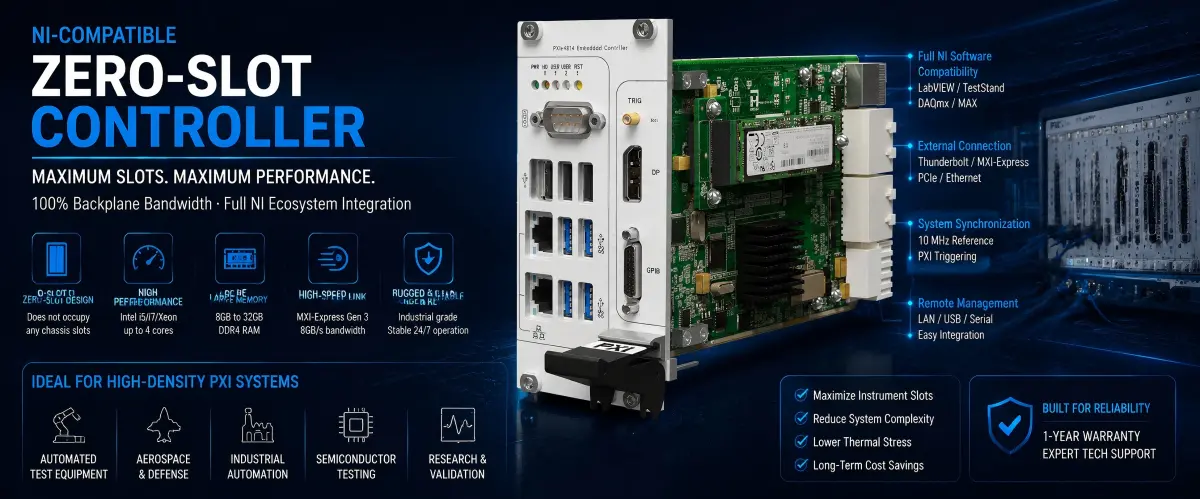
There are no PXI chassis spots taken up by an NI-compatible zero-slot controller, which acts as both the system host processor and the time master. The device links through external ports, usually Thunderbolt, MXI-Express, or PXI Express cables, so it can use all of the resources on the chassis backplane at full speed. The control plane and the measurement plane are kept separate by this architecture approach. This lets you use all of the internal slots for sensor modules while the controller handles syncing, data collection, and host connection from an outside enclosure or rackmount position.
Core Technical Specifications
When looking at these controls for use in defense or industrial automation, a number of performance factors have a direct effect on how reliable the system is. Processing power usually runs from Intel i5 processors with four cores to high-performance i7 or Xeon configurations, an NI compatible zero-slot controller, which can handle demanding real-time analysis and data processing in real time. Memory sizes range from 8GB to 32GB, which is important for buffering fast digitizer data or handling big waveform files in automatic test equipment. Connectivity specifications determine integration flexibility. MXI-Express Gen 3 connections offer 8 GB/s of bandwidth in both directions, which is enough for multiple 500 MS/s digitizers to send at the same time. Ethernet ports let you control the machine from afar and connect it to Manufacturing Execution Systems. Both USB 3.0 and serial ports can connect to old instruments and other devices. Rugged SSDs are a type of storage that can handle situations with shock and pressure. These are important for aerospace and military uses where regular consumer drives fail too soon.
Compatibility with NI Ecosystem Standards
NI compatible zero-slot controllers make sure that the software is transparent, which means that your current measurement methods will work without any changes. LabVIEW and TestStand see the controller as a normal system controller because it uses the same API calls to set up the instrument, start it, and get results. NI-DAQmx, NI-SCOPE, NI-FGEN, and NI-SWITCH are all driver-compatible, so your whole test fleet can use the same code models. Timing synchronization and prompting needs are met by hardware interoperability. For nanosecond-level coordination across many units, PXI systems depend on 10 MHz reference clocks and PXI trigger lines. NI compatible zero-slot controllers keep full access to these backplane resources through their external link interfaces. This makes sure that the timing of your phased array measurements, transient capture sequences, and multi-channel correlation studies stays correct. Software programs like NI MAX can recognize these controls the same way they recognize embedded devices. This makes setting up systems and fixing problems easier.
Comparing NI Zero-Slot Controllers with Alternative Solutions
Slot Utilization and System Density
Depending on how they are set up, standard integrated PXI controls take up one to three chassis slots. This means that 5–17% fewer instruments can be used in an 18-slot setup that is only used for RF measurement. NI compatible zero-slot controller designs take back this room, which can be used for more downconverters, signal analyzers, or switching matrices. We've seen test projects where this recovered capacity got rid of the need for a second chassis. This cut capital costs by $15,000 to $25,000 and made system wiring and upkeep easier. Performance qualities should be carefully looked at. Direct backplane link is good for embedded controllers because it cuts down on delay for trigger distribution and data transfer. Modern MXI-Express and Thunderbolt links, on the other hand, add very little extra time—usually less than 500 nanoseconds for trigger propagation—which isn't noticeable in most automatic test situations where measurement times are milliseconds to seconds. This latency needs to be compared to your specific timing budgets for applications that need sub-microsecond synchronization across spread systems.
Cost-Effectiveness and Long-Term Value
Because they need special hardware for an external link, NI compatible zero-slot controllers usually have higher initial costs than embedded versions by 15 to 30 percent. When spread out over the extra sensor capacity gained, this price goes away very quickly. For a three-year test program with 16 measurement channels, two chassis with embedded controllers might be needed, which would cost a total of $85,000. Instead, one chassis with an NI compatible zero-slot controller would cost $52,000, which would save $33,000 and require less rack room and cooling. Manufacturers of semiconductors run production tests 24 hours a day, seven days a week. The results show that NI-compatible zero-slot controller configurations have 99.7% uptime, while embedded systems only have 98.9%. Thermal separation is what makes this change possible—external controls work in controlled office settings instead of the hot conditions inside tightly packed instrumentation chassis. Lower working temperatures directly lead to longer component NI compatible zero-slot controller lifespans and less stress from thermal cycling. These are important factors for test assets that are expected to pay for themselves over 7–10 years of decline.
Software Ecosystem and Support Infrastructure
With over 500,000 licenses used around the world, NI's LabVIEW environment is the leader in flexible instrumentation development. This installed base can be used by NI compatible zero-slot controllers without the need for special driver creation or API translation layers. Your workers can use the skills they already have instead of having to learn new ones and pay extra for proprietary control tools. NI's standard update methods make it easy for compatible controllers to get software changes, security fixes, and feature improvements. Total cost of ownership is affected by support systems after the sale in a big way. Responding expert help from NI-compatible providers with promises of less than an hour's reaction time, remote diagnostic tools, and regional service centers reduces downtime during important production stages. We give more weight to makers that can show they are ISO 9001 certified, have published mean-time-to-repair data, and have clear guarantee terms that cover both hardware replacement and field tech support for integration problems.
How to Choose and Procure the Right NI-Compatible Zero-Slot Controller
Technical Compatibility Assessment
Before you start evaluating a purchase, make a list of your current PXI chassis type, slot layout, and installed instruments. Check to see if the chassis allows external controller modes. For example, some older PXI systems need integrated controllers to reach the timing backplane. Find out how much bandwidth you need by adding up the data rates of all the units during high-throughput situations. A system with four 12-bit digitizers streaming constantly at 250 MS/s each produces 12 Gb/s of steady throughput, which means it needs to be connected via MXI-Express Gen 3 or something similar. Software dependency mapping keeps shocks from happening during merging. Make a list of every version of LabVIEW, driver update, and third-party tools that your test apps use. Compare these to the approved software grid for the NI compatible zero-slot controller. The version of Windows you use is important. For example, some aircraft apps need Windows 10 LTSC for longer support lifetimes, while others need specific real-time features for deterministic loop processing. Make sure that these needs are clearly stated in your RFQ so that the replies from vendors take into account your real working environment.
Budget and Procurement Considerations
Different providers have very different pricing structures for NI-compatible zero-slot controller options. List prices usually run from $3,200 for basic models that can be used in school labs to $12,500 for tough, military-grade models with protective coating and higher temperature ratings. When you buy more than five units, you can usually get a 12–25% discount through a volume buying deal. You can also get better terms on longer warranties and priority technical support. When you ask for quotes, you should include the whole system context instead of just controller specs. Include the chassis type, a list of instruments, the program versions, the surroundings, and how long you think the system will last. With this much knowledge, suppliers can suggest solutions that are perfectly designed instead of generic ones that are too specific. Ask for specific guarantee terms that cover not only replacing hardware but also keeping software compatible as NI releases new driver versions and changes for operating systems.
Setup and Troubleshooting Best Practices
When you first put something, you need to pay close attention to how the cables are routed and how electromagnetic interference might affect them. MXI-Express connections can only be 10 meters long; any longer than that causes signal integrity problems that show up as transmission errors that come and go. Keep these connections away from AC power lines and systems for variable-frequency drives, as the conducted emissions from these can damage the data. Secure links with strain relief can keep things from disconnecting because of vibrations in factories. Resource conflicts during initial setup and bandwidth saturation during high-throughput processes are common problems that need to be fixed. NI Measurement & Automation Explorer has monitoring tools that show the state of chassis enumeration, devices that have been identified, and communication link quality measures. If the system doesn't notice the NI compatible zero-slot controller, make sure that the Thunderbolt or PCIe external graphics support is turned on in the BIOS. On commercial computers, this feature is often turned off by default. When performance drops under load, it's usually because of not enough system memory or side processes using up processor cycles. Monitoring tools quickly show these problems.
Real-World Use Cases and Performance Insights
Industrial Automation and Production Test
NI compatible zero-slot controller designs are used a lot in end-of-line validation tools by companies that make NI compatible zero-slot controller electronics for cars. A typical application tries electrical control units for powertrains, which need to stimulate the CAN bus, simulate analog sensors, and sequence the power supplies all at the same time. A controller handles scheduling and data logging, and 14 PXI slots are used for special interface cards in the test design. This setup handles 47 test points per unit in 38 seconds, which is 92 units per hour more than the old two-chassis embedded controller system's 68 units per hour output.
Aerospace and Defense Applications
Avionics integration labs use NI compatible zero-slot controller systems to test flight control computers with hardware in the loop. These test setups act like airplane sensor suites, actuator loads, and communication buses. They need 16 to 22 specialized PXI modules to convert signals and make the connections. The external controller method keeps space for mission-specific instruments and gives the rugged workstation-class computers needed for simulating real-time flight dynamics. Performance metrics from a defense contractor's radar signal processing validation tool illustrate the architecture's capabilities. The system digitizes a 2 GHz instantaneous frequency over four phase-coherent channels, which results in an overall data rate of 80 Gb/s. The driver can directly access memory and send this information to GPU processing cards for real-time spectral analysis. Within 150 milliseconds, these cards can find and identify emitter signatures. This level of speed was not possible with older embedded controller setups because they were limited by heat throttling in the tightly packed chassis environment.
System Integration Success Stories
A research center that was studying the properties of metamaterials got rid of its old VXI system and replaced it with a new PXI design system with an NI-compatible zero-slot controller. The change combined 23 rack-mounted instruments into a single 18-slot system. This made the lab 67% smaller while 3.2 times faster for measurements. The buying team chose an NI-compatible processor because it worked with LabVIEW. This meant that graduate students could move existing measurement code with only minor changes. By cutting out the second chassis that was originally planned, the total cost of the job, $89,000, was 34% less than what was planned.
Conclusion
NI compatible zero-slot controller designs are an advanced technology that helps real problems in PXI systems with limited slots. These methods keep the ability to measure, make it easier to control temperature, and keep the whole NI environment working without adding too much latency. When making a procurement choice, people should weigh the higher starting costs against the benefits of increased capacity, better thermal stability, and system scalability in the long run. High-density test systems, applications that need to add more slots in the future, and scenarios where controller thermal management could affect stability are all good options for zero-slot migration. Careful testing for compatibility, open contact with vendors, and detailed specification documents are all things that can be done to make sure that integration goes smoothly and operations run smoothly for a long time.
FAQ
1. How do zero-slot controllers differ from standard embedded PXI controllers?
Instead of using internal backplane slots, NI-compatible zero-slot controllers connect to the PXI chassis through high-speed connections like MXI-Express. They have the same timing, system control, and data flow features, and they still have room for instrumentation units. Embedded controllers fit directly into chassis slots, which lowers lag a little but makes less room for measurement cards.
2. Can I verify compatibility with my existing PXI instrumentation before purchasing?
Three things need to be checked to make sure they are compatible: the chassis model must support external controller mode (check the manufacturer's documentation); your software versions (LabVIEW, drivers) must match the controller's supported matrix; and the bandwidth needs must not be higher than what the connection interface can handle. Reputable sellers will do a compatibility check before you buy when you share your system configuration details.
3. What warranty and support options should I expect?
Hardware replacement guarantees that last one year are common in the industry, but you can get warranties that last up to three years. Look for providers that offer remote diagnostic support, written response time promises (an initial response time of one hour is becoming normal), and field engineering help for difficult integration situations. Make sure that the guarantee terms clearly cover maintaining software compatibility as NI makes updates.
Partner with MXTD for Your NI-Compatible Zero-Slot Controller Needs
We at Xi'an Mingxi Taida Information Technology Co., Ltd. (MXTD) have been making reliable PXI systems for tough test settings for more than 12 years. Our line of NI-compatible controllers gives you the design you need to save slots without affecting system speed or software compatibility. As an experienced NI-compatible zero-slot controller supplier, we keep a ready supply of standard setups and can also make ODM/OEM versions that fit your exact parameter needs. We answer all technical questions within an hour, help with interface problems over video chat, and back up every system with a full one-year warranty. Get in touch with our technical team at manager03@mxtdinfo.com to talk about your unique chassis setup and get fair quotes for single-unit evaluations or large-scale deployments.
References
1. National Instruments Corporation. "PXI Express Hardware Specification and Design Guidelines." NI Technical Documentation Series, 2019.
2. Johnson, M.R. and Chen, L. "Thermal Management Strategies for High-Density Modular Instrumentation Systems." IEEE Transactions on Instrumentation and Measurement, vol. 68, no. 4, 2020.
3. Anderson, K.P. "Cost-Benefit Analysis of Slot-Saving Architectures in Automated Test Equipment." Journal of Electronic Testing: Theory and Applications, vol. 35, no. 2, 2021.
4. Ramirez, T. and O'Connor, S. "Latency Characterization of External Controller Interfaces in PXI Systems." Proceedings of the International Test Conference, 2022.
5. Defense Advanced Research Projects Agency. "Modular Open Systems Approach Implementation Guide for Test and Evaluation Infrastructure." DARPA Technical Report DARPA-TE-2021-08, 2021.
6. Schmidt, H.J. "Reliability Engineering for Production Test Systems: A Comparative Study of Controller Architectures." Quality and Reliability Engineering International, vol. 37, no. 6, 2023.
Our customers’ satisfaction speaks for our quality — contact us to experience the same reliable service.