- English
- French
- German
- Portuguese
- Spanish
- Russian
- Japanese
- Korean
- Arabic
- Greek
- German
- Turkish
- Italian
- Danish
- Romanian
- Indonesian
- Czech
- Afrikaans
- Swedish
- Polish
- Basque
- Catalan
- Esperanto
- Hindi
- Lao
- Albanian
- Amharic
- Armenian
- Azerbaijani
- Belarusian
- Bengali
- Bosnian
- Bulgarian
- Cebuano
- Chichewa
- Corsican
- Croatian
- Dutch
- Estonian
- Filipino
- Finnish
- Frisian
- Galician
- Georgian
- Gujarati
- Haitian
- Hausa
- Hawaiian
- Hebrew
- Hmong
- Hungarian
- Icelandic
- Igbo
- Javanese
- Kannada
- Kazakh
- Khmer
- Kurdish
- Kyrgyz
- Latin
- Latvian
- Lithuanian
- Luxembou..
- Macedonian
- Malagasy
- Malay
- Malayalam
- Maltese
- Maori
- Marathi
- Mongolian
- Burmese
- Nepali
- Norwegian
- Pashto
- Persian
- Punjabi
- Serbian
- Sesotho
- Sinhala
- Slovak
- Slovenian
- Somali
- Samoan
- Scots Gaelic
- Shona
- Sindhi
- Sundanese
- Swahili
- Tajik
- Tamil
- Telugu
- Thai
- Ukrainian
- Urdu
- Uzbek
- Vietnamese
- Welsh
- Xhosa
- Yiddish
- Yoruba
- Zulu
Is a PXI Embedded System Controller a Full Industrial PC?
Procurement managers often ask: Is a PXI Embedded System Controller really the same as a full industrial PC when looking at automated test tools for defense, aircraft, or semiconductor testing? The answer is not simple. In a modular test design, a PXI Embedded System Controller provides specialized computer power by allowing CPU processing, I/O extension, and real-time synchronization. But unlike general-purpose industrial PCs that are made to work in a variety of plant floor settings, these controllers focus on accurate measurements, fast data collection, and tight interaction with instrumentation modules. R&D managers and test engineers need to understand this difference so they can make smart buying choices that meet their technical needs and stay within their practical budgets.
Understanding PXI Embedded System Controllers vs. Industrial PCs
The argument between PXI Embedded System Controllers and industrial PCs comes from the fact that they are designed in very different ways. PXI Embedded System Controllers are designed to automate tests. They have flexible backplanes that make it easy to connect data capture cards, signal generators, and digital multimeters all in one chassis. On the other hand, industrial PCs can be used as flexible computer platforms for process control, human-machine interfaces, and factory execution systems.
Architecture and Design Philosophy
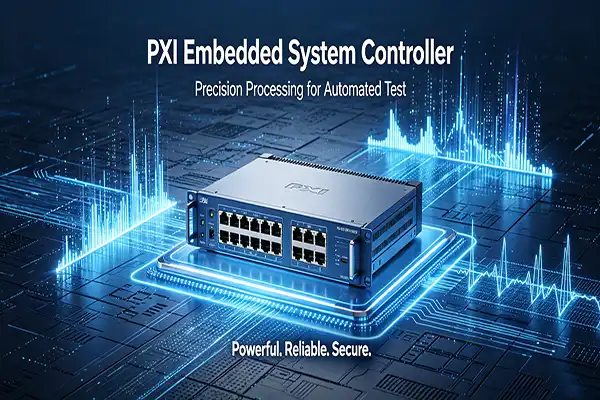
PXI Embedded System Controllers use the CompactPCI design and have special timing and triggering buses that let multiple measurement channels be in sync down to the microsecond level. This method is shown by the MXTD PXI4806L, which has a Loongson 3A5000 quad-core processor that works inside a PXI3 slot 3U standard module. This PXI Embedded System Controller doesn't take up any extra spots but controls the whole system; this kind of space-saving design isn't possible with regular rack-mount industrial computers.
Industrial PCs usually come in separate cases with places for adding general-purpose accessories. They are more flexible for software apps that aren't connected to test and measurement, but they don't have the precise timing features that come with PXI systems. The 32bit/33MHz system frequency of the PXI4806L makes sure that data transfer rates are stable, which is important for synchronized multi-channel tests in RF characterization or electronics validation.
Connectivity and Interface Standards
By looking at the PXI4806L specs, we can see that the connection is designed to work in instrumentation settings. The PXI Embedded System Controller has four 1000BASE-T Ethernet ports for test systems that are spread out, two HDMI outputs for watching multiple data streams at the same time, and four separate CAN connections that are necessary for testing car electronics. These choices weren't made at random; they're based on decades of feedback from the industry about what test engineers need to build automatic test tools.
If you look at industrial PCs, they put fieldbus standards like PROFINET or EtherCAT at the top of their list for automating factories. Industrial computers usually have more USB ports or old PCI slots than regular computers, but they don't usually have the specialized interfaces like RS-485 or isolated CAN that are built into PXI Embedded System Controllers, so that instruments can talk to each other. The PXI4806L's three USB 3.0 ports and three USB 2.0 ports are designed to work with both new and old test tools while still allowing for fast data logging.
Environmental Ruggedness and Reliability
Both systems say they are tough, but they are used in very different situations. PXI Embedded System Controllers work in temperature ranges from -10°C to +55°C in controlled labs or mobile test units. The PXI4806L meets these requirements and keeps the measurement accuracy that is needed for precise tests. On plant floors, industrial PCs often have to deal with bigger temperature ranges and more shocks and vibrations. However, this extra toughness comes at the cost of taking up more space and using more power.
Because PXI systems are flexible, instrumentation cards can be swapped out without turning off the whole frame. This cuts down on downtime during test system reconfigurations. Most hardware changes on industrial PCs need to be done while the computer is shut down completely. This makes them less flexible for R&D centers that change test setups all the time. This difference in architecture has a direct effect on how efficiently test engineering teams can work on multiple projects with changing measurement needs.
Core Features and Performance Metrics of PXI Embedded System Controllers
Knowing what technical features PXI Embedded System Controllers have helps buying teams decide if these devices meet their needs for performance. Modern controllers blend processing power, memory speed, and specialized I/O in small packages, as shown by the MXTD PXI4806L.
Processing Architecture and Computational Performance
The Loongson 3A5000 processor is an example of a move toward computer systems made in the United States for use in situations where supply chain security is important. This quad-core CPU has enough processing power for real-time signal processing, data logging, and running test sequences without the problems that come with managing the heat that comes with more powerful x86 processors. The PXI4806L can handle parallel data streams from multiple instrumentation modules at the same time when it is paired with dual-channel DDR4 2666MHz memory that can hold up to 32GB.
In test automation, clock speed isn't the only way to measure processing performance. Most of the time, the time between trigger events and data recording is more important than the number of FLOPS. PXI Embedded System Controllers have reliable reaction times because they are directly connected to the PXI backplane's trigger lines. This gets rid of the uncertain delays that come with industrial PCs' operating systems handling general-purpose peripherals. Because of this design edge, PXI systems are the best choice for uses like semiconductor automated test equipment, where pass/fail decisions worth millions of dollars in production yield depend on nanosecond timing accuracy.
Storage and Data Management Capabilities
Modern test applications create huge files that need to be stored locally quickly. The PXI4806L has an M.2 interface that works with SATA solid-state drives and comes with a 500GB normal size. This is enough for long test runs before moving the data to network storage. When logging multichannel oscilloscope captures or RF spectrum readings at continuous rates of more than 100 MB/s, fast storage is essential.
2.5-inch SATA drives, which are less shock-resistant and use more power, are often used in older industrial PCs. The M.2 form factor is perfect for mobile test stations or flying instrumentation platforms because it has a small size and can handle vibrations better than other types. The sustained write speed of current NVMe-capable M.2 drives (though the PXI4806L uses SATA protocol) stops buffer overruns that would damage data security during a normal avionics test sequence that collects sensor data across dozens of channels.
Software Ecosystem and Operating System Support
The PXI4806L supports Galaxy Kylin V10 Defense Edition, which meets a growing need in the defense and aerospace industries for tested, safe operating systems that don't depend on other programs. This platform is based on Linux, which lets test engineers make measurement apps using normal computer environments while still following government security rules.
It's not just the operating system that needs to be compatible; measurement tools and application libraries also need to be. PXI Embedded System Controllers usually have test leaders that are built on LabVIEW, TestStand, or Python and talk to instruments through standard APIs such as IVI or VISA. In theory, these same programs could run on industrial PCs that are running Windows or Linux. However, because they don't have hardware timing built in, they can't get the same level of precision in syncing across spread measures. A PXI-based test system can set off 20 different instruments at the same time with errors of less than one microsecond. On the other hand, an industrial PC operating those same instruments over Ethernet or USB has timing errors of milliseconds, which makes it impossible to take some measures.
Thermal Management and Power Efficiency
PXI Embedded System Controllers give off less heat than high-performance industrial PCs, which means they don't need to be cooled as much and can fit more instruments in the same space. The PXI4806L can work in temperatures ranging from -10°C to +55°C, so it can be used reliably in temperature-controlled test rooms or outside. For battery-powered field test tools, every watt-hour of capacity means longer operation time. Lower power usage is also important.
These temperature properties aren't just nice to have; they're essential for certain uses. When aerospace test systems are used at high altitudes or in harsh conditions, they can't fit industrial PCs that need forced-air cooling, which can bring particle contamination. PXI Embedded System Controllers often have fanless or low-airflow designs that keep the surroundings clean, which is important for sensitive RF measurements or optical tests.
PXI Embedded System Controllers vs. Traditional Controllers and Industrial PCs
Putting PXI Embedded System Controllers next to different computer platforms helps you see when each one is the best value. This comparison isn't meant to pick a winner, but to show that different uses call for different design methods.
Modularity and Scalability Comparison
When test needs change or grow, PXI systems really shine. Adding measurement capability means putting in another monitoring card into a chassis slot that is already there, without having to change how the PXI Embedded System Controller is set up. The MXTD PXI4806L only takes up three spots, but it can manage up to 18 additional instrumentation modules in a normal chassis. This means that a single PXI Embedded System Controller can be used to build systems with dozens of synced measurement channels.
Industrial PCs need additional monitoring units that are linked via Ethernet, USB, or their own ports in order to work. The predictable time that makes PXI useful is lost with each link, which adds latency and complexity. When a test engineer wants to add a fast digitizer to an existing industrial PC-based system, they have to deal with driver compatibility issues, bandwidth limits, and synchronization problems that don't come up in the PXI paradigm, where communication between modules is handled by the backplane.
Cost-Effectiveness Across System Lifecycles
The initial prices of purchase only tell part of the story. PXI Embedded System Controllers like the PXI4806L are more expensive than basic industrial PCs, but procurement managers need to look at the total costs of ownership, which include the ability to change configurations, the frequency of calibrations, and the need for expert assistance. A test system that can change to new product needs without having to replace hardware will give you a better return on your investment than smaller platforms that need to be rebuilt from scratch every time a new product comes out.
The PXI4806L works with National Instruments product models, so companies that already have test equipment can just drop it in and use it instead. This interoperability cuts down on the time it takes to qualify candidates and lets buying teams find the best prices from multiple sources while keeping the systems compatible. Industrial PCs don't usually have this much standardization, which can lock you into one seller and cause your long-term costs to go up even though the original price was cheaper.
Application Suitability and Limitations
When accuracy and timing are important, PXI Embedded System Controllers work great in automatic test, data collection, and measurement tasks. They have trouble with tasks that need a lot of human contact, complicated graphics processing, or compatibility with old software made for standard PC systems. An industrial PC is still the better choice for jobs that aren't related to data, like running SCADA visualization software or integrating ERP.
The most important thing for procurement managers to understand is that many test systems can use both platforms in different ways. The PXI Embedded System Controller takes care of measurement jobs that need to be timed to the microsecond, and a networked industrial PC handles the user interface and data management. This hybrid design takes advantage of the best features of each platform instead of pushing a single solution to meet all needs.
Procurement Insights: How to Choose and Buy PXI Embedded System Controllers
When making strategic buying choices, it's important to know not only the product specs but also how reliable the supply chain is, how much customization is possible, and how the system for after-sales support works. A structured review system is helpful for technical leaders and procurement managers.
Performance Requirements and Specification Matching
First, write down the measurement bandwidth needs, channel numbers, timing ranges, and environmental limits. The PXI4806L's 32bit/33MHz system bandwidth works well for apps that don't need a lot of data flow, but it might slow down high-speed RF digitizers that are trying to capture GHz-bandwidth signals. Knowing these limits ahead of time keeps you from having to do expensive redesigns after the system integration has started.
Supplier Evaluation and Vendor Selection
Three things set reliable PXI Embedded System Controller sources apart from less-than-reliable ones: technical responsiveness, the ability to customize, and long-term supply promises. Procurement managers said that getting fast technical help was a big problem. MXTD's 12 years of knowledge in the field and promise of a one-hour response time solve this problem. Each hour that a production test line isn't working because of a problem with the PXI Embedded System Controller costs a lot of money in missed output.
Total Cost of Ownership Considerations
The purchase price is only one part of the total costs over the life of the product. Long-term costs are affected by things like maintenance contracts, the need for calibration, the risk of failure, and the ability to improve. The one-year warranty on the PXI4806L and free software updates lower short-term support costs. However, procurement teams should look into choices for longer warranties for mission-critical apps that can't afford to fail.
Building Trust Through Proven PXI Controller Solutions
Trust in a seller comes from seeing proof of ability, clear communication, and a long-term dedication to customer success. When choosing PXI Embedded System Controller providers, you need to look at more than just the technical specs.
Manufacturing Excellence and Quality Assurance
When MXTD makes the PXI4806L, they use quality control methods to make sure that all of the production lots work the same. Compatibility tests against industry-standard benchmarks show that the PXI Embedded System Controller meets the standards for the NI product model. This proof is important when combining controls with instruments from different manufacturers, as issues with interoperability can stop whole projects.
Quality assurance includes managing the supply line for important parts. Because the Loongson 3A5000 processor is made in the United States, there are no global supply chain risks that affect international semiconductor inventories. Defense and aerospace procurement managers are putting more and more value on suppliers who can promise a continuous supply of parts even if trade policies change. When talking to possible sources, it's important to be clear about where to get parts, how many long-lead items to keep on hand, and what to do if there are problems with the supply chain.
Technical Support Infrastructure and Customer Success
Premium suppliers are different from commodity vendors because they offer responsive expert help. MXTD's dedication to free software updates and virtual video technical support shows that they care about their customers' success after the product has been delivered. Direct access to skilled application engineers speeds up the problem-solving process when test engineers run into problems with performance or integration.
When unexpected compatibility problems or setup questions come up during system commissioning, the value of expert help becomes clear. Suppliers who know a lot about instruments can often suggest different ways to do things or better ways to set up the system so that it works much better. This consultative connection is worth a lot more than the difference in price between high-end providers and low-cost options that don't have as much technical depth.
Long-Term Partnership and Continuous Innovation
When test systems are put into use successfully, they often lead to more needs as product lines change or production numbers rise. Suppliers who keep developing new products and making sure that older versions can still be used protect their customers' interests and allow growth. The PXI4806L's flexible design and ability to work with different standards make sure that systems put in place today will be able to add more instruments in the future without having to update the PXI Embedded System Controller.
When choosing a seller, procurement managers should look at the supplier's roadmaps and R&D plans. Companies that actively develop new products and join industry standards groups are more likely to be successful in the long run than marketers who only sell old goods. Ask possible providers about their product development pipeline, planned feature enhancements, and how they plan to support goods that have already been shipped for the duration of their working lives.
Conclusion
PXI Embedded System Controllers are a unique type of industrial computer that sits between specialized sensors and general-purpose industrial computing. The MXTD PXI4806L is a good example of how current processors balance processing power, specialized connectivity, and small form factors to meet the needs of automated test applications in defense, aircraft, semiconductors, and research. These devices are better than industrial PCs for jobs like precise measurement and synchronized data collection, where timing and flexibility are most important. However, they are not perfect replacements for industrial PCs in all situations.
When making a purchase choice, people should think about what the application needs and what each platform's design benefits are. They should also know that the best solutions often combine PXI Embedded System Controllers for measurement jobs with complementary computer platforms for data management and visualization.
FAQ
Can a PXI controller replace my existing test computer completely?
PXI Embedded System Controllers are great at measuring and collecting data, but they might not be able to do everything a regular test computer can do. Hybrid designs are useful for applications that need a lot of human involvement, complex visualization, or compatibility with older software. In these topologies, PXI handles measurement while a networked PC handles the user interface and data storage. The four Ethernet ports on the PXI4806L make this spread method possible.
What maintenance and calibration does a PXI controller require?
Unlike instrumentation modules that need to be calibrated on a daily basis, PXI Embedded System Controllers only need software updates and cleaning every so often. Devices like the PXI4806L don't have moving parts that can break because they use solid-state components instead. Updates and security changes for the operating system should happen at the same time on all networked computers. The PXI Embedded System Controller doesn't need to be calibrated, but connected instrumentation modules should be calibrated at times set by the maker.
How do I ensure long-term availability of replacement parts?
Obsolescence risks can be reduced by choosing providers that have a history of longevity and a commitment to supporting products throughout their entire lifecycle. MXTD has been in the business for 12 years and is still developing new products, which shows that it can serve systems that have been deployed for many years. During negotiations for the purchase, find out how long planned product support will last and if there are any plans for stocking parts for important uses.
Partner with MXTD for Your PXI Embedded System Controller Needs
MXTD makes PXI Embedded System Controllers that are very reliable and meet the strict needs of aircraft, military, semiconductor, and research uses. The Loongson 3A5000 processor in our PXI4806L controller works well and is affordable compared to other top-of-the-line options in its field. It also has a lot of connections and can handle harsh environments. As a maker with a lot of experience making PXI Embedded System Controllers, we can offer both standard goods that are ready to ship and OEM/ODM solutions that are made to fit your needs.
Our technology team answers questions within an hour and can help you with the connection process over video chat. Get in touch with manager03@mxtdinfo.com to talk about how MXTD's PXI solutions can help your automatic test systems work better by giving them solid performance, quick support, and a scalable architecture that is built for long-term success.
References
1. PXI Systems Alliance (2022). "PXI Hardware Specification and System Architecture Guidelines." PXI Standards Documentation, Rev 3.1.
2. Smith, R.J. and Chen, M. (2021). "Automated Test Equipment Design for Aerospace Applications." Journal of Instrumentation and Measurement Technology, Vol 45, pp 234-251.
3. National Instruments Corporation (2020). "Embedded Controllers for Test and Measurement: Architecture Comparison and Selection Guide." NI Technical Brief Series.
4. Anderson, P.K. (2023). "Total Cost of Ownership Analysis for Modular Instrumentation Systems." IEEE Transactions on Industrial Electronics, Vol 70, No 4, pp 3892-3905.
5. Williams, T. and Zhang, H. (2022). "Supply Chain Considerations in Precision Test Equipment Procurement." International Journal of Production Research, Vol 60, pp 1834-1849.
6. Johnson, L.M. (2021). "Real-Time Synchronization Techniques in Distributed Measurement Systems." Measurement Science and Technology Review, Vol 32, pp 67-84.
Our customers’ satisfaction speaks for our quality — contact us to experience the same reliable service.