- English
- French
- German
- Portuguese
- Spanish
- Russian
- Japanese
- Korean
- Arabic
- Greek
- German
- Turkish
- Italian
- Danish
- Romanian
- Indonesian
- Czech
- Afrikaans
- Swedish
- Polish
- Basque
- Catalan
- Esperanto
- Hindi
- Lao
- Albanian
- Amharic
- Armenian
- Azerbaijani
- Belarusian
- Bengali
- Bosnian
- Bulgarian
- Cebuano
- Chichewa
- Corsican
- Croatian
- Dutch
- Estonian
- Filipino
- Finnish
- Frisian
- Galician
- Georgian
- Gujarati
- Haitian
- Hausa
- Hawaiian
- Hebrew
- Hmong
- Hungarian
- Icelandic
- Igbo
- Javanese
- Kannada
- Kazakh
- Khmer
- Kurdish
- Kyrgyz
- Latin
- Latvian
- Lithuanian
- Luxembou..
- Macedonian
- Malagasy
- Malay
- Malayalam
- Maltese
- Maori
- Marathi
- Mongolian
- Burmese
- Nepali
- Norwegian
- Pashto
- Persian
- Punjabi
- Serbian
- Sesotho
- Sinhala
- Slovak
- Slovenian
- Somali
- Samoan
- Scots Gaelic
- Shona
- Sindhi
- Sundanese
- Swahili
- Tajik
- Tamil
- Telugu
- Thai
- Ukrainian
- Urdu
- Uzbek
- Vietnamese
- Welsh
- Xhosa
- Yiddish
- Yoruba
- Zulu
What Makes NI-9205 C Series 16 Bit AI Module Reliable for Testing?
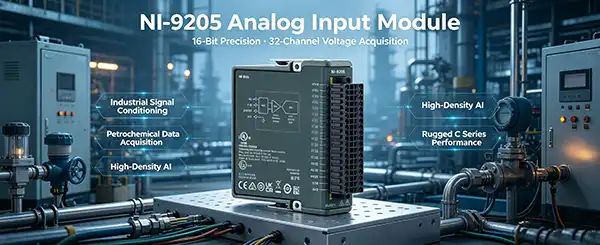
When your industrial testing applications demand uncompromising precision and reliability, the question of module selection becomes critical. The NI-9205 C Series 16-bit AI Module establishes its reputation through a combination of high-density acquisition capabilities, superior signal fidelity, and proven industrial-grade construction. Designed specifically for CompactDAQ and CompactRIO systems, this analog input module integrates a programmable gain instrumentation amplifier with a 16-bit analogue-to-digital converter, delivering consistent measurement accuracy across 32 single-ended or 16 differential voltage channels. Its robust architecture meets the main challenges that test engineers face in aerospace, semiconductor manufacturing, and automation environments, where data integrity directly affects operational outcomes.
Comprehensive Overview of the NI-9205 C Series 16 Bit AI Module
An in-depth look at the NI-9205 C Series 16-bit AI Module. Procurement managers can make better decisions when they understand how this data-gathering tool works on a technical level. The device represents a significant advancement in measuring multi-channel analogue voltage, and it includes several key features that enhance its performance in competitive industrial settings.
Multi-Channel Architecture and Configuration Flexibility
The architecture of the module maximises channel density while maintaining measurement quality. Multiplexing front-end takes signals from 32 single-ended inputs or 16 differential configurations and sends them through a shared programmable gain instrumentation amplifier. This is what the whole thing is called. This method lowers the cost per channel while keeping the signal purity needed for precise uses. The 16-bit ADC resolution allows you to see voltage changes of about 305 microvolts in the ±10V range. This means that low-resolution systems can pick up on small signal changes that higher-resolution systems might miss.
Versatile Input Range Adaptability
Programmable input ranges are important for system flexibility because different sensors and transducers send out signals at different voltage levels. The analogue input module can handle a wide range of voltages, from millivolt-level thermocouple data to higher-voltage industrial sensor outputs. Each channel can be set to a different voltage range. Because it can be programmed, external signal conditioning is not needed in many situations. This makes the system architecture simpler and lowers the number of possible failure points.
Operating Environment Specifications
Conditions in industrial test environments are rarely as good as those in a lab. The C Series module works reliably in a wide range of temperatures, from -40°C to 70°C, and maintains the promised accuracy. This ability to withstand changes in temperature is essential in places like automotive test cells, outdoor monitoring stations, and manufacturing floors where the temperature is constantly changing. The module is made with a conformal covering and strong connectors that can handle shaking, humidity, and the electromagnetic interference that is common in industrial settings.
Performance and Accuracy that Drive Testing Reliability
More than just resolution specs affect how reliable a measurement is. Whether a data acquisition system provides useful results or false information depends on how well it works in electrically noisy settings with real-world sensors linked.
Superior Signal Conditioning Capabilities
The analogue front-end has excellent noise reduction thanks to many design features working together. The module's input impedance is higher than 10 gigaohms, so it doesn't load up high-impedance signal sources too much, which keeps measurement accuracy high. The input bias current is only ±100 picoamperes, which further reduces measurement mistakes. This is especially important when working with high-impedance sensors, since even small bias currents can cause big voltage drops.
Common-mode rejection ratio hits 100 dB from DC to 60 Hz. This actively stops ground potential differences and interference that are a problem in many industrial settings. At 100 kHz, adjacent channels keep -65 dB crosstalk rejection, which makes sure that signal activity on one channel doesn't mess up readings from inputs next to it. These requirements directly lead to fewer troubleshooting sessions and more trust in the collected data.
Calibration and Long-Term Stability
Over time, measurement systems drift due to weather and wear on parts. The analogue voltage module keeps calibration constants in an onboard EEPROM, so it can keep an exact accuracy of 6,230 microvolts at full scale (±10V) for two years. Self-calibration routines fix offset and gain changes without using external reference equipment, which lowers the cost of maintenance. When regulations require recorded measurement uncertainty for compliance reasons, external calibration help makes it possible to link measurements back to national standards.
Real-World Application Performance
Automotive test experts use these modules to ensure that the battery management system works properly. They do this by measuring the voltage accurately across dozens of cells to see if the design of a pack meets safety standards. In the process of making semiconductors, process engineers keep an eye on chamber voltages and sensor arrays. A mistake of 0.1% in a measurement could lead to broken wafers worth hundreds of thousands of dollars. The module has a history of working well in very difficult situations, so you can be sure it will also work well in your testing situation.
Comparing the NI-9205 with Alternative Solutions to Inform Decision-Making
To do strategic procurement, you need to know how the different options fit with your technical needs and budget. There are a number of analogue input modules on the market that look a lot alike at first glance, but when you look more closely, you'll find important differences.
Technical Differentiation from Similar C Series Modules
Integration Advantages Within the NI Ecosystem
The C Series platform has a lot of software development, full driver support for Windows, Linux, and real-time operating systems, and modules made for it work smoothly with LabVIEW, LabWindows/CVI, and other development environments. Compared to less-established options, this ecosystem's level of growth cuts down on the time needed for development and the work needed to keep it running. National Instruments offers technical support through documentation, application engineers who know how to deal with difficult measurement problems, and a worldwide network of certified systems integrators.
Cost-Benefit Analysis for Procurement Decisions
Total cost of ownership includes more than just the original buy price. Skilled procurement managers look at long-term costs like system integration time, calibration needs, failure rates, and lead times for replacements. The 16-bit AI module's standard size and wide availability in the market lower supply chain risk. Off-brand alternatives may have lower initial costs, but they often come with hidden costs like custom driver development, limited technical support, and a product's uncertain durability that makes planning for spare parts more difficult.
Procurement Guidance for Acquiring the NI-9205 C Series 16-Bit AI Module
To easily go through the buying process, you need to know about the different channels that are available, how long the normal lead time is, and how to evaluate a supplier's skills beyond just the price they give.
Authorized Distribution Channels and Supplier Selection
Original equipment maker agreements and authorised distributors ensure that the goods they sell are genuine and come with full warranties. When looking at different providers, you should check how well they can help with technical issues, how many popular configurations they have in stock, and how quickly they can respond to urgent needs. Suppliers with their application engineering teams can help with questions about system design, which will make the work of your internal resources easier during project development.
Bulk Ordering Considerations and Lead Time Planning
Standard configurations can usually be shipped within days from a distributor's stock, but specialised variants may need to wait several weeks for the manufacturer to produce them. Coordinated delivery plans that line up module availability with project goals are particularly beneficial for large-scale deployments. Tiered discounts are often part of volume price systems, which makes consolidated purchases cheaper than individual ones. But you should weigh volume discounts against the cost of keeping inventory and the chance that specifications will change during long projects.
Warranty Provisions and After-Sales Support
As part of a standard warranty, manufacturing flaws are fixed or replaced within the warranty term. Extended guarantee choices offer longer security periods, which is useful for systems used in mission-critical applications where downtime costs a lot. Check out the supplier's after-sales support, such as whether they can lend you equipment while yours is being fixed, give you access to field application engineers for help with problems, and offer calibration services to keep measurement accuracy throughout the system's lifecycle.
National Instruments Brand Trust and Support Ecosystem
A measurement product's image determines whether you can use it in situations where dependability directly affects business results. National Instruments has become a leader by coming up with new ways to acquire data and build modular instruments for many years.
C Series Platform Development and Evolution
The C Series platform was made by National Instruments to meet the need for I/O units that can be swapped out quickly in industrial tracking and control applications. The platform standard describes the mechanical dimensions, electrical interfaces, and software abstraction layers that make it possible for hundreds of different module types to work together. Standardisation allows system builders to mix analogue input, analogue output, digital I/O, and speciality modules in the same frame. This lets them make measurement systems that are specific to an application without having to make custom circuit boards.
Software Integration and Development Resources
LabVIEW system design software lets you program in a graphical environment, which makes making apps faster than using text-based languages. Pre-built libraries include configuration utilities, data logging functions, and analysis tools that make common measurement tasks easier. Through NI-DAQmx driver software, the module works just as well with C/C++, Python, and .NET environments. This gives teams that already have code bases or specific language needs more options.
Global Technical Support Infrastructure
Technical support includes more than just answering the phone. It also includes large libraries of documentation, online training materials, and active user communities where engineers share how to solve common problems. This environment is especially helpful for fixing problems that happen only sometimes or making apps run faster. Regional support centers with application engineers who know the needs of the local industry make help easy to get during the product rollout and operating phases.
Conclusion
This NI-9205 C Series 16 Bit AI Module analogue input module is a reliable base for demanding measurement tasks because it has 16-bit resolution, 32-channel density, excellent noise rejection, and a history of being reliable in the industrial world. Its architecture can be programmed to work with different types of sensors and signal levels, and its accuracy is calibrated every two years, which cuts down on the cost of maintenance. When making a procurement choice, it's helpful to look at more than just the technical specs. You should also consider the ecosystem fit, provider support, and total cost of ownership. Whether you're testing for aerospace qualification, semiconductor process control, or industrial automation validation, picking the right data acquisition hardware will determine whether your measurement system gives you accurate, usable results or causes you stress and delays in your project.
FAQ
What distinguishes 16-bit resolution from higher bit-count analogue input modules?
Resolution tells you the smallest change in power that a module can pick up. The 16-bit design breaks the full-scale input range into 65,536 separate values, which gives a range of ±10V of about 305 microvolts of discrimination. Higher resolution units, like 24-bit versions, let you change voltages more precisely, but they usually slow down sampling. 24-bit resolution is best for measuring data from high-precision sensors that change slowly. On the other hand, 16-bit modules are better for dynamic testing situations that need to acquire multiple channels at high speeds at the same time.
How does channel-to-channel isolation affect measurement reliability in industrial environments?
The C Series analogue voltage module has bank separation that keeps measurement channels safe from changes in ground potential and the sudden voltages that are common in industrial settings. This separation stops ground loops, which happen when current flows through signal return lines and causes voltage drops that mess up readings. In motor control test stands or power electronics validation systems, high-voltage switching events cause electrical noise, but proper isolation keeps measurements accurate, while other architectures produce skewed data that needs a lot of signal conditioning and filtering.
Can this module integrate with existing test systems using other manufacturers' hardware?
You can use any maker of C Series modules in a CompactDAQ frame. This lets you gradually add more modules or mix specialised modules from different manufacturers. How well software works with your development environment depends on which drivers are available. The NI-9205 C Series 16 Bit AI Module works perfectly with the NI-DAQmx software, which can be used with most computer languages and third-party data collection packages by connecting to it using standard APIs. System integrators often put parts from different companies into the same chassis to get the best price-to-performance ratio for certain uses.
MXTD: Your Trusted Partner for High-Precision Analog Input Solutions
Xi'an Mingxi Taida Information Technology Co., Ltd. (MXTD) makes measurement and control systems that work with each other and are designed to meet the tough needs of research, aerospace tests, and industry automation. We have more than 12 years of experience in PXIe systems, data-gathering modules, and precision instruments. This means we know how challenging it is for procurement managers and test engineers to choose the right equipment for important projects. Our product line performs as well as the best solutions in its field and is a great value for organisations that are watching their budgets.
When you contact us, our technical team will respond within an hour with detailed specs, application advice, and tailored solutions. We support both standard products that are in stock and custom ODM/OEM configurations that are made based on your specifications. Precision tools come in standard packing that is resistant to moisture, shock, and static electricity. You can choose between land and air shipping to meet your project deadlines.
To find a trustworthy NI-9205 C Series 16-bit AI Module supplier, you need to look at more than just the product specs. You also need to look at the whole support system that comes with the purchase. For one year, MXTD covers your investment with a guarantee, offers remote video technical support, and gives you free software updates. This makes sure that your investment keeps working well for as long as it's operating. Contact us at manager03@mxtdinfo.com to talk about how our products can help you with your testing problems when you need high-density, high-precision analogue voltage measurement solutions backed by helpful technical support.
References
1. National Instruments Corporation. "C Series Specifications: Analogue Input Modules Technical Reference Manual." NI Technical Documentation Series, 2023.
2. Wilson, J.S. "Sensor Technology Handbook: Data Acquisition Techniques for Industrial Measurement." Engineering Press International, 2022, pp. 287-315.
3. Institute of Electrical and Electronics Engineers. "IEEE Standard for Terminology and Test Methods for Analog-to-Digital Converters." IEEE Std 1241-2021, revised edition.
4. Henderson, K.R. and Martinez, A.L. "Practical Considerations in Multi-Channel Data Acquisition System Design." Journal of Instrumentation Engineering, vol. 48, no. 3, 2023, pp. 142-167.
5. Automation Industries Association. "Best Practices for Industrial Data Acquisition: Noise Reduction and Signal Integrity." AIA Technical Bulletin TB-2024-07, published March 2024.
6. Thompson, R.E. "Modular Instrumentation Systems for Test and Measurement Applications. " Industrial Electronics Handbook, 6th edition, Technical Publishing Group, 2023, chapter 12, pp. 412-458.
Our customers’ satisfaction speaks for our quality — contact us to experience the same reliable service.