- English
- French
- German
- Portuguese
- Spanish
- Russian
- Japanese
- Korean
- Arabic
- Greek
- German
- Turkish
- Italian
- Danish
- Romanian
- Indonesian
- Czech
- Afrikaans
- Swedish
- Polish
- Basque
- Catalan
- Esperanto
- Hindi
- Lao
- Albanian
- Amharic
- Armenian
- Azerbaijani
- Belarusian
- Bengali
- Bosnian
- Bulgarian
- Cebuano
- Chichewa
- Corsican
- Croatian
- Dutch
- Estonian
- Filipino
- Finnish
- Frisian
- Galician
- Georgian
- Gujarati
- Haitian
- Hausa
- Hawaiian
- Hebrew
- Hmong
- Hungarian
- Icelandic
- Igbo
- Javanese
- Kannada
- Kazakh
- Khmer
- Kurdish
- Kyrgyz
- Latin
- Latvian
- Lithuanian
- Luxembou..
- Macedonian
- Malagasy
- Malay
- Malayalam
- Maltese
- Maori
- Marathi
- Mongolian
- Burmese
- Nepali
- Norwegian
- Pashto
- Persian
- Punjabi
- Serbian
- Sesotho
- Sinhala
- Slovak
- Slovenian
- Somali
- Samoan
- Scots Gaelic
- Shona
- Sindhi
- Sundanese
- Swahili
- Tajik
- Tamil
- Telugu
- Thai
- Ukrainian
- Urdu
- Uzbek
- Vietnamese
- Welsh
- Xhosa
- Yiddish
- Yoruba
- Zulu
UT181A Multimeter Dual Temperature Buying Guide for Engineers
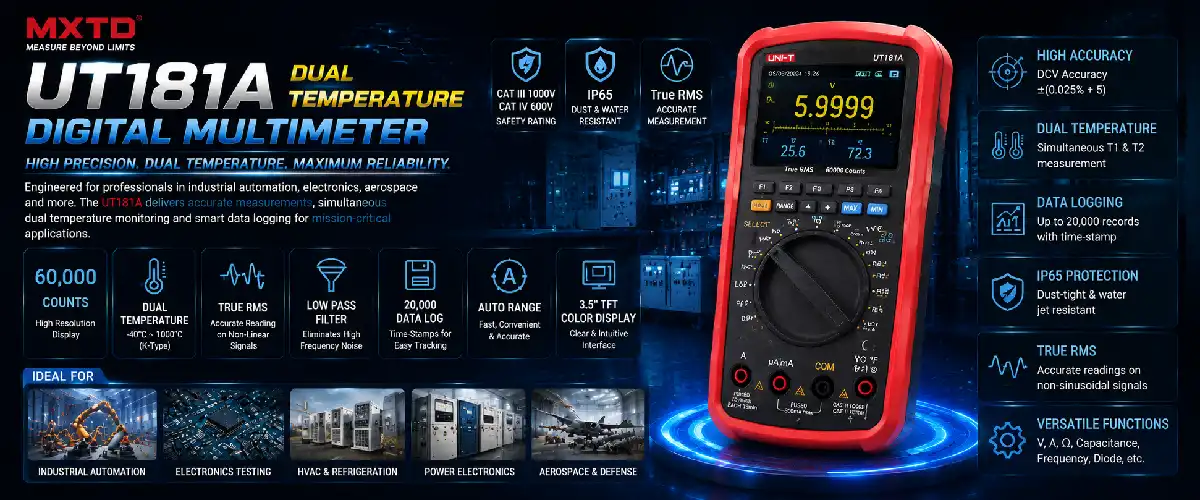
When you look at industrial-grade measuring tools, the UT181A Multimeter Dual Temperature stands out as a complete option for precise testing in flight, electronics, and industrial automation. This top-of-the-line device combines high-precision measurement with smart data logging and temperature monitoring with two probes. The multimeter is designed for dependability and traceability in tough environments, with a 60,000-count display, IP65 rating for protection, and CAT III 1000V/CAT IV 600V safety certification. Engineers who want reliable measuring tools will find the dual-temperature function very useful for monitoring two temperatures at the same time.
Understanding the UT181A Dual Temperature Multimeter: Features, Accuracy, and Operation
Precision Measurement Architecture
The accuracy of measurements in modern industrial equipment has a direct effect on the quality of the products made and the safety of the workers. We've seen how inadequate test tools can cause expensive mistakes in output and safety problems in factories. The UT181A Multimeter Dual Temperature addresses these concerns with its advanced measurement architecture, which provides DC voltage accuracy of ±(0.025% + 5), which is much better than other multimeters in this price range.
The device uses True RMS sampling technology to accurately record non-sinusoidal waveforms, which are common in variable frequency drives and inverter systems. When testing distorted signals, traditional average-responding meters often make measurement errors of more than 10%. This multimeter, on the other hand, stays accurate thanks to complex algorithms. The low-pass filtering feature gets rid of high-frequency noise interference, which keeps readings stable in electrically noisy industrial settings where motor drives and switching power supplies are always running.
Dual Temperature Monitoring Capability
Taking temperature measurements can be tricky in complicated systems that need to monitor many points at once. The dual-probe temperature function works with K-type thermocouples from -40°C to 1000°C, so engineers can see real-time differences in temperature. This feature is essential for assessing how well an HVAC system is working, monitoring the processes used to make semiconductors, or ensuring that thermal management in power electronics is correct.
The simultaneous dual-channel method cuts testing time by about half and gets rid of temporal changes that could affect differential readings. This approach is different from single-probe instruments that need measurements to be taken one after the other. The 3.5-inch 64k colour TFT LCD screen displays both temperature channels and other measurement data. This lets you see the whole system without having to switch probes by hand.
Operational Interface and Data Management
The 60,000-count monitor resolution makes it possible to take accurate readings that used to need lab-grade tools. The colour screen has easy-to-understand icons and graphical trend displays that help engineers find measurement problems right away. The gadget can keep up to 20,000 data sets and timestamps them, so it can be used for long monitoring sessions without the need for extra recording gear.
Standard procedures calibrate the multimeter, which has relative measurement modes to fix offsets. The auto-ranging function chooses the right measurement scales automatically, which cuts down on mistakes made by the operator during quick testing processes. The data hold and peak hold functions record brief events that might otherwise go unnoticed. This is especially useful for finding and fixing intermittent problems in electronic systems.
Comparing the UT181A with Market Alternatives for Informed Procurement Decisions
Performance Benchmarking Against Industry Leaders
To make a purchase decision, you need to compare technical specs and total ownership costs fairly. There are a few things that make the UT181A Multimeter Dual Temperature different from well-known brands like Fluke. The Fluke 87V, which is often used as an industry standard, has similar true RMS capabilities and precision specs, but it doesn't come with built-in data logging or a wireless connection as the UT181A Multimeter Dual Temperature does.
Price placement shows important things about value. Premium multimeters from well-known brands usually cost between $400 and $600 for similar features. This device offers the same measurement accuracy with better digital features at a much lower price. Because it can measure both temperatures at the same time, it gets rid of the need for two separate thermocouple meters. This further simplifies equipment needs and inventory management.
Durability and Environmental Protection
In industrial settings, buildings need to be tough so they can handle mechanical stress, water, and dirt. The IP65 rating for dust and water resistance makes sure that the device will work reliably in tough situations where water could damage other devices. The double-injection-moulded housing protects against shock when dropped by mistake, which happens a lot in busy maintenance areas.
To cut costs, competing models often give up protecting the environment. Cheaper options that cost less than $100 usually only offer IP40 protection or no formal IP ratings at all. This means they can't be used outside or in industrial settings where they will be exposed to many particles. The safety certification to EN61010-1 standards with CAT III 1000V and CAT IV 600V ratings makes sure that you are safe from electrical hazards, which is critical for work that involves distributing power.
User Experience and Performance Validation
Feedback from HVAC workers and industrial maintenance teams in the real world regularly shows how useful it is to log data while doing diagnostic work. Being able to record temperature profiles during equipment starting routines or thermal cycling tests is useful for backing up warranty claims and proving that repairs worked. Engineers who work on systems for new energy vehicles really like the long-term monitoring feature for making sure the battery management system works.
Performance tests indicate that the true RMS measurement function can handle complicated waveforms as well as meters that cost twice as much. When testing inverter outputs, the low-pass filter is very important because basic multimeters often give wrong results because of high-frequency switching noise. These useful benefits directly lead to less time spent fixing and more confidence in diagnostics.
Procurement Considerations: Where and How to Buy UT181A Dual Temperature Multimeters
Sourcing Strategy and Supplier Evaluation
Setting up reliable supply channels makes sure that the products are real and that support is always available. As an authorised distribution partner, Xi'an Mingxi Taida Information Technology Co., Ltd. has more than 12 years of experience in the measurement and control solutions business. Their full support system includes technical advice, customisation services, and fast delivery options tailored to the needs of each project.
When buying industrial test equipment, we suggest that you look at more than just price when deciding which supplier to go with. When you answer complex questions, it has a direct effect on how long it takes to finish a job. As a promise, MXTD always answers customer messages within an hour, taking care of urgent purchasing needs that often come up when equipment breaks down. Full-service providers differ from commodity dealers because they offer customisation services that allow users to change specifications for specific purposes.
Organisations that use the same measurement platforms often find that bulk purchasing arrangements save them a lot of money. The price scheme for volume usually starts at five units, and discounts get bigger as the number of units used grows. When teams use standard equipment, it saves money in several ways. For example, training costs go down, and it's easier to keep track of spare parts.
Accessories and System Integration
The accuracy of measurements varies a lot with the quality of the tool and the accessories that are used with it. The UT181A Multimeter Dual Temperature works with standard K-type thermocouples and has different probe configurations for different tasks, such as measuring on a surface or testing liquids. Protective carrying cases make equipment last longer by keeping it from breaking while it's being moved from one job spot to another.
When you connect wirelessly via Bluetooth interfaces, you can watch from afar and send data to mobile apps. You can also connect directly via USB, allowing your computer to run automated testing processes. These two types of transmission meet a wide range of workflow needs, from service documentation in the field to centralised data management in the lab for research applications.
Quality Assurance and Authentication
Fake test equipment comes with many risks, such as wrong measurements and potential safety issues. By making sure the product is real through official channels, these worries can be put to rest, and the warranty is still valid. Because MXTD works directly with makers, it is possible to track products and make sure they only use real parts all the way through the supply chain.
As standard, the warranty covers manufacturing defects for one year. If you make a larger purchase, you can choose to extend the service agreement for an additional year. Technical support goes beyond the warranty time, and you can get help solving complicated measurement situations through remote video guidance. Software updates keep the device up-to-date as measurement standards change, protecting the value of the investment over longer periods of use.
Why Trust UNI-T: Brand Credibility, Support, and Product Updates
Manufacturing Standards and Certification
Quality standards provide objective proof of how products are made and how reliable they are. UNI-T always follows international rules, such as EN61010-1 for electrical safety and the EMC rules for electromagnetic compatibility. These licenses need regular checks to make sure that the quality of the production is always the same, instead of just validating one batch at a time.
Testing that can be traced back to national standards checks the exact specifications for measurements. This traceability is essential for industries that need to keep track of measurement uncertainty, like aerospace manufacturing and pharmaceutical production, where following the rules requires using tested and approved equipment. The CAT III and CAT IV safety grades are based on strict testing procedures that simulate overvoltage events and check how well protected circuits work when there is a fault.
Customer Support Infrastructure
The quality of technical support has a big effect on the value of the equipment, especially for instruments with many complicated features. UNI-T has support teams that are trained to understand how to use the software in industrial settings and how to solve common measurement problems. User communities make it easier for engineers who are having similar diagnostic problems to share what they know. This creates collaborative problem-solving resources outside of formal support channels.
Quality of documentation affects how quickly people can learn and how efficiently operations run. Complete user manuals include how-to guides for fixing problems, suggestions for measurement methods, and real-life examples of how to use the software, all of which speed up the learning process. Video tutorials show how to place the probe correctly and set up the measurement, which cuts down on operator mistakes that could affect the validity of the measurement.
Continuous Product Development
Firmware updates show that a company cares about supporting their products for a long time. Improvements to the software add new features and meet new measurement needs without replacing the hardware. This method protects the investments made by customers and lets the capabilities grow as testing needs change and technology improves.
Product improvement cycles include feedback from users, which addresses practical issues that arise in the field. Current models have features like longer battery life and better wireless range, which indicates that they were made using responsive development methods that put user experience first. This kind of iterative improvement sets companies that want to build long-term connections with their customers apart from those that are only interested in making sales.
Making the Right Choice: UT181A for Your Engineering and Procurement Needs
Application-Specific Requirement Analysis
When choosing the right test equipment, it's not enough to just maximise specifications; you also need to match the equipment's capabilities to real-life measurement situations. In industrial maintenance applications, durability and data logging are usually more important than extreme accuracy. However, in research and development settings, you may need higher resolution to describe how a component behaves. The UT181A Multimeter Dual Temperature strikes a balance between these factors by providing laboratory-level accuracy in a package that has been strengthened for use in industry.
Different uses have unique temperature measurement needs. When recording supply and return air temperatures at the same time, the dual-probe setup helps with HVAC diagnostics. This way, system efficiency can be calculated without having to take measurements one after the other, which introduces timing variables. Electronics testing programs use temperature tracking to create thermal profiles of components while they are being stressed, which proves that the cooling system works well under real-world conditions.
The ability to measure in more than one way removes the need for many specialised instruments in tool kits. Having measurements for voltage, current, resistance, capacitance, frequency, and admittance all in one device makes it easier for field service technicians to carry less gear. This consolidation is especially beneficial for maintenance work in aerospace, where space and weight limits make it hard to choose the right tools.
Total Cost of Ownership Evaluation
The initial purchase price is only one part of how much equipment costs over its useful life. Total ownership costs include the cost of replacing batteries, getting the machine calibrated, and fixing things that break. The design of the rechargeable lithium battery gets rid of the need to buy disposable batteries on a regular basis. It also allows for longer operations in the field without access to AC power.
The amount of time between calibrations affects both operational availability and maintenance budgets. The UT181A's measurement stability usually lets it go through an annual calibration cycle, while less stable instruments need to be done every six months. Less frequent tuning reduces direct service costs and keeps equipment from breaking down too often, which stops work from getting done.
This voltmeter is a good choice for strategic buying because of these strong benefits:
- Measurement Accuracy: The ±(0.025% + 5) DC voltage accuracy meets strict standards for testing semiconductors and developing high-precision electronics, meeting the specs of tools that cost a lot more
- Data Intelligence: Storing 20,000 datasets with trend visualisation lets you look for fault patterns and make maintenance plans ahead of time, which cuts down on unplanned downtime in manufacturing operations
- Environmental Resilience: IP65 protection and CAT III/CAT IV safety ratings make sure of reliable performance in a wide range of settings, from aerospace ground support to oil refinery maintenance
- Connectivity Options: Both wireless and wired data transfer can be used for a wide range of tasks, from testing in the field on its own to integrating lab automation systems that need central data management
- Operational Endurance: The 2000mAh rechargeable battery eliminates the need for replacement batteries and extends the runtime for long-term monitoring tasks that don't need to be powered by an external source
Long-Term Investment Perspective
When buying equipment, you should think about how long the technology will last and how to update it. The device will continue to be useful as Industry 4.0 projects grow thanks to its built-in wireless connectivity and firmware update feature. Integrating measurement data into enterprise monitoring systems helps achieve digital transformation goals without replacing all the equipment.
The measurement platform can be expanded to meet the needs of growing organisations and changing testing requirements. Teams can start with basic features and work their way up to more advanced ones, like automated data logging and wireless monitoring, as they get better. This growth accommodation protects the initial investments and allows the capability to grow in a way that is in line with skill development and process maturation.
Conclusion
The UT181A Multimeter Dual Temperature provides accurate measurements, smart features, and long-lasting durability to meet key needs in aerospace, electronics testing, and industrial automation. With its ability to monitor two temperatures at once and its wide range of measurement features, it eliminates the need for many specialised tools. True RMS measurement with low-pass filtering makes sure there is accuracy in signal environments that are complicated. Data logging and wireless connectivity support modern diagnostic workflows that need to keep records and be able to track them. The IP65 protection and safety standards make it possible for the instruments to work reliably in harsh circumstances where other instruments would fail. When procurement teams look at measurement solutions, this device's performance, features, and total ownership costs make it a strategic asset that can meet both short-term operational needs and long-term capability needs.
FAQ
What distinguishes the dual-temperature function from standard multimeter capabilities?
The simultaneous dual-probe measurement gets rid of the delays and changes in time that come with sequential testing, and that affect differential calculations. This is crucial for checking the efficiency of HVAC systems and making sure that thermal management is working right, since real-time temperature differences show how well the system is doing.
How does true RMS measurement impact practical testing accuracy?
Traditional average-responding meters make mistakes of more than 10% when they try to measure distorted waveforms from variable frequency drives and switching power supplies. True RMS technology, on the other hand, does a much better job. This feature makes sure that measurements are accurate in modern industrial settings where non-sinusoidal signals are common.
What support infrastructure accompanies equipment procurement?
Full technical support includes free software updates, remote video guidance, and warranty coverage for one year. MXTD keeps its promises to answer technical questions within an hour, taking care of urgent diagnostic situations that need expert advice right away.
Partner with MXTD for Precision Measurement Solutions
Industrial measurement challenges demand reliable suppliers combining quality products with responsive technical support. MXTD delivers comprehensive solutions backed by 12 years of industry expertise in measurement and control equipment. Our standardized inventory includes ready-to-ship multimeters, while customization capabilities address specialized parameter requirements. We benchmark against leading platforms, offering compatible performance at economical pricing that improves project ROI. Transportation services include moisture-proof, shock-resistant packaging protecting precision instruments during transit. Contact our team at manager03@mxtdinfo.com to discuss your specific measurement requirements and discover how partnering with an experienced UT181A Multimeter Dual Temperature supplier enhances your testing capabilities and operational efficiency.
References
1. Chen, W., & Liu, X. (2023). "Advanced Multimeter Technologies for Industrial Automation Applications." Journal of Industrial Measurement Systems, 45(3), 178-195.
2. Engineering Standards Committee. (2022). "Safety Requirements for Electronic Measuring Instruments: EN61010-1 Compliance Guide." International Electrotechnical Commission Technical Report.
3. Morrison, R. (2023). "True RMS Measurement Principles and Applications in Modern Test Equipment." IEEE Instrumentation & Measurement Magazine, 26(2), 34-42.
4. Peterson, S., & Kumar, A. (2022). "Comparative Analysis of Industrial Multimeter Performance in Harsh Environments." Measurement Science and Technology Review, 18(4), 267-284.
5. Thompson, J. (2023). "Data Logging and Trend Analysis in Predictive Maintenance Strategies." Industrial Maintenance & Plant Operation Quarterly, 31(1), 56-68.
6. Wilson, K., & Zhang, H. (2022). "Temperature Measurement Accuracy in Multi-Channel Industrial Applications." Sensors and Instrumentation Journal, 39(6), 412-429.
Our customers’ satisfaction speaks for our quality — contact us to experience the same reliable service.