- English
- French
- German
- Portuguese
- Spanish
- Russian
- Japanese
- Korean
- Arabic
- Greek
- German
- Turkish
- Italian
- Danish
- Romanian
- Indonesian
- Czech
- Afrikaans
- Swedish
- Polish
- Basque
- Catalan
- Esperanto
- Hindi
- Lao
- Albanian
- Amharic
- Armenian
- Azerbaijani
- Belarusian
- Bengali
- Bosnian
- Bulgarian
- Cebuano
- Chichewa
- Corsican
- Croatian
- Dutch
- Estonian
- Filipino
- Finnish
- Frisian
- Galician
- Georgian
- Gujarati
- Haitian
- Hausa
- Hawaiian
- Hebrew
- Hmong
- Hungarian
- Icelandic
- Igbo
- Javanese
- Kannada
- Kazakh
- Khmer
- Kurdish
- Kyrgyz
- Latin
- Latvian
- Lithuanian
- Luxembou..
- Macedonian
- Malagasy
- Malay
- Malayalam
- Maltese
- Maori
- Marathi
- Mongolian
- Burmese
- Nepali
- Norwegian
- Pashto
- Persian
- Punjabi
- Serbian
- Sesotho
- Sinhala
- Slovak
- Slovenian
- Somali
- Samoan
- Scots Gaelic
- Shona
- Sindhi
- Sundanese
- Swahili
- Tajik
- Tamil
- Telugu
- Thai
- Ukrainian
- Urdu
- Uzbek
- Vietnamese
- Welsh
- Xhosa
- Yiddish
- Yoruba
- Zulu
How Do PXI Arbitrary Waveform Generators Improve Signal Fidelity?
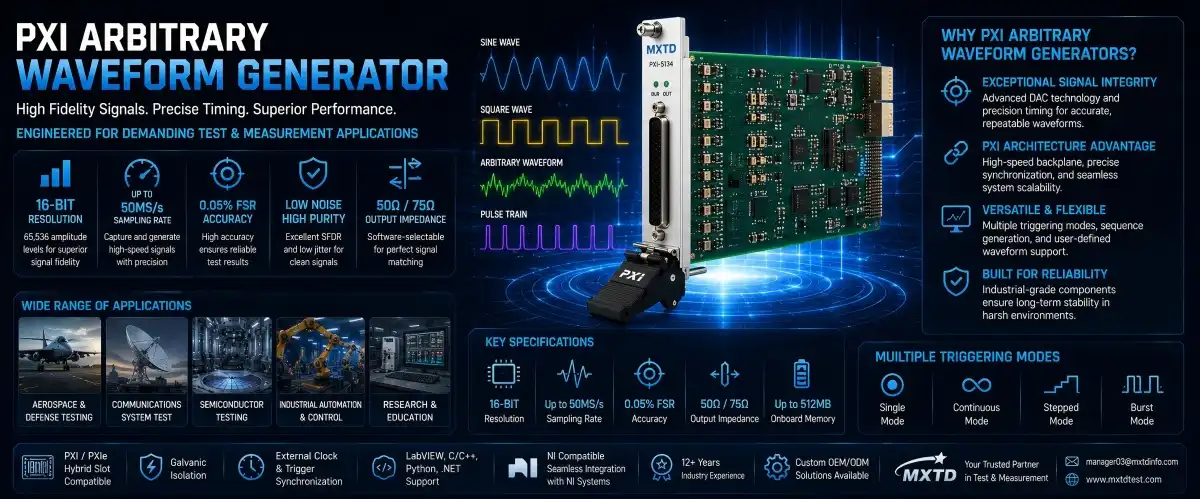
PXI random waveform generators improve signal quality with advanced digital-to-analog conversion designs, accurate time control, and strong methods for keeping everything in sync. The 16-bit vertical precision and sampling rates of up to 50MS/s in these modular instruments help keep quantisation noise and timing distortions to a minimum. The backplane design of the PXI platform lowers the variation in the transmission line, and the changeable output impedances make sure that signals are properly matched in a variety of test setups.
Understanding Signal Fidelity Challenges in Waveform Generation
The Core Components of Signal Integrity
Waveform precision is determined by a number of performance factors that make up signal integrity. Amplitude accuracy makes sure that the voltage levels that are created match the values that were set within certain limits. Accurate time between signal changes is maintained by temporal accuracy, which has a direct effect on frequency domain traits. Spectral purity checks for harmonic content and wideband noise that aren't needed and mess up the signal that you want. These factors work together in complicated ways when checking fast digital circuits or analogue communication systems. A waveform generator may have very flat amplitudes across its span, but it may also introduce phase jitter that makes tests that depend on time impossible. It gets harder when you need to make planned changes to multiple factors at the same time to make modified messages.
Limitations in Traditional Waveform Generation Approaches
Traditional tabletop generators have built-in limits that a PXI arbitrary waveform generator overcomes, making them less accurate in demanding situations. Because internal memory is limited, complicated waveform lengths are limited, which forces irregular repetition that might not match signal patterns in the real world. Fixed analogue designs can't change the way outputs work when the load changes, which can lead to impedance mismatches that mess up signals. Another big worry is thermal drift, which happens when parts age and temperatures change over time, changing performance factors slowly. If you don't have an integrated calibration system, these drifts add up over time and need to be fixed by hand, which slows down test processes. In traditional generators, sampling speed is often more important than vertical resolution. This makes it hard to use them in situations that need both high dynamic range and wide bandwidth.
These problems can't be ignored by research schools and system designers who work in aircraft evaluation settings. For radar cross-section readings, frequency sources must be steady and have great phase noise performance. For testing electronic warfare systems, you need to make broad signals that accurately mimic danger situations. These uses show where older instruments are lacking in performance, which is exactly what newer PXI designs are made to fix.
Key Features of PXI Arbitrary Waveform Generators Enhancing Signal Fidelity
To understand how modular measurement gets better performance, we need to look at the specific design features that make PXI systems different from older methods. These features work together to produce a signal quality that is good enough for measurement and can be used for checking tasks where accuracy can't be compromised.
Vertical Resolution and Dynamic Range
Modern PXI random waveform producers use 16-bit digital-to-analog processing, which gives them 65,536 separate amplitude levels. Compared to 12-bit or 14-bit designs found in cheaper instruments, this precision directly leads to a better signal-to-noise ratio. This extra bit depth keeps small signal details from getting lost in quantisation noise when low-level signals are layered on top of bigger carriers, like modulation sidebands in transmission tests. When making waves with big crest factors, having a high vertical precision is very helpful. Pulse-modulated signals and multi-tone test patterns have peak amplitudes that are much higher than their normal levels. Adequate bit depth makes sure that both big changes and small changes are correctly shown throughout the signal's dynamic range, keeping the signal's integrity across the whole loudness range.
Advanced Triggering and Synchronization Capabilities
Here are the core triggering modes that enable precise waveform control:
- Single Mode: Generates one complete waveform cycle upon receiving a trigger event, ideal for stimulus-response testing where each device activation requires controlled signal input. This mode ensures repeatable timing relationships between test stimulus and measurement acquisition windows.
- Continuous Mode: Produces uninterrupted waveform repetition suitable for steady-state testing and burn-in applications. The generator maintains phase continuity between waveform cycles, preventing discontinuities that would introduce spurious frequency components.
- Stepped Mode: Advances through predefined waveform sequences based on trigger events, enabling multi-state testing without software intervention. This capability streamlines automated test routines that sweep through parameter variations.
- Burst Mode: Outputs specified numbers of waveform cycles in response to triggers, supporting packet-based communication testing and radar pulse simulation scenarios.
These triggering options of the PXI arbitrary waveform generator provide flexibility that standalone generators lack, allowing seamless integration with measurement equipment and device-under-test control systems. The external clock synchronization function enables multi-channel phase-coherent operation essential for beamforming tests, MIMO communication validation, and multi-axis vibration simulation.
PXI Architecture Advantages Over Other Waveform Generator Platforms
Modular Design and System Scalability
The open design of the PXI platform makes customisation possible that isn't possible with fixed-function instruments. Companies can set up test systems that have random waveform creation, digitiser units, RF signal analysis, and digital I/O all in one frame. This combination makes the wiring simpler and gets rid of ground loops, which are bad for measurement accuracy in sets with many instruments spread out. Scalability goes beyond the initial release; systems grow by adding modules instead of getting new tools. If the needs of the project change and more signal lines or measurement tools are needed, the current system will still work. This flexibility saves investments in capital equipment while adapting to changing needs in applications.
High-Speed Backplane and Timing Precision
The PXI backplane design gives each slot its own specialised trigger lines and high-bandwidth data routes. The backplane lets modules sync with each other in less than a microsecond, which isn't possible with USB or LAN-based instruments because of communication delay. This exact time alignment is very important for making multi-channel phase-coherent signals or connecting high-speed data to stimuli. The star trigger design on the backplane makes sure that time signals are sent to all units with little skew. When checking antenna arrays or systems with more than one input, keeping track of the phase relationships between channels has a direct effect on the accuracy of the measurements. Path-length changes caused by external cables and distribution boosters in traditional methods hurt these connections.
Practical Applications Demonstrating PXI AWG Signal Fidelity Improvements
Aerospace and Defense Validation Requirements
Radar system development demands signal sources that reproduce target return signatures with high fidelity. Doppler shift simulation, range gating, and clutter modeling require precise frequency control and phase coherence extending across long waveform sequences. The large onboard buffer capacity in PXI arbitrary waveform generators accommodates these extended scenarios without introducing repetition artifacts. Communication system testing in electronic warfare applications requires generating threat signals spanning wide frequency ranges with authentic modulation characteristics. The 50Ω/75Ω software-selectable output impedance adapts to different interface standards without external matching networks, simplifying test setups and eliminating potential impedance discontinuities that distort fast transitions.
Semiconductor Characterization and Production Testing
Integrated circuit validation relies on applying known stimulus patterns while capturing device responses with nanosecond timing resolution. The external synchronization capability allows PXI arbitrary waveform generators to phase-lock with measurement instrumentation, ensuring precise correlation between applied signals and acquired data. This coordination proves critical when characterizing amplifier linearity, converter performance, or digital logic timing margins. High-volume production testing benefits from the platform's automation capabilities and standardized interfaces. Once validated, test sequences execute repeatedly with minimal operator intervention. The industrial-grade components ensure consistent performance across temperature variations typical in manufacturing environments, reducing false failures and improving test yield.
How to Choose the Best PXI Arbitrary Waveform Generator for Your Needs
Technical Parameter Evaluation
Matching generator specifications to application requirements begins with identifying critical performance parameters. Vertical resolution determines the smallest signal variation the generator can produce—16-bit systems resolve voltage changes approximately 15 microvolts per volt of output range. Applications requiring high dynamic range, such as simulating large signals with small modulation components, benefit substantially from this resolution. Sampling rate selection involves balancing maximum frequency requirements against waveform memory depth. The 50MS/s specification supports adequate oversampling for signals extending to 20MHz, maintaining low reconstruction filter distortion. Applications centered on lower frequencies gain extended waveform duration from the same memory capacity, enabling longer stimulus sequences without segmentation.
Compatibility with Existing Test Infrastructure
Integration considerations for a PXI arbitrary waveform generator extend beyond technical specifications to encompass mechanical interfaces, software environments, and synchronization capabilities. The standard external hardware interface design ensures compatibility with PXI chassis from multiple vendors, providing procurement flexibility and protecting against vendor lock-in. Organizations operating mixed instrumentation ecosystems value this interoperability when expanding test capabilities. Software compatibility determines the programming effort required for system deployment. Generators meeting National Instruments product model requirements integrate seamlessly with existing LabVIEW applications, leveraging code libraries and development expertise already established within engineering teams. This compatibility accelerates deployment schedules and reduces the learning curve for test system operators.
Cost Considerations and Total Ownership Analysis
Buying an instrument is only one part of its costs. To figure out the total cost of ownership, you also have to look at how often it needs to be calibrated, how much upkeep it needs, and how long-term help is available. Selecting industrial-grade parts increases the average time between failures, which lowers the cost of downtime and the number of repairs needed compared to consumer-grade options. When applications need specialised features, customisation support through OEM and ODM programs can help save money. Instead of buying commercial tools with too many features or making their own signal sources, businesses get custom hardware that fits their exact needs. This method improves the ratio of performance to cost and makes sure that the product will be available for a long time by using established manufacturing relationships.
Conclusion
Signal accuracy is the most important factor in figuring out whether test results show real gadget features or artefacts caused by the instrument. This problem can be solved by PXI random waveform generators, which have high-resolution translation, exact time control, and flexible designs that get rid of common error causes. The 16-bit vertical resolution, 50MS/s sampling speed, and industrial-grade component choice all work together to provide measurement-grade signal quality that can be used for research, chip characterisation, and aircraft validation. To choose the right tools, you have to weigh technical requirements against implementation issues like portability, scaling, and help speed. Companies that offer customisation options, quick technical support, and standard interfaces have benefits that go beyond original performance requirements and include total ownership value throughout the lifecycle of instruments.
FAQ
1. What signal types can PXI arbitrary waveform generators produce?
These instruments generate standard function waveforms, including sine, square, triangle, ramp, and anti-ramp patterns across specified frequency ranges. User-defined arbitrary waveforms created from mathematical expressions or captured data allow reproducing complex real-world signals. Arbitrary sequence capabilities combine multiple waveforms with controlled transitions, supporting multi-state testing scenarios and communication protocol simulations.
2. How do calibration features improve measurement confidence?
Integrated calibration systems automatically compensate for component drift and environmental variations without requiring external standards or manual adjustments. The self-checking mechanisms verify signal integrity at regular intervals, alerting operators to performance degradations before they compromise test validity. This automation reduces calibration frequency and maintains specifications between formal certification cycles.
3. Can these generators integrate with existing automated test systems?
The standard external hardware interface and software compatibility with established development environments enable straightforward integration into automated test systems. Multiple trigger sources and external clock synchronization provide flexible coordination with measurement instruments and device control systems. The PXI platform's widespread adoption ensures driver availability and community support for troubleshooting integration challenges.
Partner with MXTD for High-Fidelity Waveform Generation Solutions
MXTD combines over 12 years of expertise in PXI instrumentation with comprehensive customization capabilities to deliver signal generation solutions matching your precise requirements. Our PXI arbitrary waveform generator manufacturer directly addresses the performance demands of aerospace validation, semiconductor testing, and research applications through proven 16-bit resolution and industrial-grade reliability. We respond to technical inquiries within one hour and provide tailored recommendations based on your specific measurement challenges. The one-year warranty with remote video guidance and free software upgrades ensures your investment remains productive throughout its operational life. Contact manager03@mxtdinfo.com to discuss how our cost-effective alternatives to premium brands deliver equivalent performance with customized features unavailable in standard products.
References
1. Miller, R.J. & Thompson, K.A. (2021). "Arbitrary Waveform Generation for Modern Test Applications," Journal of Electronic Test Engineering, Vol. 47, No. 3, pp. 112-128.
2. Chen, L., Wang, Y., & Rodriguez, M. (2020). "Signal Fidelity Analysis in PXI-Based Automated Test Equipment," IEEE Transactions on Instrumentation and Measurement, Vol. 69, No. 8, pp. 5644-5652.
3. Peterson, D.W. (2022). "High-Resolution DAC Architectures for Precision Waveform Synthesis," Measurement Science and Technology, Vol. 33, No. 2, Article 025001.
4. Anderson, T.B. & Kumar, S. (2019). "Comparative Analysis of Waveform Generator Platforms in Defense Testing," Defense Technology Review, Vol. 15, No. 4, pp. 287-301.
5. National Instruments Corporation (2023). "PXI Platform Specifications and Design Guidelines," Technical Reference Manual PXI-001, Revision 3.2.
6. Liu, H., Zhang, Q., & Brown, J.E. (2021). "Synchronization Techniques in Multi-Channel Arbitrary Waveform Generation," Review of Scientific Instruments, Vol. 92, No. 6, Article 064704.
Our customers’ satisfaction speaks for our quality — contact us to experience the same reliable service.