- English
- French
- German
- Portuguese
- Spanish
- Russian
- Japanese
- Korean
- Arabic
- Greek
- German
- Turkish
- Italian
- Danish
- Romanian
- Indonesian
- Czech
- Afrikaans
- Swedish
- Polish
- Basque
- Catalan
- Esperanto
- Hindi
- Lao
- Albanian
- Amharic
- Armenian
- Azerbaijani
- Belarusian
- Bengali
- Bosnian
- Bulgarian
- Cebuano
- Chichewa
- Corsican
- Croatian
- Dutch
- Estonian
- Filipino
- Finnish
- Frisian
- Galician
- Georgian
- Gujarati
- Haitian
- Hausa
- Hawaiian
- Hebrew
- Hmong
- Hungarian
- Icelandic
- Igbo
- Javanese
- Kannada
- Kazakh
- Khmer
- Kurdish
- Kyrgyz
- Latin
- Latvian
- Lithuanian
- Luxembou..
- Macedonian
- Malagasy
- Malay
- Malayalam
- Maltese
- Maori
- Marathi
- Mongolian
- Burmese
- Nepali
- Norwegian
- Pashto
- Persian
- Punjabi
- Serbian
- Sesotho
- Sinhala
- Slovak
- Slovenian
- Somali
- Samoan
- Scots Gaelic
- Shona
- Sindhi
- Sundanese
- Swahili
- Tajik
- Tamil
- Telugu
- Thai
- Ukrainian
- Urdu
- Uzbek
- Vietnamese
- Welsh
- Xhosa
- Yiddish
- Yoruba
- Zulu
What Makes 32-Channel ARINC429 Boards Ideal for Lab Testing?
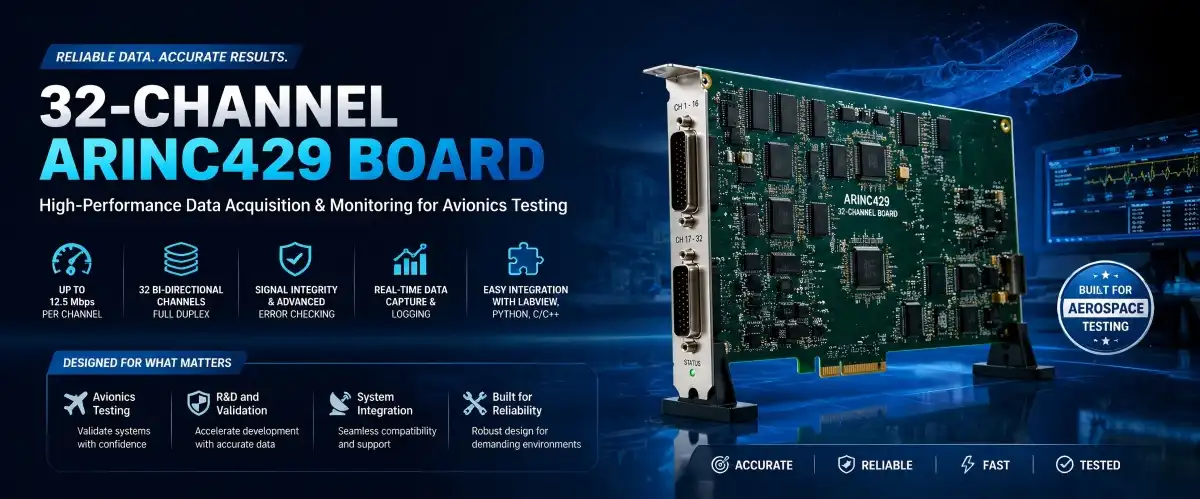
A 32-channel ARINC429 board offers great flexibility and parallel data processing features that directly meet the needs of current aviation labs. These boards can watch and send data over multiple communication channels at the same time, which cuts down on testing time and improves accuracy in difficult system validation jobs. In a single PXIe slot, the high channel density allows for full fault injection situations, real-time monitoring, and testing of multiple systems working together. This combining of functions makes lab sets easier, equipment footprints smaller, and data throughput higher. These are all very important for R&D teams that have to meet strict legal requirements and tight development plans.
Understanding 32-Channel ARINC429 Boards and Their Role in Lab Testing
What is ARINC429 Protocol and Why It Matters
ARINC429 is the main transmission standard for both business and military avionics systems. It sends digital data at set speeds of either 12.5 kbps or 100 kbps. Each word that is sent has 32 bits that are grouped into areas that hold data, labels, and parity checks. The stability of this protocol comes from its one-way, point-to-point design, which lowers the risk of data collisions and improves signal integrity. To correctly confirm avionics subsystems, testing tools must be able to copy these exact traits. A 32-channel ARINC429 board makes these working conditions happen on a larger scale, which lets engineers test whole aircraft communication systems in safe labs.
Channel Density Advantages in Complex Testing Scenarios
Channel capacity is what limits labs that work on projects that use flight management systems, engine controls, guidance units, and cockpit screens, all at the same time. Traditional 8-channel or 16-channel connections need more than one board, which takes up more rack space and makes it harder to keep everything in sync. With 32-channel setups, these needs can be met by a single interface card, which keeps the timing of all the data lines very close to each other. This design efficiency is very helpful during hardware-in-the-loop testing, where the truth of the test depends on how well the parts work together in terms of time.
Technical Architecture Supporting Lab Requirements
Modern ARINC429 testing boards use FPGA-based signal processing to give you configurable logic resources that can change with test methods without having to buy new hardware. Onboard memory buffers record short-lived events and strange protocol behavior that real-time tracking systems might miss. The PXIe form factor allows for fast data flow to host computers, providing the data rates needed to record all 32 channels at full speed. When you use differential line drivers and receivers, the signal quality stays the same over long wire runs that are common in lab rack setups. This is because they keep the voltage levels and rise times that are required by ARINC429 standards.
Core Performance and Technical Benefits for Lab Applications
Data Throughput and Latency Considerations
The success of multi-channel aircraft testing boards has a direct effect on how well tests work and how good the data is. When all 32 channels work at full speed at the same time, a properly built 32-channel ARINC429 board can handle overall data rates over 3.2 Mbps. The delay between receiving data and the host being available stays below 10 microseconds, which lets automatic test processes make decisions in real time. During fault injection testing, where test equipment has to find oddities and change input patterns on the fly, this response is very important. The low-jitter clock spread across all channels keeps everything in sync to within nanoseconds, which makes sure that events in different data streams can be correctly linked.
Signal Integrity in High-Density Configurations
Putting 32 differential transceiver pairs on a single board is very hard for signal security, which is what sets industrial-grade systems apart from commercial ones. Advanced designs use multi-layer PCBs with separate ground planes, controlled impedance lines, and smart component placement that keeps interference between channels to a minimum. Shielded connection systems keep low-voltage differential signals from being messed up by electromagnetic radiation from the outside. Power supply filters and delivery networks keep digital switching noise away from analog front ends that are more sensitive. Because of these technical factors, channel 32 keeps the same signal quality as channel 1, which means that measurements are always accurate.
Software Integration and Diagnostic Capabilities
Only when they are used with complex software settings do the hardware features of testing interfaces work at their best. Leading ARINC429 boards come with full driver support for LabVIEW, Python, C/C++, and .NET frameworks, which makes it easy to connect them to test automation systems that are already in place. Configuration tools make it easy to change channel parameters like bit rate, parity settings, and label filters without having to program low-level registers. Real-time tracking tools show all channels at the same time, decoded protocol data, error figures, and timing readings. Advanced triggering features make it possible to sync data collection with outside events or certain protocol conditions. This helps find intermittent problems that only happen in certain operating situations.
Typical Lab Testing Applications Leveraging 32-Channel ARINC429 Boards
Embedded System Validation and Certification
Before getting an airworthiness certificate from regulatory bodies, avionics equipment goes through a lot of hard validation processes. Test engineers have to make sure that the protocol is correctly implemented, that timing rules are followed, that data is correct, and that faults are handled in thousands of different operating situations. In order to simulate the entire aircraft data bus environment and record the unit being tested's behavior, a 32-channel ARINC429 board acts as both a trigger generator and a reaction monitor. This feature speeds up compliance testing by getting rid of the need to put real airplanes during the development stages. In a controlled lab setting, engineers can re-create certain flight conditions, add strange but acceptable data patterns, and check for smooth degradation when a component fails.
Real-Time Data Acquisition for R&D Cycles
Instruments that are flexible enough to change to changing project needs without taking a long time to buy are needed by research and development teams. Multi-channel avionics connections allow engineers to do exploratory testing, in which they watch many data points at once to find out how different systems interact in ways that were not expected. Keeping track of all contact channels makes large datasets that can be used for post-test analysis, training machine learning algorithms, and making the system work better. As engineers test prototypes, they connect avionics bus traffic to other instruments, such as analog measures, digital I/O, and video capture, to get a full picture of how the system works in different situations.
Fault Injection and Reliability Testing
Aerospace systems need to be able to handle a number of different types of failure, such as stuck bits, wrong parity, invalid labels, and time errors. More advanced testing boards can automatically add these faults and watch how the system responds through separate receive lines. A 32-channel setup lets you inject faults into multiple data sources at the same time, which lets you replicate complicated failure scenarios that you can't do with fewer channels. Test sequences make sure that safety-critical systems properly find problems, sound the right alarms, and keep working safety margins. This way of testing not only makes sure that individual parts work, but also that the whole system's combined fault management design does.
Comparative Analysis: Selecting the Best 32-Channel ARINC429 Board for Your Lab
Key Technical Specifications for Procurement Decisions
To choose the right testing equipment, you need to carefully compare the equipment's specs to the needs of the application. Channel count is only one part of a choice grid that has many more. Managers in charge of buying things should look at the fastest data rates per channel, the freedom of the transmit/receive setup, and the label filtering options. Some boards only use certain channels for broadcast or reception. However, customizable designs let any channel work in either mode, which gives you more options for testing. The board's ability to find small protocol violations depends on its timing resolution. The best boards offer sub-microsecond clock accuracy. How long the board can collect data without help from the server depends on the buffer depth. This is important for long-term stress tests.
Manufacturer Landscape and Product Positioning
Several well-known companies make avionics testing tools, and some of them offer 32-channel ARINC429 options with different sets of features. Curtiss-Wright Defense Solutions makes ruggedized boards for harsh settings that can handle a wider range of temperatures and have better mechanical specs. ADLINK Technology focuses on integrating software, providing complete computer interfaces, and sample code that speeds up the building of test systems. Abaco Systems specializes in high-density packaging and has conduction-cooled options that can be used in sealed box setups. The design goals of each manufacturer's goods are different, and buying teams should make sure that these features work with their particular working settings and integration needs.
MXTD's Value Proposition in the Market
We at MXTD have built a strong reputation as a trustworthy 32-channel ARINC429 board provider by offering low prices and quick technical help. We know exactly what aerospace and defense labs need because we've been making PXIe frames, boards, and testing tools for more than 12 years. Our ARINC429 boards offer performance that meets industry standards and cost savings for procurement managers who are watching their pennies. The boards have FPGA-based designs that let you change how they are set up, full software driver support, and industrial-grade construction that makes sure they work reliably during long test runs. Standard items are in stock and can be shipped right away. Technical questions are answered within one hour, and our engineering team can help with ODM/OEM customization for unique needs.
Total Cost of Ownership Considerations
The price of buying equipment is only one part of the long-term costs of owning it. Managers in charge of buying things should look at things like guarantee coverage, how quickly technical help responds, software update policies, and the availability of spare parts. Some companies charge a fee every year for software upkeep and changes, while others include these services in the price of the software when it is first bought. Remote debugging cuts down on downtime when problems happen, which is especially helpful for labs that work different times. Training materials like sample programs, application notes, and good documents speed up the hiring of new engineers and lower the costs of internal development. MXTD offers a one-year guarantee, free software updates, and the ability to negotiate special support plans for customers who buy a lot or know what they're doing.
Best Practices for Integrating 32-Channel ARINC429 Boards into Your Lab Testing Setup
Installation and Initial Configuration
For integration to work, the hardware must be installed correctly and according to the manufacturer's instructions. 32-channel transceivers make a lot of heat when they're working all the time, so PXIe boards need frames that can keep them cool. Make sure that the chassis power sources have enough power for all the boards that are attached, plus extra power in case you need it in the future. Place boards in slots that have the right number of PCIe lanes for them. For high-channel-count connections, this is usually x4 or x8. Methodically connect the wires and write down the channel assignments to avoid misunderstanding while the test program is being made. To keep the signal strong and stop links from dropping out, use high-quality shielded wires with the right strain relief in the connectors. Before starting to build an application, use the manufacturer's troubleshooting tools to make sure the installation went well.
Software Configuration and Driver Optimization
After installing the hardware, you should change the settings in the operating system to get the best data speed and the least amount of delay. Turn off any power control tools that could slow down the PCIe bus while testing. Install the most recent driver versions from the manufacturer, and pay attention to any needs or limits that are specific to your operating system. Set the right amount for your DMA buffers. Larger buffers improve throughput but raise latency, while smaller buffers lower latency but may lower throughput. Set thread priorities for processes that collect data so that lower-priority jobs don't get in the way of actions that need to be done quickly. Make sure that the application code handles errors correctly so that any strange interactions between the host and hardware can be found and logged.
Maintaining Signal Quality and Measurement Accuracy
In high-density testing setups, the way cables are managed and the electrical surroundings have a big effect on the quality of measurements. Cables for ARINC429 should not be near power supplies, motor drives, or other things that could make noise. Keep the wire bend radius that the connector maker tells you to keep, and the signal will be strong. Use known-good data sources or loopback tests to check the accuracy of the timing and the voltage levels on a regular basis. During long test runs, keep an eye on the board's temperature and make sure that there is enough movement and that the cooling fans are working properly. When the system is first set up, write down some basic speed data. This will allow you to look at trends and see when things start to get worse before they affect test results. MXTD helps customers with these optimization steps by giving them online advice, which makes sure they get the most out of their equipment investments.
Preventive Maintenance and Troubleshooting Strategies
Set up repair plans that include checking and cleaning connectors and making sure they work every so often. Over time, dust and oxidation build up on avionics joints, which lowers the contact resistance and causes periodic faults that are hard to figure out. Keep extra wires and connectors on hand to figure out if the problem is with the board or the connections. Keep thorough records of how the board is used, including how long it is powered on, when it changes temperatures, and any strange behavior. This literature is very helpful for troubleshooting problems that happen from time to time or for figuring out whether the behavior seen is caused by real mistakes or by misinterpreting how something works. Our technical team is always ready to help with difficult problems, drawing on a wealth of knowledge gained from a wide range of application scenarios.
Conclusion
The 32-channel ARINC429 board is now an essential piece of equipment in current avionics testing labs because it provides the channel density, speed, and reliability needed for full system validation. These connections combine testing features that were previously needed on multiple boards. This lowers the cost of equipment, makes syncing easier, and raises the quality of the data. When choosing the right gear, you have to weigh the technical specs, the supplier's help options, and the total cost of ownership against the needs of the application. Integrating tools correctly makes it work better, and preventative care makes sure it will last for a long time. As avionics systems get more complicated, the testing infrastructure needs to change, too. This means that high-channel-count interfaces are not only useful, but they're also necessary to keep development and approval plans.
FAQ
What advantages do 32-channel boards provide compared to lower channel counts?
High channel density lowers the amount of equipment needed, saves rack space, and makes it easier to sync up multiple data streams. When testing full airplane subsystem simulations, it's necessary to keep an eye on a lot of buses at once. This is why 32-channel setups are more useful and cost-effective than putting together a bunch of smaller boards. All channels use the same time reference, which makes sure that events on different buses can be correctly linked.
Can these boards be customized for specific testing requirements?
A lot of companies, like MXTD, give customization services that are made to fit the wants of each application. Changes could include special connector arrangements, wider temperature ranges, custom FPGA software that uses secret protocols, or connecting to existing rack-mount chassis systems. Our engineering team works with customers to describe their needs, come up with unique solutions, and make sure the right paperwork is done. Production times depend on how complicated the changes are, but we keep in touch with you throughout the whole process.
How do I verify compatibility with existing test systems?
When checking for compatibility, both hardware and software should be looked at. Hardware compatibility checks the presence of PXIe chassis physical slots, the power supply's capacity, the chassis's ability to cool properly, and the ease of access to connectors. Software compatibility includes support for multiple operating systems, tools for computer languages, and the ability to work with test automation frameworks such as LabVIEW and TestStand. MXTD gives full specs and offers pre-purchase advice to make sure that the products will work together. This lowers the risk of integration problems and stops you from making mistakes that cost a lot of money.
Partner with MXTD for Your Avionics Testing Needs
The 32-channel ARINC429 board options that MXTD offers are the best in the business. They are designed to work in harsh lab settings in aerospace, defense, and advanced electronics testing. Our goods have performance levels that are comparable to those of high-end makers, and their prices are low enough that you can get the most out of your instrumentation budget. As a reputable 32-channel ARINC429 board maker with in-depth knowledge of the PXIe ecosystem, we offer both standard setups that can be shipped right away and custom solutions that are made to fit specific needs. When people ask questions, our expert team answers them within an hour, which is very important during times of intense growth. We offer ODM/OEM services, free software updates, remote video help, and a range of guarantee options. Get in touch with us at manager03@mxtdinfo.com to talk about your specific testing needs and find out how our solutions can help you speed up development while lowering the total cost of your tools.
References
1. Airlines Electronic Engineering Committee. (2001). ARINC Specification 429: Mark 33 Digital Information Transfer System. Aeronautical Radio, Incorporated.
2. Spitzer, C. R. (2017). Avionics: Elements, Software, and Functions. CRC Press.
3. Tooley, M., & Wyatt, D. (2019). Aircraft Communications and Navigation Systems: Principles, Maintenance, and Operation for Aircraft Engineers and Technicians. Routledge.
4. Moir, I., & Seabridge, A. (2020). Design and Development of Aircraft Systems. John Wiley & Sons.
5. Collinson, R. P. G. (2011). Introduction to Avionics Systems. Springer Science & Business Media.
6. Kayton, M., & Fried, W. R. (1997). Avionics Navigation Systems. John Wiley & Sons.
Our customers’ satisfaction speaks for our quality — contact us to experience the same reliable service.