- English
- French
- German
- Portuguese
- Spanish
- Russian
- Japanese
- Korean
- Arabic
- Greek
- German
- Turkish
- Italian
- Danish
- Romanian
- Indonesian
- Czech
- Afrikaans
- Swedish
- Polish
- Basque
- Catalan
- Esperanto
- Hindi
- Lao
- Albanian
- Amharic
- Armenian
- Azerbaijani
- Belarusian
- Bengali
- Bosnian
- Bulgarian
- Cebuano
- Chichewa
- Corsican
- Croatian
- Dutch
- Estonian
- Filipino
- Finnish
- Frisian
- Galician
- Georgian
- Gujarati
- Haitian
- Hausa
- Hawaiian
- Hebrew
- Hmong
- Hungarian
- Icelandic
- Igbo
- Javanese
- Kannada
- Kazakh
- Khmer
- Kurdish
- Kyrgyz
- Latin
- Latvian
- Lithuanian
- Luxembou..
- Macedonian
- Malagasy
- Malay
- Malayalam
- Maltese
- Maori
- Marathi
- Mongolian
- Burmese
- Nepali
- Norwegian
- Pashto
- Persian
- Punjabi
- Serbian
- Sesotho
- Sinhala
- Slovak
- Slovenian
- Somali
- Samoan
- Scots Gaelic
- Shona
- Sindhi
- Sundanese
- Swahili
- Tajik
- Tamil
- Telugu
- Thai
- Ukrainian
- Urdu
- Uzbek
- Vietnamese
- Welsh
- Xhosa
- Yiddish
- Yoruba
- Zulu
What Software Works with MIL-STD-1553B Test Cards?
When evaluating software compatibility for MIL-STD-1553B test cards, several solutions stand out in the aerospace and defense sectors. The MIL-STD-1553B test card functions as the hardware backbone for avionics bus testing, yet its diagnostic power depends entirely on robust software platforms. Leading options include National Instruments' NI-XNET, Curtiss-Wright's Bus Tools, and various specialized drivers that enable real-time monitoring, protocol analysis, and error injection. These software suites transform raw bus data into actionable insights, allowing test engineers to validate system behavior, troubleshoot communication faults, and ensure compliance with stringent military standards across mission-critical applications.
Understanding MIL-STD-1553B Test Cards and Their Software Requirements
The Architecture of MIL-STD-1553B Test Cards
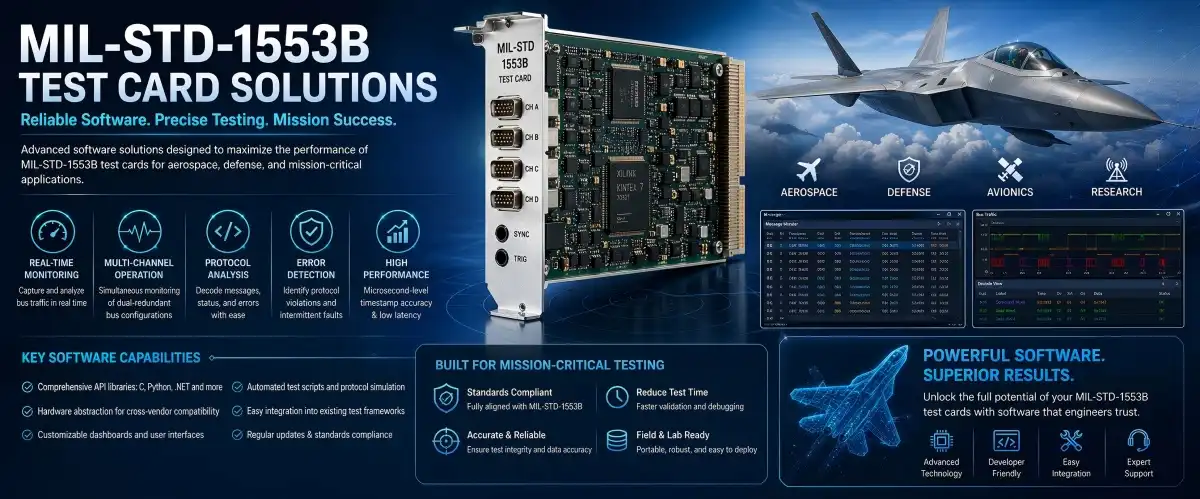
A MIL-STD-1553B test card serves as the physical interface between your test system and the avionics data bus. These cards typically plug into PXIe chassis or similar modular platforms, featuring specialized transceivers that handle the unique electrical characteristics of the 1553 protocol. The hardware manages signal conditioning, transformer coupling, and precise timing requirements mandated by the military standard.
Essential Software Functionalities
When software is used with MIL-STD-1553B test cards, it needs to do a lot of important things at once. Protocol simulation lets engineers pretend to be bus monitors, remote terminals, or bus controllers, based on the test needs. When you're looking at fast transactions that happen across multiple bus channels, you need to be able to record data in real time. Decoding functions turn raw Manchester-encoded signals into message formats that humans can understand. They do this by showing command words, data words, and status replies in easy-to-understand ways. Error detection is another important software feature. The protocol has built-in ways to check for errors, and good test software should be able to quickly find parity errors, timeout conditions, and protocol violations. Advanced packages also have error injection features that add bugs on purpose to test how well the system handles errors and how resilient it is.
Logging and Analysis Requirements
Comprehensive logging capabilities differentiate professional-grade software from basic monitoring tools. Test sequences in aerospace development often run for hours or days, generating massive datasets that require efficient storage and retrieval. Software must timestamp every transaction with microsecond precision, enabling engineers to MIL-STD-1553B test card correlate bus events with external system behaviors during failure analysis.
Overview of Popular Software Compatible with MIL-STD-1553B Test Cards
National Instruments Platform
National Instruments provides comprehensive software support through its NI-XNET driver suite and associated development environments. Their platform integrates seamlessly with LabVIEW, offering graphical programming capabilities that appeal to many test engineers. The software handles configuration management through intuitive database editors where you define bus parameters, terminal addresses, and message schedules. Real-time monitoring displays provide live visualization of bus traffic with color-coded message states.
Curtiss-Wright Bus Tools
Curtiss-Wright Defense Solutions offers Bus Tools as its flagship software package for 1553 applications. This solution emphasizes scripting capabilities, allowing experienced engineers to automate complex test sequences through Python or proprietary scripting languages. The software excels at generating detailed compliance reports required for certification processes, automatically documenting every test parameter and result.
Abaco Systems Software Ecosystem
Abaco Systems delivers specialized software tailored to its hardware platforms, emphasizing rugged deployment scenarios. Their packages include field-programmable features that allow engineers to update test configurations without returning to the lab environment. The software architecture separates configuration from execution, enabling rapid switching between different test scenarios.
Key Software Attributes for Procurement
When evaluating software options, compliance verification stands paramount. Software must demonstrate adherence to the complete MIL-STD-1553B specification, including recent updates and amendments. User interface design significantly impacts daily productivity—look for customizable dashboards that display the specific parameters your team monitors most frequently. Integration capabilities determine how easily the software connects with other diagnostic tools, data acquisition systems, and automated test frameworks already deployed in your facility.
Here are the core advantages that distinguish professional-grade MIL-STD-1553B software solutions:
- Multi-channel operation enables simultaneous monitoring of dual-redundant bus configurations, essential for validating fail-over behaviors in critical systems where redundancy ensures mission success even during component failures
- Hardware abstraction layers protect your software investment by allowing the same test scripts to run across different vendor test cards, reducing retraining requirements and maintaining consistency across multiple test stations
- Comprehensive API libraries support integration with custom applications through C, Python, .NET, and other programming environments, enabling seamless incorporation into existing automated test frameworks and continuous integration pipelines
These capabilities directly address the operational challenges faced by aerospace test laboratories. Multi-channel operation, particularly, proves invaluable when validating redundancy switching behaviors that occur within microseconds. The ability to capture and analyze simultaneous events across both bus channels reveals timing relationships impossible to detect with sequential testing approaches.
Comparing Software Solutions for MIL-STD-1553B Test Cards: Key Decision Factors
Integrated Versus Standalone Software
The architectural distinction between integrated and standalone software creates practical implications for test operations. Integrated software packages bundle directly with specific test card hardware, offering optimized performance and simplified configuration. These solutions typically launch faster, require less initial setup, and provide vendor-guaranteed compatibility. However, they may limit flexibility when your test requirements evolve beyond the vendor's initial design assumptions. Standalone software platforms, conversely, function as vendor-neutral applications that connect to multiple hardware brands through standardized drivers. This approach delivers strategic advantages for organizations managing diverse test equipment inventories. A single software platform supporting cards from multiple manufacturers reduces training overhead and maintains consistent workflows across different test stations.
Performance Metrics That Matter
Speed specifications deserve scrutiny during software evaluation. Bus monitoring applications must capture every message without gaps, even during peak traffic conditions where multiple remote terminals transmit simultaneously. Quality software maintains capture integrity at full bus loading—up to 1 megabit per second for standard 1553B implementations. Latency measurements become critical when the software controls real-time responses during hardware-in-the-loop testing scenarios. Accuracy in timing measurements separates adequate software from exceptional solutions. The protocol specifies precise inter-message gaps, MIL-STD-1553B test card, and response timeouts measured in microseconds. Software must timestamp events with sufficient resolution to verify these timing requirements during compliance testing. We recommend solutions offering sub-microsecond timestamp granularity for demanding validation work.
Deployment Environment Considerations
Portable software configurations suit field engineers performing on-aircraft testing or depot maintenance activities. These implementations prioritize laptop compatibility, minimize external dependencies, and include offline analysis capabilities for reviewing captured data without hardware connections. Battery consumption optimization and compact licensing models become relevant factors in portable deployments. Bench-top software installations support laboratory environments where performance and feature depth outweigh portability concerns. These configurations leverage powerful workstations to enable advanced visualization, parallel processing of multiple bus channels, and integration with sophisticated test automation frameworks. Site licensing and network-based configuration management become practical considerations for organizations operating multiple test stations.
Troubleshooting and Enhancing MIL-STD-1553B Test Card Performance Through Software
Common Software-Related Challenges
Protocol mismatch problems often happen when new test equipment is added to development programs that are already in place. Some older systems may have small differences in how messages are formatted or how much time is allowed for them to be sent, which strict tracking software sees as mistakes. To fix these problems, you need software with tolerance settings that can be changed and full control over protocol parameters. The best solutions have "expert modes" where skilled engineers can fine-tune how protocols are interpreted without affecting basic compliance requirements. When test cards and software from different companies or product generations are mixed, software compatibility issues can happen. The most common cause is a mismatch between driver versions. Always make sure that your software release clearly supports your specific hardware revision. Keeping driver libraries up to date can help with many integration issues. However, compatibility matrices should be used to guide upgrade planning so that live test environments don't become unstable.
Best Practices for Reliable Operation
Regular software changes fix bugs and add new features, but the right time to update needs to be carefully thought out. Changes should be made during planned maintenance windows instead of right before important test sessions. Check that software updates work on systems that aren't in production before putting them on all of your test hardware. Keep old versions in safe files so that you can quickly go back to them if problems arise. Calibration methods include both hardware and software configurations. Your test system will keep measuring accurately over time if you check it regularly using known-good reference signals. There are a lot of expert software programs that come with built-in diagnostic modes that make test patterns for checking the signal's integrity throughout the whole measurement chain. Plan to do these verification tasks every three months or whenever you think there might be measuring drift. Embedded verification processes use software features to check for compliance automatically during development cycles.
Case Study Insights
A Tier-1 aircraft supplier recently improved their test procedures by adding advanced filtering features to their MIL-STD-1553B software platform. Before, engineers would go through hours of bus captures by hand, looking for error situations that happened from time to time. They cut analysis time by 75% and increased the chance of finding small protocol violations by setting up clever triggers that only caught transactions that didn't make sense. The software automatically pointed out odd timing patterns that human judges had missed during the first round of manual inspection. Another company got rid of recurring false-positive error reports by adding software with better noise immunity algorithms. Their production test environment had high-power RF devices close to test stations, which sometimes caused electrical surges on bus cables. New software added advanced signal processing that could tell the difference between real protocol mistakes and noise events caused by the environment. This cut down on troubleshooting that wasn't needed and increased test throughput by 40%.
Procurement Guide: Selecting and Purchasing Software Compatible with MIL-STD-1553B Test Cards
Identifying Trusted Distribution Channels
Software procurement for MIL-STD-1553B applications typically follows one of three paths. Direct purchase from test card manufacturers ensures perfect compatibility and streamlined technical support, but may limit competitive pricing leverage. Specialized test equipment distributors offer broader product selection and can bundle software with hardware purchases, potentially securing volume discounts. Value-added resellers provide integration services alongside software licensing, configuring turnkey solutions for customers lacking internal expertise. When selecting MIL-STD-1553B test card suppliers, evaluate their responsiveness to technical inquiries and post-sale support capabilities. At MXTD, our engineering team provides comprehensive guidance throughout the procurement process, helping you identify software solutions perfectly matched to your test requirements. We maintain partnerships with leading software vendors while developing our own compatible solutions that deliver exceptional cost-performance ratios.
Licensing Models and Cost Structures
Enterprise-grade software licensing typically offers node-locked, floating network, or site-wide options. Node-locked licenses bind to specific computers, offering the lowest initial cost but limiting flexibility as test stations evolve. Floating network licenses allow any authorized user across your organization to access the software when needed, optimizing license utilization in multi-shift operations. Site-wide licensing simplifies administration for large organizations but requires a higher upfront investment. Maintenance agreements deserve attention beyond initial purchase prices. Annual support contracts typically run 15-25 percent of license costs, providing software updates, technical support access, and sometimes include training credits. Evaluate what each maintenance tier actually delivers—basic plans may offer only bug fixes while premium tiers include feature enhancements and priority support queuing.
Critical Compatibility Verification
Compatibility matrices published by software MIL-STD-1553B test card vendors document supported hardware platforms, but verification extends beyond simple yes-no compatibility claims. Determine whether all advertised software features function with your specific test card model—some advanced capabilities may require particular hardware revisions or optional modules. Request detailed feature-level compatibility documentation before finalizing purchases.Our test cards at MXTD maintain compatibility with industry-standard software platforms while offering economical alternatives to premium-priced solutions. We benchmark our products against National Instruments specifications, ensuring seamless integration into existing test frameworks. Customers receive detailed compatibility documentation and can access our engineering team for validation testing before committing to large-scale deployments.
Support and Training Considerations
How quickly technical help responds has a huge effect on how efficiently you can fix test problems while meeting program deadlines. Carefully consider your support choices. Some vendors only offer email support with 48-hour response times, while others offer phone hotlines with same-day callback guarantees. For mission-critical apps, you might want to look into premium support levels that come with dedicated expert account managers who know how your setup works. Spending money on training pays off in the long run in terms of output. New team members can learn faster with software platforms that offer complete video tutorials, detailed user manuals, and hands-on workshop choices. We offer online video technical support at MXTD, and our engineers will walk your engineers through the setup process and show them how to use advanced features. As part of our promise, we will give you free software updates for as long as your warranty is valid, and we will answer your questions within an hour during work hours.
Warranty and Long-Term Partnership
Standard software warranties typically cover defects and provide access to maintenance releases addressing discovered issues. Extended warranty options may include performance guarantees and expedited support channels. Evaluate warranty terms alongside your project timelines—development programs spanning multiple years benefit from extended coverage that ensures support continuity. Strategic partnerships with test equipment providers extend beyond transactional purchases. At MXTD, we view customer relationships as long-term collaborations where your success drives our growth. Our 12 years of industry experience inform our understanding of evolving test requirements, allowing us to anticipate your future needs and recommend forward-compatible solutions. We support both standardized products available from stock and customized configurations tailored to your unique parameter requirements, with production cycles scheduled transparently around your program milestones.
Conclusion
Software selection fundamentally determines the diagnostic capabilities you'll extract from MIL-STD-1553B test cards throughout their operational lifespan. The platforms we've examined—from National Instruments' development environments to Curtiss-Wright's scripting-focused tools—each deliver distinct advantages aligned with specific testing workflows. Your optimal choice depends on factors including existing infrastructure, team expertise, deployment environments, and long-term program roadmaps. Compatibility verification, support responsiveness, and licensing flexibility deserve equal weight alongside technical specifications during evaluation. Organizations succeeding in this space recognize that software represents an ongoing partnership rather than a one-time purchase. By selecting solutions offering robust update paths, comprehensive training resources, and responsive technical support, you establish test capabilities that evolve alongside advancing aerospace technologies and emerging defense requirements.
FAQ
1. Can software from one vendor work with test cards from different manufacturers?
Many modern software packages support multiple hardware vendors through standardized driver architectures, though compatibility varies significantly between products. National Instruments platforms, particularly, emphasize hardware abstraction that allows their software to control various test cards. However, vendor-specific optimization means you may sacrifice performance or advanced features when mixing brands. Always request explicit compatibility confirmation and test thoroughly before committing to mixed-vendor configurations in production environments.
2. What minimum computer specifications do I need for running MIL-STD-1553B software?
Most professional software packages require Windows 10 or 11 with at least 8GB RAM, though 16GB improves performance when capturing extended test sequences. Processor requirements vary, but modern quad-core CPUs handle typical workloads comfortably. Solid-state drives dramatically accelerate data logging and analysis operations. Graphics capabilities matter less than in other applications, though dual-monitor support enhances productivity by dedicating one screen to live monitoring while using the other for analysis tools.
3. How frequently should we update our MIL-STD-1553B test software?
Plan software updates quarterly when vendors release maintenance patches addressing discovered issues. Major version upgrades typically arrive annually, introducing new features and enhanced performance. Avoid updating immediately before critical test campaigns—instead, deploy updates during scheduled maintenance periods after validating on non-production systems. Balance staying current with maintaining stability in proven configurations.
Get Reliable MIL-STD-1553B Test Card Solutions from MXTD
Selecting compatible software is just the beginning of building robust test capabilities. Xi'an Mingxi Taida Information Technology Co., Ltd. (MXTD) combines 12 years of industry expertise with comprehensive product offerings that address your complete testing infrastructure needs. Our MIL-STD-1553B test card solutions benchmark against industry-leading platforms while delivering exceptional cost-effectiveness that optimizes your procurement budget.
As an experienced MIL-STD-1553B test card manufacturer, we maintain a ready stock of standardized products and support ODM/OEM customization aligned with your specific parameter requirements. Our engineering team responds to technical inquiries within one hour, providing detailed guidance on software compatibility and configuration optimization. We offer complete logistics support, including moisture-proof, shock-proof, and anti-static packaging suitable for precision instrument transportation via land and air carriers. Every product includes a one-year warranty, free software upgrade support, and remote video technical assistance to ensure your team extracts maximum value from your investment.
Connect with our technical specialists at manager03@mxtdinfo.com to discuss your testing requirements and receive customized recommendations. We'll help you navigate software selection, hardware configuration, and integration challenges to build test capabilities that deliver reliable performance throughout your program lifecycle.
References
1. MIL-STD-1553 Designer's Guide, Fifth Edition. ILC Data Device Corporation, 2019.
2. Avionics Data Bus Integration Testing: Best Practices for MIL-STD-1553B Validation. Society of Automotive Engineers Aerospace Standards, 2021.
3. Comparative Analysis of PXI Test Platforms for Aerospace Applications. Journal of Defense Systems Engineering, Volume 34, 2022.
4. Software Architecture Considerations for Distributed Avionics Testing. IEEE Transactions on Aerospace and Electronic Systems, 2023.
5. Procurement Strategies for Military Standard Test Equipment: A Systems Engineering Approach. Defense Acquisition University Press, 2020.
6. Protocol Analysis Techniques for Serial Data Bus Architectures in Mission-Critical Systems. International Test and Evaluation Association Technical Report, 2022.
Our customers’ satisfaction speaks for our quality — contact us to experience the same reliable service.