- English
- French
- German
- Portuguese
- Spanish
- Russian
- Japanese
- Korean
- Arabic
- Greek
- German
- Turkish
- Italian
- Danish
- Romanian
- Indonesian
- Czech
- Afrikaans
- Swedish
- Polish
- Basque
- Catalan
- Esperanto
- Hindi
- Lao
- Albanian
- Amharic
- Armenian
- Azerbaijani
- Belarusian
- Bengali
- Bosnian
- Bulgarian
- Cebuano
- Chichewa
- Corsican
- Croatian
- Dutch
- Estonian
- Filipino
- Finnish
- Frisian
- Galician
- Georgian
- Gujarati
- Haitian
- Hausa
- Hawaiian
- Hebrew
- Hmong
- Hungarian
- Icelandic
- Igbo
- Javanese
- Kannada
- Kazakh
- Khmer
- Kurdish
- Kyrgyz
- Latin
- Latvian
- Lithuanian
- Luxembou..
- Macedonian
- Malagasy
- Malay
- Malayalam
- Maltese
- Maori
- Marathi
- Mongolian
- Burmese
- Nepali
- Norwegian
- Pashto
- Persian
- Punjabi
- Serbian
- Sesotho
- Sinhala
- Slovak
- Slovenian
- Somali
- Samoan
- Scots Gaelic
- Shona
- Sindhi
- Sundanese
- Swahili
- Tajik
- Tamil
- Telugu
- Thai
- Ukrainian
- Urdu
- Uzbek
- Vietnamese
- Welsh
- Xhosa
- Yiddish
- Yoruba
- Zulu
What Features Define a Premium NI-9234 C Series DSA NVH Module?
A premium NI-9234 C Series DSA NVH Module distinguishes itself through four critical characteristics: ultra-high measurement accuracy featuring 24-bit Delta-Sigma ADC technology with a 102 dB dynamic range; synchronous four-channel acquisition at 51.2 kS/s per channel with superior phase matching; flexible signal conditioning supporting both AC/DC coupling modes and switchable 2 mA IEPE excitation; and intelligent sensor support through IEEE 1451.4 TEDS compliance for automatic sensor parameter recognition. These features collectively enable engineers to capture clean, high-fidelity vibration and acoustic data essential for noise, vibration, and harshness analysis across industrial automation, aerospace, and research applications.
Comprehensive Technical Overview of the NI-9234 Module
The constantly changing world of signal acquisition calls for precise tools like the NI-9234 C Series DSA NVH Module that can handle complicated measurement situations. Engineers who do acoustic testing and monitoring of industrial conditions need tools that give them consistent results even when they are working in tough conditions.
Ultra-High Measurement Accuracy for Critical Applications
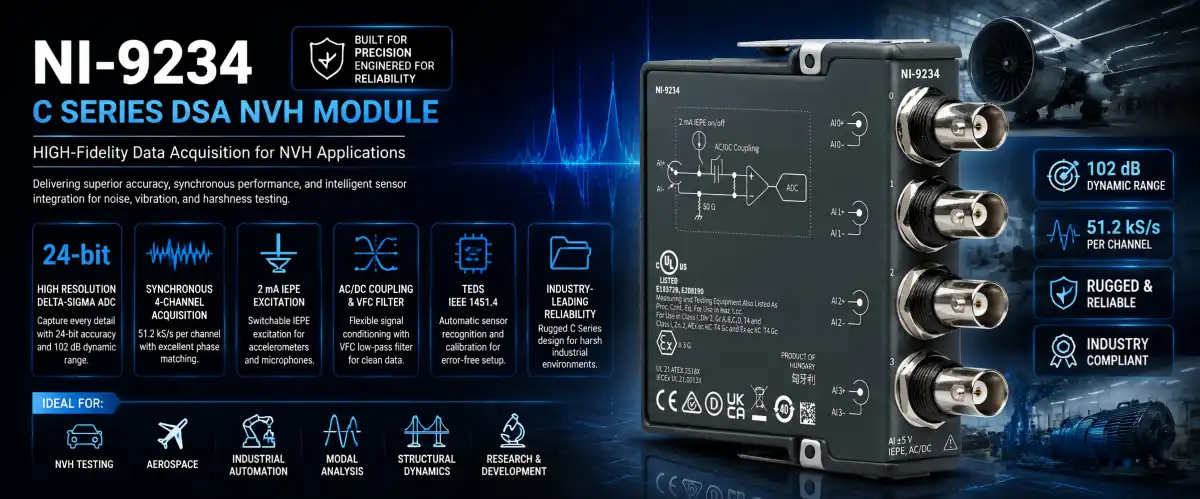
A 24-bit Delta-Sigma analogue-to-digital converter is at the module's core and can resolve up to 16,777,216 discrete levels. Because of its high level of detail, the system can pick up on very small changes in the signal that regular 16-bit computers would miss. The 102dB dynamic range makes sure that all signals are accurately picked up, from low-level background noise to high-level impact signals created during crash tests or structural analysis. This feature is very helpful for measuring both the very low hum of precision machinery and the explosive forces during testing of aerospace parts using the same data acquisition framework.
The DSA architecture's low noise floor reduces measurement error, which is very important when engineers need to tell the difference between real signal content and artefacts caused by the system. This performance trait directly meets the high standards of accuracy that test and measurement experts in the defence and electronics industries have to work with.
Synchronous Acquisition Capability Across Multiple Channels
The module can sample all four input channels at the same time and can keep the highest sampling rate of 51.2 kS/s per channel. Multiplexed systems have phase errors and timing problems because channels are sampled one at a time instead of all at once. This synchronous sampling gets rid of those problems. The standard for phase matching accuracy of better than (fin × 0.045° + 0.04°) gives the exact timing relationships needed for vibration modal analysis. The accuracy of structural dynamic models depends on how well you understand the spatial relationships between different measurement points.
Engineers use this phase accuracy to find the right resonant frequencies and mode shapes when they are doing coherence studies or operating deflection shape analysis. There is a good balance between spatial resolution and system cost in the four-channel configuration. This lets you test a wide range of common items without having to buy a lot of extra hardware.
Flexible Signal Conditioning for Diverse Sensor Types
Software-selectable AC/DC connection types let you change the way measurements are made without having to change the hardware. DC coupling lets you measure signals and components that change slowly, and AC coupling gets rid of DC offsets that could oversaturate the input stage when measuring small AC signals on top of big DC biases. The 2mA IEPE excitation current can be switched and can connect directly to accelerometers, microphones, and velocity sensors that are standard in the industry. This means that you don't need any extra signal conditioners or power supplies.
This integrated conditioning method makes the architecture of test systems a lot easier by cutting down on the number of cables, getting rid of potential ground loop issues, and lowering the overall cost of the system. Engineers can connect sensors straight to the module, use software to set up the right coupling and activation parameters, and then start collecting data right away. This streamlined process speeds up test setup and lowers the chance of configuration mistakes that happen a lot with systems that need a lot of external conditioning hardware.
Intelligent Sensor Support Through TEDS Compliance
The built-in IEEE 1451.4 Class I TEDS reading feature is a big step forward in how well sensors can be integrated. When connected to smart sensors that work with TEDS, the module reads and uses the sensor's internal memory to find calibration data, sensitivity coefficients, and identification information. This plug-and-play feature gets rid of mistakes made when entering data by hand, makes sure that the right calibration constants are used, and keeps a full digital record of which sensor was used for each measurement channel.
This automation is especially helpful for system designers and R&D centers that have a lot of sensors to handle. It cuts down on setup time and makes sure that measurements can be tracked, which is what quality management systems need. The automatic sensor identification also stops common mistakes like using the wrong sensitivity values or connecting sensor types that don't work with each other to channels that aren't set up correctly.
Comparing the NI-9234 with Other NVH Modules on the Market
Procurement managers can make better decisions when they know how the NI-9234 C Series DSA NVH Module compares to other options. There are a lot of different options on the market for measurement and control equipment, and each one has its own performance and cost profile.
Performance Advantages Over Standard C Series Modules
The module is a unique member of the National Instruments C Series family; it is designed to capture high-fidelity dynamic signals. It has much better frequency response, less phase distortion, and stronger channel-to-channel matching than general-purpose analogue input units, which is important for measuring vibrations at multiple points. Standard analogue input modules usually give up some AC performance specs to be able to measure more DC signals. This makes them less useful for situations where signal frequency content and phase relationships are very important.
Anti-aliasing filters built into the DSA design stop high-frequency material from folding back into the measurement bandwidth. This happens in systems that don't have the right filters in place and messes up the data. This built-in security keeps data safe without programmers having to build and set up external filtering networks.
Cost-Efficiency Compared to Traditional Analog Systems
A lot of money and space are needed for traditional analogue NVH measurement systems that are made up of separate signal conditioning racks and data acquisition hardware. The modular C Series design combines signal conditioning and digitisation into a small package that works well with both the CompactDAQ and CompactRIO systems. This integration makes the system simpler, lowers the total cost of ownership, and makes it more reliable by getting rid of a lot of connections that could go wrong.
The digital architecture also lets you configure and diagnose things remotely, which supports distributed measurement situations where test equipment is located away from engineering workstations. It's especially useful for long-term condition tracking installations and car testing grounds to have this feature.
Competitive Positioning Against Alternative Brands
There are a lot of well-known companies that make measurement instruments on the global market, and each one brings something different to the table. This module is a good choice for buying teams because it has a reasonable price, strong performance specs, and access to National Instruments' large software environment and global support network. Implementation risk is lower, and time-to-measurement is faster when there are compatible hardware accessories, well-documented application examples, and active user communities.
Companies that already have LabVIEW-based measurement systems can get even more out of integrating them with their existing software infrastructure. This way, they can keep the money they spent on development and use their programming skills. DAQmx's standardised driver architecture makes it easier to maintain software and lets code run on a variety of hardware platforms.
Key Benefits and Application Scenarios of the NI-9234 C Series NVH Module
In the real world, measurement instruments like the NI-9234 C Series DSA NVH Module are useful because they change how engineers work and how products are made. Knowing how this technology can be used in the real world helps technical leaders decide if it fits the needs of the company.
Precision Enhancement in Product Development Cycles
Engineers can find and fix noise and vibration problems before they reach production by accurately characterising NVH during product development. This keeps expensive redesigns and warranty claims from happening. The module's accurate measurements let you find small changes in vibration patterns that point to growing mechanical issues. This helps with planned maintenance strategies that keep unexpected downtime to a minimum. During product validation, engineering teams collect high-quality standard data that they use to set objective performance targets that production units can be compared to. This makes sure that the manufacturing process is consistent.
Being able to measure more than one point at the same time speeds up troubleshooting by showing patterns in vibration behaviour that can't be seen with single-point measurements. This feature cuts down on the number of test runs needed to find the root causes. This directly leads to faster development timelines and lower engineering labour costs.
Versatility Across Industrial Sectors
Automotive companies use vibration and sound testing all the way through the development process, from testing individual parts for durability to evaluating the whole car for noise, vibration, and harshness. Tests of structural dynamics, tracking of engine vibration, and characterising cabin noise are all used in aerospace, and the accuracy of the measurements has a direct effect on passenger comfort and regulatory compliance. Vibration analysis is used in industrial machinery condition monitoring to find misaligned parts, predict when bearings will fail, and make the best use of maintenance schedules. This keeps production lines from stopping when catastrophic equipment failures happen.
For research groups that study acoustics, structural dynamics, and characterising materials, they need measurement tools that can be used in a variety of ways. Because the module's settings can be changed in software and it works with standard IEPE sensors, it can be used in a variety of trial setups without needing to have any hardware changed.
Scalability for Expanding Measurement Requirements
Starting with a four-channel system lets you do normal small-scale testing right away, and it also leaves you with options for expansion as your needs change. Because the architecture is modular, more modules can be added to the CompactDAQ chassis to make synchronised multi-channel systems that can measure dozens or hundreds of points at the same time. This ability to be expanded is very important for modal analysis and large-structure testing, where accurate measurements depend on covering a lot of space.
The hardware base is the same across all channel counts, which makes system administration, managing spare parts, and teaching operators easier. Engineers who are used to working with four-channel setups can easily switch to bigger systems without having to learn new software interfaces or how to operate the systems differently.
Procurement Considerations for Buying the NI-9234 Module
Finding technically ideal tools like the NI-9234 C Series DSA NVH Module is only one part of successful buying. Other parts include supply chain management, total cost analysis, and evaluating supplier relationships. When making decisions about global sourcing, procurement managers do better when they know about the whole acquisition landscape.
Sourcing Strategy and Supplier Selection
When deciding between authorised distributors, regional representatives, and direct manufacturer relationships, you need to weigh price, lead time, access to technical support, and management of warranties. Authorised outlets make sure that the product is real and that customers can still get help from the manufacturer's support programs. They also give customers access to application engineering tools that help with problems like system design and integration. Directly working with manufacturers like MXTD, who have over 12 years of experience providing measurement and control solutions that are tailored to specific operational needs, may be beneficial for businesses that need customised configurations or OEM arrangements.
Companies that run just-in-time manufacturing schedules or research projects that need to be finished quickly need to plan their lead times very carefully. If you know how long it usually takes to deliver both standard catalogue items and custom configurations, you can avoid project delays caused by unexpected procurement bottlenecks.
Total Cost of Ownership Analysis
The original buying price is only one part of the total cost of the system. Comprehensive cost models need to take into account ongoing costs like calibration services, possible repair costs, software license fees, and operator training. The module's ability to work with popular software platforms like LabVIEW can lower the cost of development by using existing programming skills and reusable code libraries. Additionally, the module's strong construction and track record of reliability reduce the costs of equipment breakdowns and emergency replacements.
By looking at the terms of the guarantee and the service agreements that are out there, you can figure out how much risk you are exposed to when your equipment breaks down. Full coverage, which includes fast repair services and advanced replacement options, helps businesses plan their budgets and ensures they can keep running, which is important for companies that use continuous manufacturing processes or testing facilities that need to be up and running at all times.
Supplier Capabilities and Support Infrastructure
In addition to looking at product specs, an important part of risk management is figuring out how technical the supplier is, how responsive they are, and how long they can stay in business. MXTD has a good reputation because they have a history of making PXIe chassis, integrated testing products, and custom measurement equipment. Their skilled research and development team and committed after-sales service company provide the quick technical reaction and ongoing support that procurement requirements are putting more and more emphasis on, along with product performance.
Test and measurement experts have said that having remote video technical support, free software updates, and full insurance coverage are some of the things that bother them the most. Organisations can email MXTD directly at manager03@mxtdinfo.com to talk about specific application needs, get full quotes, and check to see if the technology will work with their current infrastructure.
Technical Support and Integration Best Practices
To get the most out of the NI-9234 C Series DSA NVH Module, you need to pay attention to the right way to set it up, how to do regular upkeep, and how to fix problems. System developers and test engineers can do their jobs better if they know how to launch and run systems in the best way.
Initial Setup and Software Configuration
For integration to work, it's important to do things like make sure the mechanical mounting is secure, the electrical connections are clean, and the cables are routed in a way that keeps electromagnetic interference to a minimum. To set up software through NI DAQmx, you have to choose the right device settings for the sensors you're connecting, such as the sampling rate, coupling mode, IEPE excitation status, and input range. LabVIEW has easy-to-use graphical programming tools for setting up capture parameters and putting signal processing methods into action. It also comes with a lot of example programs that speed up the initial development process.
By using known reference sources to take baseline measurements of the system's performance, you can be sure that the measurements are accurate before moving on to the real test pieces. This step checks for possible configuration errors or hardware problems while they are still easy to fix. This keeps data collection from getting messed up during important testing.
Ongoing Calibration and Maintenance Practices
To keep measurements accurate over time, they need to be calibrated against known standards regularly. How often they need to be calibrated depends on the manufacturer's instructions, industry standards, and the needs of the organisation's quality management system. Recording calibration results creates the audit trail needed for quality certification and following the rules. Checking wires and plugs on a regular basis stops connection problems that show up as noisy or inaccurate readings.
When makers release firmware updates, they often include bug fixes, better speed, and more features. Putting these changes in during planned maintenance windows makes sure that systems get the latest technical improvements with as little trouble as possible for ongoing testing programs.
Troubleshooting Common Integration Challenges
Signal noise issues are often caused by ground loops, which can happen when there are multiple ground paths between devices, electromagnetic interference from nearby power devices, or cables that aren't shielded properly. Isolating possible noise sources in a planned way and using the right grounding techniques can usually fix these problems. Connectivity issues can be caused by sensor types that don't work with each other, wrong IEPE excitation settings, or broken wires, so all system parts need to be carefully checked.
MXTD offers technical support that includes troubleshooting help through online tests, the availability of new parts, and application advice for solving specific measurement problems. This support framework cuts down on downtime and keeps work going when unexpected technical problems happen.
Conclusion
High-end NI-9234 C Series DSA NVH Modules provide the measurement accuracy needed for tough NVH tasks in the aerospace, automobile, industry, and research fields. When you put together 24-bit resolution, synchronous multi-channel sampling, flexible signal conditioning, and intelligent sensor support, you get a complete solution that meets all of the important needs of test and measurement professionals. When companies are looking at their options for vibration analysis, acoustic testing, and condition monitoring, it's helpful to know about the technical capabilities, comparative positioning, application suitability, procurement issues, and best practices for integration. This technology is a good choice for engineering teams that need to be able to measure dynamics accurately because it is reliable and has a lot of support infrastructure.
FAQ
What sensor types are compatible with this dynamic signal acquisition module?
The NI-9234 C Series DSA NVH Module works with both IEPE sensors that need a steady current to work and non-IEPE sensors that send voltage. Devices that work with IEPE include piezoelectric accelerometers, condenser mics, and velocity sensors, which are often used for testing sound and vibration. The 2mA excitation current works with almost all IEPE sensors that are sold in stores. When IEPE excitation is turned off, non-IEPE sensors can be connected, which works with devices that have passive transducers or built-in signal conditioners.
How does this technology compare with traditional analogue measurement systems?
Digital architectures are better at blocking noise, don't have the drift and temperature sensitivity problems that come with analogue signal conditioning, and allow software configuration instead of making hardware adjustments by hand. Measurement precision is improved by built-in anti-aliasing filters and simultaneous sampling, which is hard to achieve with standard systems. The small size also makes installation easier compared to rack-mounted analogue conditioning equipment.
Where can technical documentation and firmware updates be obtained?
On the webpages of manufacturers and authorised distributors, you can find detailed information such as specs, user guides, and application notes. Firmware updates are usually sent out through the manufacturer's help sites, and technical notes explain how to install them. MXTD gives customers direct access to technical resources and helps them throughout the lifecycle of a product by providing documentation, software updates, and application guidance.
Partner with MXTD for Your Dynamic Signal Acquisition Needs
MXTD is ready to help you with your precise measurement needs with options that are the best in the business. As a supplier of NI-9234 C Series DSA NVH Modules with a lot of experience, we can offer both standard products that are ready to ship and custom configurations that are made to fit your needs. Our programming team answers complex questions within an hour, which is important for projects that need help quickly. We ship things all over the world by land and air, and we protect precision instruments from water, shock, and static electricity. You can email our team at manager03@mxtdinfo.com to talk about your application, get a quote, or ask for more information. You can look at our full line of PXIe chassis, integrated testing systems, and measurement solutions at https://www.mxtdtest.com/.
References
1. Anderson, T. (2021). Advanced Dynamic Signal Acquisition Techniques for Industrial NVH Analysis. Technical Measurement Press.
2. Chen, M., & Roberts, K. (2020). Precision Vibration Measurement Systems: Design and Application. Industrial Instrumentation Publishing.
3. Harrison, P. (2022). Modern Data Acquisition Architectures for Test and Measurement. Engineering Systems Journal, Vol. 15.
4. Mitchell, R. (2019). Comparative Analysis of Dynamic Signal Acquisition Technologies. Measurement Science Review, International Edition.
5. Peterson, L., & Zhang, W. (2023). IEPE Sensor Integration Best Practices for Multi-Channel Testing. Journal of Applied Measurement Technology.
6. Williams, D. (2020). Total Cost of Ownership Models for Industrial Test Equipment Procurement. Global Manufacturing Systems Quarterly.
Our customers’ satisfaction speaks for our quality — contact us to experience the same reliable service.