- English
- French
- German
- Portuguese
- Spanish
- Russian
- Japanese
- Korean
- Arabic
- Greek
- German
- Turkish
- Italian
- Danish
- Romanian
- Indonesian
- Czech
- Afrikaans
- Swedish
- Polish
- Basque
- Catalan
- Esperanto
- Hindi
- Lao
- Albanian
- Amharic
- Armenian
- Azerbaijani
- Belarusian
- Bengali
- Bosnian
- Bulgarian
- Cebuano
- Chichewa
- Corsican
- Croatian
- Dutch
- Estonian
- Filipino
- Finnish
- Frisian
- Galician
- Georgian
- Gujarati
- Haitian
- Hausa
- Hawaiian
- Hebrew
- Hmong
- Hungarian
- Icelandic
- Igbo
- Javanese
- Kannada
- Kazakh
- Khmer
- Kurdish
- Kyrgyz
- Latin
- Latvian
- Lithuanian
- Luxembou..
- Macedonian
- Malagasy
- Malay
- Malayalam
- Maltese
- Maori
- Marathi
- Mongolian
- Burmese
- Nepali
- Norwegian
- Pashto
- Persian
- Punjabi
- Serbian
- Sesotho
- Sinhala
- Slovak
- Slovenian
- Somali
- Samoan
- Scots Gaelic
- Shona
- Sindhi
- Sundanese
- Swahili
- Tajik
- Tamil
- Telugu
- Thai
- Ukrainian
- Urdu
- Uzbek
- Vietnamese
- Welsh
- Xhosa
- Yiddish
- Yoruba
- Zulu
NI-9213 C-Series Thermocouple Input Module Buying Guide for Engineers
When selecting temperature measurement hardware for demanding industrial applications, understanding the technical specifications and procurement pathways becomes essential. The NI-9213 C-Series Thermocouple Input Module represents a high-density, 16-channel solution engineered for precision temperature acquisition across automotive, aerospace, semiconductor, and research environments. This module integrates seamlessly with CompactDAQ and CompactRIO chassis, offering engineers reliable thermocouple signal conditioning with 24-bit resolution and built-in cold junction compensation. Throughout this guide, we examine the module's core capabilities, compare alternatives, and outline procurement strategies to help technical teams make informed investment decisions.
Understanding the NI-9213 Thermocouple Input Module
The NI-9213 C-Series Thermocouple Input Module solves three major problems that engineers face when they have to set up temperature measurement systems with a lot of channels. Some of these problems are the use of slots in flexible frames, the need for accurate measurements in noisy environments, and the complexity of the system during integration. By looking at the module's technical architecture, we can see how the choices made during its creation lead to useful results.
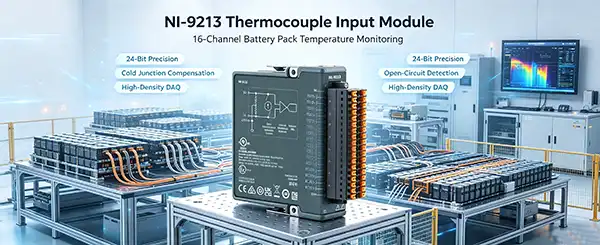
High-Density Architecture and Channel Configuration
In the C-Series product family, this 16-channel thermocouple input module has the most channels of any single module. When engineers put eight units into a single frame, they get access to 128 channels for measuring temperature without having to add more hardware. Compared to options with a lower channel count, this density saves rack room and makes the infrastructure for wiring easier. The spring terminal connections make installation faster and keep the electrical contact strong even when the temperature changes and there is vibration, which is common in industrial settings.
Advanced Signal Conditioning Features
The module has an analog-to-digital converter with 24 bits, automatic zeroing circuitry, and cold junction compensation built right in. This three-layer method reduces offset drift, accounts for changes in the temperature of the reference joint, and provides measurement accuracy good enough for tough situations. The automatic zero channel checks for internal offset mistakes on a regular basis, so it stays accurate over long periods of time without any help from a person. The built-in anti-aliasing filter also gets rid of high-frequency noise before digitisation, which makes system design easier by lowering the need for external signal filtering.
Thermocouple Type Support and Measurement Range
The module works with normal thermocouple types, such as J, K, T, E, N, B, R, and S setups, and can handle temperatures ranging from very cold to very hot in industrial settings. The open-circuit thermocouple detection feature lets workers know when a sensor fails or there is a problem with the connection. This keeps bad data from getting into control algorithms or analysis processes. Channel-to-ground separation keeps ground loop interference at bay, which is especially helpful when measuring at multiple points where sensors are connected to equipment with different electrical potentials.
NIST Traceable Calibration and Accuracy Specifications
Each module comes with NIST-traceable calibration documentation. This sets up the measurement traceability that quality management systems in the defence, aerospace, and pharmaceutical industries need. The calibration certificates say how accurate the device is across the operational temperature range. This lets engineers figure out the total measurement uncertainty when they add in the variations in the thermocouple wires and the effects of the installation. This paperwork helps with meeting the rules and auditing requirements that are popular in businesses with a lot of rules.
Dual Timing Mode Operation
With the ability to switch between two timing modes, engineers can find the best measurement throughput for each application. When the module is in high-speed mode, it quickly gets data from all sources, making it good for tracking short-lived thermal events. Longer integration periods lower noise and improve the ability to measure low-level signals in high-resolution mode. This makes it perfect for steady-state thermal profiling where measurement accuracy is more important than update rate. Because of this, a single piece of hardware can be used for a variety of measurement tasks without the need for multiple module versions.
Comparing NI-9213 with Other Thermocouple Input Modules
Knowing how this thermocouple measurement solution stacks up against other options helps buying teams choose gear that fits the needs of the project and stays within the budget. These choices are based on both technical specs and the total cost of ownership.
NI-9213 Versus NI-9214 Module Comparison
The NI-9214 has 16 channels, which is the same as the NI-9213 C-Series Thermocouple Input Module, but the time and some filtering features are different. Both units accurately measure temperature, but the 9213's dual time mode makes it more useful for a wider range of situations. The price per channel is about the same for both options, but the needs of the project may make one configuration better than the other when it comes to update rates and connecting to other systems. When choosing between these very similar options, engineers should look at sample rate needs and software compatibility.
Market Alternatives and Competitive Analysis
Several companies make thermocouple input units that work with modular frame systems. Engineers should look at channel count, resolution, cold junction adjustment accuracy, and the development of the software environment when comparing different options. Some competitors offer cheaper options with fewer channels, which might work for smaller-scale tasks but need extra modules for systems with a lot of channels. LabVIEW and other National Instruments development environments offer full software support that often makes up for any extra cost by making integration easier and speeding up time to launch.
Advantages of High-Channel-Count Design
When compared to lower-channel options, this high-density thermocouple module has the following main benefits:
- Reduced chassis slot consumption: By combining 16 channels into one module, engineers keep the ability to add more measurement types, such as voltage, current, or digital I/O, within the same chassis. This makes mixed-signal test systems more flexible.
- Lower acquisition cost per channel: 16-channel modules become more cost-effective as the number of channels rises. This means that large-scale thermal mapping projects, like those used for checking car climates or keeping an eye on semiconductor processes, can save a lot of money.
- Simplified system architecture: Fewer parts mean less setup complexity, fewer possible failure spots, and easier troubleshooting during start-up and ongoing operations.
Procurement Considerations for NI-9213
To get through the buying process, you need to know about the different channels, prices, and support choices that affect the costs of both short-term deployment and long-term operations. Before making a final choice on hardware, B2B buyers should look at more than one way to buy it.
Authorized Distribution and OEM Pathways
When you buy thermocouple input modules from an authorised distributor, you can be sure that you are getting real goods that come with maker warranties and expert support. With more than 12 years of experience in the field, Xi'an Mingxi Taida Information Technology Co., Ltd. offers approved measurement and control options that work with current NI ecosystems. As a supplier with a lot of experience, MXTD offers both standard configurations of the NI-9213 C-Series Thermocouple Input Module that can be shipped right away and customised configurations that are made to fit the needs of a specific application. When people ask technical questions, the company answers them within an hour, meeting the pressing buying needs that come up in project-driven settings.
Pricing Structures and Volume Discounts
The price of each module is different depending on the number of orders, the delivery schedule, and any customisation needs. When you buy in bulk for deployments across multiple sites or system integrator builds, you can usually get volume discounts that make the project more cost-effective. Purchasing managers should ask for thorough quotes that list the prices of each module, as well as the costs of any needed extras like cable kits or chassis mounting hardware, as well as the costs of shipping. Knowing the total arrival cost helps you make accurate budget predictions and avoids surprises during project execution.
Lead Times and Delivery Considerations
Standard configurations are shipped quickly from the distributor's stock, usually just a few days after the order is placed. For production scheduling reasons, longer wait times may be needed for orders with specific requirements or a lot of them. Engineers should talk to providers early on in the planning process to find out when their products will be available and to make sure that delivery doesn't interfere with other parts of the system. MXTD supports both land and air shipping with packaging that is moisture-proof, shock-proof, and anti-static, built just for precision instrumentation. This makes sure that modules come ready to be used right away.
Warranty Coverage and After-Sales Support
For one year after the purchase date, most manufacturer warranties cover problems with the materials or the work. MXTD backs this promise up with quick technical support, such as remote video guidance, free software updates, and warranty terms that can be changed based on the needs of the application. This support after the sale is especially helpful during system commissioning, when engineers are having trouble integrating the system or need help setting it up for a specific application. When compared to automated help systems, having access to experienced expert teams cuts down on downtime and speeds up problem-solving.
Maximizing NI-9213 Performance in Your Applications
Paying attention to installation methods, environmental factors, and regular upkeep processes is necessary to get the best measurement accuracy and system dependability. When engineers follow these best practices, they get the most out of their thermocouple sensor expenses.
Installation Best Practices for Accuracy
When thermocouple wires are routed correctly, electromagnetic radiation that can mess up low-level temperature data is kept to a minimum. Separating thermocouple lines from power cords, making sure that the wire types used from the sensor to the module terminals stay the same, and making sure that the electrical connections are clean all improve the quality of the measurements. The spring terminal design of the module makes field wiring easier while keeping the connection strong even when the temperature changes. However, engineers should check the tightness of the terminals during installation and at regular maintenance intervals.
Software Integration and Configuration
The NI-9213 C-Series Thermocouple Input Module works perfectly with NI LabVIEW and other development environments from the National Instruments software family. Engineers use easy-to-use graphical tools to set channel settings like thermocouple type, measurement range, and filtering choices. The software automatically calculates cold junction correction and thermocouple linearisation, which makes programming easier and gets rid of common application mistakes. Pre-built example programs speed up development by giving you tried code templates that you can change to fit your needs.
Environmental Considerations and Calibration
Calibration precision is maintained throughout the span of the product as long as the module is used within certain temperature ranges. The automatic zero channel fixes any changes in the internal offset, and the general correctness of the system is checked against known temperature standards regularly. A lot of businesses set up annual calibration schedules that keep track of how well their measurement systems are working and meet the needs of their quality management systems. The right way to mount, cool, and ground a chassis is important for controlling environmental factors like vibration, humidity, and electrical noise.
Troubleshooting Common Issues
When measurement errors happen, thorough debugging quickly finds the root causes. The open-circuit detection tool finds broken thermocouples or connections that aren't tight right away. If readings look shaky, engineers should look at how the cables are routed, make sure there is good grounding, and check the links between the terminals. If temperature numbers are different from what you would expect, it could mean that there are problems with cold junction compensation, the thermocouple type setup is wrong, or there is calibration drift. When you need help with a complicated application problem, the user community forums and technical support resources that National Instruments and partners like MXTD keep up are very helpful.
Why Choose National Instruments Compatible Solutions for Engineering Projects?
Investing in measurement technology that has been used before and is backed by well-known companies lowers the risk of a project and gives you access to ongoing innovation and support resources. Original tools and compatible alternatives each have their own benefits, which rely on the size of the project and the goals of the company.
Ecosystem Maturity and Community Support
National Instruments has built a community of engineers, researchers, and system integrators around the world who share best practices, application knowledge, and troubleshooting tips. This shared knowledge speeds up the process of fixing problems and makes it easier for engineers who are new to modular instrumentation tools to learn how to use them. Aside from maker technical help channels, online forums, technical literature, and example code repositories offer information that can be accessed 24 hours a day, seven days a week.
Compatible Solutions and Cost Optimization
MXTD provides measurement solutions that work with NI product ecosystems and offer cost savings that help projects stick to their budgets without sacrificing performance. The company has more than ten years of experience with PXIe chassis, interface boards, connectors, and integrated testing systems. They offer reliable alternatives that are good for low-cost uses. When you combine stable product performance, competitive price, and quick technical help, you get a great deal. This is especially true for large-scale deployments where the cost per channel has a big effect on the total project cost.
Future-Proofing Through Scalable Architecture
Modular instrumentation architectures can adapt to changing measurement needs as products age and facilities are upgraded. Adding channels or measurement tools means adding more units instead of replacing whole systems. This protects the initial hardware investments. Because software is compatible across generations of products, test programs and user interfaces can be used again and again, even when the hardware underneath is updated. This ability to grow with the project is especially useful in research and development centers and universities, where measurement needs grow as the project's scope does.
Conclusion
The NI-9213 C-Series Thermocouple Input Module is designed to record temperatures at high densities in industrial automation, aircraft, semiconductor, and research settings. Its 16-channel architecture, 24-bit resolution, automatic zeroing, and full support for thermocouple types meet the high-precision needs of complex engineering projects. Technical teams should look at more than just module specs when deciding how to buy something. They should also think about how quickly the seller is, how much customisation is possible, and how long the supplier promises to support the product. Companies that want to improve both technical performance and costs can benefit from compatible solutions that experienced companies like MXTD make. These solutions combine tested measurement technology with quick service and low prices.
FAQ
What thermocouple types does the module support?
The module can hold J, K, T, E, N, B, R, and S-type thermocouples, so it can be used for a wide range of temperatures, from very cold environments to industrial processes that need to be very hot. When measurement systems use different types of sensors in different areas or steps of a process, this wide compatibility gets rid of the need for multiple module versions.
How does the module maintain accuracy in places with a lot of electrical noise?
Isolation from channel to ground stops ground-loop interference, and built-in anti-aliasing filters get rid of high-frequency noise before the data is digitised. The automatic zero channel occasionally fixes any internal offset drift, and good installation methods, such as keeping the cable away from power lines, further improve the accuracy of measurements in harsh industrial settings.
What are the operating temperature limits for this module?
The module works effectively in a wide range of industrial temperatures that are common in labs and factories. Working within certain limits makes sure that the tuning is correct and that the parts last a long time. In technical documentation, there are detailed environmental specifications that help engineers make sure that the system they are designing and planning to install will work in the places where they want to put it.
Partner with MXTD for Your Thermocouple Measurement Needs
Xi'an Mingxi Taida Information Technology Co., Ltd. can help you measure temperature needs by providing high-quality thermocouple input solutions that work with common platforms in the industry. As a supplier of NI-9213 C-Series Thermocouple Input Modules with over 12 years of experience, we offer quick technical support, low prices, and the ability to make changes to fit your needs. Our team answers technical questions within an hour and sends you both stock options and ODM/OEM options that are made just for you. You can talk to our experts about your project needs, get full quotes, or set up remote technical meetings by emailing manager03@mxtdinfo.com. You can look at our full line of PXIe chassis, interface boards, connectors, and integrated measurement systems at www.mxtdtest.com. These are made to meet the high performance and reliability standards of research, aerospace, industrial automation, and semiconductors.
References
1. Webster, J.G. and Eren, H., 2014. Measurement, Instrumentation, and Sensors Handbook: Spatial, Mechanical, Thermal, and Radiation Measurement. CRC Press.
2. Bentley, R.E., 2005. Handbook of Temperature Measurement Vol. 3: The Theory and Practice of Thermoelectric Thermometry. Springer Science & Business Media.
3. Liptak, B.G., 2018. Instrument Engineers' Handbook, Volume One: Process Measurement and Analysis. CRC Press.
4. National Instruments Corporation, 2019. NI-9213 Operating Instructions and Specifications. Technical Documentation.
5. Morris, A.S. and Langari, R., 2020. Measurement and Instrumentation: Theory and Application. Academic Press.
6. Pollock, D.D., 1991. Thermocouples: Theory and Properties. CRC Press.
Our customers’ satisfaction speaks for our quality — contact us to experience the same reliable service.