- English
- French
- German
- Portuguese
- Spanish
- Russian
- Japanese
- Korean
- Arabic
- Greek
- German
- Turkish
- Italian
- Danish
- Romanian
- Indonesian
- Czech
- Afrikaans
- Swedish
- Polish
- Basque
- Catalan
- Esperanto
- Hindi
- Lao
- Albanian
- Amharic
- Armenian
- Azerbaijani
- Belarusian
- Bengali
- Bosnian
- Bulgarian
- Cebuano
- Chichewa
- Corsican
- Croatian
- Dutch
- Estonian
- Filipino
- Finnish
- Frisian
- Galician
- Georgian
- Gujarati
- Haitian
- Hausa
- Hawaiian
- Hebrew
- Hmong
- Hungarian
- Icelandic
- Igbo
- Javanese
- Kannada
- Kazakh
- Khmer
- Kurdish
- Kyrgyz
- Latin
- Latvian
- Lithuanian
- Luxembou..
- Macedonian
- Malagasy
- Malay
- Malayalam
- Maltese
- Maori
- Marathi
- Mongolian
- Burmese
- Nepali
- Norwegian
- Pashto
- Persian
- Punjabi
- Serbian
- Sesotho
- Sinhala
- Slovak
- Slovenian
- Somali
- Samoan
- Scots Gaelic
- Shona
- Sindhi
- Sundanese
- Swahili
- Tajik
- Tamil
- Telugu
- Thai
- Ukrainian
- Urdu
- Uzbek
- Vietnamese
- Welsh
- Xhosa
- Yiddish
- Yoruba
- Zulu
What Features Define a High-Quality RF Class Microwave Hermetic Connector?
When buying precise RF parts for important uses, it's very important to know what "excellence" means. A good RF Class Microwave Hermetically Sealed Insulator Connector always works electrically because it has strong sealing technology, is stable at all temperatures, and is made of better materials. These links keep the purity of the signal over wide frequency ranges, and their airtight glass-to-metal covers keep outside contaminants from getting into the sensitive electronics. Controlled characteristic impedance, minimal voltage standing wave ratio, wide operating temperature ranges, and proven dielectric strength are all important features for aerospace, defence, telecommunications, and industrial automation applications where mission success depends on reliability.
Understanding Microwave Hermetic Connectors: Fundamentals and Key Features
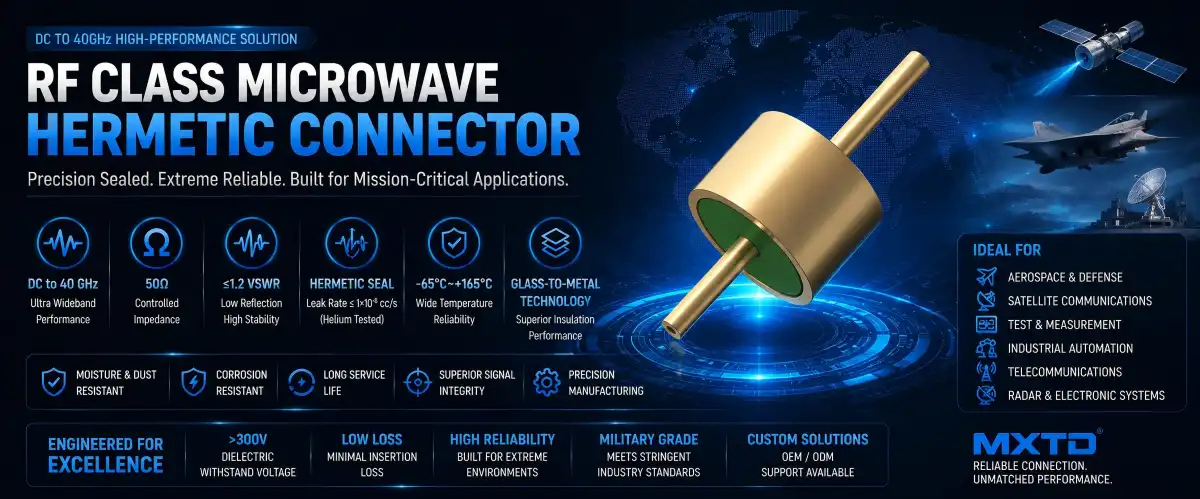
Microwave hermetic connections are unique technical solutions that protect the environment while delivering high-quality radio waves. At their core, these parts create airtight shields that keep moisture, toxic gases, and other contaminants from getting into sensitive radio circuits and lowering their performance in tough operating settings.
The Science Behind Hermetic Sealing Technology
Glass-to-metal bonding processes that make molecular-level barriers are what hermetic sealing depends on. Hermetic seals, on the other hand, stay intact for decades of use, while mechanical seals break down over time. The technology uses special glass materials that have thermal expansion coefficients that are perfectly matched to metal conductors. This keeps stress cracks from happening when the temperature changes. Glass flows into tiny surface bumps during high-temperature sintering processes, creating strong bonds that can withstand changes in pressure and temperature. Working with research centers and defence companies has taught us that the choice of insulation material has a huge effect on how reliable something will be in the long run. Glass insulators with low dielectric constants and low loss tangents keep the purity of the signal while keeping the airtight seal. The best RF Class Microwave Hermetically Sealed Insulator Connector designs use iron-cobalt-magnesium alloys for the inner and outer conductors. This matches the conductors' thermal expansion, which keeps the seal intact even when the temperature changes many times from -65°C to +165°C.
Critical Performance Parameters That Define Quality
Premium sealed connections are different from regular ones in a number of ways that can be measured. Characteristic impedance control to 50±2 ohms makes sure that signal bounce is kept to a minimum and power transfer is maximised. This is important for accurate measurement in test systems. Specifications for voltage standing wave ratios of ≤1.2 show good impedance matching across the working frequency range. This has a direct effect on the accuracy of measurements in aircraft and semiconductor tests. Modern wideband communication systems, radar uses, and high-speed digital connections can all use frequencies ranging from DC to 40 GHz with an RF Class Microwave Hermetically Sealed Insulator Connector. For high-power RF uses, dielectric withstand voltage ratings above 300V offer extra safety. These specs aren't just random numbers; they're engineering decisions that strike a balance between electrical performance, mechanical dependability, and accuracy in production.
Comparing Hermetic vs. Standard RF Connectors: Making Informed Choices
Procurement decisions between hermetic and standard RF connectors involve understanding performance trade-offs in real-world operating conditions. While standard connectors suffice for benign laboratory environments, hermetic designs prove essential where environmental protection determines system reliability.
Environmental Resistance and Longevity Advantages
Hermetic connections are very good at keeping out moisture. They keep working electrically even when the humidity level is high enough for normal connectors to fail due to dielectric absorption and rust. Infiltration of moisture changes the resistance properties, raises insertion loss, and speeds up the breakdown of contacts. These ways of breaking down are taken care of by hermetic sealing, which increases the operating life from years to decades without lowering performance. Standard connections have a hard time with high temperatures. Mismatches in thermal expansion cause mechanical stress, and the buildup of moisture during temperature cycles speeds up rusting. Hermetic RF Class Microwave Hermetically Sealed Insulator Connector designs can work continuously from -65°C to +165°C without the seal breaking down or the electrical parameters moving. This temperature range is very important for aircraft use where equipment has to work in both hot desert conditions and cold high-altitude conditions during single trips. Another important thing to think about is the pressure difference. Standard connections let gas move between them and the environment, so they can't be used in settings with high pressure or low pressure. Hermetic connections keep internal atmospheres stable even when the pressure outside changes. This lets them work in pressurised flight systems, vacuum conditions in spacecraft, and underwater uses. Defence companies really like this feature because it helps electronic warfare systems work the same way even when the height changes.
Material Durability and Signal Integrity Comparison
The main difference between hermetic and regular connections is the material they are made of. Plastic insulators and metal contacts that have been coated are common in standard connections. These are fine for cost-conscious business uses, but they can break down over time and wear out mechanically. Hermetic connections have contacts made of valuable metals and clay or glass separators. This gives them better physical stability and resistance to rust. At microwave levels, differences in signal quality become clear. Standard plug-ins have higher dielectric values and loss tangents, which weaken signals and mess up their timing. In hermetic designs, glass insulators keep their dielectric qualities the same across a wide range of temperatures and frequencies. This keeps measurement accuracy, which is very important for test tools and precision instruments.
Because sealed designs are mechanically strong, they can be mated many times without losing their effectiveness. When standard connections are mated hundreds of times, the resistance may change because the contacts wear out and the insulation deforms. When properly built, hermetic connections keep their specs over thousands of rounds, which lowers operational costs even though they cost more at first. System integrators working on long-term projects know that these benefits in longevity mean less upkeep work and more system uptime.
Selecting the Right Microwave Hermetic Connector for Your Applications
Choosing optimal hermetic connectors requires matching technical specifications to application requirements while considering environmental conditions and integration constraints. Procurement professionals must evaluate multiple parameters simultaneously to ensure selected components meet both immediate needs and long-term reliability expectations.
Electrical Parameter Evaluation and Application Matching
Characteristic impedance matching represents the foundation of proper connector selection. Most RF systems standardize on 50Ω impedance, requiring connectors with tight tolerance control to minimize reflections. Applications involving sensitive measurements—semiconductor testing, antenna characterization, material property evaluation—demand connectors with VSWR specifications ≤1.2 across operating frequencies to prevent measurement errors from impedance discontinuities. Frequency range capabilities must encompass both current requirements and potential future upgrades. A connector rated DC to 40 GHz supports applications from low-frequency power distribution through millimeter-wave communication systems. This bandwidth flexibility proves valuable for test systems designed to accommodate evolving technology standards. Telecommunications equipment manufacturers particularly benefit from wideband connector capabilities, enabling platform reuse across product generations. Power handling considerations influence connector selection for transmitter applications and high-power test systems. While low-power measurement applications pose minimal stress, radar systems and RF power amplifiers require connectors capable of sustained high-power operation without dielectric heating or contact degradation. Dielectric withstand voltage specifications guide continuous and peak power capabilities, with 300V ratings supporting most industrial and aerospace applications.
Environmental Compliance and Testing Validation
Operating temperature ranges must exceed anticipated environmental extremes with adequate safety margins. The -65°C to +165°C rating common in aerospace-grade RF Class Microwave Hermetically Sealed Insulator Connector designs accommodates both high-altitude cold and equipment internal heating, providing reliability across mission profiles. Research institutions conducting materials testing under extreme conditions rely on this temperature capability for accurate measurements across thermal cycles. Hermeticity testing validation ensures purchased connectors meet sealing specifications. Reputable manufacturers perform helium leak testing to verify seal integrity, typically guaranteeing leak rates below 1×10⁻⁸ atm·cc/sec. This specification ensures internal atmospheres remain uncontaminated throughout product lifecycles measured in decades. Defense applications particularly scrutinize hermeticity certifications, as seal failures in deployed systems create field maintenance burdens and mission risks.
Shock and vibration resistance specifications matter for mobile and aerospace applications where mechanical stress challenges component integrity. Connectors designed for military applications undergo testing to MIL-STD-202 standards, validating performance through vibration profiles simulating aircraft operation, ground vehicle transport, and explosive shock events. System architects designing avionics systems and military communications equipment specify these qualification levels to ensure operational reliability.
Market Overview: Leading Brands and Solutions for Microwave Hermetic Connectors
The hermetic connector market encompasses established international brands and specialized manufacturers, each bringing distinct capabilities and value propositions. Understanding supplier landscapes helps procurement teams balance technical requirements, delivery timelines, and budget constraints.
Established International Manufacturers and Their Offerings
Amphenol maintains market leadership through extensive product portfolios spanning military, aerospace, and industrial applications. Their hermetic connector lines emphasize proven reliability through decades of field deployment, with comprehensive qualification documentation supporting aerospace certification processes. Procurement teams value their established supply chains and global support infrastructure, though premium pricing reflects brand reputation and qualification investments. TE Connectivity offers broad hermetic connector families supporting telecommunications and industrial automation alongside aerospace applications. Their manufacturing scale provides volume pricing advantages for large projects, while standardized product families simplify qualification and reduce engineering effort. Defense contractors appreciate their responsive technical support and willingness to accommodate modified standard designs for application-specific requirements.
Huber+Suhner specializes in precision RF components with emphasis on measurement accuracy and electrical performance. Their hermetic connectors target test equipment and instrumentation applications where electrical parameter stability outweighs cost considerations. Research institutions and metrology laboratories favor their products for applications demanding traceable calibration and long-term measurement repeatability.
Emerging Alternatives and Value Proposition Analysis
Alongside established brands, specialized manufacturers offer compelling alternatives balancing performance and cost-effectiveness. MXTD exemplifies this approach, leveraging over 12 years of design and manufacturing experience to deliver hermetic connectors meeting rigorous aerospace and industrial requirements. Their products achieve NI equipment compatibility benchmarks while offering economic advantages through direct manufacturing relationships and flexible customization capabilities. What sets emerging manufacturers apart involves engineering responsiveness and procurement flexibility. Standard products ship from inventory while customization requests receive rapid engineering evaluation—often within hours rather than days. This responsiveness proves valuable during system development when design iterations require quick supplier feedback on feasibility and lead times. Procurement teams working under aggressive project schedules find that this agility reduces critical path risks.
After-sales support differentiates suppliers significantly. Manufacturers providing remote technical guidance, application engineering assistance, and responsive warranty service reduce total ownership costs and project risks. The commitment to one-year warranties with negotiable extensions for special circumstances demonstrates confidence in product quality while providing procurement teams with risk mitigation. Technical directors evaluating long-term supplier relationships weigh these support capabilities alongside initial pricing.
Future Trends and Innovations in Microwave Hermetic RF Connectors
Technological advancement continues to reshape hermetic connector capabilities, driven by industry demands for higher frequencies, greater integration density, and enhanced environmental resilience. Understanding emerging trends helps procurement teams and system architects prepare for evolving technology landscapes.
Advanced Sealing Technologies and Material Innovations
Nano-coating technologies are enhancing hermetic seal longevity through molecular-level surface treatments that improve glass-to-metal bonding strength and resist chemical attack. These coatings enable hermetic connectors to withstand more aggressive environments—including corrosive industrial atmospheres and extended saltwater exposure—expanding application possibilities for marine and offshore installations. Early adoption by defense contractors validates these technologies for next-generation naval systems. New types of glass with very low dielectric values are making it possible for sealed connectors to work at frequencies higher than 40 GHz. They can now work at millimeter-wave frequencies that allow 5G communications and car radar. These materials keep their ability to seal hermetically while cutting down on dielectric losses that slow down high-frequency performance. Telecommunications equipment makers keep a close eye on these changes because they allow total security in situations that needed less secure connection methods before.
Modern soldering methods make thermal cycling last longer by making the surfaces between metal and glass more regular and reducing the amount of stress that is concentrated in those areas for RF Class Microwave Hermetically Sealed Insulator Connector. These new ways of making things increase the useful life of things that are used in places where temperatures change a lot. This lowers the overall cost of ownership for things like aircraft bases and industrial process control systems. Research schools that do rapid life testing say that connections that use these process improvements are much more reliable.
Miniaturization and High-Density Integration Demands
Miniaturisation of hermetic connections is driven by the need for small, light systems in the industry. This is done without sacrificing electrical performance or environmental protection. Next-generation aircraft need to be lighter while also having more electronic features, which puts pressure on connectivity options that are smaller. As a result, manufacturers are coming up with micro-miniature hermetic designs that keep all the electrical specs in cases that are 30–40% smaller than the ones used in the past. High-density connection arrays support phased array antennas and wideband test systems by letting multiple RF channels work in small areas. As seal shape and temperature management become more important, it's hard to keep the airtight integrity while lowering the center-to-center space. New developments in this area allow system builders to increase platform usefulness without making the platform bigger. This is useful for apps that need to save space, like aircraft and robotic aerial vehicles.
An additional new trend is the use of inactive components inside sealed connection systems. Adding impedance matching networks, filtering elements, or signal processing directly to connection hardware lowers the number of external components needed and raises the reliability of the system by keeping extra circuits inside sealed shells. Defence companies that are making electronic weapons systems like this are merging methods because it makes the systems smaller, lighter, and more reliable.
Conclusion
To choose high-quality RF Class Microwave Hermetically Sealed Insulator Connector parts, you have to balance the requirements for electrical performance, the needs of the surroundings, and the cost of the parts. Controlled resistance, wide temperature operation, broad frequency response, better materials, and proven hermeticity are some of the features that make it suitable for challenging aircraft, defence, and industrial uses. It's easier to match the powers of a component to its surroundings when you know the differences between sealed and standard connections. When buying, teams know about both well-known names and new companies, they can find choices that meet both technology needs and price limits. Organisations can get ready for changing system needs by keeping an eye on technological trends like miniaturisation, closing innovations, and integration. Strategic relationships with suppliers make sure that projects can get both standard and custom solutions that help them succeed.
FAQ
1. What distinguishes RF Class Microwave Hermetically Sealed Insulator Connector designs from standard RF connectors?
Hermetic connectors provide airtight glass-to-metal seals protecting internal components from moisture, gases, and contaminants, while standard connectors use mechanical seals or plastic insulators offering limited environmental protection. This fundamental difference enables hermetic designs to maintain electrical specifications across extreme temperatures, pressure differentials, and harsh environments where standard connectors would fail.
2. How can procurement teams verify hermetic connector quality before purchase?
Request manufacturer certifications documenting helium leak testing results, typically specifying leak rates below 1×10⁻⁸ atm·cc/sec. Review material specifications confirming glass insulator properties and conductor alloy compositions. Examine qualification test reports validating temperature cycling, vibration resistance, and electrical parameter stability. Reputable manufacturers provide comprehensive documentation supporting quality claims and enabling informed procurement decisions.
3. What customization options exist for specialized applications and typical lead times?
Manufacturers supporting OEM and ODM customization adapt mounting configurations, mating interfaces, cable terminations, and electrical parameters to application requirements. Standard products often ship from stock within days, while custom designs require engineering validation and tooling, extending lead times to several weeks depending on modification complexity. Early supplier engagement during design phases aligns customization schedules with project timelines.
Partner with MXTD for Superior RF Class Microwave Hermetically Sealed Insulator Connector Solutions
MXTD brings over 12 years of specialized experience delivering high-reliability hermetic connectors to aerospace, defense, and industrial automation sectors. Our RF Class Microwave Hermetically Sealed Insulator Connector products meet stringent NI compatibility standards while offering exceptional cost-effectiveness through direct manufacturing relationships. We maintain a ready inventory of standard configurations and provide comprehensive OEM/ODM customization capabilities with rapid one-hour response times to technical inquiries. Whether you need a trusted RF Class Microwave Hermetically Sealed Insulator Connector supplier for existing designs or an engineering partnership developing custom solutions, our team delivers responsive support throughout procurement cycles. Contact manager03@mxtdinfo.com today to discuss your hermetic connector requirements and discover how our combination of technical expertise, flexible manufacturing, and customer-focused service accelerates your project success.
References
1. Johnson, R.K. & Williams, T.M. (2021). "Hermetic Sealing Technologies for Microwave Applications: Materials Science and Manufacturing Processes." Journal of Electronic Packaging and Manufacturing, Vol. 43, Issue 2, pp. 134-152.
2. Chen, L. & Davidson, P.A. (2020). "Performance Characterization of Glass-to-Metal Sealed RF Connectors Under Extreme Environmental Conditions." IEEE Transactions on Components, Packaging and Manufacturing Technology, Vol. 10, No. 8, pp. 1342-1356.
3. Martinez, S.R. (2022). "Comparative Analysis of Hermetic versus Non-Hermetic RF Interconnection Systems in Aerospace Applications." Aerospace Electronic Systems Magazine, Vol. 37, Issue 4, pp. 28-41.
4. Thompson, K.J., Anderson, M.H. & Liu, Y. (2019). "Advanced Materials for High-Frequency Hermetic Connectors: Dielectric Properties and Thermal Stability." Materials Science and Engineering Reports, Vol. 142, pp. 88-117.
5. Walker, D.B. & Singh, A.K. (2023). "Qualification Testing Methodologies for Hermetically Sealed Microwave Components in Defense Systems." Military Electronics and Photonics Quarterly, Vol. 29, No. 1, pp. 45-67.
6. Zhang, H., Roberts, C.L. & O'Brien, M.P. (2021). "Emerging Trends in Miniaturized Hermetic RF Connectors for Next-Generation Communication Systems." International Journal of RF and Microwave Computer-Aided Engineering, Vol. 31, Issue 6, Article e22654.
Our customers’ satisfaction speaks for our quality — contact us to experience the same reliable service.