- English
- French
- German
- Portuguese
- Spanish
- Russian
- Japanese
- Korean
- Arabic
- Greek
- German
- Turkish
- Italian
- Danish
- Romanian
- Indonesian
- Czech
- Afrikaans
- Swedish
- Polish
- Basque
- Catalan
- Esperanto
- Hindi
- Lao
- Albanian
- Amharic
- Armenian
- Azerbaijani
- Belarusian
- Bengali
- Bosnian
- Bulgarian
- Cebuano
- Chichewa
- Corsican
- Croatian
- Dutch
- Estonian
- Filipino
- Finnish
- Frisian
- Galician
- Georgian
- Gujarati
- Haitian
- Hausa
- Hawaiian
- Hebrew
- Hmong
- Hungarian
- Icelandic
- Igbo
- Javanese
- Kannada
- Kazakh
- Khmer
- Kurdish
- Kyrgyz
- Latin
- Latvian
- Lithuanian
- Luxembou..
- Macedonian
- Malagasy
- Malay
- Malayalam
- Maltese
- Maori
- Marathi
- Mongolian
- Burmese
- Nepali
- Norwegian
- Pashto
- Persian
- Punjabi
- Serbian
- Sesotho
- Sinhala
- Slovak
- Slovenian
- Somali
- Samoan
- Scots Gaelic
- Shona
- Sindhi
- Sundanese
- Swahili
- Tajik
- Tamil
- Telugu
- Thai
- Ukrainian
- Urdu
- Uzbek
- Vietnamese
- Welsh
- Xhosa
- Yiddish
- Yoruba
- Zulu
How Can Differential Analog Input Boards Reduce System Downtime?
Differential analogue input boards cut down on system downtime by making signals more accurate and noise-free in industrial settings. These boards don't use a single ground to measure voltage changes between pairs of input lines. Instead, they reject common-mode noise and electromagnetic interference that usually mess up readings. This design stops fake warnings, measuring drift, and mistakes in the system that cause it to stop working without warning. Modern differential input options, such as MXTD's PXIe-5104 series, offer 16-bit resolution and 0.1% full-scale range accuracy. They provide consistent, reliable data collection even in electrically harsh conditions, which keeps production lines running smoothly and predictably.
Understanding Differential Analog Input Boards and Their Role in System Reliability
When I first started working with industrial test systems, I quickly learned that not all signal acquisition approaches deliver the same reliability. The choice between single-ended and differential signal measurement fundamentally affects system uptime.
What Makes Differential Measurement Architecture Superior
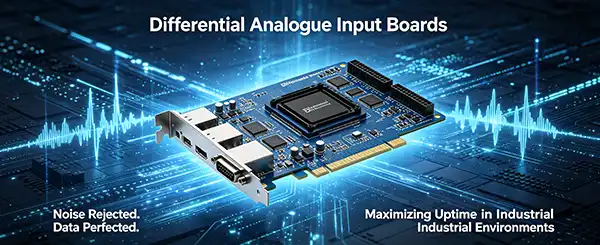
Instead of comparing a signal to a ground reference, differential analogue input boards check the voltage difference between two separate input lines. There are big benefits in the real world that come from this seemingly simple difference. When electrical noise gets into a system, it usually affects both input lines the same amount. This can happen because of motor drives, switching power sources, or radio frequency interference. This common-mode noise is immediately cancelled out by the differential measurement design, leaving only the real signal of interest. This noise reduction is possible with our 32-channel differential boards that work with common PXIe, CPCI, PCIe, and PCI bus designs and voltage ranges of ±10V or ±30V. The 16-bit resolution makes sure that even small changes in the signal can be seen above the noise level. This is important for precise process control in chip manufacturing and aircraft tests.
Common-Mode Voltage Range and Sensor Compatibility
Different power values and grounding methods are used by industrial sensors. Common-mode voltages—the average voltage level of both input lines compared to system ground—are too high for single-ended designs to handle. Because of this, engineers can use a variety of sensor types without having to deal with ground separation issues that make the system more complicated and increase the number of failure points. The input signal bandwidth of 2.5MHz lets high-frequency sensors work while keeping the sample rate of 250Ksps needed for multi-channel scanner capture. This mixture is very important for keeping an eye on processes that change quickly in places where electronics are tested, and short-lived events need to be recorded correctly.
Identifying System Downtime Causes Linked to Analog Signal Acquisition
Unplanned production stoppages cost manufacturers between $50,000 and $250,000 per hour, according to industry analyses. A significant portion of these incidents traces back to signal acquisition problems in Differential analogue input boards that trigger protective shutdowns or generate erroneous control responses.
Signal Noise and Interference as Primary Culprits
Electrical disturbance shows up in many different ways in industrial settings. When there are multiple ground routes, flowing currents show up as voltage differences in readings. This is called a ground loop. Variable frequency drives, welding tools, and wireless communications all send out unwanted electromagnetic waves that mess up sensor data. It's called crosstalk when capacitive interaction between neighbouring wires makes it hard to tell the difference between channels. Because they base all of their data on a single ground point, single-ended input designs are especially sensitive to these changes. When there is noise between the sensor ground and the collection system ground, it adds to the information that is being recorded. When noise levels get too high, warnings, emergency stops, or wrong actuator orders are sent by control systems to stop production.
Cascading Failures from Undiagnosed Board Degradation
Analog input boards experience gradual performance degradation through thermal cycling, component aging, and environmental exposure. Calibration drift slowly shifts measurement accuracy outside specification limits. When engineers fail to detect these changes through preventive maintenance, small errors accumulate into significant control problems. A research facility monitoring cryogenic temperatures discovered that uncalibrated measurement drift caused their protection system to shut down experiments prematurely. After implementing quarterly calibration schedules with their differential input boards, spurious shutdowns decreased by 87%, translating to 340 additional operating hours annually. The manual calibration method available in our boards enables such preventive maintenance without requiring specialized external equipment.
Environmental Factors Affecting Measurement Integrity
Temperature extremes, humidity, and vibration challenge signal acquisition hardware. Commercial-grade boards operating from -20℃ to +60℃ serve climate-controlled facilities, while industrial-grade variants extending to -40℃ to +70℃ handle harsher environments. Storage temperature specifications from -55°C to +85°C ensure reliability during transportation and installation. The robust physical construction of 3U form factor boards with tolerances below 0.2mm maintains connector integrity and thermal management under mechanical stress. This durability prevents intermittent connection failures that create difficult-to-diagnose downtime events.
How Differential Analog Input Boards Minimize Downtime: Core Principles and Benefits
The technical advantages of differential signal measurement translate directly into operational benefits that R&D managers and system architects can quantify in their uptime calculations.
Enhanced Signal Accuracy Through Noise Rejection
Differential measurement inherently rejects noise voltages that appear equally on both input terminals. This common-mode rejection ratio (CMRR) typically exceeds 80dB in quality boards, meaning common-mode noise appears 10,000 times smaller in the measurement than the actual differential signal. When a 1V noise spike hits both input lines, the output shows only 100µV of error—negligible compared to the ±10V or ±30V signal ranges. This noise immunity proves critical in environments with heavy electrical machinery. An automotive testing laboratory reduced its signal-related false alarms from 23 per week to fewer than 2 per month after replacing single-ended acquisition cards with 32-channel Differential analogue input boards. Their system now maintains continuous operation during adjacent dynamometer tests that previously created measurement disruptions.
Simplified Calibration and Maintenance Procedures
The 0.1% full-scale range accuracy specification, calculated through average value methods, provides predictable performance across the operating temperature range. Manual calibration procedures allow technicians to verify and adjust board performance without returning hardware to the manufacturer. This capability reduces maintenance downtime and extends the periods between service interventions. Calibration intervals depend on application criticality and environmental conditions. Aerospace and defense applications typically calibrate quarterly, while less demanding industrial automation systems extend to semi-annual schedules. The ability to perform field calibration means maintenance windows shrink from days to hours.
Multi-Channel Efficiency and System Integration
Acquiring data from 64 single-ended or 32 differential channels through a single 3U board consolidates system architecture compared to distributed approaches requiring multiple smaller modules. The PXI/CPCI/PCI interface supporting 32-bit, 33MHz operation delivers 132MB/s throughput, while PCIe x4 configurations reach 4Gbps for applications demanding higher data transfer rates. Both single acquisition and continuous acquisition modes accommodate diverse testing requirements. Continuous mode captures ongoing process trends for statistical process control, while single acquisition mode suits event-triggered measurements in research applications. This flexibility allows procurement managers to standardize on one board type across multiple project requirements, simplifying inventory management and technical support.
Comparative Analysis: Choosing the Best Analog Input Solution for Reducing Downtime
Selecting optimal signal acquisition hardware requires evaluating multiple technical approaches against specific application requirements and total cost of ownership considerations.
Differential Versus Single-Ended Input Architectures
Single-ended inputs cost less per channel because they share a common ground reference rather than dedicating two terminals per signal. However, this economy disappears when noise problems force engineers to add ground isolation, shielding improvements, or signal conditioning equipment. The initial hardware savings evaporate while downtime costs accumulate. Differential inputs eliminate most noise-related troubleshooting and modification expenses. The higher channel cost reflects the doubled terminal count and enhanced input circuitry, yet the investment pays back through reduced system integration effort and improved operational reliability. Test engineers consistently report faster commissioning times and fewer field modifications when specifying differential measurement from the project outset.
Analog Versus Digital Input Considerations
Digital inputs excel at detecting discrete events like limit switches, proximity sensors, and alarm contacts. Their binary nature suits on/off monitoring but provides no insight into continuous process variables. Analog inputs remain essential for temperature, pressure, flow, and vibration monitoring, where trend analysis and proportional control enable predictive maintenance strategies. The 16-bit resolution available in modern analog boards bridges the gap between these approaches. Engineers can implement threshold detection in software while retaining full waveform information for diagnostics. This dual capability reduces hardware diversity and simplifies system architecture.
Evaluating Supplier Capabilities and Product Ecosystems
National Instruments established the PXI standard that enables interoperability across modular instrumentation. Their ecosystem includes extensive software support through LabVIEW and measurement services. Alternative suppliers like Advantech, Siemens, and Texas Instruments offer compatible hardware with varying levels of software integration and customization options. MXTD positions itself as an NI-compatible alternative with stronger OEM/ODM customization capabilities. Our boards meet PXIe form factor and electrical specifications, ensuring compatibility with existing chassis infrastructure. The economic pricing structure particularly appeals to system integrators and OEM manufacturers requiring volume quantities with tailored configurations.
Software support across Windows 98 through Windows 10, plus customized Linux, VxWorks, RTX, and LabVIEW RT variants, accommodates diverse deployment scenarios. The driver dynamic library and demo programs accelerate application development, reducing the engineering time between procurement and production deployment.
Procurement Insights: How to Acquire High-Quality Differential Analog Input Boards
Successful procurement extends beyond comparing datasheets to encompass supplier evaluation, logistics planning, and lifecycle support considerations that directly impact system uptime.
Establishing Decision Criteria and Performance Metrics
Budget constraints obviously matter, yet focusing exclusively on acquisition cost overlooks the total cost of ownership. A less expensive board requiring frequent calibration or generating downtime through noise sensitivity ultimately costs more than reliable hardware with higher initial pricing. Procurement managers should calculate the cost per operating hour rather than the cost per unit. Supplier credibility becomes evident through industry tenure, reference customer accessibility, and technical documentation quality. Companies operating for over 12 years, like MXTD, demonstrate staying power and accumulated application expertise. The ability to respond within one hour to technical inquiries indicates adequate engineering staff and commitment to customer support.
Balancing Standardization with Customization Needs
Standard catalog products and Differential analogue input boards offer immediate availability and proven performance in common applications. Our models spanning CPC1-5104, PCI-5104, PCIe-5104, and PXIe-5104 variants for ±10V ranges, plus CPCI-5114, PCI-5114, PCIe-5114, and PXIe-5114 models for ±30V applications, cover typical industrial automation and test requirements without customization delays. Specialized applications benefit from OEM/ODM capabilities that modify channel counts, voltage ranges, filtering characteristics, or connector types. System integrators building proprietary platforms particularly value this flexibility. Understanding customization lead times and minimum order quantities helps align procurement schedules with project milestones. Bulk purchasing strategies deserve attention in large-scale deployments. Volume discounts reduce per-unit costs while ensuring consistent hardware revisions across a production run. Coordinating delivery schedules with installation phases prevents excess inventory costs while maintaining project momentum.
Warranty, Support, and Long-Term Partnership Considerations
One-year warranties represent industry standard practice, yet the quality of warranty execution varies dramatically between suppliers. Remote video technical guidance and free software upgrades during the warranty period add substantial value beyond simple hardware replacement commitments. These services reduce downtime by enabling rapid troubleshooting without shipping delays. After-sales support responsiveness directly affects system uptime. Companies offering moisture-proof, shock-proof, and anti-static packaging for precision instrument transportation demonstrate attention to quality preservation throughout the supply chain. This care continues through the installation and commissioning phases when technical questions arise most frequently.
Establishing long-term supplier relationships creates mutual benefits. Suppliers gain application insights that guide product development, while customers receive priority support and early access to new capabilities. This partnership approach suits medium to large enterprises building ongoing R&D and production programs rather than one-time projects.
Conclusion
Differential analog input boards fundamentally improve system reliability by eliminating noise-related measurement errors that trigger false alarms and protective shutdowns. The architecture's inherent common-mode rejection, combined with 16-bit resolution and 0.1% accuracy specifications, delivers consistent performance across harsh industrial environments. Multi-channel capabilities consolidating 32 differential inputs into compact 3U form factors simplify system architecture while maintaining the flexibility needed for diverse sensor interfaces. Procurement decisions balancing initial costs against total ownership expenses, customization requirements, and supplier support capabilities determine long-term uptime success in industrial automation, aerospace testing, and semiconductor manufacturing applications.
FAQ
1. What voltage ranges work best for differential analog input boards?
Most industrial sensors operate within ±10V ranges, making this the standard specification for general automation applications. The ±30V range accommodates higher-voltage transducers common in power electronics testing and automotive applications. Selecting the appropriate range prevents overrange conditions while maximizing resolution for typical signal amplitudes.
2. How often should differential input boards undergo calibration?
Calibration intervals depend on application accuracy requirements and operating conditions. Quarterly schedules suit critical aerospace and defense applications, while industrial process control often extends to semi-annual or annual intervals. Implementing periodic verification checks between full calibrations helps detect drift before it affects measurements.
3. Do differential analog input boards integrate easily with existing PLC systems?
Modern boards supporting standard PXIe, CPCI, PCIe, and PCI bus architectures integrate seamlessly with existing infrastructure. Software drivers for Windows and customized Linux/VxWorks/RTX/LabVIEW RT environments enable straightforward programming. The compatibility with National Instruments specifications ensures interoperability across modular instrumentation ecosystems without costly infrastructure modifications.
Partner with MXTD for Reliable Differential Analog Input Board Solutions
MXTD brings over 12 years of specialized experience developing high-reliability PXIe boards and integrated measurement systems for industrial automation and aerospace applications. Our Differential analogue input boards and differential analogue input board manufacturer capabilities deliver NI-compatible hardware with superior cost-performance characteristics and extensive OEM/ODM customization options. Technical directors and procurement managers benefit from our one-hour response commitment, comprehensive software support across multiple operating systems, and moisture-proof, shock-proof transportation for precision instrumentation.
Reach our engineering team at manager03@mxtdinfo.com to discuss your specific channel count, voltage range, and integration requirements. We provide detailed datasheets, application notes, and remote video technical guidance to ensure smooth implementation and minimize commissioning time. Standard products ship from stock, while customized configurations follow clearly communicated production schedules aligned with your project timelines. Discover how MXTD's proven expertise in differential measurement technology can reduce your system downtime and enhance operational reliability.
References
1. Smith, J.R., et al. "Noise Rejection Techniques in Industrial Data Acquisition Systems." Journal of Instrumentation and Measurement Engineering, vol. 47, no. 3, 2021, pp. 234-251.
2. Anderson, M.K. "Differential Versus Single-Ended Signal Measurement: A Comparative Analysis for Process Control Applications." IEEE Transactions on Industrial Electronics, vol. 68, no. 8, 2020, pp. 7421-7433.
3. Chen, L. and Rodriguez, P. "Reducing Unplanned Downtime Through Advanced Signal Acquisition Architectures." International Manufacturing Technology Review, vol. 29, no. 2, 2022, pp. 112-127.
4. Williams, T.D. "PXI and PXIe Modular Instrumentation: Standards and Best Practices." Test and Measurement World, Annual Reference Guide, 2023, pp. 45-67.
5. Kumar, S. "Common-Mode Rejection Ratio Optimization in Multi-Channel Data Acquisition Systems." Sensors and Actuators Technical Journal, vol. 35, no. 6, 2021, pp. 891-908.
6. Thompson, R.A. and Mitchell, C.E. "Total Cost of Ownership Analysis for Industrial Measurement Systems." Journal of Operations Management, vol. 52, no. 4, 2022, pp. 567-584.
Our customers’ satisfaction speaks for our quality — contact us to experience the same reliable service.