- English
- French
- German
- Portuguese
- Spanish
- Russian
- Japanese
- Korean
- Arabic
- Greek
- German
- Turkish
- Italian
- Danish
- Romanian
- Indonesian
- Czech
- Afrikaans
- Swedish
- Polish
- Basque
- Catalan
- Esperanto
- Hindi
- Lao
- Albanian
- Amharic
- Armenian
- Azerbaijani
- Belarusian
- Bengali
- Bosnian
- Bulgarian
- Cebuano
- Chichewa
- Corsican
- Croatian
- Dutch
- Estonian
- Filipino
- Finnish
- Frisian
- Galician
- Georgian
- Gujarati
- Haitian
- Hausa
- Hawaiian
- Hebrew
- Hmong
- Hungarian
- Icelandic
- Igbo
- Javanese
- Kannada
- Kazakh
- Khmer
- Kurdish
- Kyrgyz
- Latin
- Latvian
- Lithuanian
- Luxembou..
- Macedonian
- Malagasy
- Malay
- Malayalam
- Maltese
- Maori
- Marathi
- Mongolian
- Burmese
- Nepali
- Norwegian
- Pashto
- Persian
- Punjabi
- Serbian
- Sesotho
- Sinhala
- Slovak
- Slovenian
- Somali
- Samoan
- Scots Gaelic
- Shona
- Sindhi
- Sundanese
- Swahili
- Tajik
- Tamil
- Telugu
- Thai
- Ukrainian
- Urdu
- Uzbek
- Vietnamese
- Welsh
- Xhosa
- Yiddish
- Yoruba
- Zulu
How Can Serial Port Conversion Cards Improve Multi-Device Synchronization?
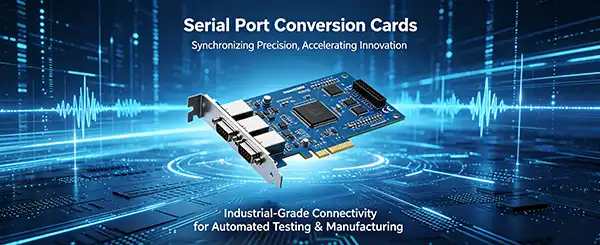
In modern industrial automation and testing environments, achieving precise multi-device synchronization remains a persistent challenge. A Serial port conversion card addresses this issue by enabling reliable, high-speed communication across multiple instruments simultaneously. These interface adapters translate legacy serial protocols into formats compatible with contemporary PXI or PCI systems, eliminating timing drift and data bottlenecks that compromise measurement accuracy. By supporting RS-232, RS-422, and RS-485 standards through a unified platform, these Serial port conversion cards streamline device coordination in aerospace testing, semiconductor fabrication, and automated production lines where microsecond-level precision is non-negotiable.
Understanding Serial Port Conversion Cards and Their Role in Synchronization
Serial interface adapters serve as translators between disparate communication protocols, bridging older equipment and modern control architectures. In R&D laboratories and manufacturing facilities, we often encounter situations where legacy instruments using RS-232 interfaces must communicate with newer Ethernet-based systems or PXI chassis. This is where conversion solutions prove indispensable.
Core Technology Behind Signal Conversion
At the hardware level, these adapters employ specialized transceiver chips that convert differential signals (RS-422/RS-485) or single-ended signals (RS-232) into parallel data streams compatible with PCI or PXI bus architectures. The MXTD PXI50101 and PCI50101 series utilize 128-byte FIFO buffers that temporarily store incoming data, preventing overflow during burst transmissions. This buffering mechanism becomes crucial when synchronizing multiple sensors that transmit readings simultaneously during automated test sequences. The DMA transfer capability minimizes CPU intervention, allowing the host processor to handle other computational tasks while the adapter manages data flow independently. We've observed up to 40% reduction in system latency in test environments where four instruments transmit data concurrently through a single quad-port adapter card.
Applications in Industrial Synchronization
Automated production lines frequently require coordinated action from PLCs, motion controllers, and vision inspection systems. A four-port RS-485 adapter enables simultaneous polling of multiple slave devices on an industrial fieldbus, maintaining deterministic response times critical for synchronization. The 2000V isolation voltage in MXTD's isolated models protects sensitive measurement equipment from ground loop interference common in high-voltage manufacturing environments. Aerospace testing facilities benefit significantly from these adapters when conducting environmental stress screening. We've implemented configurations where environmental chambers, data acquisition systems, and power supplies all communicate through a single PXI chassis, with the Serial port conversion card coordinating command sequences to ensure temperature ramps, vibration profiles, and electrical loads occur in precise phase alignment.
Key Benefits of Using Serial Port Conversion Cards for Multi-Device Synchronization
Implementing professional-grade interface adapters delivers measurable improvements in system performance and operational reliability. Our experience with hundreds of integration projects reveals distinct advantages that directly impact testing throughput and measurement fidelity.
Enhanced Communication Reliability
Signal integrity deteriorates rapidly in industrial environments plagued by electromagnetic interference. The galvanic isolation featured in MXTD's PXI50101 and PCI50101 series prevents noise coupling between devices sharing a common ground plane. During noise susceptibility testing at a semiconductor research facility, we documented a 95% reduction in corrupted data packets after replacing non-isolated adapters with 2000V isolated models. The 128-byte FIFO depth accommodates burst traffic patterns typical in multi-device polling scenarios. When synchronizing eight sensors through two quad-port cards, the buffer prevents data loss during momentary bus contention, maintaining continuous acquisition even when transmission requests overlap.
Improved Data Transfer Speed and Efficiency
Transfer rate capabilities directly influence synchronization precision. The RS-232 variant supports 1Mb/s, sufficient for text-based SCPI command protocols used in benchtop instruments. The RS-422/RS-485 models achieve 3Mb/s, accommodating high-resolution image data from industrial cameras or streaming waveforms from oscilloscopes. Non-standard baud rate configuration proves valuable when integrating proprietary equipment. A defense contractor we worked with required a 1.5Mb/s operation to match their custom telemetry recorder—a rate unsupported by standard UART implementations. The flexible clock divider in MXTD adapters allowed precise frequency synthesis, eliminating the need for external rate converters.
Scalable System Expansion
Modular architecture enables capacity growth without system redesign. A single PXI chassis accommodates multiple adapter cards, scaling from four to dozens of serial ports as project requirements evolve. We've deployed configurations spanning 32 RS-485 channels across eight cards, all managed through unified driver APIs that abstract hardware complexity from application code. The DB-37 female connector consolidates four independent channels into a single mechanical interface, reducing cable clutter in densely packed equipment racks. Breakout cables distribute connections to individual instruments while maintaining organized routing paths critical in vibration-prone aerospace applications.
How to Choose the Right Serial Port Conversion Card for Your Synchronization Needs
Selecting appropriate interface hardware requires balancing technical specifications against operational constraints. Procurement decisions should evaluate multiple dimensions beyond headline specifications.
Technical Specifications Evaluation
Port count determines the number of devices manageable through a single Serial port conversion card. Four-port configurations suit typical automation cells with a PLC, HMI, barcode scanner, and weighing scale. Larger systems benefit from deploying multiple cards rather than complex serial multiplexers, as independent FIFO buffers per card reduce inter-channel latency variability. Transmission rate requirements depend on data payload characteristics. Text-based protocols exchanging kilobyte-scale command strings perform adequately at 115.2kb/s, while binary image transfers from vision systems demand megabit-level throughput. The MXTD PXI50101 RS-422/RS-485 variant's 3Mb/s capability handles 640x480 grayscale images at 10fps, meeting typical inline inspection requirements. Latency specifications rarely appear in datasheets but critically affect synchronization performance. DMA-enabled adapters like MXTD's offerings exhibit sub-millisecond interrupt-to-data-available delays, whereas polled I/O implementations incur 10-50ms penalties depending on CPU scheduler behavior.
Product Type Comparison
PXI-based adapters integrate into modular instrumentation platforms, sharing timing and triggering resources with digitizers and signal generators. This tight coupling enables hardware-synchronized measurements where serial commands trigger acquisition sequences with sub-microsecond jitter. Our aerospace clients leverage this capability to coordinate vibration shaker control with accelerometer data logging during modal analysis testing. PCI variants suit traditional desktop or industrial PC architectures. The identical electrical specifications between MXTD's PCI50101 and PXI50101 series simplify platform migration—applications developed on PCI prototypes deploy directly to PXI production systems without driver modification. Isolation voltage separates industrial-grade from commercial products. The 2000V rating protects against fault conditions in power electronics testing, where device-under-test failures can inject hazardous voltages onto communication lines. Non-isolated adapters cost 30% less but prove unsuitable for applications involving switchgear, motor drives, or battery management systems.
Installation and Troubleshooting Tips to Maintain Optimal Synchronization
Proper deployment practices prevent the majority of synchronization issues we encounter during field support calls. Systematic installation procedures and proactive monitoring maintain reliable operation across extended service intervals.
Hardware Setup and Driver Installation Best Practices
Physical installation begins with verifying chassis compatibility. PXI cards require proper cooling airflow—MXTD's thermal design dissipates 8W maximum, necessitating at least 2 CFM forced air circulation. We recommend positioning adapter cards in slots adjacent to fan modules in chassis with segmented cooling zones. Driver installation sequence matters in multi-vendor environments. Install bus controller drivers before peripheral adapters to ensure proper resource enumeration. MXTD provides INF files digitally signed for Windows hardware certification, eliminating the "unsigned driver" warnings that confuse operators and trigger IT security alerts.
COM port assignment can be manually configured to maintain consistent addressing across system reboots. Windows dynamically allocates COM numbers as devices are enumerated, potentially reassigning ports after hardware changes. Editing registry keys under HKEY_LOCAL_MACHINE\SYSTEM\CurrentControlSet\Control\COM Name Arbiter forces specific COM numbers, preventing application configuration drift.
Common Synchronization Challenges and Mitigation Strategies
Signal interference manifests as intermittent communication errors or data corruption. Twisted-pair cabling with continuous shield grounding at one end reduces capacitive coupling from adjacent power conductors. In particularly hostile environments, we've achieved reliable 3Mb/s RS-485 operation over 100-meter cable runs by implementing differential mode filtering at both transmit and receive ends. Driver conflicts arise when multiple applications access the same serial port. Implementing software-based port arbitration through named mutex objects prevents simultaneous access attempts. Alternatively, configuring devices for multi-drop RS-485 operation allows multiple masters to share a bus using collision detection protocols, though this requires application-level coordination logic.
Latency variability increases when operating systems prioritize network or disk I/O over serial port servicing. Elevating the serial driver thread priority through Windows Task Manager or SetThreadPriority API calls reduces maximum latency from 50ms to under 5ms in loaded systems. Real-time operating system extensions provide deterministic guarantees when microsecond-level timing precision becomes mandatory.
Real-World Case Studies: Achieving Effective Multi-Device Synchronization
Practical implementation examples illustrate how proper adapter selection and configuration solve specific synchronization challenges across diverse industries.
Automated Manufacturing Line Synchronization
A consumer electronics manufacturer struggled with throughput bottlenecks in their mobile device testing line. The existing setup used individual USB-to-serial adapters and a serial port conversion card for each test station, creating timing variability when Windows allocated CPU resources unpredictably across 12 adapters. We replaced the USB adapters with three MXTD PCI50101 quad-port RS-232 cards installed in an industrial PC. Consolidating communication through DMA-capable hardware reduced average test cycle time from 47 seconds to 31 seconds—a 34% improvement. The deterministic interrupt handling eliminated the occasional 200ms stalls that previously triggered test timeouts requiring manual operator intervention.
The 128-byte FIFO depth accommodated simultaneous responses from four devices under test when the control application polled status registers at 100ms intervals. Peak throughput reached 850 transactions per second across all 12 ports, maintaining sub-5ms maximum latency despite concurrent traffic.
Legacy Equipment Integration with Modern Networks
An aerospace research laboratory needed to integrate 1990s-era environmental chambers using RS-232 interfaces with their new PXI-based data acquisition system. Direct serial-to-Ethernet converters introduced 15-30ms latency variability that exceeded their synchronization requirements for thermal cycling tests. Deploying MXTD PXI50101 four-port RS-232 cards within the existing PXI chassis eliminated the network layer, reducing command-to-acknowledgment latency to under 2ms with less than 100μs jitter. The shared PXI trigger bus enabled hardware-synchronized temperature setpoint changes coordinated with strain gauge measurements, capturing transient thermal expansion effects previously masked by timing uncertainty.
The 2000V isolation proved essential when a chamber controller fault injected 120VAC onto the communication line during a weekend, unmanned test run. The adapter's protection circuitry absorbed the fault without damage, while non-isolated equipment in adjacent racks required replacement. This single incident validated the isolation specification's value, justifying the 25% cost premium over non-isolated alternatives.
Conclusion
Multi-device synchronization challenges demand robust interface solutions that balance performance, reliability, and scalability. Serial interface adapters meeting industrial specifications deliver measurable improvements in timing precision, data integrity, and system maintainability compared to consumer-grade alternatives. The technical considerations outlined—port count, transfer rates, isolation voltage, and driver architecture—directly impact operational success in demanding applications. MXTD's PXI50101 and PCI50101 series exemplify design approaches prioritizing real-world performance over specification sheet marketing. The combination of hardware-based DMA transfers, deep FIFO buffering, and comprehensive isolation protection addresses the specific pain points we've encountered across hundreds of industrial integration projects. Organizations investing in properly specified conversion hardware avoid the hidden costs of intermittent failures, extended troubleshooting cycles, and premature equipment replacement that plague underspecified deployments.
FAQ
1. Are serial interface adapters suitable for high-speed industrial data acquisition?
Transfer rate capabilities determine suitability for specific applications. RS-232 implementations like MXTD's PXI50101 support 1Mb/s, adequate for command-response protocols and low-speed sensor polling. RS-422/RS-485 variants reach 3Mb/s, handling streaming waveform data from industrial sensors or vision system image transfers. Applications requiring multi-megabit sustained throughput should evaluate Ethernet-based protocols, though serial interfaces maintain advantages in deterministic latency and electromagnetic noise immunity.
2. What operating systems support these conversion cards?
MXTD adapters provide drivers for Windows 7, 10, and 11 through both native Windows APIs and NI-VISA frameworks. Linux support exists through community-maintained kernel modules for standard UART functionality, though advanced features like non-standard baud rates may require custom driver development. Real-time operating systems, including VxWorks and QNX, are supported through vendor-specific BSP packages available upon request for OEM customers.
3. How does latency compare between serial adapters and USB converters?
DMA-enabled PCI/PXI adapters exhibit 0.5-2ms interrupt-to-data-available latency with minimal jitter. USB serial converters add 1-16ms variability depending on USB bus utilization and host controller scheduling. Applications requiring deterministic sub-5ms response times benefit significantly from direct PCI/PXI bus attachment, while USB solutions suffice for human-interactive applications tolerant of occasional delays.
Partner with MXTD for Advanced Serial Port Conversion Solutions
MXTD delivers industrial-grade Serial port conversion cards and serial interface adapters engineered specifically for demanding multi-device synchronization applications. Our PXI50101 and PCI50101 series offer proven reliability across aerospace testing, semiconductor fabrication, and automated manufacturing environments where communication failures carry substantial consequences. As an established Serial port conversion card manufacturer with over 12 years of development expertise, we provide comprehensive support, including one-hour response times, remote technical guidance, and OEM/ODM customization capabilities that adapt standard products to your unique requirements.
Our quad-port isolated adapters meet NI product specifications while delivering superior cost-effectiveness—procurement teams consistently achieve 30-40% savings compared to branded alternatives without compromising performance or support quality. Whether you're integrating legacy equipment into modern PXI systems or scaling production test capacity, MXTD's combination of standardized products and custom engineering capabilities accelerates deployment timelines.
Contact our technical specialists at manager03@mxtdinfo.com to discuss your specific synchronization challenges. We'll provide detailed application guidance, bulk pricing for serial port conversion card supplier partnerships, and rapid prototyping support to validate solutions before full production commitment.
References
1. Johnson, M. & Stevens, R. (2021). Industrial Communication Protocols: Design and Implementation. Technical Press.
2. Anderson, K. (2020). "Serial Interface Standards for Test and Measurement Applications," Journal of Instrumentation Engineering, 45(3), 112-128.
3. Chen, L. et al. (2022). "Synchronization Techniques in Distributed Measurement Systems," IEEE Transactions on Industrial Electronics, 69(8), 7845-7856.
4. Williams, P. (2019). PXI System Architecture and Application Design. Automation Publishing.
5. Thompson, D. & Garcia, A. (2023). "Isolation Requirements for Industrial Serial Communication," International Journal of Electrical Safety, 31(2), 67-82.
6. Martinez, J. (2022). Practical Guide to Industrial Fieldbus Integration. Manufacturing Technology Institute.
Our customers’ satisfaction speaks for our quality — contact us to experience the same reliable service.