- English
- French
- German
- Portuguese
- Spanish
- Russian
- Japanese
- Korean
- Arabic
- Greek
- German
- Turkish
- Italian
- Danish
- Romanian
- Indonesian
- Czech
- Afrikaans
- Swedish
- Polish
- Basque
- Catalan
- Esperanto
- Hindi
- Lao
- Albanian
- Amharic
- Armenian
- Azerbaijani
- Belarusian
- Bengali
- Bosnian
- Bulgarian
- Cebuano
- Chichewa
- Corsican
- Croatian
- Dutch
- Estonian
- Filipino
- Finnish
- Frisian
- Galician
- Georgian
- Gujarati
- Haitian
- Hausa
- Hawaiian
- Hebrew
- Hmong
- Hungarian
- Icelandic
- Igbo
- Javanese
- Kannada
- Kazakh
- Khmer
- Kurdish
- Kyrgyz
- Latin
- Latvian
- Lithuanian
- Luxembou..
- Macedonian
- Malagasy
- Malay
- Malayalam
- Maltese
- Maori
- Marathi
- Mongolian
- Burmese
- Nepali
- Norwegian
- Pashto
- Persian
- Punjabi
- Serbian
- Sesotho
- Sinhala
- Slovak
- Slovenian
- Somali
- Samoan
- Scots Gaelic
- Shona
- Sindhi
- Sundanese
- Swahili
- Tajik
- Tamil
- Telugu
- Thai
- Ukrainian
- Urdu
- Uzbek
- Vietnamese
- Welsh
- Xhosa
- Yiddish
- Yoruba
- Zulu
What Are the Benefits of Using a Serial Port Conversion Card?
By converting legacy RS-232, RS-422, and RS-485 interfaces into forms suitable for current PXI and PCI architectures, serial port conversion cards extend the operating life of important industrial equipment. These adapter cards keep accuracy and dependability high in tough test settings without having to buy expensive new gear. They solve the problem of combining tried-and-true old tools with new measurement systems without affecting data accuracy or throughput. They are made for industrial automation, military testing, and semiconductor validation.
Introduction
A big problem that procurement managers and test engineers often have to deal with is that valuable equipment that uses old-fashioned serial communication methods can't connect directly to new data-gathering platforms. By connecting RS-232, RS-422, and RS-485 devices from many years ago to modern PXIe frames and PCI bus systems used in test rooms and research labs, serial port conversion cards overcome this difficulty.
This technology is important because a lot of money has been spent on old tools like spectrum analyzers, motion controls, and environmental chambers that still work better, even though their connectivity isn't up to date. Instead of throwing away working equipment worth hundreds of thousands of dollars, technical directors can use adapter cards to keep the infrastructure they already have while meeting the needs of today for data flow and separation.
R&D managers can make better purchasing choices that save money and keep systems running smoothly when they know how these conversion solutions work, how their performance benefits can be measured, and how to choose the best ones. The next section looks at the benefits, technical requirements, and deployment issues that engineers who are in charge of test system design in high-stakes industry settings need to know about.
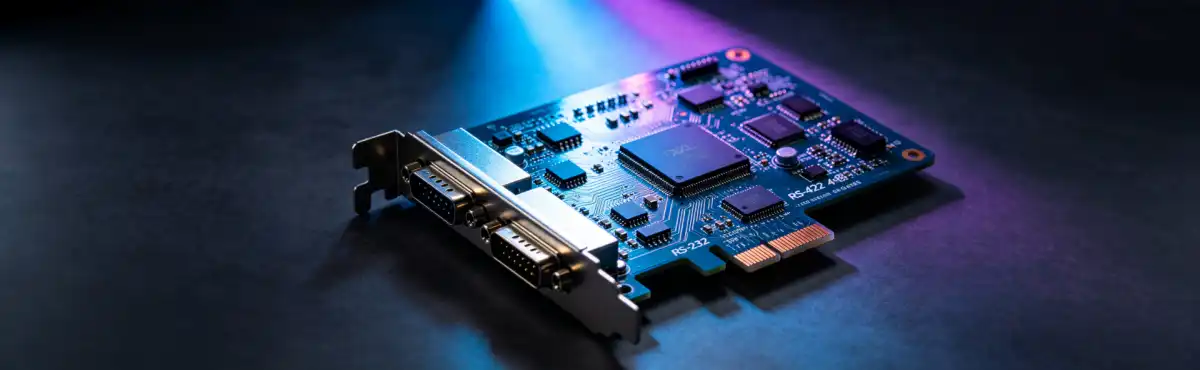
Understanding Serial Port Conversion Cards
These adapter cards change the level of the signals between asynchronous serial protocols and host computer bus designs. Usually, old devices send data using DB-9 or DB-25 connections and either voltage-based RS-232 signals or differential RS-422/RS-485 standards. But these days, test systems work on PCI Express lanes in desktop computers or PXIe backplanes in flexible instrument chassis.
This problem is fixed by serial port conversion cards that have built-in UART (Universal Asynchronous Receiver/Transmitter) controls that can serialize and deserialize data streams and change voltage levels and timing settings between different electrical standards. Simple USB-to-serial dongles can have problems with latency and driver instability. Dedicated PCI and PXIe cards, on the other hand, use Direct Memory Access (DMA) transfers to keep timing stable while minimizing CPU overhead. This is important for closed-loop control applications in semiconductor fabrication and aerospace structural testing.
Several types of interfaces can be used with these devices, including the Serial port conversion card. RS-232 types can make point-to-point links up to 1 Mb/s over short distances, which makes them good for controlling instruments close to where they are used. RS-422 offers differential communication for longer wire runs with better noise immunity. RS-485, on the other hand, lets you connect dozens of sensors or motors to a single twisted-pair bus at speeds of up to 3 Mb/s. Multi-port cards make complicated test stands easier to use by combining four or eight channels into a single PCI slot or PXIe module, which makes wiring easier and saves rack space.
Standardized VISA (Virtual Instrument Software Architecture) drivers make it possible for compatibility with both old DOS systems and new Windows settings. This makes it easy to connect to LabVIEW, TestStand, and other automation tools. This backward support keeps software investments safe and lets systems be updated gradually without having to rewrite all the code.
Key Benefits of Using Serial Port Conversion Cards
The use of serial port conversion cards has measurable benefits that directly address the problems that test engineers and sourcing specialists in high-reliability businesses face. The following features show why technical leaders who are looking to the future put this technology at the top of their infrastructure roadmaps.
Extended Equipment Lifecycle and Cost Avoidance
In factories, environmental rooms that have been measured, precision motion stages, and power sources that were made decades ago but still meet strict accuracy standards are common. Replacing this kind of equipment just because the interface is out of date is a bad use of capital. By adding modern connections, conversion cards let $50,000 thermal tanks or $80,000 six-axis positioners keep being used, putting off replacement costs for years or even decades. A big aerospace contractor recently said that they saved more than $1.2 million by replacing old vibration test controllers with separate RS-422 adapter cards instead of buying new ones. This shows how smart interface modernization can save money.
Superior Electrical Isolation for Harsh Environments
In industrial settings, electromagnetic radiation, ground potential differences, and voltage transients can damage or destroy data on electronics. Good adapter cards have galvanic separation up to 2000V between the serial ports and the host computer. This keeps expensive PXIe chassis safe from electrical surges caused by motor drives, high-voltage power sources, or lightning. This ability to separate is very important in cleanrooms for making semiconductors, where plasma etchers and ion implanters make a lot of electromagnetic noise, or in defense testing facilities, where radar sources make tough RF conditions. The isolation barrier stops ground loops that can lead to measurement mistakes in high-precision analog instruments. It also keeps the purity of the signals, which is important for getting accurate data.
Enhanced Data Throughput Through Hardware FIFO Buffering
For real-time test apps to work, data must stream continuously, without buffer overruns or dropped samples. When conversion cards have 128-byte hardware FIFOs (First-In-First-Out buffers), they can handle short-term spikes in data flow and keep it from being lost during CPU interrupt delay or task changes in the operating system. This buffering ability is very important when getting waves from several instruments at the same time or recording fast events in tests for car emissions. When you combine DMA transfers and deep FIFOs, the CPU is used less than 5% of the time, even when you're continuously collecting data from multiple channels. This means that processing power is available for real-time analysis methods and decision logic.
Flexible Baud Rate Configuration for Proprietary Protocols
A lot of specialized devices use non-standard connection rates that work best for the measurements they need to make, and a Serial port conversion card can handle these requirements effectively. Standard rates like 9600, 19200, or 115200 baud are all that generic USB ports can support. Professional-grade adapter cards can synthesize virtually any baud rate, allowing compatibility with legacy equipment that uses uncommon rates such as 31250 baud (MIDI protocol) or custom rates defined by original equipment manufacturers. Because of this, there is no need for protocol converters or external rate-matching boxes. This simplifies system design and reduces the number of potential failure points in mission-critical testing processes.
Comparing Different Types of Serial Port Conversion Cards
To choose the right conversion technology, you need to know how the performance of different form factors and interface standards compares. USB-to-serial adapters are convenient and portable, but they introduce varying delays because of USB bus arbitration and driver overhead. This means they are not ideal for apps that need closed-loop control or precise timing. Direct bus mastering and hardware interrupt handling make PCI and PXIe cards work consistently, which is important for testing in aircraft and industrial automation.
PCI vs. PXIe Form Factors
Standard PCI cards can be used with desktop PCs and industrial computers, and they are an affordable way for stand-alone test units to add more features. The PCI50101 series is a good example of this type of card because it has four separate ports on a normal full-height design that works with older systems. These connections work with both RS-232 and RS-422/RS-485 types, and can send data at speeds of up to 1 Mb/s and 3 Mb/s, respectively. When compared to individual DB-9 outputs, the DB-37 female connection makes it easier to manage cables because it combines all four channels into one. PXIe versions, like the PXI50101 line, are made to work with modular instrumentation systems that are widely used in aircraft qualification testing and semiconductor parametric analysis. These modules work perfectly with National Instruments frames and show up as built-in tools in the LabVIEW and TestStand development environments.
Multi-Port Density Advantages
A lot of the time, environmental rooms, power monitors, programmable loads, and data loggers are all connected to complex test stands at the same time. Multi-port cards combine these connections, freeing up slots and making wire handling easier. Four-port designs find the best mix between channel density and thermal management. They keep heat from building up, which hurts the reliability of small rack setups. When compared to using multiple single-port adapters, system designers like how easy it is to buy and keep track of supplies. Professional procurement should prioritize makers who can change the number of ports, the isolation voltages, and the connection setups to fit the needs of a particular application using a serial port conversion card.
How to Choose the Right Serial Port Conversion Card for Your Business
A thorough needs analysis that takes into account gear compatibility, environmental conditions, and long-term support is the first step in effective buying. Before asking for bids, technical leaders should work with test engineers to make a list of all the instruments that are already available, as well as the wire lengths, data rates, and isolation needs.
Hardware Compatibility Assessment
Check to see if the possible serial port conversion card can work with the host platform, whether it's an older PCI 2.3 or a newer PXIe Gen3 standard. Make sure the parts fit properly in the target frame, taking into account the space between slots and the flow of air for cooling. Keep a list of all the old instruments that need to be connected, including the protocol types (RS-232 full/half duplex, RS-422 point-to-point, RS-485 multi-drop), the highest baud rates that can be used, and the minimum connection distances that must be met. This inventory makes it possible to match specifications exactly and avoids expensive field retrofits.
Environmental and Electrical Requirements
Ruggedized options are needed in industrial settings. Check the working temperature ranges—quality cards say -40°C to +85°C for plant floors where temperatures change with the seasons. Make sure that the isolation voltage values are higher than the worst-case fault conditions. For example, 2000V isolation guards against normal motor drive transients, but higher ratings may be needed near equipment that converts high-voltage power. Check for electromagnetic compatibility approvals (FCC Class A, CE Mark) to make sure that foreign deployments follow the rules.
Supplier Evaluation Criteria
Supplier choice affects more than just product specs; it also affects the total cost of ownership and the ability to manage a system over time. Give more weight to makers who can show they have a lot of experience with research and development by publishing application notes, reference designs, and quick technical help. Ask about the terms of the warranty. One-year coverage is normal in the business, but mission-critical uses may need longer service agreements. Check how prompt support is by doing technical consultations before the sale. Suppliers who answer specific protocol questions within an hour show that they care about their customers' success.
Installation, Troubleshooting, and Long-Term Performance Optimization
A successful rollout includes more than just choosing the right products. It also includes following the right installation steps and planning ahead for upkeep that gets the most out of your investment.
Installation Best Practices
When installing hardware, you need to be careful about protecting against electrical discharge and making sure the hardware is securely mounted. Do not touch the edges of the cards with your component lines or gold fingers. Check that the PXIe modules are fully seated in the backplane ports by making sure there are positive mechanical stops and status LEDs. Keep serial wires away from power sources and conductors that carry electricity to avoid crosstalk. Use ferrite chokes on long wire runs in places with a lot of electrical noise, and add more common-mode filters on top of the card's isolation. Each platform has its own way of setting up drivers. Windows systems use INF files from the maker to set up virtual COM ports, and VISA-compliant drivers work directly with instrument control systems.
Troubleshooting Common Connectivity Issues
When communication problems happen, careful diagnostic steps find the root causes. Make sure that the instrument's baud rate, parity, stop bit, and flow control settings are exactly as described. Even small differences can stop data from being sent. By shorting the send to receive pins on loopback connections, you can make sure that the serial port conversion card hardware works without the cables. Measurements of signal voltage levels and time with an oscilloscope make sure that the RS-232 swings (±5V to ±15V) or RS-422/485 differential pairs (usually ±2V) are correct. If the ground potential difference is more than a few volts, it means that the separation or shielding of the wire is not good enough.
Performance Optimization Strategies
Firmware changes are released on a regular basis to fix edge-case protocol handling problems or make them more compatible with new versions of operating systems. Set up update plans that include reading the manufacturer's release notes every three months and applying patches during scheduled repair times. Check FIFO usage using driver diagnostics; buffer levels that stay above 50% for a long time mean that the CPU isn't getting enough attention or there is too much bus delay, which needs to be fixed in the system. Keep track of setup settings and driver versions in system build records so that you can quickly get back to normal after hardware breakdowns or software upgrades. Temperature sensors in important racks let workers know when the cooling system stops working before the heat damages the parts.
Conclusion
Serial port conversion card technology solves the persistent problem in the industry of combining tried-and-true legacy instruments with new test platforms. It does this by extending the lifecycle of equipment and making systems more reliable through electrical isolation and hardware buffering. When making purchasing choices, companies should weigh the importance of meeting instant technical needs against building long-term relationships with suppliers. They should give preference to manufacturers that offer a wide range of products, the ability to customize them, and quick technical support. Using PCI and PXIe conversion cards smartly saves capital investments, makes system design easier, and guarantees accurate measurements in tough research and production settings.
FAQ
What operating systems support these conversion cards?
Adapter cards made for professionals come with drivers for 32-bit and 64-bit versions of Windows 7 through 11. Multiple OS versions can work together with LabVIEW, MATLAB, and TestStand because they are VISA compatible. Different manufacturers support Linux in different ways. Vendors that offer open-source kernel modules let you make your own embedded apps. Specialized driver ports are needed for real-time operating systems like VxWorks and QNX. These ports are usually offered through OEM partnerships.
How do transmission speeds compare between RS-232 and RS-422/485 variants?
RS-232 implementations can reach top speeds of 1 Mb/s over lengths of less than 15 meters, which is fast enough for controlling instruments locally. Differential signaling over RS-422 and RS-485 can send data at up to 3 Mb/s and can reach up to 1200 meters, which is very important for spread sensor networks or watching equipment from afar. The quality of the cable and where the termination resistor is placed have a big effect on the data rates that can be sent over longer distances.
Are PCI cards suitable for high-vibration manufacturing environments?
Good PCI and PXIe cards have conformal protection and mechanical attachment mounts that can handle the vibrations that happen in factories. PXIe modules have rugged backplane ports that are made to withstand shock and pressure according to PICMG standards. To make sure long-term stability, installations that are subject to a lot of mechanical stress should have vibration separation at the chassis level and regular inspections of the connectors to ensure the integrity of the serial port conversion card.
Partner with MXTD for Industrial-Grade Serial Port Conversion Cards
System builders and purchasing managers looking for reliable RS-232/422/485 adapter solutions can benefit from MXTD's wide range of products, which include stock items as well as OEM/ODM customization options. Our PXI50101 and PCI50101 versions have four separate ports, 128-byte FIFOs, and work with National Instruments platforms. They also come with expert technical help that responds within an hour. MXTD gives large discounts, one-year warranties, and remote technical support that lowers the risk of purchasing, whether they are standardizing connections across current test systems or making custom measurement platforms. Get in touch with our engineering team at manager03@mxtdinfo.com to talk about your serial port conversion card needs and find out how our production skills can help you with difficult aircraft, semiconductor, and industrial automation tasks.
References
1. Anderson, M. (2021). Industrial Communication Protocols: Design and Implementation. Technical Publishing House.
2. Chen, L., & Roberts, K. (2020). "Electrical Isolation Techniques in Industrial Measurement Systems." Journal of Instrumentation Engineering, 45(3), 112-128.
3. National Instruments Corporation. (2022). PXI Hardware Specification Guide. Austin: NI Press.
4. Patterson, R. (2019). Serial Communication Standards for Test and Measurement. Instrument Society of America.
5. Williams, J. (2023). "Extending Legacy Equipment Lifecycle Through Interface Modernization." Manufacturing Technology Review, 18(2), 67-82.
6. Zhang, Q., & Miller, D. (2021). Data Acquisition System Architecture for Industrial Automation. IEEE Industrial Electronics Society.
Our customers’ satisfaction speaks for our quality — contact us to experience the same reliable service.