- English
- French
- German
- Portuguese
- Spanish
- Russian
- Japanese
- Korean
- Arabic
- Greek
- German
- Turkish
- Italian
- Danish
- Romanian
- Indonesian
- Czech
- Afrikaans
- Swedish
- Polish
- Basque
- Catalan
- Esperanto
- Hindi
- Lao
- Albanian
- Amharic
- Armenian
- Azerbaijani
- Belarusian
- Bengali
- Bosnian
- Bulgarian
- Cebuano
- Chichewa
- Corsican
- Croatian
- Dutch
- Estonian
- Filipino
- Finnish
- Frisian
- Galician
- Georgian
- Gujarati
- Haitian
- Hausa
- Hawaiian
- Hebrew
- Hmong
- Hungarian
- Icelandic
- Igbo
- Javanese
- Kannada
- Kazakh
- Khmer
- Kurdish
- Kyrgyz
- Latin
- Latvian
- Lithuanian
- Luxembou..
- Macedonian
- Malagasy
- Malay
- Malayalam
- Maltese
- Maori
- Marathi
- Mongolian
- Burmese
- Nepali
- Norwegian
- Pashto
- Persian
- Punjabi
- Serbian
- Sesotho
- Sinhala
- Slovak
- Slovenian
- Somali
- Samoan
- Scots Gaelic
- Shona
- Sindhi
- Sundanese
- Swahili
- Tajik
- Tamil
- Telugu
- Thai
- Ukrainian
- Urdu
- Uzbek
- Vietnamese
- Welsh
- Xhosa
- Yiddish
- Yoruba
- Zulu
What Are the Benefits of CPCI Portable Test Computers?
A CPCI portable test computer represents a big step forward in industrial testing technology. They combine flexible architecture with a design that can be used in the field to meet the most demanding diagnostic needs in modern engineering settings. These specialized systems give industries like aerospace and military, semiconductor fabrication, and industrial robotics the computing power and flexibility they need, while still allowing for the movement needed for on-site testing. We've seen that procurement managers and test engineers are under more and more pressure to cut down on testing cycles, make measurements more accurate, and keep operations flexible across multiple locations. With over 12 years of experience in measurement and control systems, the author of this guide gives expert decision-makers clear explanations of how these devices deal with those pressures. Understanding the unique benefits of CompactPCI-based portable systems will help you make purchasing decisions that will give you measurable returns in testing efficiency and long-term operational value, whether you're looking at alternatives to desktop configurations or rugged solutions for use in the field.
Understanding CPCI Portable Test Computers
What Defines a CPCI Portable Test Computer?
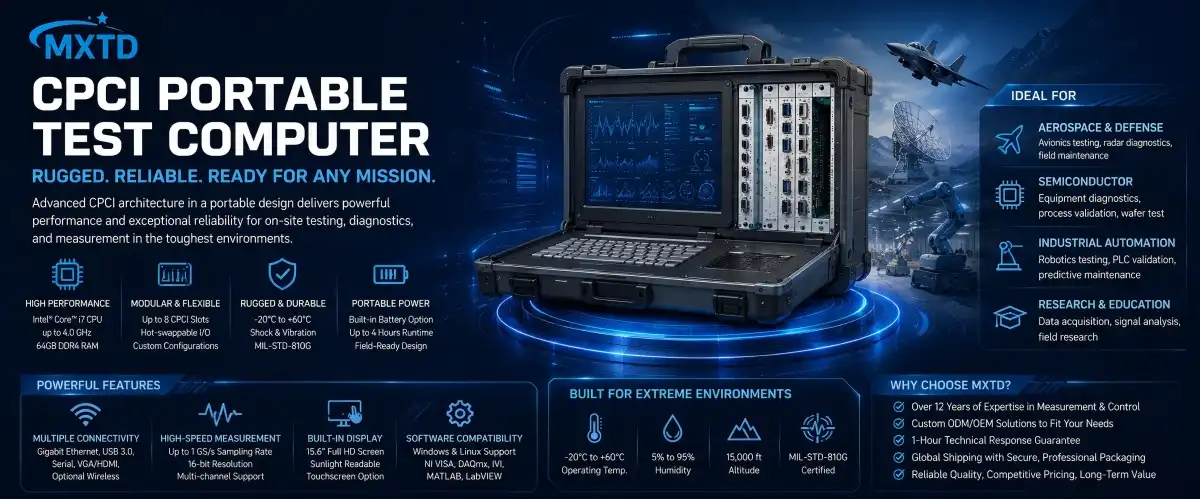
A CPCI portable test computer takes the CompactPCI standard—a strong, flexible bus architecture that was first made for military and telecommunications use—and puts it into a portable form factor that can be used for field testing and mobile diagnostics. These systems are different from regular desktop PCs because they have ruggedized cases with shock-mounted internal parts and industrial-grade ports that can handle vibration, high temperatures, and electromagnetic interference. The design is based on a backplane that can hold multiple hot-swappable boards. This lets you set up the system perfectly for your measurement jobs without having to carry around extra hardware. These systems are built around high-performance processors, usually quad-core or higher, and memory setups that can be expanded from 8GB to 64GB, based on the needs of the application.
Core Hardware and Software Components
The backplane is like the brain of the computer. It lets 32-bit or 64-bit parallel bus communication happen at speeds of up to 1 Gbps, which is a lot faster than many PC peripheral links. In a single chassis, data gathering cards, signal generators, digital I/O modules, and communication ports can all be supported by peripheral boards that slide into standard slots. Software integration usually works on Windows or Linux, and it supports driver support for VISA, DAQmx, and IVI-compliant instrument drivers, as well as industry-standard measurement libraries. This layer of software makes sure that it works with the current test code and lets it be quickly added to existing processes. Gigabit Ethernet, USB 3.0, serial ports, and optional wireless units are all available for connectivity.
Performance Specifications for Industrial Environments
Most CPU setups use Intel Core i5 or i7 processors, which have clock speeds between 2.5 and 4.0 GHz and can handle signal processing jobs that require a lot of computing power. Storage units use solid-state drives with capacities between 256GB and 2TB. These drives ensure quick boot times and stable data storage without the mechanical risks that come with spinning disks. These systems can work in temperatures ranging from -20°C to +60°C, which is very important for testing in open settings or factories that aren't controlled. Display units have 1920x1080 screens that can be read in direct sunlight, and touch controls that let you use them while wearing gloves. When it comes to portable uses, weight is important. Most units weigh between 8 and 15 kg, based on the number of slots and battery capacity.
Key Benefits of CPCI Portable Test Computers in B2B Applications
Enhanced Portability for On-Site Field Testing
Mobility changes the way testing is done in ways that PC systems just can't match. When aerospace technicians are working in hangars to fix avionics systems or when semiconductor process engineers are fixing equipment at faraway fabrication plants, they can carry a self-contained test platform with them instead of having to ship or move devices back and forth between labs and production floors, which can take time. The CPCI portable test computer has an oscilloscope, data logging, signal generation, and control ports all built into a 19-inch or smaller case that is easy for one person to carry. We've seen maintenance teams cut down on diagnosis rounds by 40% when they bring full testing right to the point of failure instead of taking equipment apart to analyze it in the lab.
Industrial-Grade Reliability and Durability
In industrial testing, where measurement accuracy affects product quality and safety standards, reliability is what makes something valuable. The parts in these portable systems are approved for extended temperature ranges and continued operation. This is very different from consumer-grade laptops, which slow down when the temperature outside rises. Moving parts that can break when they are vibrated, which is common in factories and mobile test labs, are taken care of by solid-state storage and shock-mounted systems. Conformal coating keeps circuit boards safe from moisture and chemicals, which increases their useful life in harsh environments like chemical processing or remote sites. For industrial-grade units, the mean time between failures (MTBF) is often more than 50,000 hours, while for business computing tools, it's usually only 20,000 hours. Superior Computing Performance for Complex Testing Tasks
To handle real-time data streams, run complicated algorithms, and see the results at the same time, modern test scenarios need a lot of computer power. The CompactPCI portable test computer design has computing power on par with fixed workstations. Its multi-core processors can acquire data in parallel across dozens of channels and do frequency analysis, statistical processing, and automatic decision logic. We've built systems that can sample 16 analog inputs at 1 MS/s per channel, apply digital filtering, and stream results to network storage without dropping samples.
Reduced Total Cost of Ownership
Specialized portable test systems may cost more than household gadgets at first, but when you look at the total cost of ownership over the lifecycle of the tools, you can see that you save a lot of money. As test needs change, the modular design makes the system more useful because you can upgrade single measurement cards or processing units instead of whole platforms. Being able to work with industry-standard boards from more than one seller keeps you from being locked into one vendor and helps keep prices low for upgrades.
Compatibility with Existing Test Infrastructures
Many technological advances are held up by problems with integration. However, open standards help movable CompactPCI systems reduce these risks. The desktop PCI bus architecture gave rise to the CompactPCI bus design. This made sure that the software would work with decades of test code and driver libraries. Most of the time, moving existing test programs can be done with only minor changes, protecting the intellectual property that was put into validation processes and measurement routines. Instrument modules are also physically compatible; many data collection and signal processing boards made for desktop PCI or PXI chassis also come in CompactPCI versions, so you can use known hardware in portable setups. Standard methods like TCP/IP, MODBUS, and OPC can be used for network connections.
Comparison of CPCI Portable Test Computers with Other Solutions
Advantages Over Desktop PC-Based Test Systems
Desktop computers are easy to use and don't cost much to get started with, but they have problems when used in the field. The most obvious difference is mobility. Desktop towers need stable surfaces, reliable AC power, and climate-controlled spaces, which rules out many installation and upkeep situations. The CPCI portable test computer can handle vibrations, changes in temperature, and short-term battery operation that would damage or stop desktop computers. There are big differences in how flexible expansion is. Desktop systems have limited internal slots and USB devices that connect from the outside, which limits the speed and latency of measures.
Contrasts with PXI Modular Systems
Both PXI (PCI eXtensions for measurement) and CompactPCI come from the same family tree and are used for flexible measurement applications. However, there are important differences between the two that affect platform choice. The PXI standard focuses on benchtop setups with advanced timing and syncing features across multiple chassis, making them ideal for labs with a lot of channels. CompactPCI puts durability and mobility first, giving up some syncing complexity in exchange for being able to work in harsh environments and without any outside help. The physical shape is different. PXI cases usually have a depth of more than 40 cm and need to be mounted on a rack or take up a lot of bench space. Portable, CompactPCI enclosures, on the other hand, can hold screens and input devices and are easy to carry. PXI systems still don't use batteries very often, which limits how useful they are for field deployment.
Market Landscape and Leading Manufacturers
There are specific needs in the market for small test computers, and many companies have made products that meet the needs of the industry and the military. Companies like Kontron and MEN Micro make CompactPCI systems that focus on working in a wide range of temperatures and meeting military weather standards. These systems are good for use in defense and aircraft uses where equipment needs to work in harsh conditions. ADLINK Technology has movable tools that are designed to work best with high-performance computers in testing self-driving cars and automating factories. Advantech offers low-cost CompactPCI options that balance speed and affordability for business and industry uses. When comparing providers, you should look at more than just the hardware specs.
Practical Guidance: How to Choose and Use CPCI Portable Test Computers
Key Selection Criteria for Procurement
To avoid spending for features that won't be used or limiting system performance, make sure that the hardware specs match your measurement needs exactly. Review your most computationally intensive test cases to figure out what kind of processing you need. Real-time digital signal processing and machine vision apps work best with quad-core processors and dedicated GPUs, while dual-core configurations are fine for simple data logging jobs. The number of slots affects how much space can be added. Make sure there are enough places for the measurement cards you currently have, plus at least two extras in case you need to add more in the future. Battery life needs to be at least as long as a normal field session. Systems that allow hot-swappable battery modules can keep working for longer by rotating batteries while one pack charges. When trying outside, the display specs matter. High-brightness panels with anti-glare coatings can still be read in full sunlight. Different applications have different connectivity needs. Make sure your CPCI portable test computer has enough USB ports, Ethernet links, and any other connections your extra equipment needs.
Evaluating Supplier Reputation and Support
Technical specs aren't the only thing that matters; how well your investment will pay off in the long run depends on how well your seller can do their job. Companies that have done a lot of research and development and have been making products for a long time show that they are committed to product quality and new ideas. We've seen that companies that have been making measurement systems for more than 12 years have the institutional knowledge to know what customers want and how to solve unusual technology problems. Carefully consider the warranty terms; full warranties that cover parts and work for at least one year, with choices for longer coverage, protect against early failures and manufacturing flaws.
Maintenance Practices and Operational Best Practices
To get the most out of the equipment's usefulness and dependability, you need to pay attention to how it is used after it has been bought. Set up regular maintenance plans that include cleaning the ventilation ports to keep dust from building up and stopping the cooling, checking the joints for corrosion or mechanical damage, and using calibration processes every six months to make sure the battery is still healthy. When moving portable systems from one place to another, keep them in safe cases to keep them from being exposed to shock and pressure beyond what is standard for the system. Keep extra batteries in good shape by charging and discharging them on a regular basis. Lithium-ion batteries lose power when they are left drained for long periods of time. Set up software update methods to include firmware and driver improvements that makers release.
Procurement Insights and Supplier Selection for CPCI Portable Test Computers
Identifying Certified and Authorized Distributors
Working with authorized dealers and direct makers lowers the risks that come with fake parts, gray-market equipment that doesn't come with a guarantee, and limited technical support. When you can, check with the maker directly to make sure the seller has permission, and ask for proof that the product you're buying is real. Companies that have ISO 9001 quality management licenses show that they are dedicated to using the same processes and quality controls all the way through the production and delivery processes. We've formed relationships with board makers and component providers to make sure that we only get real parts.
Analyzing Pricing Structures and Warranty Benefits
The prices of portable test computers vary a lot depending on how complicated the configuration is, how safe the setting is, and where the seller stands. Entry-level systems with basic processing and three upgrade slots usually cost between $8,000 and $15,000. Fully designed ruggedized platforms with eight slots and high-performance processors may cost more than $35,000. When you buy more than five units, you can get a volume price, which gives you discounts from 8% to 15% based on the number of units and how they are configured. Comparing total costs means taking into account more than just the gear price.
MXTD's Comprehensive Solutions and Customer Success
Xi'an Mingxi Taida Information Technology Co., Ltd. has more than 12 years of experience in measurement and control systems. They offer both standard CompactPCI portable test computers and unique solutions that are made to fit your exact parameter needs. We keep a stock of basic industrial configurations that can be shipped right away, and our engineering team creates ODM and OEM products that are made to exact specs and meet agreed-upon production dates. Our answer guarantee means that you'll get technical advice within an hour of sending us a question. This helps you plan projects and make proposals quickly. We know that shipping precision tools needs to be done carefully. Our shipping procedures include shock-resistant crates, moisture-proof packing, and anti-static protection.
Conclusion
CPCI portable test computer systems meet important needs in modern industrial testing with their powerful computing, flexible design, and ability to be used in harsh environments. These platforms provide measured value by shortening the time it takes to do diagnostics, allowing testing to happen on-site where it used to be possible only in labs, and offering upgrade paths that keep the system relevant as measurement needs change. We looked at how their better total cost of ownership, industrial-grade dependability, and ability to work with existing test infrastructure make them strong alternatives to both desktop setups and benchtop PXI systems for uses that value mobility and weather resilience. A successful procurement relies on carefully matching system specifications to real measurement needs, choosing suppliers with proven technical skills and quick customer service, and using best practices that extend the life of equipment. Choosing to use these specialty platforms is a smart investment in testing capabilities that will improve operational efficiency and competitive placement in research, aerospace, semiconductors, and industrial automation.
FAQ
What industries commonly deploy compact PCI portable test systems?
These platforms are used a lot in the aerospace and defense industries for testing avionics, diagnosing radar systems, and doing field repair on military equipment that needs to be mobile and work reliably in harsh circumstances. CPCI portable test computer systems are used by semiconductor companies to fix problems with process equipment and to connect chip probe stations in situations where being on the factory floor or in a clean room is important. Some uses for industrial automation are setting up distributed control systems, checking the health of manufacturing equipment, and making sure that quality standards are met across various production sites. Research organizations like how the modules can be put together to make specialized measurement systems and how they can be moved around for outdoor studies in materials characterization and environmental monitoring.
How do portable test computers enhance testing efficiency compared to traditional methods?
By bringing full diagnostic capabilities directly to the equipment, delays caused by taking parts apart, transporting them to central labs, and putting them back together again after testing are eliminated. Real-time measurements taken while equipment is running pick up on temporary conditions and faults that go away when systems are moved or turned off. Integrated processing lets you analyze data and make decisions right away, without having to wait for post-processing processes. This speeds up the fixing process. Putting together multiple instrument functions on a single platform makes setup easier and cuts down on link mistakes that take time in multi-box setups.
What support and warranty standards should I expect from reputable suppliers?
At the very least, the terms should cover parts and work for one year, and expert help should be available by phone, email, and remote desktop assistance. Response promises of one business day for questions that aren't pressing and four hours for problems that affect production show how professional help works. During the guarantee time, software changes and firmware fixes should be given for free. Longer guarantee options, advance replacement programs, and on-site service options all show that sellers are putting more effort into building long-term ties with customers than making quick sales.
Ready to Upgrade Your Testing Capabilities with MXTD?
To improve your troubleshooting work, you need a CPCI portable test computer provider whose products are known to be reliable and whose technical support is quick to respond. MXTD provides both through a wide range of standard and custom measurement options, as well as more than ten years of engineering experience in industrial robotics and aerospace uses. Our portable test tools compare themselves to the best products from top makers and offer cheaper options that help buyers save money without sacrificing performance or compatibility. We keep a ready supply of standard configurations that can be used right away, and we can also customize them to meet specific needs that other providers can't meet. Get in touch with our expert team at manager03@mxtdinfo.com to talk about your measurement problems and find out how our portable test computers, precision connectors, and combined testing systems can help you run your business more smoothly. We answer technical questions within an hour and offer thorough talks, product demonstrations, and configuration suggestions that are specific to your application. This helps you make confident purchasing choices that lead to measurable improvements in testing.
References
1. CompactPCI Systems Handbook: Architecture, Design, and Implementation for Industrial Computing, IEEE Industrial Electronics Society Technical Standards Committee, 2019.
2. Portable Test Equipment Selection Guide for Aerospace and Defense Applications, Society of Automotive Engineers International Technical Paper Series, 2021.
3. Modular Instrumentation Architectures: Comparative Analysis of PXI, CompactPCI, and VME Standards, Journal of Electronic Test and Measurement, Volume 38, Issue 4, 2022.
4. Ruggedized Computing Systems for Harsh Environment Applications, International Society of Automation Technical Report, 2020.
5. Total Cost of Ownership Models for Industrial Test Equipment Procurement, IEEE Instrumentation and Measurement Magazine, December 2023.
6. Field Testing Best Practices for Electronics Manufacturing and Semiconductor Process Equipment, SEMI International Standards Publication, 2022.
Our customers’ satisfaction speaks for our quality — contact us to experience the same reliable service.