- English
- French
- German
- Portuguese
- Spanish
- Russian
- Japanese
- Korean
- Arabic
- Greek
- German
- Turkish
- Italian
- Danish
- Romanian
- Indonesian
- Czech
- Afrikaans
- Swedish
- Polish
- Basque
- Catalan
- Esperanto
- Hindi
- Lao
- Albanian
- Amharic
- Armenian
- Azerbaijani
- Belarusian
- Bengali
- Bosnian
- Bulgarian
- Cebuano
- Chichewa
- Corsican
- Croatian
- Dutch
- Estonian
- Filipino
- Finnish
- Frisian
- Galician
- Georgian
- Gujarati
- Haitian
- Hausa
- Hawaiian
- Hebrew
- Hmong
- Hungarian
- Icelandic
- Igbo
- Javanese
- Kannada
- Kazakh
- Khmer
- Kurdish
- Kyrgyz
- Latin
- Latvian
- Lithuanian
- Luxembou..
- Macedonian
- Malagasy
- Malay
- Malayalam
- Maltese
- Maori
- Marathi
- Mongolian
- Burmese
- Nepali
- Norwegian
- Pashto
- Persian
- Punjabi
- Serbian
- Sesotho
- Sinhala
- Slovak
- Slovenian
- Somali
- Samoan
- Scots Gaelic
- Shona
- Sindhi
- Sundanese
- Swahili
- Tajik
- Tamil
- Telugu
- Thai
- Ukrainian
- Urdu
- Uzbek
- Vietnamese
- Welsh
- Xhosa
- Yiddish
- Yoruba
- Zulu
What Applications Use PXI Embedded System Controllers Most?
PXI Embedded System Controllers are the most popular choice for automatic testing and measurement in defense, aircraft, semiconductor production, and telecoms. When accuracy, timing, and real-time control are very important, like in hardware-in-the-loop testing, production validation, and RF signal analysis, these modular controllers really shine. PXI Embedded System Controllers are always chosen by industries that need scalable test designs with strict flow requirements because they are reliable and easy to integrate.
Introduction
For modern industrial tests, you need precise tools that can change with the needs of the job without losing their dependability. In the past ten years, PXI-based technologies have changed how engineering teams deal with difficult measurement problems. Now, procurement managers have to make tough choices about how to balance technology requirements with long-term support promises. Test engineers, on the other hand, need systems that work well with the infrastructure they already have.
R&D teams are under more pressure than ever because of the rise of self-driving cars, 5G networks, and advanced chip nodes. When checking multi-channel systems that work with nanosecond time tolerances, traditional stand-alone tools are no longer enough. When PXI Embedded System Controllers in PXI chassis designs really shine, they give real benefits. Because they can centralize control and coordinate multiple measurement tools, they are essential in production settings that make thousands of units every day.
Knowing which apps can use these PXI Embedded System Controllers most effectively helps tech teams choose the best hardware setups. It's also important to know how the skills of the seller affect the downtime of the system and the total cost of ownership. This guide talks about both technical selection criteria and practical buying issues. It does this by using examples from different industries where testing accuracy has a direct impact on product quality and market competitiveness.
Understanding PXI Embedded System Controllers and Their Role in Industry
Architectural Foundations
PXI Embedded System Controllers that are built into PXI chassis take up no or very few slots but handle the whole system. These built-in PXI Embedded System Controllers don't use wires to connect to external computers; instead, they directly access the backplane bandwidth, which lowers latency in high-speed acquisition situations. The design combines standard PC working power with industrial-grade durability, so it can be used in places where temperatures change and regular hardware breaks.
Modular Integration Capabilities
When programmers arrange multiple instrument modules at the same time, the real power shows up. Without any help from outside sources, a single PXI Embedded System Controller can start waveform generators, get analog inputs, manage digital I/O lines, and record data streams. This modularity cuts down on the need for rack space while improving synchronization accuracy, which is very important in situations like testing car radar, where timing mistakes measured in nanoseconds can invalidate results.
Real-Time Control Requirements
In a lot of test cases, reactions to measured conditions need to be predictable. Real-time operating systems on PXI Embedded System Controllers let control methods run consistently every microsecond, which is necessary for closed-loop testing and hardware modeling. This feature sets them apart from general-purpose computers, which can experience random delays when the running system stops working.
Top Industrial Applications Using PXI Embedded System Controllers
Semiconductor Test and Validation
Manufacturers of semiconductors use PXI Embedded System Controllers to probe at the wafer level and characterize packaged devices. These systems check that chips work by measuring voltage, temperature, and frequency, and each device often handles hundreds of measurement points. Parametric analyzers, oscilloscopes, and power sources are coordinated by the PXI Embedded System Controllers, which also run complicated test routines that figure out product binning.
Optimizing yield in fabrication facilities depends on getting quick feedback from tools that watch the process in real time. PXI Embedded System Controllers allow statistical process control in real time, detecting differences before whole wafer batches end up as scrap. Because they can connect to production execution systems, closed-loop quality processes are made possible, which lowers the number of defects that get out.
Aerospace and Defense Systems
Modular test systems are used by defense contractors to make sure that electronics and electronic warfare tools are working properly. For these uses, you need tough hardware that has been tested and approved for military temperature ranges and pressure profiles. PXI Embedded System Controllers with MIL-STD ports make it easier to connect to older equipment and follow strict security rules for secret programs.
Instrumentation for flight tests is another important use case. When used in airborne data gathering systems, PXI Embedded System Controllers have to be able to handle changes in altitude, electromagnetic interference, and mechanical shock while still measuring accurately. Their small size and low power use make them ideal for use in cockpits where room and temperature control are limited.
Automotive Testing for ADAS and EV Platforms
Before they go into production, advanced driving aid systems are tested in millions of different situations. To make conditions that can be repeated, test engineers use PXI Embedded System Controllers to coordinate camera stimulators, radar target simulations, and car network interfaces. To meet coverage goals and stay on plan for development, the systems must run tests faster than real time.
Electric car battery management systems need to be tested thoroughly under a wide range of temperature conditions and charge-discharge rates that mimic years of heavy use. During multi-week test sessions, PXI Embedded System Controllers keep an eye on environmental chambers, power electronics, and data loggers to make sure that safety certifications can be tracked.
Telecommunications Infrastructure Validation
Manufacturers of network devices test base stations, routers, and optical transceivers with PXI Embedded System Controllers that create traffic patterns that follow the protocol and check the accuracy of the signals. These systems test the performance of 5G millimeter waves, which require exact time alignment across antenna arrays and frequency bands. Multiple RF instruments are synchronized by PXI Embedded System Controllers to measure beamforming accuracy and output in a range of transmission conditions.
Industrial Automation and Robotics
At the end of the production line, PXI Embedded System Controllers are used to test and calibrate the functionality of the products. They are used in robotic assembly rooms to check torque specs, the accuracy of vision systems, and the calibration of sensors. The PXI Embedded System Controllers keep track of quality data that is used in statistical studies to find ways to make the process better. This has a direct effect on the number of defects and the cost of warranties.
Why PXI Embedded System Controllers Are Preferred in These Applications
Performance and Scalability Advantages
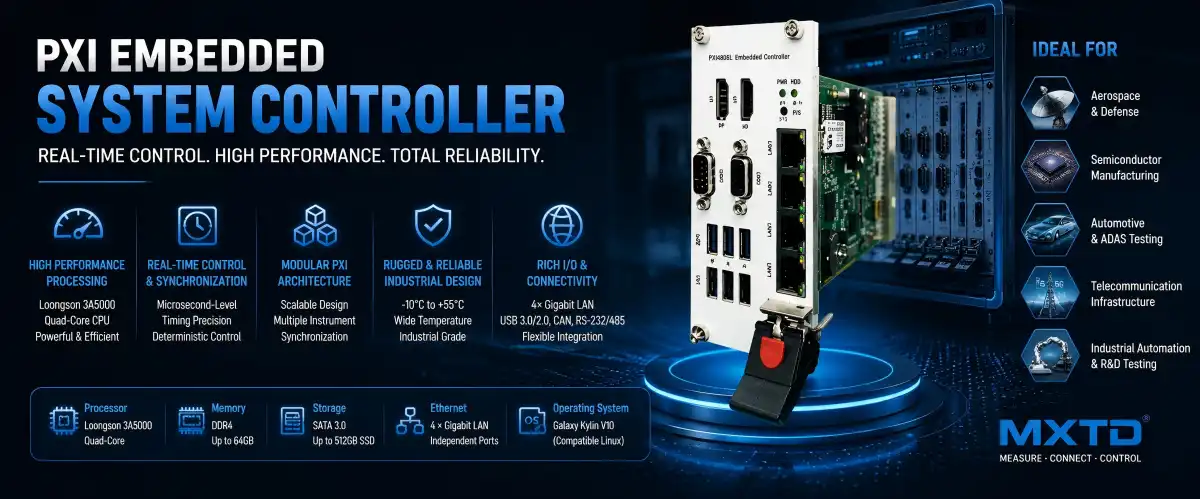
Signal processing jobs that used to need their own computers can now be done on PXI Embedded System Controllers built on current processor architectures. The MXTD PXI4806L is a great example of this development because it has a Loongson 3A5000 quad-core processor that is both fast and good at keeping heat down. This processing power allows for direct analysis, which lowers the amount of raw data that needs to be stored, which is a big deal when test systems produce terabytes of data every week.
How fast PXI Embedded System Controllers can talk to instrument units is based on the system bandwidth. The 32bit/33MHz PXI bus standard gives enough throughput for most mixed-signal tasks while keeping environments from different vendors compatible. When apps need faster data rates, processors that support PXI Express use serial protocol speeds of more than 8 GB/s per slot.
Rugged Construction for Harsh Environments
When test equipment is used in factories, it is exposed to changes in temperature, airborne contaminants, and mechanical vibrations that kill office computers in just a few months. PXI Embedded System Controllers that can work in a wide range of temperatures work efficiently in places where there isn't a lot of cooling equipment. The PXI4806L can work in temperatures from -10°C to +55°C, so it can be used on plant floors all over the world without the need for expensive environmental barriers.
The choice of components has a direct effect on the average time between failures. Industrial-grade DDR4 memory, solid-state storage, and conformal-coated circuit boards all make equipment last longer in places where the temperature changes. These improvements to reliability cut down on unplanned downtime that messes up production plans and the accuracy of test data.
Comprehensive Connectivity Options
In modern test settings, you need to be able to connect different kinds of tools. PXI Embedded System Controllers can talk to old instruments, sensors, and programmable logic controllers without having to make special connections because they have standard USB, Ethernet, and serial ports. The PXI4806L has four Gigabit Ethernet ports that let you set up different networks for measurement data, IT infrastructure in the building, and online access. This keeps your data safe while letting you build a flexible system.
CAN bus connections make testing cars easier by letting PXI Embedded System Controllers connect to vehicle networks as diagnostic tools or simulation nodes. Industrial protocols that are popular in process control settings can be used with RS-485 connectivity. This flexibility lowers the cost of integration when test systems need to work with tools from more than one provider.
How to Evaluate and Choose the Right PXI Embedded System Controller for Your Application
Defining Technical Requirements
Figuring out how much an application needs is the first step in choosing the right PXI Embedded System Controller. Processing and memory requirements are set by the number of measurement channels, the sampling rate, and the analysis methods that are needed. Test engineers should write down the worst-case scenarios in which systems deal with the most channel setups and the signal processing that requires the most computing power.
Environmental issues often rule out candidates during the first round of screening. For uses on the production floor, increased temperature ratings and vibration protection are important. In laboratories, on the other hand, acoustic noise levels may be more important. Certification rules for certain fields, like aircraft DO-160, car ISO 26262, or medical IEC 60601, limit the PXI Embedded System Controllers that can be used to those that have been proven to meet these standards.
Comparative Analysis of Controllers
When considering choices, make specification matrices that show how the processors, memory, storage, and I/O connections compare. Think about the total cost of the system, which should include any software rights that are needed. Some companies offer development environments as a package, while others charge separately for toolchains.
The PXI4806L has strong benefits for teams looking for choices over current providers. Its Loongson chip design gives it performance that is similar to well-known platforms while also letting OEMs make changes that standard products can't. With four different CAN interfaces, car applications can be handled without the need for separate protocol modules. This cuts down on the number of slots needed and the complexity of the system.
Supplier Evaluation Criteria
In addition to product specs, a supplier's skills have a big effect on the long-term success of a project. This company, Xi'an Mingxi Taida Information Technology Co., Ltd. (MXTD), has been developing PXI systems, connections, and combined measurement solutions for more than 12 years. When people ask about technology issues, their engineering team answers them within an hour and fixes problems quickly so that work doesn't stop.
Customization is important when regular goods almost meet the needs but don't have the right interfaces or mechanical dimensions. MXTD helps with ODM and OEM development, changing PXI Embedded System Controllers to fit specific approval or environmental needs. This freedom is very helpful for system designers who have to build solutions around the needs of each customer.
Care should be taken to read over the warranty terms and the availability of help. MXTD offers one-year warranties, but longer warranties can be arranged based on the size of the operation and how important the application is. Their online video technical help cuts down on the average time it takes to fix things, when service visits would take days longer.
Integration Planning
For operations to go well, jobs related to mechanical, electrical, and software integration need to be coordinated. PXI Embedded System Controllers have to fit physically with frame backplanes and make sure there is enough airflow to keep the computer cool. Before you buy, make sure that the mounting hardware and measurements match the rack setups you want to use.
Software compatibility affects how long it takes to create and how hard it is to fix bugs. The PXI4806L works with the Galaxy Kylin V10 operating system and has drivers for popular instrument modules to make sure it fits in easily. Compatible APIs make it easier to move test programs from old platforms to new PXI Embedded System Controllers, which cuts down on the need to rewrite a lot of code.
Troubleshooting and Common Challenges in PXI Embedded System Controller Applications
Hardware Diagnostic Approaches
Systematic fixing quickly finds the root causes of PXI Embedded System Controllers that won't boot or act strangely. First, use multimeters to check the power source voltages at the chassis backplane links. Intermittent contacts can show signs that a component is failing. To get rid of module flaws from the diagnostic scope, take out all instrument modules except the PXI Embedded System Controllers.
Memory mistakes often show up as random crashes when tasks that use a lot of data are being done. During off-shift hours, run extended memory checks to find failed modules before they mess up test data. Monitoring tools for solid-state drives can tell when storage fails weeks before it completely fails. This lets you replace the drives before they fail, which avoids unplanned downtime.
Trouble with software and drivers
Intermittent faults are annoying because PXI Embedded System Controller operating systems and device drivers don't always work well together. Keep the paperwork that connects driver versions to system software releases up to date, since updates can sometimes bring back bugs that affect certain module combos. When measurement errors can't be explained, going back to driver sets that were stable before often fixes the problem while makers look into it.
Real-time operating system configurations need to be fine-tuned to find the right mix between predictable speed and adaptability. When interrupt priorities are set incorrectly, timing-critical applications miss events. It's easier to get things up and running quickly if you work with companies like MXTD that offer reference setups that have been tested and proven to work in common use cases.
Practices for Preventive Maintenance
Regular repair makes PXI Embedded System Controllers last longer and improves their accuracy. Use known standards to check the calibration of integrated digitizers and signal conditioning units once a year. In production settings where dust builds up and slows down cooling, system air filters should be cleaned every three months.
Firmware changes from sources fix bugs that have been found and make it easier to use with new instrument modules. MXTD provides free software updates during warranty times to make sure that systems continue to gain from ongoing investments in development. Plan changes to happen during repair windows and make sure they work well on backup systems before putting them on production equipment.
Conclusion
To choose the right PXI Embedded System Controller, you have to weigh the technical requirements against the supplier's skills and their promise of long-term assistance. Tests on semiconductors, spacecraft validation, car development, telecoms infrastructure, and industrial automation all need reliable, high-performance, flexible test systems that can be changed to meet new needs.
The choice isn't just about datasheets; it's also about how customizable, fast, and cost-effective the solution is. PXI Embedded System Controllers like the PXI4806L show how focused engineering can meet the needs of a particular business while still working with existing environments. When reviewing suppliers, procurement teams should look at how knowledgeable they are, how well they serve customers, and how willing they are to work with them on unique solutions that make their test skills stand out.
FAQ
Which fields get the most out of PXI systems with integrated controllers?
For test and measuring purposes, these PXI Embedded System Controllers are very important in aerospace, military, semiconductor manufacturing, car testing, and telecommunications. Large groups of people who need accuracy and dependability also work in research institutions and technology manufacturing.
What makes embedded controls different from computers that are tied to the chassis from the outside?
PXI Embedded System Controllers are built right into the backplanes of chassis, so there are no wires to cause problems with stability and delay. They use specialized lines instead of external protocols to connect to instrument modules. This makes synchronization more accurate and reduces the size of the system's footprint. Environmental grades are usually higher than those for consumer-grade computers, which lets them be used in work settings.
Can controls be changed to fit unique needs for automation?
Trustworthy providers, such as MXTD, offer ODM/OEM customization, which means they can change the processor choices, I/O configurations, and mechanical measurements to fit the needs of each application. Custom firmware development and higher temperature levels meet needs that go beyond standard product specs. This is especially helpful for military and industry uses that need unique solutions.
Partner with MXTD for Your PXI Embedded System Controller Needs
Picking the best PXI Embedded System Controller provider can affect how long your project takes, how reliable your system is, and how much it costs to own everything. MXTD makes PXI Embedded System Controllers that are standard in the business and can be customized in ways that other companies can't. Our PXI4806L controller offers speed that is compatible with NI at a low cost. It also comes with quick technical help and a full warranty.
Our engineering team answers technical questions within an hour, which keeps output plans from getting slowed down by troubleshooting delays. We keep a stock of common setups and can also make custom changes to meet the needs of specific environments or interfaces. As part of transportation operations, precision tools are packed in shock-proof, moisture-proof, and anti-static materials.
Get in touch with our purchasing experts at manager03@mxtdinfo.com to talk about how our PXI Embedded System Controllers can help you measure things better. MXTD's 12-year experience guarantees a smooth merging, whether you need standard units delivered right away or unique solutions made for specific uses. Find out why OEM makers and system designers trust MXTD as a PXI Embedded System Controller partner.
References
1. Haider, M., & Chen, L. (2021). Modular Instrumentation Systems for Advanced Test Applications. Industrial Electronics Press.
2. National Instruments Corporation. (2020). PXI Express Technology Overview and Applications Guide. Technical White Paper Series.
3. Patel, R., & Thompson, K. (2022). "Embedded Controllers in Automated Test Equipment: Performance Benchmarks and Selection Criteria." Journal of Electronic Testing, 38(4), 421-438.
4. Society of Automotive Engineers. (2023). Test and Validation Requirements for ADAS Systems. SAE International Standards Publication.
5. Wu, J., & Anderson, P. (2021). "Real-Time Control Architectures for Semiconductor Manufacturing Test Systems." IEEE Transactions on Instrumentation and Measurement, 70, 1-12.
6. Zhao, X., Martinez, S., & O'Brien, T. (2022). Aerospace Test System Design: Hardware Integration and Reliability Engineering. McGraw-Hill Professional.
Our customers’ satisfaction speaks for our quality — contact us to experience the same reliable service.